California
California to give newborns free diapers. What it means for families


Top moments from CNN California governor debate recap
Breaking down key takeaways, highlights, and analysis from the CNN California governor debate, including standout moments and candidate contrasts.
Gov. Gavin Newsom announced that newborn babies in California will start receiving free diapers as part of a new “first-in-the-nation” initiative to support families across the state with the rising cost of living.
Newsom, along with state leaders, met in San Francisco on Friday, May 8 to unveil California’s new partnership with Baby2Baby, a national nonprofit that provides diapers to children in need, and to explain how this new program will provide families with 400 “high-quality” diapers before they leave the hospital.
Over the last six years, families have seen the average cost of diapers increase by 45% or “thousands plus dollars a year,” which has made raising a family unattainable for some, Newsom said during the press conference.
“Every baby born in California deserves a healthy start in life — and that means making sure parents have the basics they need from day one,” Newsom said. “One out of four families skip meals in order to pay for diapers.”
“The biggest problem defined universally, in our cities, our state and our nation, is the issue of affordability. This is what affordability looks like; it’s not a slogan, it’s a box. A box of diapers,” Newsom added.
This new effort will be known as Golden State Start, as California uses its bulk purchasing power to obtain 40 million high-quality diapers in hopes of easing financial strain for families and supporting infant health by helping parents maintain an adequate supply of clean diapers.
“The first days at home with a newborn should be focused on the love, connection, and joy of an expanded family, not stress about affording diapers,” said Kim Johnson, secretary of the California Health and Human Services Agency. “This program helps ensure families can begin that journey with greater stability and peace of mind.”
The program is expected to start at the beginning of this summer in participating California hospitals. The list of participating hospitals was not released at the time of publication, but Newsom noted that the state was in talks with at least 60 hospitals across California.
During the first year of the program, CalRx and Baby2Baby noted that they would prioritize hospitals that serve large numbers of Medi-Cal patients to ensure low-income families benefit early from the program. The state plans to scale the program to additional hospitals and birthing centers over time.
Newsom noted that this program is expected to grow: In 2027, the state is set to purchase 80 million diapers from manufacturers, with the goal of eventually purchasing up to 160 million.
“California families deserve to feel supported during one of life’s more exciting, yet vulnerable transitions,” Jennifer Siebel Newsom, the first partner, said in a press release. “Golden State Start will deliver immediate relief, allowing parents to focus on what matters most — caring for their newborn. Together with Baby2Baby, we can ease the financial burden on California parents while supporting healthier outcomes for babies and their mothers.”
Noe Padilla is a Northern California Reporter for USA Today. Contact him at npadilla@usatodayco.com, follow him on X @1NoePadilla or on Bluesky @noepadilla.bsky.social. Sign up for the TODAY Californian newsletter or follow us on Facebook at TODAY Californian.



Redwood Valley, Calif. — A 5.6 magnitude earthquake shook Northern California on Wednesday morning, according to the U.S. Geological Survey.
The quake was centered 7 miles north of Redwood Valley in Mendocino County, north of Ukiah, and east of Highway 101. It had a depth of 5.0 miles.
A ShakeAlert notification went off on many people’s phones moments before the earthquake hit at 8:10 a.m., initially forecasted as a 6.1 magnitude quake by the U.S. Geological Survey (USGS) and downgraded moments later.
People across Northern California felt the quake. Reports came in from as far away as Eureka, Redding, Sacramento, and the Bay Area. Most people reported light to moderate rolling and shaking.
Since the initial quake, several aftershocks have hit the same area. Three smaller quakes between 2.6-2.7 magnitude were detected in the same area between 8:17 a.m. and 9:06 a.m., and are expected to continue.
So far, there have not been any reports of major damage or injuries.
—
BE THE FIRST TO COMMENT
Report a correction or typo.
California
DOJ charges 10 Southern California defendants in largest federal healthcare fraud crackdown in US history

Laura Ingraham: Fraudsters beware!
The Department of Justice announces the largest healthcare fraud takedown in U.S. history, charging 455 defendants across 45 states. They allegedly stole $6.5 billion from Medicare and Medicaid through wound care schemes and other fraudulent claims. Some funds were used for luxury homes and vehicles like a $135,000 Maserati.
NEWYou can now listen to Fox News articles!
Federal authorities on Tuesday charged 10 Southern California defendants in a series of healthcare fraud schemes, including one case involving nearly $270 million in fraudulent Medi-Cal claims and another that allegedly defrauded Medicare out of approximately $27 million.
The charges were part of the Justice Department’s broader “2026 National Health Care Fraud Takedown,” which resulted in charges against 455 defendants nationwide in schemes involving more than $6.5 billion in alleged fraud.
Acting Attorney General Todd Blanche described the operation as “the greatest combined federal and state effort in combating healthcare fraud in history.”
“Fraudsters can no longer rip off American taxpayers,” Blanche said during a news conference announcing the initiative. “If you seek to harm or cheat Americans, we will find you, seize any assets and prosecute you to the fullest extent of the law.”
FBI ADDS 2 FUGITIVES TO ‘MOST WANTED FRAUDSTERS’ LIST AMID HISTORIC $6.5B HEALTHCARE TAKEDOWN: PATEL
Acting Attorney General Todd Blanche speaks during a news conference announcing what federal officials described as the largest healthcare fraud takedown in U.S. history, resulting in charges against 455 defendants nationwide. (Ken Cedeno / AFP via Getty Images)
In the Central District of California, federal prosecutors brought criminal charges against 10 defendants accused of defrauding government-funded healthcare programs or abusing their positions as medical professionals to illegally prescribe controlled substances.
The U.S. Attorney’s Office for the Central District of California said five individuals were arrested in the greater Los Angeles area for allegedly participating in a scheme that involved submitting nearly $270 million in fraudulent claims to Medi-Cal for expensive prescription drugs.
Among those charged was Christina Mareik, 61, also known as Christina Marie Sanchez Hernandez, of Whittier.
HOSPICE FRAUD USES STOLEN IDENTITIES FOR FAKE PATIENTS
The Justice Department announced charges against 10 Southern California defendants in connection with multiple healthcare fraud schemes. (Department of Justice)
Prosecutors allege Mareik helped facilitate fraudulent prescriptions that generated nearly $270 million in claims to Medi-Cal, which ultimately paid out more than $178 million.
According to prosecutors, the claims involved expensive drugs containing low-cost generic ingredients that were either not medically necessary or were never provided to the purported recipients.
Authorities said Mareik also sent thousands of fraudulent prescriptions to a co-conspirator and caused the submission of fraudulent prescriptions under her own name.
LOS ANGELES HOSPICE FRAUD REACHES BILLIONS AS MEDICARE PROVIDERS SCAM FEDERAL SYSTEM WITH FAKE COMPANIES
Federal prosecutors allege Southern California defendants participated in schemes that defrauded Medicare and Medi-Cal of hundreds of millions of dollars. (Department of Justice)
Mareik was arrested June 17 and charged with healthcare fraud.
The charges also include a San Fernando Valley man accused of operating hospice care companies that fraudulently billed Medicare approximately $27 million, according to prosecutors.
Prosecutors also charged Oren David Shachar, 59, of Van Nuys; Abraham Shin, 66, of Corona; and Jeannie Choi, 57, of Torrance.
The three defendants face a 16-count indictment alleging they conspired to defraud Medicare out of approximately $27 million.
CLICK HERE TO DOWNLOAD THE FOX NEWS APP
The charges include conspiracy to commit healthcare fraud, healthcare fraud, aggravated identity theft, monetary transactions involving criminally derived property exceeding $10,000, and violations of the Anti-Kickback Statute.
Fox News Digital’s Alexandra Koch contributed to this report.

The IPOs of SpaceX, OpenAI and Anthropic could deliver billions of dollars to California’s coffers.
We’ve seen this movie before.
In 2022, California recorded a nearly $100 billion surplus, saved just $10 billion in its rainy day fund and then spent the rest. Two years later, a $56 billion deficit loomed.
Now, with the state facing ongoing operating deficits of more than $10 billion, we’re back in familiar territory.
The coming IPO windfall is a rare second chance. But we’ll only benefit from it if we first fix the structural flaw that’s caused us to squander every previous boom — a budget reserve that isn’t built to hold what we put in it.
The stakes this time are higher than ever. The war in Iran raised recession risk, and the federal government is systematically dismantling the funding streams California has depended on for decades.
When Washington retreats, Sacramento has to choose: cut services, raise taxes or have enough saved to bridge the gap. Right now, we don’t have enough saved.
We’re not outside observers wringing our hands. We helped shape the fiscal architecture the state is now straining against, and we’re here to say: It needs to be rebuilt.
As California state controller, one of us campaigned alongside Gov. Arnold Schwarzenegger to pass Proposition 58 in 2004 — creating California’s first Budget Stabilization Account. The other authored the Assembly Constitutional Amendment that became Proposition 2 in 2014 — the stronger, harder-to-raid replacement that voters approved with 69% support.
California’s tax system is the envy of progressive states and the nightmare of budget directors. We tax the wealthy at high rates, capture enormous capital gains revenue in boom years and then discover — every single time — that the peak doesn’t last.
If California treats the IPO windfall from SpaceX, Anthropic and OpenAI as permanent revenue, our state would repeat exactly the mistake we made four years ago.
Gov. Gavin Newsom and Assemblymember Avelino Valencia have each proposed important reforms to strengthen the fund. First, they call for requiring the state to make deposits until the fund reaches 20% of the general fund total, rather than the current 10%. Second, they propose changing an arcane accounting rule that treats saving for future downturns as spending.
We see one additional opportunity to make the rainy day fund even stronger.
If we want a larger budget reserve, we have to do more than merely allow it — we need to require it. Proposition 58 taught us everything we need to know on this front: Between 2004 and 2014, with that proposition fund in place, only two deposits were made. If we want consistent deposits during the boom times, they can’t be optional.
These reforms should be a win-win for the California Legislature. A larger reserve is the most durable protection that public sector workers, social service recipients and education advocates have against the kind of emergency cuts that have repeatedly gutted programs during downturns.
It’s also the strongest argument against tax increases in a recession because you don’t need to raise taxes if you actually save during the booms.
Building a stronger rainy day fund isn’t the cautious choice. It’s the visionary one — the closest thing we have to investing in the next generation of Californians.
We built the last rainy day fund because we’d lived through the consequences of not having one. We’re making the same argument again, for the same reason except now the stakes are higher. This time, the federal backstop is weaker, and the next storm is closer than it looks.
Fix the fund this year. The next generation of Californians will thank us for it.
Mike Gatto served in the state Assembly between 2010 and 2016, and he authored the measure that created California’s current rainy day fund. Steve Westly served as state controller between 2003 and 2007, and he co-championed Proposition 58, California’s original rainy day fund. Westly chairs the 21st Century Alliance, a nonpartisan organization focused on solutions to the state’s most pressing challenges.
-
 Politics5 minutes ago
Vice President JD Vance’s visit gives ‘The View’ a ratings boost
-
 Sports17 minutes ago
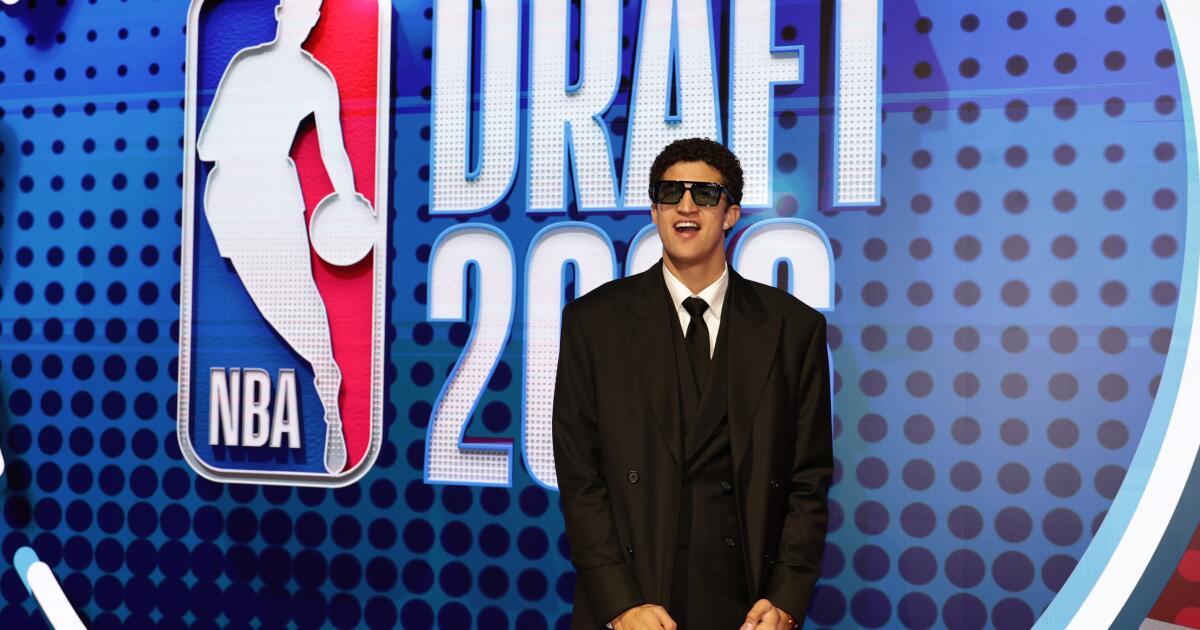
‘Super blessed’: Karim López makes NBA history as first Mexican-born first-round draft pick
-

 World25 minutes ago
Will the UK rejoin the European Union? MEPs debate Brexit on The Ring
-
News50 minutes ago
Federal judge bars Trump from implementing proof of citizenship requirement to vote
-

 Los Angeles, Ca2 hours ago
Clue may identify SUV in Long Beach hit-and-run that left woman injured
-

 Detroit, MI3 hours ago
Ilitch Companies creates gaming platform, expands beyond Detroit
-

 San Francisco, CA3 hours ago
First of its kind queer museum in San Francisco Chinatown amplifies Chinese LGBTQ artists
-

 Dallas, TX3 hours ago
These children were sold for sex. Then the system failed them again

