California
California couple charged with murder in death of toddler skip court


A Bay Area couple charged in the murder of a 2-year-old girl who reportedly overdosed on fentanyl earlier this year failed to appear in court last week to face the charges.
The tragic incident occurred just after 5 a.m. on Feb. 12, according to the San Francisco County District Attorney’s Office.
Officers with the San Francisco Police Department responded to an apartment in the 3800 block of 18th Street, near Mission Dolores Park, after receiving a 911 call reporting that a child was not breathing.
“Medics arrived at the location and pronounced the two-year-old child deceased,” the DA’s office said in a news release. “Medics observed signs of rigor mortis and lividity, indicating the child had been dead for several hours.”
Responding officers noted that Michelle Price, 38, the girl’s mother, was slurring her speech and had “an emotionless demeanor,” according to court documents. Investigators also observed drug paraphernalia in the apartment, including three pipes, lighters and torches, a used Narcan container, white powder ultimately identified as fentanyl, bottles of spoiled milk and stained sheets on the bed.
Price was arrested for child endangerment.
Her boyfriend, Steve Ramirez, 43, allegedly attempted to flee the apartment on a bicycle, leading police on a chase during which an officer was injured. At the time of his arrest, Ramirez was reportedly in possession of a pipe inside a bag on his bike. Two additional pipes with burnt residue were also found nearby, investigators said.
Blood samples taken from Price and Ramirez at the time of their arrests showed high levels of methamphetamine and fentanyl in their systems, according to the DA’s office.
An autopsy performed by the San Francisco Medical Examiner’s Office revealed no obvious signs of physical injury to the toddler. However, toxicology testing showed lethal levels of fentanyl, as well as naloxone, commonly known as Narcan, in the child’s bloodstream.
“The cause of death was determined to be acute fentanyl poisoning,” the release stated.
Price was initially charged with felony child endangerment, possession of fentanyl and possession of drug paraphernalia. Ramirez faced the same charges, along with an additional count of resisting, obstructing and delaying a peace officer.
Over the objections of prosecutors, both Price and Ramirez were allowed to remain out of custody ahead of their arraignments.

On April 15, San Francisco District Attorney Brooke Jenkins announced an amended complaint charging the couple with second-degree murder, marking the first time such charges have been brought in a fatal fentanyl overdose case in the county.
“There wasn’t really anywhere safe for this child to be inside of this home,” Jenkins said during a press conference announcing the charges. “This is a moment in time where people have to realize that we take these situations very seriously and where, I believe, parents who knowingly possess fentanyl, who understand its lethality and the danger it poses, allow their children to be exposed to it, this is something that can come with respect to accountability if a child dies.”
At the April 16 arraignment, where both defendants failed to appear, Price’s attorney told the court she may have experienced transportation issues. An attorney representing Ramirez said he did not know his client’s whereabouts, according to KTLA’s Bay Area sister station KRON.
While both attorneys said the couple was mourning the loss of the child and struggling with addiction, Ramirez’s lawyer accused the district attorney’s office of turning the case into a media circus, claiming the publicity caused his client to panic.
The judge subsequently issued bench warrants for both Price and Ramirez. It remains unclear whether either has since been taken into custody.



This is the latest instalment of The Inside Story, Wallpaper’s series spotlighting intriguing, innovative and industry-leading interior design.
Nestled at the base of the San Gabriel Mountains in Sierra Madre, a 1947 adobe home – a traditional building method using sun-dried bricks of organic materials – has been reimagined. Removed from the noise and polish of Los Angeles, this neighbourhood is shaded by California oaks, eucalyptus and pine, and shares its hillside with bears. It’s an unusual setting for a design story.
(Image credit: Michael P.H. Clifford) (Image credit: Michael P.H. Clifford)

The home’s transformation began with a fire that destroyed much of the structure, leaving only the original adobe brick wall standing. Rather than rebuild from scratch, designer Kirsten Blazek of A1000XBetter chose to work with what remained.
‘The overall vision was to maintain as much of the original character and style of the home as possible, while making it more functional for modern living,’ she explains. New rooms were added – a kitchen, a primary suite, a family room – though the expansion was restrained. ‘We worked mainly within the original footprint,’ the designer notes, ‘only adding a small amount of square footage for the primary closet.’
(Image credit: Michael P.H. Clifford)
(Image credit: Michael P.H. Clifford) (Image credit: Michael P.H. Clifford)



On the original adobe side, the layout was left untouched. The hallway windows, original to the 1947 build and ‘one of [Blazek’s] favourite features’, were preserved. ‘I wanted the house to feel like a modern California hacienda,’ she says of her guiding aesthetic, ‘and embraced that through every colour choice and finish.’
That palette draws directly from the landscape. Dunn-Edwards paints in warm, grounded tones – including an exterior shade named ‘Wild Horses’ – echo the surrounding terrain and scrubland. ‘I very much gravitate to an earth-based palette,’ says Blazek, ‘and the location at the base of the San Gabriel Mountains made that feel completely natural.’
Recreate the mood
The interiors, meanwhile, speak to a lifelong passion. ‘I have a deep connection with the American Southwest and have long collected Native American and western-influenced art and objects,’ she says. Yet the rooms never tip into pastiche. Midcentury furniture – sourced from MidcenturyLA, Amsterdam Modern and Lawson-Fenning – grounds the collected pieces with clean, modern lines. Rugs from Pampa and Salam Hello add warmth underfoot; drapery by Zak and Fox frames the windows. ‘I never want my work to feel too referential,’ Blazek reflects. ‘I love midcentury lines, so there’s a pleasing blend of both genres throughout.’

(Image credit: Michael P.H. Clifford)

(Image credit: Michael P.H. Clifford)
Among her favourite moments is the dining room fireplace – original to the house, but updated with dimensional tile from Lofa Tile. Nearby, a framed print by artist Mark Maggiori anchors the wall. ‘It’s one of my favourite pieces,’ she says. ‘I was grateful to finally find the perfect place for it.’
(Image credit: Michael P.H. Clifford) (Image credit: Michael P.H. Clifford)

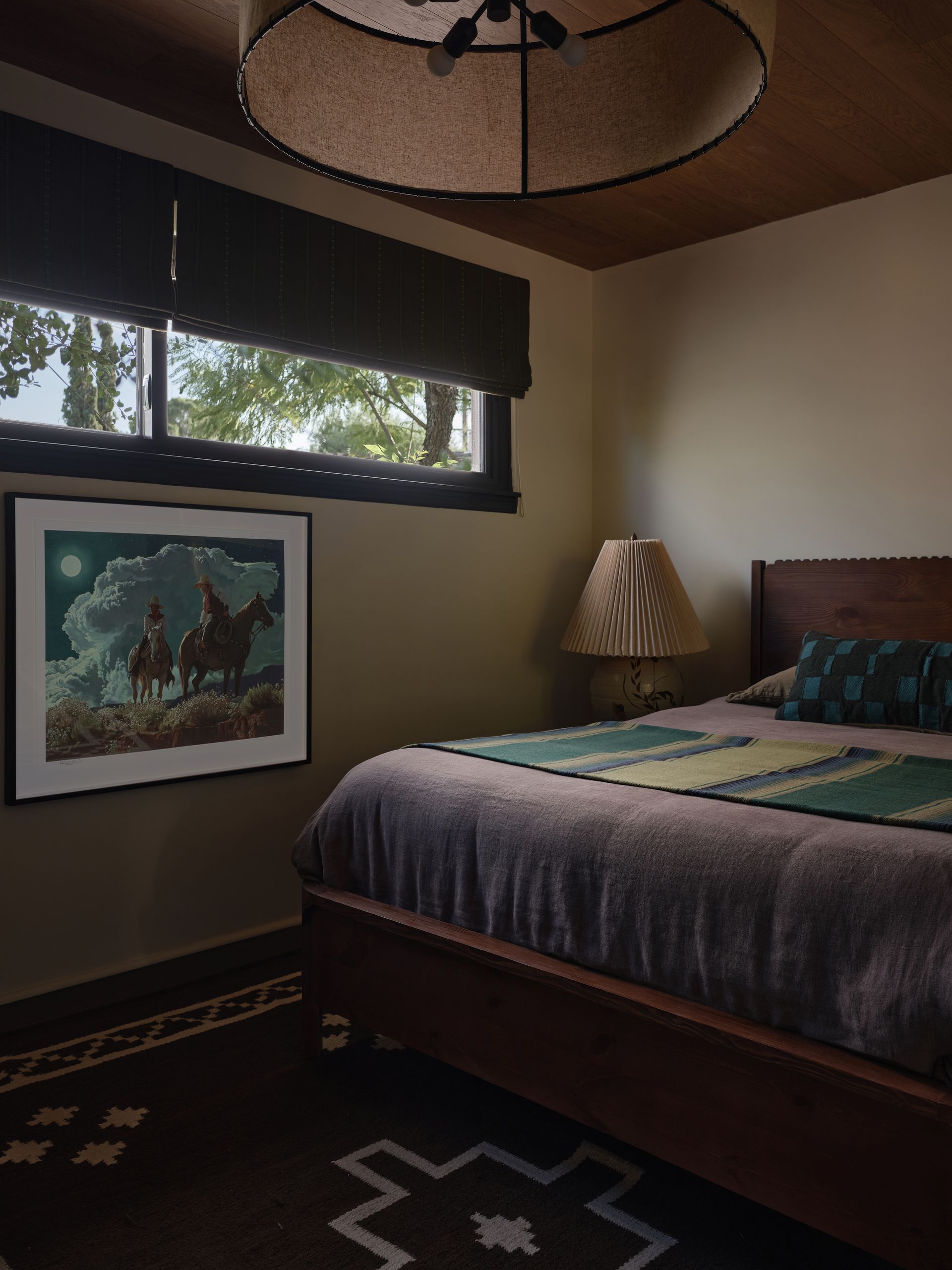
Between the ancient craft of adobe and the clean geometry of midcentury design, this renovation represents both preservation and reinvention – a modern hacienda rooted in its land, its past and the strength of Blazek’s vision.
(Image credit: Michael P.H. Clifford)

TOPICS
California
CDFW News | California Fish and Game Commission Takes Emergency Action to Prevent White Shark Take and Reduce Potential Interactions Between Hooked Sharks and Swimmers

Prosecutors Honored for Their Work to Protect Wildlife; Southern Resident Killer Whale Named CESA Candidate
Anticipating a larger presence of white sharks in Southern California as a result of warmer El Niño ocean conditions, the California Fish and Game Commission (Commission) adopted emergency regulations at its June 17-18, 2026 meeting to further protect the large ocean predator and reduce the potential for dangerous interactions with ocean users. These regulations will prohibit the use of certain fishing gear from beaches and nearshore that are used to hook large sharks and could create hazards for nearby beachgoers.
Forecasted warmer waters shift the preferred range for juvenile white sharks northward from Mexico and lead them to stay in California nearshore areas later in the year. The emergency regulations protect not only white sharks but also people recreating in the ocean, decreasing the risk of dangerous human encounters with sharks that are hooked with wire leaders from piers and beaches.
Specific gear types used to target large sharks, including hooks greater than 1.5 inches in maximum inside measurement and wire or metallic lines and leaders, will be prohibited when recreational fishing from shore or within 1,000 yards of shore from Pigeon Point (San Mateo County) south to the U.S.-Mexico border. Shore fishing includes beaches, banks, piers, jetties, breakwaters, docks and other man-made structures connected to the shore. Unless extended, the emergency regulations will expire 180 days after being filed with the secretary of state. The Commission may pursue up to two 90-day extensions of the emergency action and, ultimately, may propose continuing the restrictions through a regular rulemaking if the regulations prove to be effective.
Prosecutor of the Year
Commissioners recognized two deputy district attorneys who have demonstrated their dedication to protecting California’s natural resources and have effectively collaborated with the California Department of Fish and Wildlife (CDFW) to prosecute wildlife crimes. San Luis Obispo County Deputy District Attorney Ken Jorgensen and San Diego County Deputy District Attorney Michael McCann were presented with the Prosecutor of the Year Award for 2025.
Jorgenson’s work resulted in a landmark $165,000 settlement and injunctions in a case involving rare plant habitat destruction, and in another case a $12,500 fine and five years of probation for often under-prosecuted commercial fishing violations.
McCann assisted in the prosecution and investigation surrounding a global wildlife trafficking ring connected to illegal drug and firearm trade. The investigation disrupted a sophisticated trafficking network and resulted in multiple felony and misdemeanor charges, with more anticipated.
Southern Resident Killer Whale
The Commission named the southern resident killer whale (orca) a candidate species for listing under the California Endangered Species Act (CESA). This population of orcas inhabits ocean waters from British Columbia to California and is estimated to now number as few as 75.
Orcas face threats such as limited availability of prey; Chinook salmon are a primary food source and have experienced population decline across the entire West Coast range of orcas. The species’ abundance has also been impacted by past practices of capture for live display.
CDFW will have one year to complete a review on the status of orcas, of the best available science, before the Commission can make a final decision on CESA listing. Orca is currently listed as endangered under the federal Endangered Species Act and is considered depleted under the federal Marine Mammal Protection Act.
Western Spadefoot
Continued from the Commission’s April meeting, a decision to consider CESA candidacy for western spadefoot frog was postponed to the August meeting to give environmental advocates and the solar industry additional time to collaborate on proposing exceptions to CESA protections that would be allowed under Fish and Game Code Section 2084.
Meeting Participation and Next Meeting
Commission President Eric Sklar, Vice President Darius Anderson and Commissioners Samantha Murray and Erica Zavaleta were in attendance for both days of the June Commission meeting. Commissioner Jacque Hostler-Carmesin was in attendance for the first day. The meeting was held in Sacramento.
The complete agenda for the meeting, along with supporting information, is available on the Commission website. Archived video of past Commission meetings is available online. The next regularly scheduled meeting of the Commission is scheduled for Aug. 12-13, 2026, at the California Natural Resources Agency building in Sacramento. Participants are encouraged to attend in person, with options available for Zoom or phone; for more information visit the Commission website.
The Commission authorized public notice of upcoming potential regulation changes related to:
Harpoons and Flying Gaffs Allowance: A discussion hearing is scheduled for Aug. 12-13 and an adoption hearing Oct. 14-15 on amendments to regulations related to allowing use of harpoons and flying gaffs in the recreational tuna fishery.
###
Media Contacts:
Krysten Kellum, CDFW Communications, (916) 825-7120
Alicia de la Garza, CDFW Communications, (916) 754-7237
California
Bug infestation found at California Department of Education headquarters, employees sent home

Bugs have once again been found inside the California Department of Education headquarters in downtown Sacramento, prompting employees to leave the building and raising concerns among workers about returning to the office.
Employees were instructed to go home after bugs were detected in the building, according to state workers and union representatives.
They say it’s not the first time. Union representatives and employees confirmed to CBS News Sacramento that this is the second bug-related incident at the headquarters in the past two years.
“If they’re in one place, it’s very easy for them to be throughout the entire building,” said Anica Walls, president of SEIU Local 100.
The discovery has renewed concerns about workplace safety, particularly as state employees prepare for expanded return-to-office requirements.
“Let’s do what’s necessary and make sure that our employees stay safe and that when they are in the building, they’re not contracting or taking home anything that they don’t need to be,” Walls said.
The California Department of Education confirmed the building experienced a bed bug incident in 2024. However, officials said they are still awaiting pest control reports to determine whether the insects recently discovered are bed bugs or another species.
State workers say they want a permanent solution rather than temporary fixes.
“It’s smart to fix the problem the correct way rather than trying to just mitigate the issue and shut down certain floors,” Walls said.
While most state agencies are scheduled to move to a four-day-a-week, in-office schedule beginning next week, California Department of Education employees will continue their current hybrid schedule of two in-office days per week through the end of the year.
In a statement, the department said it is working with the Department of General Services and pest control specialists to inspect the entire building.
“As stated in the message to our employees, we are actively coordinating follow-up inspections and remediation efforts and will provide updates as soon as additional information becomes available,” the department said.
Union representatives said the department was responsive during the previous infestation and expressed hope for a quicker resolution this time.
“Last time, they were really receptive to the conversations with employees, which was good. We’re hoping for another good outcome, hopefully just a little more expedient this time,” Walls said.
CBS News Sacramento also spoke with a local pest control company, which said that if the insects are confirmed to be bed bugs, treatment could take several months.
The process typically involves repeated inspections and treatments every one to two weeks, including high-heat treatments reaching approximately 160 degrees and extensive cleaning to prevent the infestation from returning.
-

 World6 minutes ago
‘Eddie Cochran: Don’t Forget Me’ Director Kirsty Bell on How Legendary Musician Influenced New Generation of ‘Rock Stars’ Like Yungblud
-
 Lifestyle44 minutes ago
‘Supergirl’ has a solid hero but could use a better villain : Pop Culture Happy Hour
-

 Technology53 minutes ago
Of course Meta thinks gambling is the future
-

 World59 minutes ago
Death toll from Venezuela earthquakes rises to at least 589, with thousands reported missing
-

 Politics1 hour ago
McCarthy says Trump will use ‘everything he can’ to force Senate action on SAVE America Act
-

 Health1 hour ago
Switching from cigarettes to vapes linked to higher risk of major eye diseases, large study finds
-

 Sports1 hour ago
2026 World Cup Odds: Which Nations are Favored to Reach Semifinals?
-

 Technology1 hour ago
World Cup ticket scams target desperate fans

