West
California police arrest two in Palisades Fire evacuation zone after 'suspicious' behavior
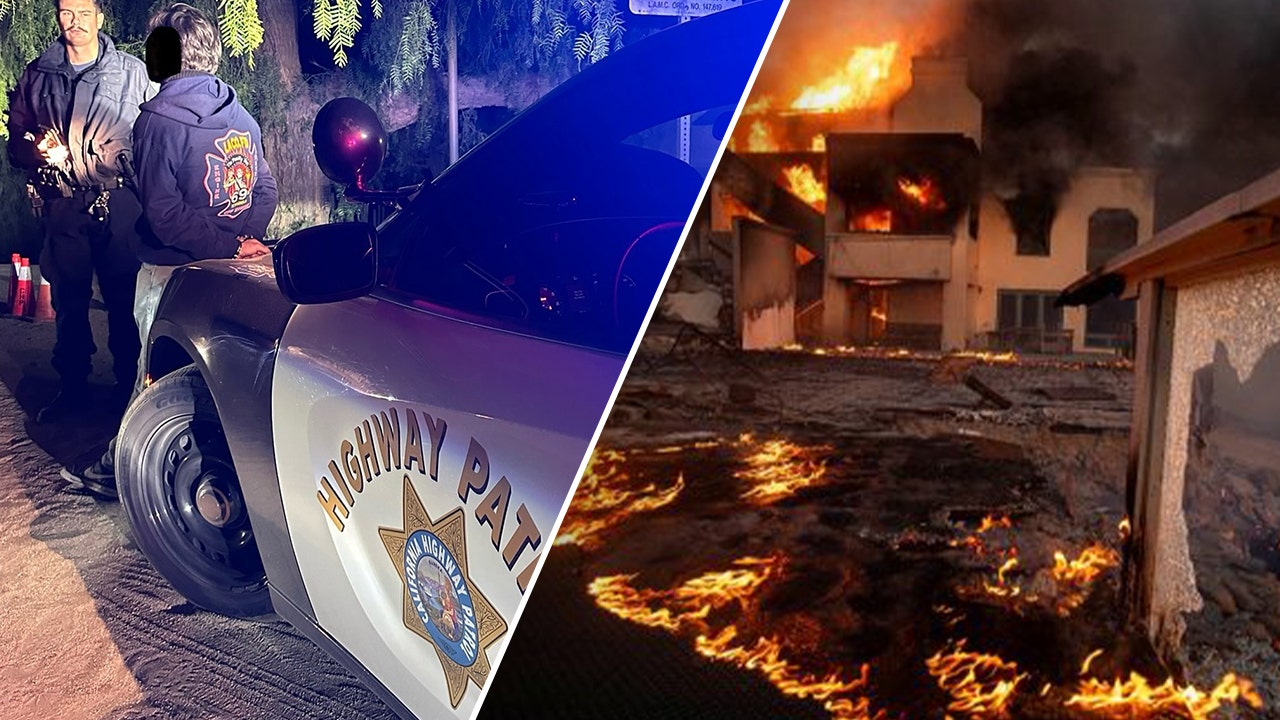
Following several arrests in recent weeks of individuals who authorities say impersonated firefighters, officials now say two more people have been taken into custody for pretending to be members of the media to enter a fire zone.
Authorities say the two suspects allegedly forged press passes to unlawfully enter a Palisades Fire evacuation zone.
Officers stationed at road closures for the Palisades Fire came into contact with “two suspicious individuals,” who were at separate roadblock locations, California Highway Patrol said in a press statement on Sunday.
COUPLE WITH FAKE FIRE TRUCK BUSTED FOR IMPERSONATING FIREFIGHTERS NEAR PALISADES FIRE IN LOS ANGELES: SHERIFF
CHP arrested two individuals accused of using forged press passes to unlawfully enter a fire evacuation zone. (Facebook/California Highway Patrol)
“These individuals had been coming and going from the closures while using what appeared to be Los Angeles County Sheriff’s Department (LASD) press passes, and their behavior raised suspicion,” the statement continued.
California Highway Patrol officers confirmed with the Los Angeles County Sheriff’s Department that the press passes were both fake, and both individuals carrying the passes were arrested.
A search of their belongings revealed more fraudulent press passes.
LOS ANGELES WILDFIRES: ARMED HOMEOWNERS PATROL FOR LOOTERS INSIDE EVACUATION ZONE
The Los Angeles County Sheriff’s Department said two individuals from Oregon have been arrested for impersonating firefighters near the Palisades Fire. (Los Angeles County Sheriffs Dept./AP Photo/Jae C. Hong/AP Photo/Ethan Swope, File)
The latest arrests follow several others in recent weeks of individuals accused of attempting to enter fire zones by using deception.
An Oregon couple was arrested on Saturday for allegedly impersonating firefighters after they attempted to enter an evacuation zone with a fake firetruck.
Last week, a burglary suspect disguised as a firefighter was arrested, the Los Angeles Police Department previously confirmed with Fox News Digital.
LA MAYOR’S OFFICE SILENT ON DEPUTY WHO WAS IN CHARGE OF FIRE DEPT., PLACED ON LEAVE FOR ALLEGED BOMB THREAT
A California Department of Corrections hand crew works containment lines ahead of the Palisades Fire Tuesday, Jan. 14, 2025 in Santa Monica, Calif. (AP Photo/Ethan Swope)
“These arrests underscore the strength of our partnership with LASD as we work together to secure and protect the communities affected by the wildfires,” CHP said in the latest statement.
“Criminal activities such as unlawful entry into evacuation zones, forging press passes, and looting will not be tolerated.”
Read the full article from Here

Utah
Hill AFB ends Starbase program that sparked STEM interest among Utah students
CLEARFIELD — A program empowering northern Utah children to discover the possibilities of science, technology, engineering, and mathematics will end after more than a decade of operation.
This week, Hill Air Force Base announced that it is ending its sponsorship of the Starbase program.
Starbase, a U.S. Department of Defense program, is offered throughout the country to provide hands-on learning experiences to young students — primarily fifth graders, according to a description on the curriculum’s website.
Starbase at Hill Air Force Base opened in 2011, and over the past 15 years, has ignited early STEM interest in more than 25,000 students in Davis and Weber counties.
Heather Ingle, a mother of two daughters — 14 and 11 — who have been in the program, said she was sad to hear that Starbase will no longer be offered at the northern Utah base.
“Just the thought of other kids not being able to have that guaranteed program, I think it’s sad,” she said.
Ingle’s oldest daughter participated in the weeklong Starbase program in Montana while their family was stationed in the Great Falls area. More recently, her 11-year-old daughter participated in it at Hill Air Force Base while the family has been stationed in Utah.
She said her 14-year-old was “strongly influenced” through the exploration of hands-on science, technology, engineering and mathematics experience and has shifted her career goals around based on what she learned.
Her younger daughter, on the other hand, wasn’t initially as interested in it.
“And then the first day happened, she came home and she loved it, and totally denied that she didn’t want to go that day,” Ingle told KSL. “She really enjoyed it — she likes to learn new things.”
A Hill Air Force Base press release issued Tuesday didn’t go into specifics about why they’re concluding the program, but it did allude to a funding issue.
“Today, northern Utah benefits from a robust network of STEM programs, many of which were inspired or accelerated by Starbase’s early success. This expansion, combined with changes in national program funding, marks a natural moment for transition. Concluding the program allows Hill AFB to realign resources to meet the growing demands of its core national security mission, confident that the community is well supported by a diverse and vibrant STEM landscape,” the base said.
Starbase’s final days at Hill Air Force Base raised a question for Ingle regarding the program’s future elsewhere, as their family will soon be relocating back to Montana and hopes their youngest child has an opportunity to experience it.
“I have a 5-year-old as well, and I really am hoping that the Starbase program in general continues,” she said.
A spokesperson for Hill Air Force Base said the program there will finish out the remainder of the school year and that it’s still active “at some other bases currently.”
Northern Utah benefits from a robust network of STEM programs, many of which were inspired or accelerated by Starbase’s early success.
–Hill Air Force Base
The base said it’s thankful to the many people who helped make Starbase a cornerstone in local STEM education.
“The base remains deeply committed to community partnership and will continue supporting educational outreach that inspires the next generation of innovators, leaders and problem‑solvers,” the base said.
For Ingle, she’s grateful for the opportunities her daughters have had at Starbase and for how it showed them a career they, too, can one day pursue.
“Outside of the doctor, lawyer, cop, firefighter — you know, it opens their eyes into so many different careers and specialties out there that you can touch, and I love that exposure,” she said.
The Key Takeaways for this article were generated with the assistance of large language models and reviewed by our editorial team. The article, itself, is solely human-written.
Wyoming
Forest Service’s rural schools payout includes $4.5M for Wyoming
The federal government owns nearly half the land in Wyoming. That gives Wyomingites easy access to national forest and Bureau of Land Management (BLM) lands, but it also means they miss out on the property taxes that would be paid by private landowners.
The federal Secure Rural Schools (SRS) program aims to rectify that.
Under the program, the U.S. Forest Service will be giving Wyoming $4.5 million this year to support rural schools and roads. That’s the state’s cut of this year’s $248 million total payout.
Wyoming Congresswoman Harriet Hageman touted the program on the House floor in December.
“With such a large percentage of Wyoming’s resources historically locked up in federal lands, including national forests, communities across my state have long weathered challenges associated with reduced flexibility and a decreased tax base,” she said. “Since [the program’s] creation, Wyoming communities have received vital funding to support infrastructure projects, public education, search and rescue operations and other critical emergency services.”
The program has been repeatedly reauthorized for decades with only a few lapses. A bill resuming the payments after its most recent lapse in 2024 advanced through Congress and was signed by Pres. Trump in December.
In April, the U.S. Forest Service announced that this year’s payout, which is determined by a complex calculation, would be $248 million across the country.
“Secure Rural Schools payments reflect our strong partnership with the counties and communities that surround national forests,” Forest Service Chief Tom Schultz said in a news release. “These funds support critical infrastructure, while advancing active forest management and restoration that keep forests resilient and communities safer. We remain committed to deliver this support directly to rural communities that depend on these resources.”
The payments will be distributed to 19 of Wyoming’s 23 counties in roughly the following amounts:
- Albany: $328,000
- Big Horn: $320,000
- Carbon: $331,000
- Converse: $19,000
- Crook: $136,000
- Fremont: $715,000
- Hot Springs: $31,000
- Johnson: $179,000
- Lincoln: $370,000
- Natrona: $3,000
- Park: $664,000
- Platte: $1,000
- Sheridan: $166,000
- Sublette: $571,000
- Sweetwater: $69,000
- Teton: $550,000
- Uinta: $46,000
- Washakie: $29,000
- Weston: $5,000
The payments to Converse, Crook, Teton, and Weston Counties do not technically stem from the Secure Rural Schools program, though they are included in the forest service’s $248 million total and Wyoming’s $4.5 million.
For these four Wyoming counties, the payments are authorized by an older program, a 1908 act of Congress that gives counties 25% of the revenue generated on federal lands within their boundaries. Individual counties may choose to receive this revenue share instead of the SRS payment, and often do when the share is higher than their SRS payment would be.
For most counties in Wyoming, the SRS payment is more generous.
From timber sales to federal compensation
Legislation passed more than a century ago saw the federal government pay states some of the revenue it generated from logging activities in national forests. That was great for counties with federal forests in their backyards, but less so for counties with other less monetizable federal lands.
In 1976, the federal government started making Payments in Lieu of Taxes (PILT) to these counties to address this disparity. A 2025 congressional overview of that program states:
“PILT was enacted in response to a shift in federal policy from one that prioritized disposal of federal lands — in which federal ownership was considered to be temporary — to one that prioritized retention of federal lands, in perpetuity, for public benefit … Along with this shift came the understanding that, because these lands were exempt from state and local taxation and were no longer likely to return to the tax base in the foreseeable future, some compensation should be provided to the impacted local governments.”
Logging revenue declined in the 1990s, so Congress stepped in with the Secure Rural Schools and Community Self-Determination Act of 2000. It provided for six years of payments to the counties that had historically shared in the federal government’s logging revenue.
“It was intended to be temporary,” said Mark Haggerty, a senior fellow with the Center for American Progress, a liberal think tank. “The payments actually declined over those six years, and then they sunset. And the idea was that those counties would transition [so] they’re not going to be reliant on timber anymore. But they’ll become a recreation county, or they’ll become a remote work county, or they’ll be a retirement [county], like they’ll find another way to pay for their budgets.”
But “a lot of these rural counties have not transitioned,” Haggerty said. So the temporary program has become a semi-permanent one, with repeated reauthorizations throughout the years, often driven by the states with the most to lose if the funding went away completely.
“Wyoming is a classic case,” Haggerty said. “Wyoming pays for things with oil and gas money. It’s hard to develop a diversified tax structure around recreation in Wyoming, because you don’t have the taxes to pay for it, right? You don’t have an income tax. You have low sales taxes because you pay for things other ways.”
As the program has been renewed, its formula has been tweaked. Its overall payouts have fallen from a peak of more than $500 million when it was first reauthorized in 2008.
But some of the formula changes have benefited certain counties more than others. Now, in addition to a county’s historic timber sales, the SRS payout also takes into consideration federal land acreage and relative income levels.
“For some poor counties that have a lot of federal land but didn’t used to get a lot of timber receipts, all of a sudden their payments went up through the roof because those other formula factors really benefited them,” Haggerty said.
In Wyoming, that included Park County, which never saw Oregon-levels of logging but does have a lot of federal land.
Center for American Progress
Those same formula factors disadvantaged richer communities like Teton County, which left the program in 2008 when those changes took effect.
Center for American Progress
Today, all of these forces, as well as recent moves by the Trump administration, might be driving a wedge into the coalition of states that historically backed the SRS program.
A bipartisan coalition fractures
In the summer of 2025, SRS funding was removed from the One Big Beautiful Bill before the legislation’s passage. The Center for American Progress published an interactive map showing how the end of that funding would affect rural counties.
Each county has the option of receiving its SRS payment or taking its share of logging or other federal land revenues under the program that’s been going since 1908. When Teton County left the SRS program in 2008, it reverted to accepting revenue shares.
For many years, especially in the early years of the SRS program, it made more sense for counties to take SRS payments instead of the 1908 shares. That meant the SRS program usually had just enough support to be reauthorized. Haggerty said support came from Congress members of both parties, but only from those representing the states that benefited.
“It’s just really difficult politically,” he said. “It’s not a partisan issue, because both Republicans and Democrats in the states that get it support it. It’s a geographic problem. They just don’t have enough places that need it.”
Today, with SRS payments falling and a presidential administration pushing for more logging on national forests, Haggerty said some counties that once benefited from the SRS payments are eying a return to revenue-sharing.
“Either they think they can get more out of revenue-sharing than what a Secure Rural Schools payment might be, or they think by tying their budgets to activities on public lands, they can force the politics to open the public lands up again to more extraction,” Haggerty said. “That’s fragmented the coalition that already wasn’t big enough to consistently get it authorized. And so the future of Secure Rural Schools, I think, is probably less secure now than it has been in the past.”
The payments lapsed in 2016, and again in 2024, when Congress did not reauthorize them. The latest reauthorization also includes retroactive payments for 2024.
San Francisco, CA
Missing man, 85, last seen in South San Francisco
SAN FRANCISCO (KRON) — A Silver Alert was activated Thursday by the California Highway Patrol after an 85-year-old man was reported missing from South San Francisco.
Zosimo Carmen is described by authorities as 5 feet 5 inches tall and weighing 155 pounds. He has gray hair and brown eyes.
Carmen was last seen around 2 a.m. on Thursday in the area of James Court and Livingston Place in South San Francisco. He was wearing a brown flannel shirt and blue sweatpants.
The Silver Alert was activated for San Mateo and San Francisco counties.
Anyone who sees Carmen is asked to call 911.
-
Pennsylvania1 minute agoMan wanted in connection with fatal stabbing in Pottstown, Pa.
-
Rhode Island7 minutes agoRhode Island man dies after crashing into Connecticut home
-
South-Carolina13 minutes agoNew poll shows tight GOP race for South Carolina governor
-
South Dakota19 minutes agoUSC Trojans Pick Up Final Transfer Portal Addition From South Dakota
-
Tennessee25 minutes agoTennessee Republicans pass a map to break up the state’s lone Democratic House seat
-
Texas31 minutes agoTexas officials monitoring two residents who were on board ship with hantavirus outbreak
-
Utah37 minutes agoHill AFB ends Starbase program that sparked STEM interest among Utah students
-
Vermont43 minutes agoTreasurer Pieciak highlights Vermont Saves eligibility expansion