West
Auraria Campus police officer shot in Denver, suspect arrested

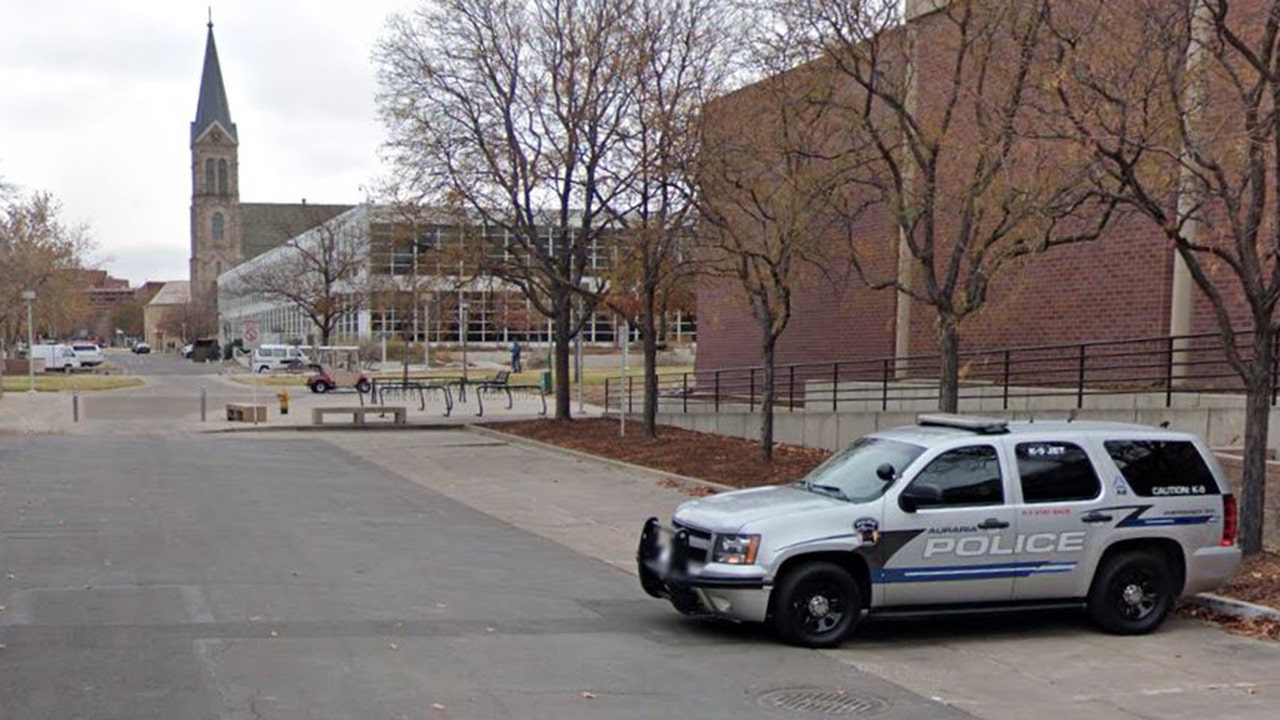
A campus police officer was shot and injured in Denver early Monday morning while trying to apprehend a suspect who had trespassed into a vehicle, officials said.
The shooting unfolded at around 1:18 a.m. on the Auraria Campus, which is shared by Community College of Denver, Metropolitan State University of Denver, and University of Colorado Denver, in downtown Denver, campus officials said in a statement.
Two campus officers approached a suspect who was found “trespassing into a vehicle,” the statement said. The suspect allegedly assaulted the officers and fled.
When the officers later tracked down the suspect, officials said he resisted, and officers deployed a taser.
TEXAS MAN ARRESTED FOR ALLEGEDLY STEALING NEIGHBORS’ DOGS, KILLING THEM
An Auraria Campus Police officer was wounded in a shooting on campus early Monday, officials said. (Google Maps, File)
The suspect then fired multiple shots, hitting one officer in the arm before fleeing a second time.
The officer was treated for a non-life-threatening gunshot wound at a hospital and was later released.
Auraria Campus is shared by Community College of Denver, the Metropolitan State University of Denver and the University of Colorado Denver. (Hyoung Chang/The Denver Post, File)
FLORIDA LIEUTENANT FATALLY SHOT BY ESTRANGED HUSBAND WHO ATTEMPTED TO MAKE CRIME LOOK LIKE A SUICIDE: DEPUTIES
Auraria Campus Police and Denver Police officers later arrested the suspect. The suspect was taken to a hospital for evaluation, though it was unclear whether the taser that officers initially deployed made contact, officials said.
CLICK TO GET THE FOX NEWS APP
The Denver Police Department is investigating the incident.
Read the full article from Here

Montana
The Record is Clear: The Wilderness Society, Greater Yellowstone Coalition, and Montana Wilderness Association have Consistently Undermined the Roadless Rule

Beartooth Range, Montana. Photo: Jeffrey St. Clair.
The Wilderness Society, the Greater Yellowstone Coalition, and the Montana Wilderness Association, now rebranded “Wild Montana,” all claim they support the Roadless Rule and have been asking people for donations to oppose efforts to repeal it. But a review of the record shows that these “conservation” groups have supported opening 1,585,000 acres or Roadless and Wilderness Study Areas to logging and road building since the roadless rule went into effect in 2001.
Tracy Stone-Manning, now the President of The Wilderness Society, has been widely quoted as supporting the Roadless Rule. But while working as a top environmental advisor for former Montana Senator Jon Tester, she strongly supported his 2009 Forest Jobs and Recreation Act. The Montana Wilderness Association, now doing business as Wild Montana, was also one of the main cheerleaders for Tester’s bill
Although the bill never passed, it would have opened one million acres of roadless lands in the Beaverhead-Deerlodge National Forest in southwest Montana and mandated logging 10,000 acres per year for 10 years in the Beaverhead and Kootenai National Forests. The Kootenai contains the smallest, most threatened grizzly population in the world in the Cabinet-Yaak. Since most grizzly bears are killed within 1/3 of a mile of a road, more logging means more logging roads would be bulldozed into grizzly habitat, resulting in more dead grizzly bears. The measure was so extreme even the Forest Service opposed it.
The groups also strongly supported former Montana Senator Max Baucus’ Rocky Mountain Front Heritage Act, passed as a rider on the 2014 defense spending bill. The measure opened 208,000 acres of roadless lands to logging and road-building and guaranteed grazing in perpetuity with no environmental analysis or public review. The pitiful 67,000 acres of wilderness tack-ons also required the sacrifice of four Wilderness Study Areas in Eastern Montana, opening 29,000 acres to oil and gas exploration and development.
Then came Tester’s 2017 Blackfoot Clearwater Stewardship Act that carved up 50,000 acres of an Inventoried Roadless Areas contiguous to the Scapegoat and Bob Marshall Wilderness Areas. The measure also allowed loggers to decide where to build roads and designated 5,000 acres as a play area for snowmobiles and mountain bikes.
The bill didn’t even make it out of committee, but now these same groups have renamed it “A River Runs Through It Act” — although there is no sponsor and no “act.” In addition to the roadless lands Tester’s bill would have destroyed, it turns over management of 70,000 acres in grizzly, lynx and wolverine habitat in the Ogden Mountain Roadless Area northwest of Lincoln Montana to the timber industry. It also converts 130,000 acres of Inventoried Roadless Areas into play areas for motorized recreation and mountain bikers.
The clearcutting, bulldozing new logging roads, and motorized recreation in roadless areas will send tons of sediment into the Blackfoot River which has been designated critical habitat for bull trout, a threatened species. It should be called “A Clearcut Runs Through It Act.”
Finally, all three groups support the Greater Yellowstone Conservation And Recreation proposal. There is no sponsor and no bill, but the proposal opens much of the Lee Metcalf Wilderness Study Area and other Inventoried Roadless Areas to motorized recreation, logging and road building. While adding only 102,000 acres as wilderness — less than half of the 250,000 acres that qualify for wilderness designation — it also significantly reduces the 155,000 acre Hyalite-Porcupine-Buffalo Horn Wilderness Study Area by 53,000 acres.
Don’t fall for the con. The record is clear: these groups have supported reducing, not protecting Inventoried Roadless Areas in the past and are doing so now.
Please consider helping us get the only bill before Congress that would designate all 23 million acres of roadless in the Northern Rockies designated as wilderness, the Northern Rockies Ecosystem Protection Act. Please also consider donating to Counterpunch to help them continue exposing hypocrites.

LAS VEGAS (KSNV) — Nevada Youth Sports is working to keep thousands of young athletes on the field after a fire believed to have been sparked by illegal fireworks caused nearly a quarter of a million dollars in damage to its facility.
The fire broke out late on the night of July 4. Jane Ramos, chief administrative officer for Nevada Youth Sports, said she received a call from the organization’s landlord telling her there had been a fire at the building.
“We got a call from our landlord saying I needed to come out here right away because there had been a fire,” Ramos said. “We didn’t really understand the scope of what had happened until we could hardly open the door because of the fumes, the smoke, and the smell.”
According to Ramos, firefighters responded shortly before midnight after flames were reported on the roof of the building. In the days since, the organization says it has learned the fire is believed to have started when embers from illegal fireworks landed on the roof.
“It’s something that was preventable if it truly was illegal fireworks,” Ramos said.
Early damage assessments estimate nearly $250,000 in structural, electrical and water damage. Ramos said the organization is still working to understand the full financial impact.
“We’re trying to assess where we are financially in all of this,” she said. “It’s really a question mark.”
The damage has forced Nevada Youth Sports to temporarily close its facility, affecting the thousands of athletes and families who rely on the organization for leagues, clinics and training programs.
Nevada Youth Sports serves more than 14,000 athletes and families across the Las Vegas Valley each year. Ramos said the organization’s immediate priority is finding alternate locations so programs can continue with as little disruption as possible.
“We’re definitely allocating our resources toward those efforts,” Ramos said. “Whatever the cost is to continue programming outside of this building, that’s where we’re focusing our efforts right now.”
While investigators continue looking into the cause of the fire, Ramos said the organization hopes whoever is responsible will be held accountable. She said neighboring businesses have provided surveillance video that could help determine exactly what happened.
“I’m hopeful that we can point some accountability somewhere,” Ramos said. “Our commercial neighbors have been very kind to offer their camera footage, so we’re still collecting all of that information before we pursue anything further.”
Despite the damage, Ramos said the organization’s commitment to local families remains unchanged.
“We’ll continue to be steadfast and patient,” she said. “Our mission is being a partner to our athletes and families. We’re here for a bigger purpose than just this building, and we’ll see it through.”
Nevada Youth Sports expects to have a better understanding of the repair timeline by the end of the week. In the meantime, leaders say they’re grateful for the community support they’ve already received as they work to restore operations.

Grant’s Monday Night Forecast
Monsoon storms will return to parts of New Mexico every day this week, while hotter temperatures move in later in the week.
Thunderstorms developed across the mountains of New Mexico Monday afternoon. These storms slowly drifted south into the evening. Almost all of these showers and storms have ended now tonight. Another round of afternoon thunderstorms is expected Tuesday, developing first over the mountains before spreading into nearby valleys and lower elevations again. However, some storms around the Four Corners will be on the drier side, increasing the threat for lightning caused wildfires with little rainfall.
The monsoon high that has been bringing thunderstorms early this week will shift well west of New Mexico on Wednesday. This will bring hotter and slightly drier weather across the state. Even so, afternoon thunderstorms will still develop, especially over the mountains and across northeast New Mexico. Drier air will limit storm coverage Thursday and Friday across central, northern, and western New Mexico, while southern and eastern parts of the state continue to see the best chance for afternoon storms. Hotter weather will also return later this week, with triple-digit heat expanding to more locations, including the Albuquerque metro area Thursday and Friday.
The heat will continue into the weekend as the monsoon high strengthens and shifts back toward Utah and Colorado. That pattern will also bring higher monsoon moisture into New Mexico, bringing increasing chances for afternoon and evening thunderstorms statewide Saturday and Sunday.
-

 Minnesota59 seconds ago
Minnesota Lynx bested by Connecticut Sun 90-89
-

 Mississippi8 minutes ago
Mississippi Lottery Mississippi Match 5, Cash 3 results for July 6, 2026
-
Missouri11 minutes ago
Missouri teachers push back on governor’s A-F school grading plan
-

 Montana16 minutes ago
The Record is Clear: The Wilderness Society, Greater Yellowstone Coalition, and Montana Wilderness Association have Consistently Undermined the Roadless Rule
-

 Nebraska23 minutes ago
Pine-Richland receiver Khalil Taylor pulls hat trick, picks Nebraska over Penn State
-

 Nevada26 minutes ago
Nevada Youth Sports estimates $250K in damage after Fourth of July firework fire
-

 New Hampshire31 minutes ago
Suspected gunman in Hampton Beach shooting was in U.S. Navy
-

 New Jersey38 minutes ago
I took my kids to this New Jersey hotel and stopped making fun of the state (for now)


