Arizona
No. 13 ASU secures season sweep with 4-set win over Arizona volleyball


Arizona volleyball served well and played one of their best sets all season, but the Wildcats still fell to No. 13 ASU in a four-set match on Thursday evening in McKale Center. The Sun Devils won 25-23, 15-25, 25-19, 25-15.
“As a veteran, team (ASU) was just doing their job out there,” said Arizona head coach Rita Stubbs. “Didn’t do anything special.”
The Wildcats have dropped several sets this year simply by giving away points on their serve. On Thursday, they didn’t do that. They had just six service errors compared to 10 for ASU. Last time the two teams played, Arizona had 19 service errors in a four-set loss. Stubbs said that came about because of how they’ve adapted in practice.
“In our 6-on-6 competition, they had to serve a certain area,” Stubbs said. “And knowing that they had to go after a person, they didn’t have to look to move forward. They were able to reset themselves.”
For 2.5 sets, they were relatively clean on offense, too. The Wildcats started the match with just two kills and five hitting errors. They seemed to find their footing at that point, getting nine straight kills without another error to end the first set.
That wasn’t enough to take the 1-0 lead, though. ASU already had a 16-9 lead when Arizona found its way. The visiting team was just good enough down the stretch to emerge victorious in the set.
It could have put the Wildcats back on their heels when they weren’t able to fulfill the comeback. Instead, they carried the momentum into the second set.
Arizona had 17 kills and just two hitting errors in the second set. The Wildcats also had 22 digs and three total blocks as they dominated their in-state rivals.
“I think all the hitters were on,” said Arizona opposite Jaelyn Hodge. “Our passing was on. So you can run your offense really good when passing is on. Keeping them out of system is a part, too.”
A great team regroups, and that’s what ASU did in the third. Arizona used a 6-1 run to take an 11-9 lead, but that was the end of the runs for the home team. The Wildcats did not score more than one point in a row for the rest of the set while the Sun Devils had five runs of two or three points. They ended it on two straight aces.
That took the wind out of Arizona’s sails. The Sun Devils led wire-to-wire in the final set. Once again, UA let its opponent go on runs without answering in kind. The Wildcats scored two points in a row four times in the final set while ASU had two or more points seven times.
“We let them have long runs, even though we said our goal was to go point for point with them, and that was partly because the hitters, our offense was not good today by any stretch of the imagination,” Stubbs said. “We had 10 kills, 12 errors in the fourth set. In that situation, the hitters were just going out there swinging with reckless abandon, and that’s not good.”
The Sun Devils began to pile up the blocks. Arizona led 7.0 to 2.0 after three sets. ASU blocked the Wildcats five times in the final set, closing the UA lead in total blocks to 9-7. Arizona’s back-row attack, which was effective for most of the match, was suddenly accounted for by the ASU block.
“In the second set, we were able to move the ball around and put it in different hands,” Stubbs said. “Back row was something that we were scoring on. Then once they start putting the block up—because they didn’t block it last (match)—once they put the block in front, then we went to the D, but then we didn’t set it the way we were supposed to.”
Arizona was led on offense by Hodge and Jordan Wilson, although neither was very efficient. Hodge had 17 kills on .178 hitting, eight digs, and three total blocks (one solo). Wilson had 15 kills on .205 hitting, 14 digs, and four total blocks (one solo).
The ranked opponents continue as Arizona goes on the road next week to play Utah and BYU. The two teams are tied at No. 21 in the AVCA rankings. The Wildcats split their home matches against the two teams, losing to the Utes and defeating the Cougars.
Lead photo courtesy of Arizona Athletics



Cardinals’ Burch shares what he learned as a rookie in 2025
Arizona Cardinals second-year player Jordan Burch says his defensive line teammates have formed a bond heading into the 2026 NFL season.
Last year in early July, Cardinals edge rusher Jordan Burch was a rookie third-round draft pick out of Oregon who was looking forward to his first NFL training camp and eventual first season.
That rookie year is behind him now, and Burch has identified what he needs to improve on heading into his second season. He said he now knows what to expect and look for, and after talking with outside linebackers coach Matt Feeney, Burch built an offseason plan with which he was comfortable.
“I don’t think anything was like a surprise,” Burch said on Thursday, July 9, at the Cardinals’ Tempe headquarters. “I kind of know what to prep for, so this offseason I can look at my old plays, and then I can call my coach and tell him, from last year to this year, what does he want to see on the field.”
Burch seeks to improve his pass rush. He played in all 17 games last season and had five solo tackles with a sack, and also broke up three passes.
Much of his position was dropping into pass coverage, so Burch looks to recognize pass catchers’ routes better in 2026. He gets help from veteran Josh Sweat, who is there to answer questions about the position they share.
“Every week, every game going against somebody good,” Burch said about takeaways from last season. “The talent of the quarterbacks. We’re playing the Rams, how quickly they get the ball out.”
Burch looks forward to building a stronger bond with his teammates, having invited some of them for dinner or to watch TV. He said he was happy with his progress as a player throughout last season.
The Cardinals open training camp Wednesday, July 22, at State Farm Stadium. It’s a week earlier than most teams because Arizona plays the Carolina Panthers in the Aug. 6 Hall of Fame Game in Canton, Ohio.
Cardinals legend Larry Fitzgerald will be among those inducted into the Pro Football Hall of Fame Aug. 8.

A new study has ranked Arizona as one of the worst states to move to for two years in a row, largely due to what it calls a poor quality of life.
The study conducted by Consumer Affairs analyzed the best states to move to in the United States, putting Arizona at the bottom of the list.
Before Arizonans get too defensive about the Grand Canyon State, Consumer Affairs used factors such as affordability, safety, economic strength and education to measure each state, leaving out factors like entertainment, retirement benefits and other considerations that may be important to people living here.
Popular states such as California and New York also landed at the bottom of the list due to their lack of affordability, even though they both have some of the best health care and education in the nation, Consumer Affairs noted.
Here’s why the study says you shouldn’t move to Arizona. Do you agree?
Why you shouldn’t move to Arizona
Arizona ranked No. 10 out of the worst states to move to, scoring especially poorly in quality of life.
Quality of life was measured by the state’s Social Progress Index, average air quality, weather, environmental protection and number of national parks. Due to Arizona’s extreme summers and Phoenix’s consistently poor air quality, it’s easy to see why Arizona ranked No. 44 in quality of life out of 50 states, even though the Grand Canyon is one of the most popular national parks in the nation.
However, Arizona also ranked poorly in other categories, sitting at No. 42 in health care and education, No. 41 in safety and No. 34 in affordability out of 50 states.
There was one category Arizona did impressively well in, ranking No. 5 in economic strength even as one of the youngest states in the country. Still, Arizona’s economic power wasn’t enough to boost its ranking.
Top 10 worst states to move to
Arizona wasn’t alone; some of the biggest states in the country were also considered the worst states to move to in 2026.
- New Mexico
- Louisiana
- California
- Arkansas
- Oklahoma
- Nevada
- Alaska
- Mississippi
- Oregon
- Arizona
Top 10 best states to move to
- Utah
- New Hampshire
- Idaho
- Minnesota
- Massachusetts
- Maine
- North Dakota
- Pennsylvania
- Iowa
- South Dakota
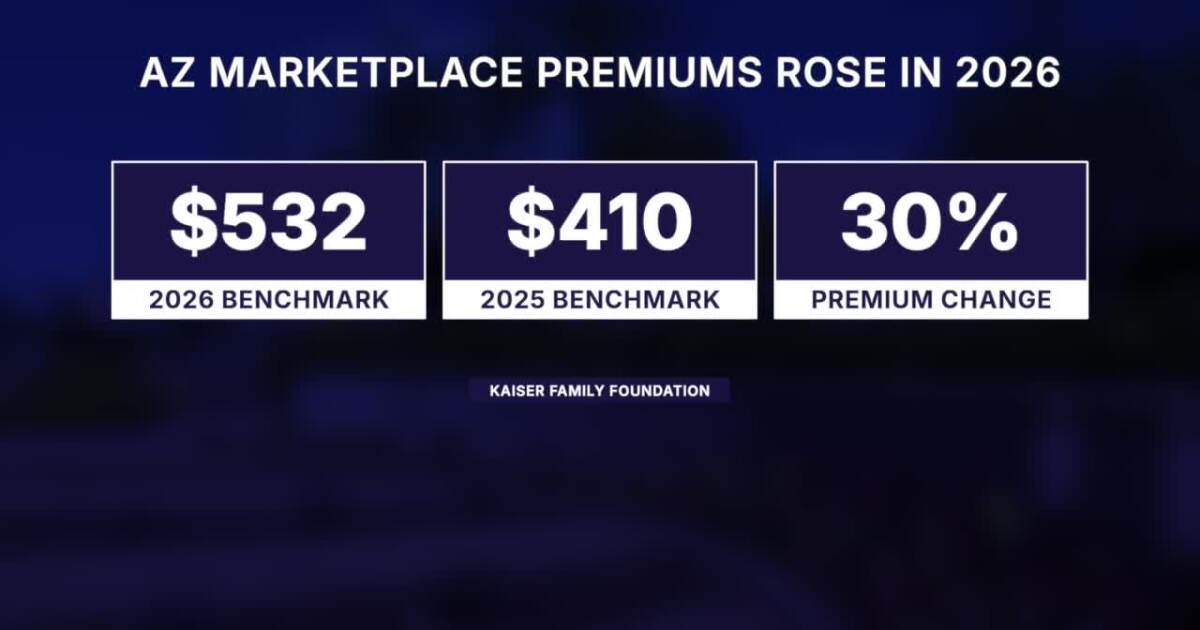
PHOENIX — Arizona’s ACA marketplace enrollment fell from 363,000 to just over 255,000 in a single year — a nearly 30% decline and the third-largest annual drop in the country.
Rising premiums and expired tax credits are driving the trend, with the average benchmark plan premium in Arizona now at $532 — up 30% from 2025.
In the player above, ABC15 Data Analyst Garrett Archer takes a look inside the numbers on how healthcare premiums are impacting health insurance enrollment.
This story was reported on-air by a journalist and has been converted to this platform with the assistance of AI. Our editorial team verifies all reporting on all platforms for fairness and accuracy.
Want more news in your community? Add ABC15 as a preferred source on Google below:

-
 Nevada7 minutes ago
Nevada bystanders pull crash victim from burning motorhome on I-15 near Mesquite
-

 New Hampshire10 minutes ago
Townsend man arrested in connection with two armed robberies in New Hampshire and New Jersey, authorities say – The Boston Globe
-

 New Jersey14 minutes ago
Are all Freedom Fuel locations $3.47? Not anymore
-

 New Mexico22 minutes ago
New Mexico’s ban on liquor ‘minis’ yields mixed results five years later
-

 North Carolina25 minutes ago
NC state budget includes $27M for Madison County’s new public service complex
-

 North Dakota30 minutes ago
The Women’s College Fan Guide To 2026 Junior Nationals – FloWrestling
-

 Ohio37 minutes ago
Ohio reports nearly 200 cases of ‘explosive diarrhea’ illness
-

 Oklahoma40 minutes ago
Every Oklahoma State Cowboys’ College Football 27 Preseason Player Rating

