Arizona
Key Senate race in Arizona could hinge on voters who back Trump and the Democratic candidate


PHOENIX (AP) — If Ruben Gallego is going to give Democrats their fourth straight U.S. Senate victory in Arizona, he’s probably going to need support from an unlikely group: Donald Trump voters.
Gallego and his GOP rival, former television news anchor Kari Lake, are both targeting undecided Republicans in a contest that will test the strength of Trump’s coattails. Ticket-splitting voters are increasingly rare in an era when partisan loyalty reigns, but they could be central in determining which party controls the Senate.
For Gallego, that means winning over voters like Winfield Morris, a 62-year-old Republican farmer and rancher who plans to vote for Trump for president but can’t get behind his loyal ally in the Senate race.
“I don’t like Kari Lake and I’m not going to vote for her,” said Morris, who lives in southern Arizona and has businesses across the state. “I don’t think she has what it takes.”
Morris supported former U.N. Ambassador Nikki Haley over Trump and Pinal County Sheriff Mark Lamb over Lake in the GOP primaries. He said he was furious to see Lake attack the late Arizona Republican Sen. John McCain in her failed 2022 campaign for governor. Trump also has attacked McCain, but Morris said he doesn’t see Democrat Kamala Harris as a viable alternative.
Morris said he likes that Gallego was a Marine and may vote for him but wants to learn more about him. He’s also considering writing in a Republican he respects, such as Lamb, who got 40% of the vote in the Senate primary despite being vastly outspent and overshadowed by Lake.
Democrats have a difficult path to keep the Senate
Democrats’ difficult path to retaining control of the Senate relies on winning over Republicans in states so red, neither presidential candidate is putting much effort into winning them. But some of those races involve established incumbents who already have a record to run on.
An ad supporting Montana Sen. Jon Tester — one of the most endangered Democrats in the Senate, who has declined to endorse Harris — showcases Republicans crossing party lines.
“Jon got over 20 bills signed into law by President Trump,” one man says in the ad.
Trump is well positioned in Ohio, but the race between incumbent Democratic Sen. Sherrod Brown and Republican challenger Bernie Moreno could be more competitive.
The effort to win over ticket-splitters is harder for less established candidates, but some are trying. In North Dakota, longshot Democratic Senate candidate Katrina Christiansen released an ad this week narrated by a rancher who says he’s voting for Trump but not for Republican Sen. Kevin Cramer.
In swing-state North Carolina, where Republican Mark Robinson’s campaign for governor is struggling following a CNN report linking him to disturbing posts on an online porn site, the Trump campaign is counting on ticket-splitting in the opposite direction, hoping GOP voters who bail on Robinson will stick with the former president in a state he badly needs to win.
In Arizona, meanwhile, Gallego is hoping to replicate the model that has propelled Democrats to narrow statewide victories since Trump’s first victory, including Sens. Kyrsten Sinema and Mark Kelly and Gov. Katie Hobbs, who defeated Lake in 2022.
He’s getting plenty of help. Democrats so far have outspent Republicans on advertising by a wide margin on the race, according to AdImpact, which tracks campaign ad spending. As of Thursday, Democrats had spent $60.7 million on the race, compared to $16.4 million spent by Republicans. Democrats also have $35.7 million in spots reserved between now and Election Day, compared to $11.7 million reserved by GOP-affiliated groups.
What to know about the 2024 Election
Gallego’s strategy relies on Democrats keeping their own supporters united, getting a majority of independents and picking up a small but decisive share of Republicans by appealing to conservatives who dislike Trump.
“Especially in modern times, to have ticket splitters that big is extraordinary. But I think it’s entirely accurate,” said Mike Madrid, a California-based Republican strategist who has worked to defeat Trump. “They’re sticking more to Trump because he’s the top-of-the-ticket nominee, and losing the presidency is a lot different than losing a Senate seat.”
Republicans have had a hard time replicating Trump’s coalition
Celebrity candidates who are close to Trump but lack strong ties to the GOP establishment have had a hard time replicating Trump’s coalition, Madrid said. Television doctor Mehmet Oz and football legend Herschel Walker both lost Senate races two years ago. As a well-known local news personality, Lake fits the mold.
Both Lake’s and Gallego’s messaging reflect the importance of undecided Republicans to the outcome of the race.
Both are running ads focused on border security, almost exclusively so in Lake’s case. Gallego even gently rebukes the Biden-Harris administration in one ad playing in heavy rotation, saying, “Arizonans know — on the border, there is no plan.” He did not appear with Harris when she visited the Arizona-Mexico border on Friday.
And both Gallego and Lake are showcasing support from Republicans. For Gallego, it’s a businessman who says in ads he’s a Republican and calls the congressman a “man of principles.” For Lake, it’s Trump himself, as she reminds his supporters that he’s backing her. She’s been one of his most steadfast allies, embracing his lie that the 2020 election was stolen from him due to widespread fraud.
The cross-currents of divided loyalties among traditionally Republican groups often surface at campaign events. For example, the Arizona Police Association, which represents thousands of officers in the state, endorsed Gallego, citing his background as a Marine combat veteran. Just three days earlier, Trump called the group’s president, Justin Harris, to the stage to bestow an endorsement on the former president at a rally outside Phoenix.
Gallego hopes there’s more where that came from, and there’s some history to suggest that’s possible.
In 2020, Republican Senate candidate Martha McSally privately fretted that she was running behind with Trump voters, which turned out to be the case. While Trump lost Arizona by 10,457 votes — .03 percentage points — McSally lost by 78,806 to Kelly, indicating tens of thousands of voters split their tickets.
Some observers say Gallego fits the profile of the kind of candidate who could replicate the path forged by Kelly, a tough-talking former astronaut.
“Ruben is a legitimate tough guy,” said Stacy Pearson, a Phoenix-based Democratic strategist, who ran the successful 2016 campaign to oust Maricopa County Sheriff Joe Arpaio, which relied on voters who backed Trump at the top of the ticket. “He’s an Iraq War vet. He is a person who sincerely pulled himself up by his bootstraps, and that resonates very much with this Western state.”
___
Associated Press writers Jack Dura in Bismarck, North Dakota, and Amy Beth Hanson in Helena, Montana, contributed to this report.



Cardinals’ Burch shares what he learned as a rookie in 2025
Arizona Cardinals second-year player Jordan Burch says his defensive line teammates have formed a bond heading into the 2026 NFL season.
Last year in early July, Cardinals edge rusher Jordan Burch was a rookie third-round draft pick out of Oregon who was looking forward to his first NFL training camp and eventual first season.
That rookie year is behind him now, and Burch has identified what he needs to improve on heading into his second season. He said he now knows what to expect and look for, and after talking with outside linebackers coach Matt Feeney, Burch built an offseason plan with which he was comfortable.
“I don’t think anything was like a surprise,” Burch said on Thursday, July 9, at the Cardinals’ Tempe headquarters. “I kind of know what to prep for, so this offseason I can look at my old plays, and then I can call my coach and tell him, from last year to this year, what does he want to see on the field.”
Burch seeks to improve his pass rush. He played in all 17 games last season and had five solo tackles with a sack, and also broke up three passes.
Much of his position was dropping into pass coverage, so Burch looks to recognize pass catchers’ routes better in 2026. He gets help from veteran Josh Sweat, who is there to answer questions about the position they share.
“Every week, every game going against somebody good,” Burch said about takeaways from last season. “The talent of the quarterbacks. We’re playing the Rams, how quickly they get the ball out.”
Burch looks forward to building a stronger bond with his teammates, having invited some of them for dinner or to watch TV. He said he was happy with his progress as a player throughout last season.
The Cardinals open training camp Wednesday, July 22, at State Farm Stadium. It’s a week earlier than most teams because Arizona plays the Carolina Panthers in the Aug. 6 Hall of Fame Game in Canton, Ohio.
Cardinals legend Larry Fitzgerald will be among those inducted into the Pro Football Hall of Fame Aug. 8.

A new study has ranked Arizona as one of the worst states to move to for two years in a row, largely due to what it calls a poor quality of life.
The study conducted by Consumer Affairs analyzed the best states to move to in the United States, putting Arizona at the bottom of the list.
Before Arizonans get too defensive about the Grand Canyon State, Consumer Affairs used factors such as affordability, safety, economic strength and education to measure each state, leaving out factors like entertainment, retirement benefits and other considerations that may be important to people living here.
Popular states such as California and New York also landed at the bottom of the list due to their lack of affordability, even though they both have some of the best health care and education in the nation, Consumer Affairs noted.
Here’s why the study says you shouldn’t move to Arizona. Do you agree?
Why you shouldn’t move to Arizona
Arizona ranked No. 10 out of the worst states to move to, scoring especially poorly in quality of life.
Quality of life was measured by the state’s Social Progress Index, average air quality, weather, environmental protection and number of national parks. Due to Arizona’s extreme summers and Phoenix’s consistently poor air quality, it’s easy to see why Arizona ranked No. 44 in quality of life out of 50 states, even though the Grand Canyon is one of the most popular national parks in the nation.
However, Arizona also ranked poorly in other categories, sitting at No. 42 in health care and education, No. 41 in safety and No. 34 in affordability out of 50 states.
There was one category Arizona did impressively well in, ranking No. 5 in economic strength even as one of the youngest states in the country. Still, Arizona’s economic power wasn’t enough to boost its ranking.
Top 10 worst states to move to
Arizona wasn’t alone; some of the biggest states in the country were also considered the worst states to move to in 2026.
- New Mexico
- Louisiana
- California
- Arkansas
- Oklahoma
- Nevada
- Alaska
- Mississippi
- Oregon
- Arizona
Top 10 best states to move to
- Utah
- New Hampshire
- Idaho
- Minnesota
- Massachusetts
- Maine
- North Dakota
- Pennsylvania
- Iowa
- South Dakota
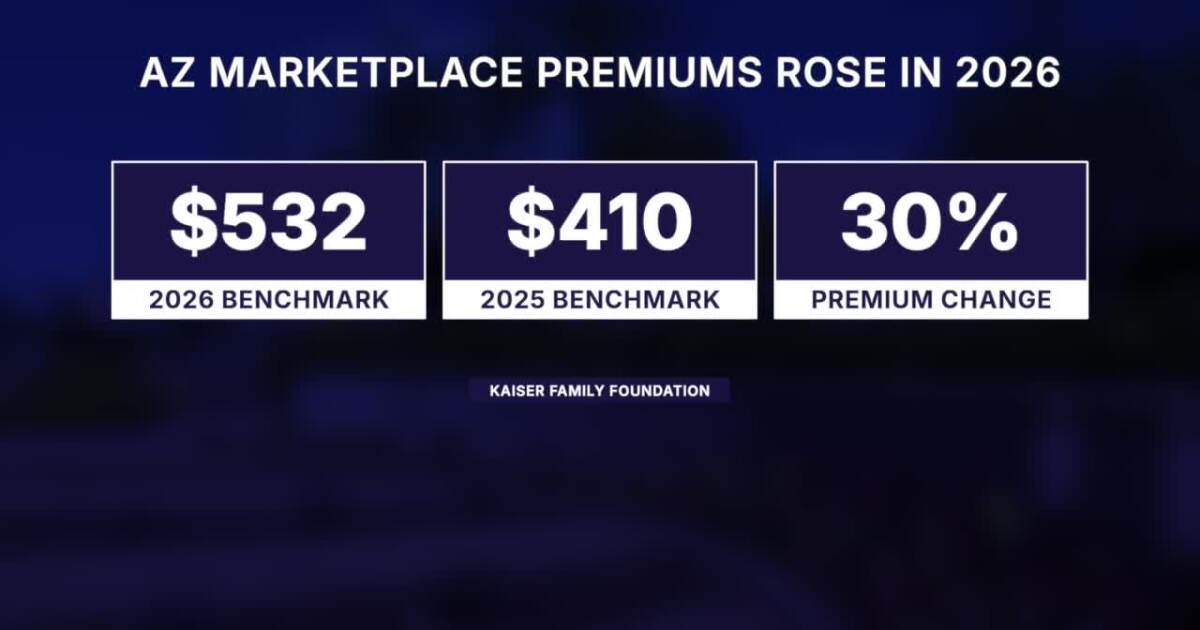
PHOENIX — Arizona’s ACA marketplace enrollment fell from 363,000 to just over 255,000 in a single year — a nearly 30% decline and the third-largest annual drop in the country.
Rising premiums and expired tax credits are driving the trend, with the average benchmark plan premium in Arizona now at $532 — up 30% from 2025.
In the player above, ABC15 Data Analyst Garrett Archer takes a look inside the numbers on how healthcare premiums are impacting health insurance enrollment.
This story was reported on-air by a journalist and has been converted to this platform with the assistance of AI. Our editorial team verifies all reporting on all platforms for fairness and accuracy.
Want more news in your community? Add ABC15 as a preferred source on Google below:

-

 Movie Reviews5 minutes ago
‘Evil Dead Burn’ Movie Review – Spotlight Report
-

 World13 minutes ago
Hoops Players’ Win Tops Big Day in NCAA Eligibility Litigation
-

 Health38 minutes ago
3 Best Peptides for Weight Loss—and the Viral One Doctors Say To Skip
-
 Lifestyle53 minutes ago
Smithsonian chief emphasizes ‘accuracy and integrity’ after White House report
-

 Technology1 hour ago
Microsoft’s carbon emissions went up 25 percent last year
-

 World1 hour ago
Jailed Catholic woman’s hunger strike highlights Iran religious persecution — US demands action
-

 Politics1 hour ago
Israel shares intelligence warning Iran plotted new assassination attempt against Trump: report
-

 Health1 hour ago
Parasitic infection causing ‘explosive’ stomach illness exceeds 1,000 cases in northern state

