Arizona
From teaching during SB 1070 to leading a state commission: meet Eva Masadiego


SB 1070: How legislation inspired a generation of Latinos into politics
Arizona’s immigration enforcement law SB1070 galvanized a generation of Latinos to run for political office and get politically involved.
Arizona Republic
Growing up in a Mexican immigrant household, Eva Masadiego, the newly appointed executive director of the Arizona-Mexico Commission, said she was taught the importance of getting an education to better serve her community.
A daughter to parents from Colima and Jalisco, Mexico, Masadiego said she was inspired by her mixed-status immigrant family to dedicate her life’s work to helping immigrant communities.
Growing up as a native Californian, her true calling in social welfare and education came during her academic journey, as she navigated higher education in a different country and looked to Arizona as SB 1070 was being debated at the Senate, leading to one of the state’s strictest periods for undocumented immigrants.
The longtime Arizonan has measured up to the task, having previously worked as the Deputy Director of Operations for Gov. Katie Hobbs, at the City of Phoenix with the Youth and Education Office and with former councilmember Daniel Valenzuela.
Her work in education and advocacy in Phoenix has prepared her to get to the position she is in now, leading the non-profit cross-border organization that seeks to “improve the economic prosperity and quality of life for all Arizonans through strong, public/private collaborations in advocacy, trade, networking and information.”
An Arizona calling that stemmed from abroad
Masadiego’s parents made it through sixth grade while living in their respective Mexican towns. This always intrigued Masadiego, wanting to learn more about the system in Mexico. So much so that while a junior at UC Berkeley; she decided to study abroad in Mexico City at the National Autonomous University of Mexico (UNAM).
Her time there, however, pushed her in a different direction: the Sonoran Desert.
While in Mexico City, she said she vividly remembers the unavoidable headlines and conversation surrounding Arizona’s Senate Bill 1070. It was talked about everywhere — on taxicab radios, in newspaper headlines, among university peers.
The legislation, passed in 2010, was known as the “show me your papers” law, which required police officers to inquire about the legal status of anyone they thought might be in the country illegally.
She wasn’t an Arizonan and her parents were Mexican nationals, but her peers still looked to her and asked her to “answer on behalf of your country” and “answer on behalf of the state of Arizona.”
“It was really difficult for me to sit there as an American student of Mexican immigrant parents and be labeled as ‘that’s your country, that’s you,’” Masadiego said. “I thought to myself, ‘If I care about immigration, if I care about policy, if I care about working with immigrant communities, I have to be in Phoenix, Arizona.’”
Upon graduation from Berkeley in 2012, she signed up for the Teach for America program and soon became a teacher within the Balsz Elementary School District in east Phoenix.
“My parents thought, ‘Why would I move to Phoenix, Arizona? Don’t you know what’s happening?’ And of course, everyone talked about it. You didn’t have to be in Arizona to know what was happening with SB 1070,” Masadiego said.
But to her, this was the perfect job. In the classroom, she could work directly with immigrant and refugee populations. Outside of the classroom, she dedicated herself to advocacy work in the Valley, organizing and helping people register to vote.
While teaching in east Phoenix, she surveyed her class and learned that 12 languages were spoken among her students. She developed a curriculum that centered around her students’ experiences, teaching them about immigration, civil rights issues and SB 1070 and other current events directly impacting them.
“I knew they would relate, being bilingual, coming from immigrant households, coming from not being born in this state and this country. I was able to have incredible conversations with my students and that really inspired me to remind myself that this is the work I wanted to do,” Masadiego said.
New bill compared to SB 1070: ‘Prepared to fight’: Arizona immigrant rights activists take HCR 2060 to court.
LUCHA announces lawsuit to prevent passage of HCR 2060 immigration bill
Living United for Change in Arizona’s leadership announce a lawsuit to prevent the passage of House Concurrent Resolution 2060 on June 5, 2024.
Education and advocacy at a state level
When Masadiego was teaching, she said she noticed many of her students were leaving the district and moving to Tolleson, Avondale and west Phoenix due to the affordable housing costs in those areas. There were many issues impacting her students and their families and she wanted to work with people who could effect change.
Her work with public officials began in 2015 when she joined the office of former Phoenix City Councilmember Daniel Valenzuela, who represented central and west Phoenix.
“It was always about how do I expand my reach and increase my impact,” Masadiego said.
During Masadiego’s time with his office, Valenzuela told The Arizona Republic that she was a strong advocate for the codePHX initiative which sought to raise funds for coding and robotic lessons for kids. It aimed to close the opportunity gender gap in tech education, he said.
“Her fingerprints were on any and all those things that we worked on at city council. Whether they were issues around public safety, economic development and of course educational initiatives that we put forth, they all had Eva’s influence, fortunately,” Valenzuela said.
Her time spent working in government led to her being named the director of National Programs at New American Leaders, an organization that encourages people of immigrant backgrounds to run for office, where she said she was tasked with expanding the organization from four to 10 states.
During that expansion, Megan Cagle, the Senior Director of Communications and Research at New American Leaders, said Masadiego worked closely with various nonprofit organizations, local advocacy groups and other individuals who worked in democracy reform across the country.
“She really did an amazing job of bringing everyone together and seeing where the needs were,” Cagle said.
Even with the setbacks caused by the pandemic, Masadiego said she was able to expand the organization to eight states.
Masadiego eventually went back to working with public officials in February 2023 when she was named Deputy Director of Operations for the Office of the Governor. In June 2024, she was asked to serve as the Executive Director of the Arizona-Mexico Commission.
The organization works in tandem with the Arizona and Sonora governments and local organizations to improve relations across the border. This is done via advocacy, commerce, networking and information sharing.
“When I think about the history of the AMC (Arizona-Mexico Commission), the Arizona-Mexico Commission has done incredible work to build a strong partnership with the country of México and the state of Sonora,” Masadiego said.
From workforce to education programs, Masadiego said she wants to eventually be able to think about new partnerships and new ways to benefit both Phoenix and Sonora communities.
Reach La Voz reporter David Ulloa Jr. at david.ulloa@gannett.com.



.jpg?w=400&resize=400,240&ssl=1 "Ex-Barcelona defender takes over as new Mexico boss as Javier Aguirre leaves after England defeat | Goal.com US")
.jpg?w=80&resize=80,80&ssl=1 "Ex-Barcelona defender takes over as new Mexico boss as Javier Aguirre leaves after England defeat | Goal.com US")


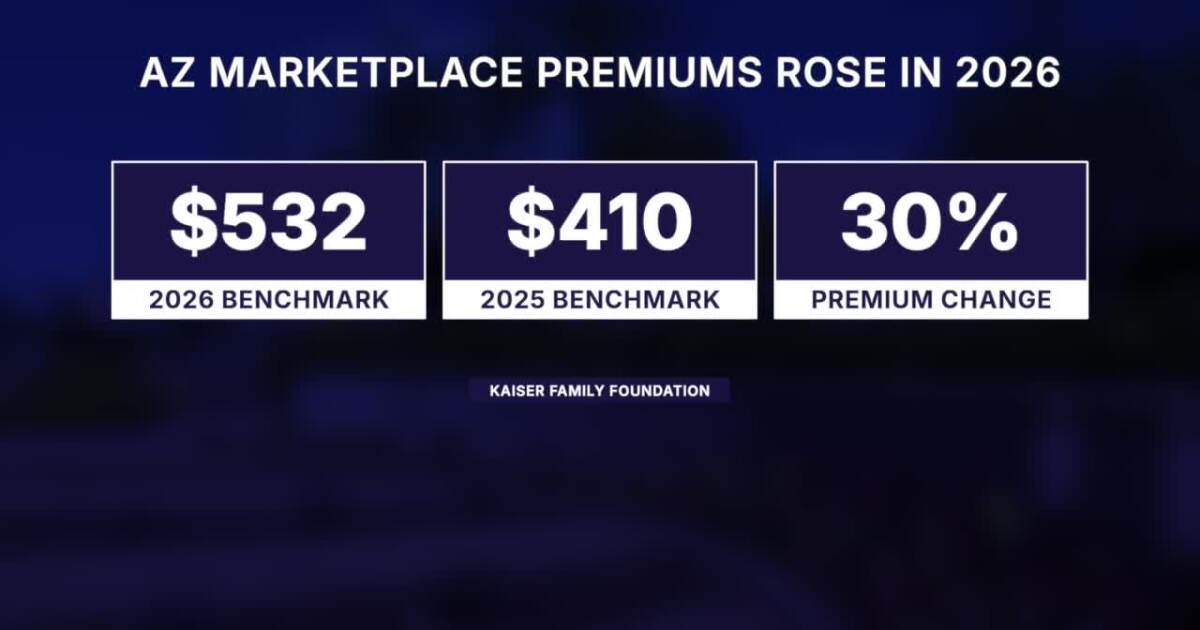
PHOENIX — Arizona’s ACA marketplace enrollment fell from 363,000 to just over 255,000 in a single year — a nearly 30% decline and the third-largest annual drop in the country.
Rising premiums and expired tax credits are driving the trend, with the average benchmark plan premium in Arizona now at $532 — up 30% from 2025.
In the player above, ABC15 Data Analyst Garrett Archer takes a look inside the numbers on how healthcare premiums are impacting health insurance enrollment.
This story was reported on-air by a journalist and has been converted to this platform with the assistance of AI. Our editorial team verifies all reporting on all platforms for fairness and accuracy.
Want more news in your community? Add ABC15 as a preferred source on Google below:

Arizona
Arizona man pleads guilty after illegally living in forest for years among ‘1,000lbs of trash’

A man in Arizona has pleaded guilty to violating federal fire restrictions and unlawfully residing in a national forest, after authorities said he spent years living at a makeshift campsite surrounded by what officials described as “approximately 1,000 pounds of trash”.
Mark Aaron Gatz was arrested on 25 June at his illegal campsite in Arizona’s Tonto national forest, according to court records. A United States Forest Service (USFS) officer wrote in documents submitted to court that Gatz had been operating an “illegal campsite” with a “hot wood burning campfire” despite fire restrictions and that he had told investigators that he had been living in the forest for about eight years.
The officer wrote that a records check found that Gatz had previously received multiple citations and was the subject of six outstanding federal arrest warrants for earlier violations, including for building fires during fire restrictions, constructing on national forest service lands, unsanitary conditions and occupying national forest as a residence.
Gatz “said that he knew about current fire restrictions but had to have fire to eat”, authorities said. The documents show that USFS officers made contact with Gatz multiple times over the last year or so, and issued him warnings as well as a violation notice for having campfires during fire restrictions.
Notes from officers’ previous encounters with Gatz earlier this year, submitted into the court docket, state that authorities observed “trash such as clothing, pans, tools, and plastic cups scattered throughout the campsite along with a structure that was four feet in height build using wood panels”.
During an encounter with Gatz in May, officers reported observing “approximately 1,000 pounds of trash” at the site, which they said included tires, plastic bags, trash bags, aluminum cans and other items. They also wrote that they found that the campfire site had been left unattended by Gatz the previous day while still hot.
In a separate report filed by law enforcement from an encounter in February, one officer wrote that “upon arrival at the camp, I was flabbergasted by the amount of debris in the area”.
Investigators said that during that encounter, the debris consisted of three ladders, six to eight totes “overfilled with debris”, five 55-gallon drums, eight tires, multiple bicycle frames, 5 gallons of motor oil, plywood and other “miscellaneous lumber”, and they wrote that trash was scattered over approximately half an acre of Forest Service land and creating what officers described as public safety concerns.
In a separate report from July 2025, officers said they observed what they described as a “large messy campsite” while patrolling the area due to complaints “from the district office abut one large messy camp”.
“There was roughly half an acre of resources ruined due to so much trash and goods on the ground for an extended period of time,” the officer wrote.
This week, after Gatz pleaded guilty, he was sentenced to time served and three years of probation, according to court records.
A representative for Gatz did not immediately respond to a request for comment.

Odds of winning the Powerball and Mega Millions are NOT in your favor
Odds of hitting the jackpot in Mega Millions or Powerball are around 1-in-292 million. Here are things that you’re more likely to land than big bucks.
The Arizona Lottery offers multiple draw games for those aiming to win big.
Here’s a look at Tuesday, July 7, 2026 results for each game:
Winning Mega Millions numbers
02-31-35-36-63, Mega Ball: 12
Check Mega Millions payouts and previous drawings here.
Winning Pick 3 Evening numbers
Evening: 4-7-2
Winning Fantasy 5 numbers
03-05-10-14-37
Check Fantasy 5 payouts and previous drawings here.
Winning Triple Twist numbers
03-06-18-23-27-32
Check Triple Twist payouts and previous drawings here.
Feeling lucky? Explore the latest lottery news and results
What time is the Powerball drawing?
Powerball drawings are at 7:59 p.m. Arizona time on Mondays, Wednesdays and Saturdays.
How much is a Powerball lottery ticket today?
In Arizona, Powerball tickets cost $2 per game, according to the Arizona Lottery.
How to play the Powerball
To play, select five numbers from 1 to 69 for the white balls, then select one number from 1 to 26 for the red Powerball.
You can choose your lucky numbers on a play slip or let the lottery terminal randomly pick your numbers.
To win, match one of the 9 Ways to Win:
- 5 white balls + 1 red Powerball = Grand prize.
- 5 white balls = $1 million.
- 4 white balls + 1 red Powerball = $50,000.
- 4 white balls = $100.
- 3 white balls + 1 red Powerball = $100.
- 3 white balls = $7.
- 2 white balls + 1 red Powerball = $7.
- 1 white ball + 1 red Powerball = $4.
- 1 red Powerball = $4.
There’s a chance to have your winnings increased two, three, four, five and 10 times through the Power Play for an additional $1 per play. Players can multiply non-jackpot wins up to 10 times when the jackpot is $150 million or less.
Are you a winner? Here’s how to claim your lottery prize
All Arizona Lottery retailers will redeem prizes up to $100 and may redeem winnings up to $599. For prizes over $599, winners can submit winning tickets through the mail or in person at Arizona Lottery offices. By mail, send a winner claim form, winning lottery ticket and a copy of a government-issued ID to P.O. Box 2913, Phoenix, AZ 85062.
To submit in person, sign the back of your ticket, fill out a winner claim form and deliver the form, along with the ticket and government-issued ID to any of these locations:
Phoenix Arizona Lottery Office: 4740 E. University Drive, Phoenix, AZ 85034, 480-921-4400. Hours: 7:30 a.m. to 5 p.m. Monday through Friday, closed holidays. This office can cash prizes of any amount.
Tucson Arizona Lottery Office: 2955 E. Grant Road, Tucson, AZ 85716, 520-628-5107. Hours: 7:30 a.m. to 5 p.m. Monday through Friday, closed holidays. This office can cash prizes of any amount.
Phoenix Sky Harbor Lottery Office: Terminal 4 Baggage Claim, 3400 E. Sky Harbor Blvd., Phoenix, AZ 85034, 480-921-4424. Hours: 8:30 a.m. to 5 p.m. Monday through Sunday, closed holidays. This office can cash prizes up to $49,999.
Kingman Arizona Lottery Office: Inside Walmart, 3396 Stockton Hill Road, Kingman, AZ 86409, 928-753-8808. Hours: 8 a.m. to 8 p.m. Monday through Friday, 8:30 a.m. to 5 p.m. Saturday and Sunday, closed holidays. This office can cash prizes up to $49,999.
Check previous winning numbers and payouts at https://www.arizonalottery.com/.
This results page was generated automatically using information from TinBu and a template written and reviewed by an Arizona Republic editor. You can send feedback using this form.
-

 Crypto1 minute ago
Binance maintains commitment to EU, seeking more licences in Asia
-

 Finance6 minutes ago
How Banreservas mobilised diaspora capital
-

 Fitness13 minutes ago
I’d Fallen Into an Exercise Rut—Until Trail Running Reminded Me How Joyful Movement Could Be
-

 Movie Reviews21 minutes ago
Movie review: Supergirl is a blast
-

 World26 minutes ago
Trump Says He Thinks He Will Remove Syria From US Terrorism Sponsor List
-
 Lifestyle1 hour ago
Appeals court denies Trump’s request to halt removal of his name from the Kennedy Center
-

 Technology1 hour ago
Meta is reportedly working on smart glasses that would be recording all the time
-

 World1 hour ago
Trump says ‘Iran lies and cheats’ as IRGC emerges as dominant force in negotiations with US

