Arizona
Clyde Volz’s impact on Arizona track and field community runs deep


Freddie Crittenden details Paris 2024 Olympics experience
Interview with Phoenix Track Club’s Freddie Crittenden, who made the final in the men’s 110-meter hurdles at the 2024 Paris Olympics.
Clyde Volz, a high school track and field coach at Sunnyslope and Greenway high schools in Phoenix for more than 30 years, had the kind of impact on athletes that still is being felt today.
Volz, who won two Arizona Interscholastic Association state titles and created the Great Southwest Classic, passed away last month at the age of 85.
He coached many athletes during his time.
Tim O’Neil is one of the athletes who felt the most impact from his head coach. Volz took in O’Neil, a talented all-around sophomore track and field athlete at Sunnyslope who was living from couch to couch while in high school after a rough home life.
“He took me under his wing and made me realize there’s some bigger and better things out there for me,” said O’Neil.
O’Neil, who never had a family member graduate high school and planned to hang drywall for a career, had his life significantly changed by meeting Volz. Eventually, O’Neil morphed into one of the top-ranked athletes in the country for the high jump and went on to Mesa Community College before competing at the University of Nevada. O’Neil then competed professionally for Adidas after college.
But, like his mentor, O’Neil made his biggest impact as a coach.
It was O’Neil who convinced a young Devon Allen to first try out the hurdles while at Phoenix Brophy Prep. Allen, under the tutelage of O’Neil, became one of the greatest high school hurdlers Arizona has ever seen before taking the NCAA by storm at Oregon and making two Olympic teams in 2016 and 2020.
After a stint with the Philadelphia Eagles, Allen recently returned to the track as one of the athletes signed by Michael Johnson’s new professional track and field league, Grand Slam Track.
Allen isn’t the only Olympian that O’Neil has coached. This past summer, Freddie Crittenden III – who moved to Arizona specifically to be coached by O’Neil – made the 2024 Paris Olympics in the 110-meter hurdles. And it all started with O’Neil, which started with Volz.
“Clyde Volz saved my life,” O’Neil said. “I wouldn’t have been in college. I definitely wouldn’t be coaching track. I would have never met my wife. My life would be so drastically different without that guy, and that’s not an exaggeration. That’s the impact he made – he left the world in a better place for me.”
‘Pushing me out there’
It was in 1993 when Ron Smith was convinced by Volz to pick up a microphone while at the Glendale Invitational. Smith had announced some sporting events before, but it was just in his neighborhood near Shadow Mountain High School in Phoenix.
Volz helped the upstart announcer’s name and phone number get out into the community and hired him to call meets.
Now, 31 years later, Smith has become the preeminent voice of the sport in the state.
“He was the one that started pushing me out there,” Smith said. “He’s the one who put me in bigger venues in front of much larger crowds, which then led other people asking me to come to their place. He’s the one who put me in those significant situations. I felt like all of a sudden, I was on the ‘inside.’”
Smith, who was a coach before he started announcing, was heavily influenced by Volz and his determination to track and field. So too was Ron Mann, whose own coaching career was started by Volz back in 1972.
Mann’s first coaching job came with Volz at Sunnyslope.
After leaving Sunnyslope, Mann eventually became the director of cross-country and track and field at Northern Arizona University, following stops at Thunderbird High and Mesa and Glendale community colleges. Mann’s teams made history in 1998, as NAU became the first school in conference history to win all four cross-country titles (team and individual) in the same year. He produced at least one Olympian in every summer Games from 1984 to 2004.
“I wouldn’t be where I was without Clyde Volz giving me that opportunity,” Mann said. “The modeling I got, he was representative of somebody who had ethics and morals, did everything the right way and had a vicious love for track and field. That formed my career from that point.”
Volz will best be remembered for his loyalty to his athletes. He used to film Super 8mm footage of his team working out, develop the film, cut it up and show it back to them – in the 1970s. Volz also used to take a school bus and drive it around the cinder track to compress the surface, making it firmer for his athletes.
On the track, Volz coached legendary in-state athletes, like Brian Muir (shot put), Doug Reynolds (discus) and Jeff Cannada (distance), to name a few. Volz was the founder of the Arizona State High School Decathlon and Heptathlon Championships. The Great Southwest Classic, his creation, became a premiere showcase for track and field talent.
“There’s no question that Clyde is paramount in his legacy the sport in Arizona,” Mann said. “There are very few that could even come close to equaling him in terms of what he did. He’s right at the very top in the way that he approached the sport and his complete dedication.”
Logan Stanley is a sports reporter with The Arizona Republic who primarily focuses on high school, ASU and Olympic sports. To suggest ideas for human-interest stories and other news, reach out to Stanley at logan.stanley@gannett.com or 707-293-7650. Follow him on X, formerly Twitter: @LSscribe.



Cardinals’ Burch shares what he learned as a rookie in 2025
Arizona Cardinals second-year player Jordan Burch says his defensive line teammates have formed a bond heading into the 2026 NFL season.
Last year in early July, Cardinals edge rusher Jordan Burch was a rookie third-round draft pick out of Oregon who was looking forward to his first NFL training camp and eventual first season.
That rookie year is behind him now, and Burch has identified what he needs to improve on heading into his second season. He said he now knows what to expect and look for, and after talking with outside linebackers coach Matt Feeney, Burch built an offseason plan with which he was comfortable.
“I don’t think anything was like a surprise,” Burch said on Thursday, July 9, at the Cardinals’ Tempe headquarters. “I kind of know what to prep for, so this offseason I can look at my old plays, and then I can call my coach and tell him, from last year to this year, what does he want to see on the field.”
Burch seeks to improve his pass rush. He played in all 17 games last season and had five solo tackles with a sack, and also broke up three passes.
Much of his position was dropping into pass coverage, so Burch looks to recognize pass catchers’ routes better in 2026. He gets help from veteran Josh Sweat, who is there to answer questions about the position they share.
“Every week, every game going against somebody good,” Burch said about takeaways from last season. “The talent of the quarterbacks. We’re playing the Rams, how quickly they get the ball out.”
Burch looks forward to building a stronger bond with his teammates, having invited some of them for dinner or to watch TV. He said he was happy with his progress as a player throughout last season.
The Cardinals open training camp Wednesday, July 22, at State Farm Stadium. It’s a week earlier than most teams because Arizona plays the Carolina Panthers in the Aug. 6 Hall of Fame Game in Canton, Ohio.
Cardinals legend Larry Fitzgerald will be among those inducted into the Pro Football Hall of Fame Aug. 8.

A new study has ranked Arizona as one of the worst states to move to for two years in a row, largely due to what it calls a poor quality of life.
The study conducted by Consumer Affairs analyzed the best states to move to in the United States, putting Arizona at the bottom of the list.
Before Arizonans get too defensive about the Grand Canyon State, Consumer Affairs used factors such as affordability, safety, economic strength and education to measure each state, leaving out factors like entertainment, retirement benefits and other considerations that may be important to people living here.
Popular states such as California and New York also landed at the bottom of the list due to their lack of affordability, even though they both have some of the best health care and education in the nation, Consumer Affairs noted.
Here’s why the study says you shouldn’t move to Arizona. Do you agree?
Why you shouldn’t move to Arizona
Arizona ranked No. 10 out of the worst states to move to, scoring especially poorly in quality of life.
Quality of life was measured by the state’s Social Progress Index, average air quality, weather, environmental protection and number of national parks. Due to Arizona’s extreme summers and Phoenix’s consistently poor air quality, it’s easy to see why Arizona ranked No. 44 in quality of life out of 50 states, even though the Grand Canyon is one of the most popular national parks in the nation.
However, Arizona also ranked poorly in other categories, sitting at No. 42 in health care and education, No. 41 in safety and No. 34 in affordability out of 50 states.
There was one category Arizona did impressively well in, ranking No. 5 in economic strength even as one of the youngest states in the country. Still, Arizona’s economic power wasn’t enough to boost its ranking.
Top 10 worst states to move to
Arizona wasn’t alone; some of the biggest states in the country were also considered the worst states to move to in 2026.
- New Mexico
- Louisiana
- California
- Arkansas
- Oklahoma
- Nevada
- Alaska
- Mississippi
- Oregon
- Arizona
Top 10 best states to move to
- Utah
- New Hampshire
- Idaho
- Minnesota
- Massachusetts
- Maine
- North Dakota
- Pennsylvania
- Iowa
- South Dakota
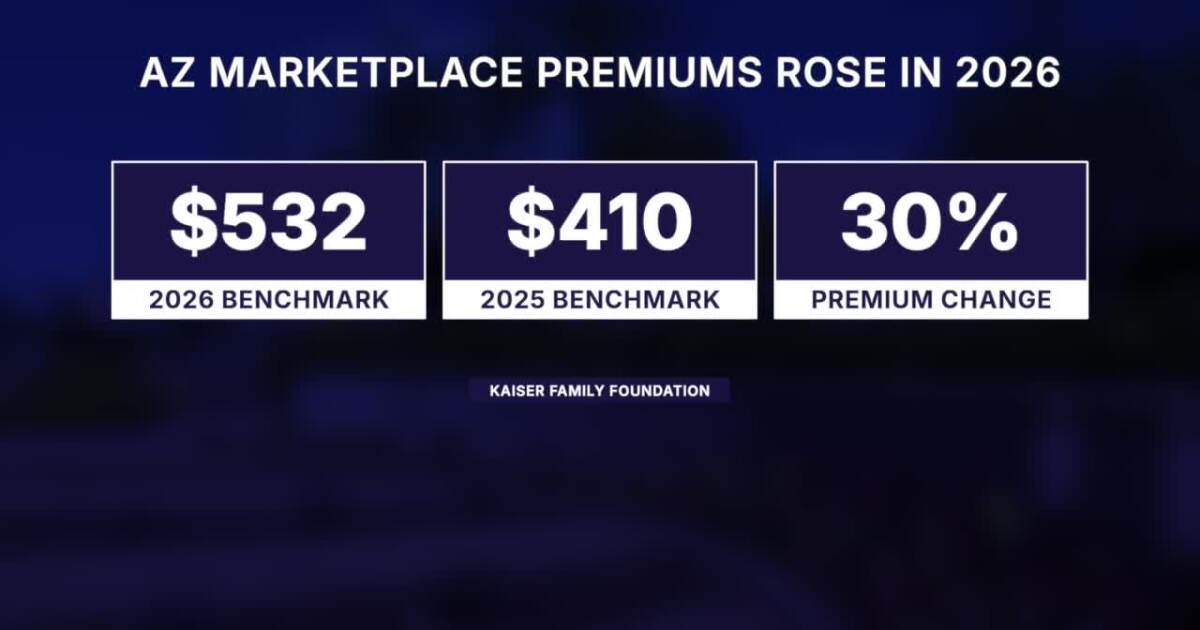
PHOENIX — Arizona’s ACA marketplace enrollment fell from 363,000 to just over 255,000 in a single year — a nearly 30% decline and the third-largest annual drop in the country.
Rising premiums and expired tax credits are driving the trend, with the average benchmark plan premium in Arizona now at $532 — up 30% from 2025.
In the player above, ABC15 Data Analyst Garrett Archer takes a look inside the numbers on how healthcare premiums are impacting health insurance enrollment.
This story was reported on-air by a journalist and has been converted to this platform with the assistance of AI. Our editorial team verifies all reporting on all platforms for fairness and accuracy.
Want more news in your community? Add ABC15 as a preferred source on Google below:

-

 News23 minutes ago
Trump fires last members of election commission, inciting fears of midterm ‘chaos’
-

 Los Angeles, Ca2 hours ago
California teen e-biker baiting police to chase tracked by drone, arrested
-

 Detroit, MI2 hours ago
Our picks for state\nSenate from Wayne Co. | Endorsements
-

 San Francisco, CA2 hours ago
Man reported missing in San Francisco
-

 Dallas, TX2 hours ago
How to buy France World Cup semifinal soccer tickets in Dallas
-

 Miami, FL2 hours ago
Miami-Dade Schools names six semifinalists for superintendent
-

 Boston, MA2 hours ago
Lawsuit: ICE detained East Boston father despite legal status
-

 Denver, CO3 hours ago
Victor Marx wins GOP primary for Colorado governor, defeating veteran lawmaker after unorthodox campaign

