Arizona
Caleb Love scores 27 to lead Arizona Wildcats over Texas Tech and into Big 12 final


Here’s what you need to know about the University of Arizona
UA was established in 1885, and its main campus is in Tucson. The Wildcats once had a live bobcat named Rufus as a mascot.
The Republic
KANSAS CITY, Mo. – Caleb Love scored 27 points to lead the Arizona Wildcats over shorthanded Texas Tech 86-80 in a Big 12 tournament semifinal game Friday at T-Mobile Center.
Arizona’s rubber-match win, coming after the teams split the regular-season series, moved Arizona to 22-11 and into the Big 12 tournament championship game against Houston at 3 p.m. Saturday. It also may have put the Wildcats back in consideration for a preferential top four NCAA Tournament seed.
Texas Tech dropped to 25-8 and is projected to receive a No. 3 seed on Sunday.
Arizona shot 50% and held Texas Tech to just 42%, though the Red Raiders hit over 50% of their field goals in the second half to keep the game within single digits for most of the second half.
Love scored his 27 points on 10-for-15 shooting while hitting 5 of 8 3-pointers. KJ Lewis added 12 points, eight rebounds and six assists despite continuing to deal with a sore right wrist, ripping off a wrap over it during the first half.
Kevin Overton led Texas Tech with 19 points but the Red Raiders were playing without two of their top three scorers: All-Big 12 first team forward Darrion Williams wore a boot Friday after playing against Baylor in a Thursday quarterfinal game, and forward Chance McMillian did not play because of an upper body strain.
In addition, Texas Tech forward JT Toppin, the Big 12’s Player of the Year, threw up in a trash can in a tunnel adjacent to the court because of over-hydration, according to ESPN’s coverage of the game. Toppin had just 10 points and five rebounds in 24 minutes while missing both 3-pointers he took.
Because the Big 12 tournament semifinals didn’t have either Kansas, Kansas State or Iowa State for the first time ever, depriving the event of nearby rooting interest, the Wildcats’ fan support was audible inside the half-empty T-Mobile Center.
While it wasn’t the sort of “McKale North” atmosphere supporting the Wildcats at recent Pac-12 Tournaments, UA fans were the biggest group on hand for the late semifinal game Friday.
Leading 47-39 at halftime, Arizona took early second half leads of up to 14 points before the Red Raiders chipped away. TTU scored seven straight points, capped by a 3-pointer from Overton, to cut UA’s lead to 64-59 with 9:08 left.
Overton later hit his fourth 3 from the right corner to pull the Red Raiders within 70-66 with 6:14 left and at that point, TTU was shooting 57.1% from the field after making only 32.4% in the first half.
But Texas Tech never came any closer from there.
In the first half, Love scored 17 points while Arizona held Texas Tech to just 32.4% percent shooting and took a 49-37 halftime lead.
Arizona shot 65.4% from the field, though the Red Raiders tied UA with 17 rebounds and scored four more points at the free-throw line.
The Wildcats outscored the Red Raiders 9-4 over the final 2:01 of what was a one-possession game for most of the first half, with little-used point guard Conrad Martinez turning a steal into a layup with 1:12 to go.
The Wildcats jumped out to a 9-0 lead, with Love scoring the first seven points of the game off a 3-pointer, a 12-footer and two free throws.But Texas Tech hit 5 of 6 3s over the next six minutes to take a 22-19 lead after Christian Anderson and Kevin Overton hit 3s on successive TTU possessions.
The game score remained with three points, with Texas Tech missing its final 12 3-pointers of the half, until Townsend hit a pair of free throws to give UA a 40-35 lead with 2:01 left in the half.
Arizona entered Friday’s game at 21-11 and Texas Tech was 25-7. The Red Raiders are fighting for a potential No. 2 NCAA Tournament while UA is projected to be hovering between a 4 and 5.



A new study has ranked Arizona as one of the worst states to move to for two years in a row, largely due to what it calls a poor quality of life.
The study conducted by Consumer Affairs analyzed the best states to move to in the United States, putting Arizona at the bottom of the list.
Before Arizonans get too defensive about the Grand Canyon State, Consumer Affairs used factors such as affordability, safety, economic strength and education to measure each state, leaving out factors like entertainment, retirement benefits and other considerations that may be important to people living here.
Popular states such as California and New York also landed at the bottom of the list due to their lack of affordability, even though they both have some of the best health care and education in the nation, Consumer Affairs noted.
Here’s why the study says you shouldn’t move to Arizona. Do you agree?
Why you shouldn’t move to Arizona
Arizona ranked No. 10 out of the worst states to move to, scoring especially poorly in quality of life.
Quality of life was measured by the state’s Social Progress Index, average air quality, weather, environmental protection and number of national parks. Due to Arizona’s extreme summers and Phoenix’s consistently poor air quality, it’s easy to see why Arizona ranked No. 44 in quality of life out of 50 states, even though the Grand Canyon is one of the most popular national parks in the nation.
However, Arizona also ranked poorly in other categories, sitting at No. 42 in health care and education, No. 41 in safety and No. 34 in affordability out of 50 states.
There was one category Arizona did impressively well in, ranking No. 5 in economic strength even as one of the youngest states in the country. Still, Arizona’s economic power wasn’t enough to boost its ranking.
Top 10 worst states to move to
Arizona wasn’t alone; some of the biggest states in the country were also considered the worst states to move to in 2026.
- New Mexico
- Louisiana
- California
- Arkansas
- Oklahoma
- Nevada
- Alaska
- Mississippi
- Oregon
- Arizona
Top 10 best states to move to
- Utah
- New Hampshire
- Idaho
- Minnesota
- Massachusetts
- Maine
- North Dakota
- Pennsylvania
- Iowa
- South Dakota
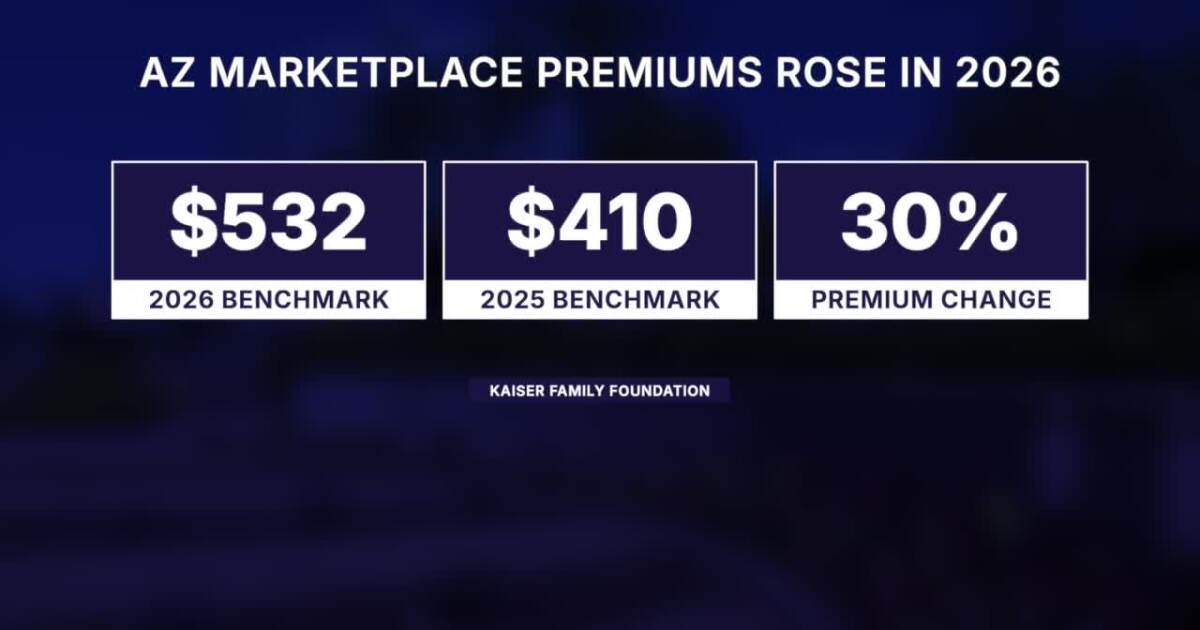
PHOENIX — Arizona’s ACA marketplace enrollment fell from 363,000 to just over 255,000 in a single year — a nearly 30% decline and the third-largest annual drop in the country.
Rising premiums and expired tax credits are driving the trend, with the average benchmark plan premium in Arizona now at $532 — up 30% from 2025.
In the player above, ABC15 Data Analyst Garrett Archer takes a look inside the numbers on how healthcare premiums are impacting health insurance enrollment.
This story was reported on-air by a journalist and has been converted to this platform with the assistance of AI. Our editorial team verifies all reporting on all platforms for fairness and accuracy.
Want more news in your community? Add ABC15 as a preferred source on Google below:

Arizona
Arizona man pleads guilty after illegally living in forest for years among ‘1,000lbs of trash’

A man in Arizona has pleaded guilty to violating federal fire restrictions and unlawfully residing in a national forest, after authorities said he spent years living at a makeshift campsite surrounded by what officials described as “approximately 1,000 pounds of trash”.
Mark Aaron Gatz was arrested on 25 June at his illegal campsite in Arizona’s Tonto national forest, according to court records. A United States Forest Service (USFS) officer wrote in documents submitted to court that Gatz had been operating an “illegal campsite” with a “hot wood burning campfire” despite fire restrictions and that he had told investigators that he had been living in the forest for about eight years.
The officer wrote that a records check found that Gatz had previously received multiple citations and was the subject of six outstanding federal arrest warrants for earlier violations, including for building fires during fire restrictions, constructing on national forest service lands, unsanitary conditions and occupying national forest as a residence.
Gatz “said that he knew about current fire restrictions but had to have fire to eat”, authorities said. The documents show that USFS officers made contact with Gatz multiple times over the last year or so, and issued him warnings as well as a violation notice for having campfires during fire restrictions.
Notes from officers’ previous encounters with Gatz earlier this year, submitted into the court docket, state that authorities observed “trash such as clothing, pans, tools, and plastic cups scattered throughout the campsite along with a structure that was four feet in height build using wood panels”.
During an encounter with Gatz in May, officers reported observing “approximately 1,000 pounds of trash” at the site, which they said included tires, plastic bags, trash bags, aluminum cans and other items. They also wrote that they found that the campfire site had been left unattended by Gatz the previous day while still hot.
In a separate report filed by law enforcement from an encounter in February, one officer wrote that “upon arrival at the camp, I was flabbergasted by the amount of debris in the area”.
Investigators said that during that encounter, the debris consisted of three ladders, six to eight totes “overfilled with debris”, five 55-gallon drums, eight tires, multiple bicycle frames, 5 gallons of motor oil, plywood and other “miscellaneous lumber”, and they wrote that trash was scattered over approximately half an acre of Forest Service land and creating what officers described as public safety concerns.
In a separate report from July 2025, officers said they observed what they described as a “large messy campsite” while patrolling the area due to complaints “from the district office abut one large messy camp”.
“There was roughly half an acre of resources ruined due to so much trash and goods on the ground for an extended period of time,” the officer wrote.
This week, after Gatz pleaded guilty, he was sentenced to time served and three years of probation, according to court records.
A representative for Gatz did not immediately respond to a request for comment.
-

 Alabama2 minutes ago
Alabama football fans invited to pep rally at River Market
-

 Alaska9 minutes ago
Did I Find a Cure for Male Loneliness? No, But I Found a Way to Embrace Solitude in the Wild.
-

 Arizona11 minutes ago
Arizona is among the worst states to move to, study says. Here’s why
-

 Arkansas17 minutes ago
Arkansas Storm Team Forecast: Very hot today; isolated showers/t’storms late
-

 California24 minutes ago
Popular California Fast-Casual Chain Mendocino Farms Opens 100th Location in Santa Barbara – edhat
-

 Colorado27 minutes ago
United Way of Southern Colorado raises over $400,000 for Aspen Acres Fire victims:
-

 Connecticut32 minutes ago
This Underrated Connecticut Town Is Getting National Recognition as One of the Best Places to Live
-

 Delaware39 minutes ago
Plans advance for Delaware city’s first Chick-fil-A restaurant

