Arizona
Arizona’s Biosphere 2 is now home to endangered Sonoyta pupfish


Endangered Sonoyta pupfish finds home at Arizona’s Biosphere 2
Peter Reinthal talks about introducing a population of the endangered Sonoyta pupfish into a desert spring habitat at Biosphere 2.
ORACLE, AZ — Four dozen Sonoyta pupfish are now swimming beneath the towering glass pyramids of the University of Arizona’s Biosphere 2 after a multi-year effort to conserve the critically endangered species.
The rare desert fish were introduced into a newly constructed desert stream habitat at the research facility on Oct. 24, welcomed by a cheering crowd of university students, biologists and self-proclaimed fish lovers.
“Biosphere 2 is a theater of all possibilities,” said Joaquin Ruiz, director of the facility. “In addition to what we do to try to understand how ecosystems operate, we’re also going to be the safe harbor of a species that is endangered.”
The release is a collaboration between the University of Arizona, U.S. Fish and Wildlife, and the Arizona Game and Fish Department.
Measuring about two inches long, the small blue-green and brown-striped fish are also called Quitobaquito pupfish because they can only be found in the wild at Quitobaquito Springs, a small, spring-fed oasis in Organ Pipe Cactus National Monument near the U.S.-Mexico border.
“Whenever I talk about pupfish in my class, I know they’re really easy to identify. They’re very cute. They’re called pupfish because they look like little puppy dogs,” said University of Arizona associate professor Peter Reinthal, who originated the idea for the pupfish introduction.
A new use for a storied structure
After teaching a hands-on portion of his class on ichthyology (the study of fish) inside Biosphere 2, Reinthal wrote a grant through the U.S. Fish and Wildlife’s Desert Fish Habitat Partnership to fund the construction of the stream inside a giant habitat once intended for humans.
Biosphere 2 — named after the planet Earth, the original biosphere — was built in the late 1980s by Space Biospheres Ventures, a private company with a goal of creating an entirely self-sustaining Earth ecosystem beneath the glass walls. In the 1990s, the facility gained national attention when researchers were locked inside Biosphere 2 for two years to simulate a futuristic space colony. The first two “missions” failed and the structure evolved into a science laboratory.
The University of Arizona gained ownership of the property in 2011 and now operates the facility as an Earth Systems Research Center and tourist destination.
State and federal agencies collaborated with the university and drafted a Safe Harbor Agreement, a voluntary agreement that allows individuals and organizations to keep populations of endangered species and contribute to their recovery.
The introduced pupfish are a part of a backup population meant to safeguard the species from extinction if the wild population declines.
The entire project took about two years of planning and implementation.
“I’ve been a scientist all my life and every project I ever do it’s to collect data or produce papers. This is the first one we did where we actually built something physical,” said Reinthal. “I really, really enjoyed that.”
Habitat loss drives population declines in hardy desert fish
Behind their “cute” faces and chubby bodies, the Sonoyta pupfish are survivors.
Adapted to live in extreme environments, the pupfish are capable of surviving drastic temperature changes, a range of pH levels and low-oxygen water.
“They can survive in 110-degree water, which is wild. And they can handle a lot of salinity,” said Brett Montgomery, topminnow and pupfish specialist with the Arizona Game and Fish Department. “They can exist in springs and streams with all those things that you wouldn’t think would allow fish to survive.”
Despite their hardy nature, the primary threat to the pupfish species has been habitat loss.
The Sonoyta pupfish were listed under the Endangered Species Act in 1986, and today, their total population is about 2,000.
The species was once found south of the border in the Rio Sonoyta, but since groundwater pumping has depleted the river, there has been no observable population in the watershed.
“A good number of animal species rely on streams like this in the natural world, and they’re valuable places to a large diversity of species, both plants and animals. We need to take care of them,” said Jason Deleeuw, terrestrial biome manager at Biosphere 2.
Habitat is also an educational tool
Deleeuw constructed the desert stream with a local construction company and help from student workers. The stream features several pools to hold the endangered fish and includes native vegetation to emulate their disappearing natural environment.
About 34,000 fish species are expected to go extinct in the next 25-50 years, according to Reinthal. A recent study co-authored by the International Union for the Conservation of Nature found that 26% of all freshwater fish species were at high risk of extinction.
Reinthal hopes the population of endangered fish will serve as an educational resource for both university classes and for those visiting Biosphere 2 as a tourist destination.
“It’s a great outreach tool,” said Reinthal. “Biosphere 2 gets about 80,000 visitors a year here, so the public can learn about fish.”
As pupfish settled into their new home right away, establishing territory and chasing each other in circles, the biologists are already planning for future introductions.
Montgomery said he hopes to introduce additional Sonoyta pupfish once the government shutdown ends, and after the pupfish are acclimated, the team plans to introduce the endangered Gila topminnow to the Biosphere 2’s desert stream habitat.
“They make people happy,” said Reinthal. “And I tell my class, if you don’t like pupfish, it means you’re a mean person.”
John Leos covers environmental issues for The Arizona Republic and azcentral. Send tips or questions to john.leos@arizonarepublic.com.
Environmental coverage on azcentral.com and in The Arizona Republic is supported by a grant from the Nina Mason Pulliam Charitable Trust.
Follow The Republic environmental reporting team at environment.azcentral.com and @azcenvironment on Facebook and Instagram.



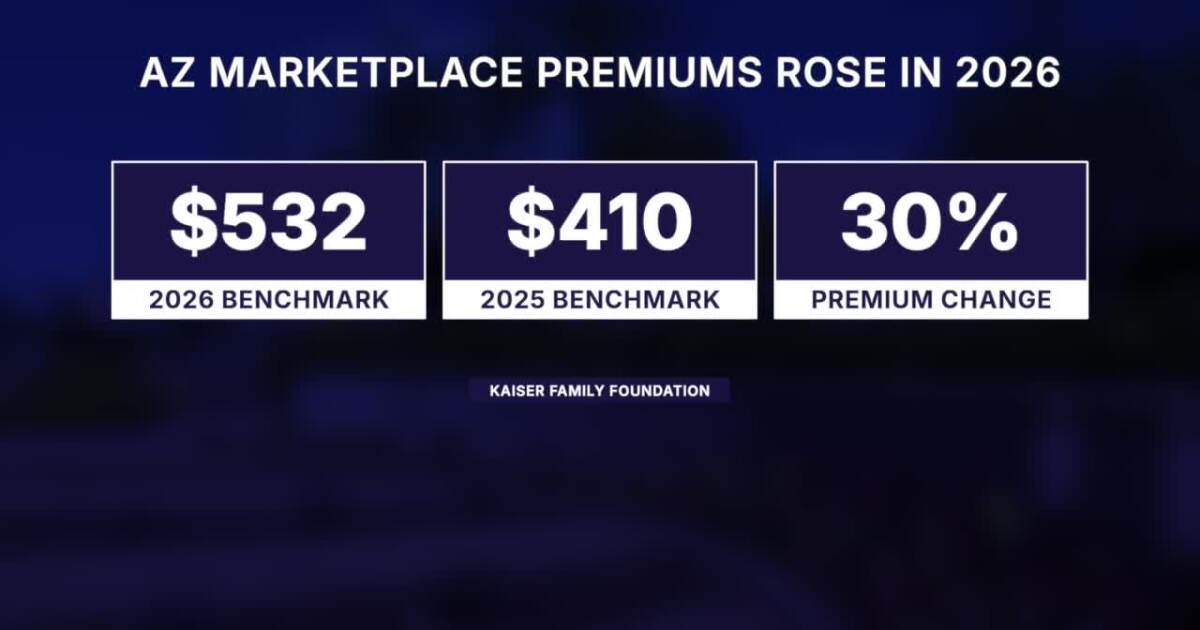
PHOENIX — Arizona’s ACA marketplace enrollment fell from 363,000 to just over 255,000 in a single year — a nearly 30% decline and the third-largest annual drop in the country.
Rising premiums and expired tax credits are driving the trend, with the average benchmark plan premium in Arizona now at $532 — up 30% from 2025.
In the player above, ABC15 Data Analyst Garrett Archer takes a look inside the numbers on how healthcare premiums are impacting health insurance enrollment.
This story was reported on-air by a journalist and has been converted to this platform with the assistance of AI. Our editorial team verifies all reporting on all platforms for fairness and accuracy.
Want more news in your community? Add ABC15 as a preferred source on Google below:

Arizona
Arizona man pleads guilty after illegally living in forest for years among ‘1,000lbs of trash’

A man in Arizona has pleaded guilty to violating federal fire restrictions and unlawfully residing in a national forest, after authorities said he spent years living at a makeshift campsite surrounded by what officials described as “approximately 1,000 pounds of trash”.
Mark Aaron Gatz was arrested on 25 June at his illegal campsite in Arizona’s Tonto national forest, according to court records. A United States Forest Service (USFS) officer wrote in documents submitted to court that Gatz had been operating an “illegal campsite” with a “hot wood burning campfire” despite fire restrictions and that he had told investigators that he had been living in the forest for about eight years.
The officer wrote that a records check found that Gatz had previously received multiple citations and was the subject of six outstanding federal arrest warrants for earlier violations, including for building fires during fire restrictions, constructing on national forest service lands, unsanitary conditions and occupying national forest as a residence.
Gatz “said that he knew about current fire restrictions but had to have fire to eat”, authorities said. The documents show that USFS officers made contact with Gatz multiple times over the last year or so, and issued him warnings as well as a violation notice for having campfires during fire restrictions.
Notes from officers’ previous encounters with Gatz earlier this year, submitted into the court docket, state that authorities observed “trash such as clothing, pans, tools, and plastic cups scattered throughout the campsite along with a structure that was four feet in height build using wood panels”.
During an encounter with Gatz in May, officers reported observing “approximately 1,000 pounds of trash” at the site, which they said included tires, plastic bags, trash bags, aluminum cans and other items. They also wrote that they found that the campfire site had been left unattended by Gatz the previous day while still hot.
In a separate report filed by law enforcement from an encounter in February, one officer wrote that “upon arrival at the camp, I was flabbergasted by the amount of debris in the area”.
Investigators said that during that encounter, the debris consisted of three ladders, six to eight totes “overfilled with debris”, five 55-gallon drums, eight tires, multiple bicycle frames, 5 gallons of motor oil, plywood and other “miscellaneous lumber”, and they wrote that trash was scattered over approximately half an acre of Forest Service land and creating what officers described as public safety concerns.
In a separate report from July 2025, officers said they observed what they described as a “large messy campsite” while patrolling the area due to complaints “from the district office abut one large messy camp”.
“There was roughly half an acre of resources ruined due to so much trash and goods on the ground for an extended period of time,” the officer wrote.
This week, after Gatz pleaded guilty, he was sentenced to time served and three years of probation, according to court records.
A representative for Gatz did not immediately respond to a request for comment.

Odds of winning the Powerball and Mega Millions are NOT in your favor
Odds of hitting the jackpot in Mega Millions or Powerball are around 1-in-292 million. Here are things that you’re more likely to land than big bucks.
The Arizona Lottery offers multiple draw games for those aiming to win big.
Here’s a look at Tuesday, July 7, 2026 results for each game:
Winning Mega Millions numbers
02-31-35-36-63, Mega Ball: 12
Check Mega Millions payouts and previous drawings here.
Winning Pick 3 Evening numbers
Evening: 4-7-2
Winning Fantasy 5 numbers
03-05-10-14-37
Check Fantasy 5 payouts and previous drawings here.
Winning Triple Twist numbers
03-06-18-23-27-32
Check Triple Twist payouts and previous drawings here.
Feeling lucky? Explore the latest lottery news and results
What time is the Powerball drawing?
Powerball drawings are at 7:59 p.m. Arizona time on Mondays, Wednesdays and Saturdays.
How much is a Powerball lottery ticket today?
In Arizona, Powerball tickets cost $2 per game, according to the Arizona Lottery.
How to play the Powerball
To play, select five numbers from 1 to 69 for the white balls, then select one number from 1 to 26 for the red Powerball.
You can choose your lucky numbers on a play slip or let the lottery terminal randomly pick your numbers.
To win, match one of the 9 Ways to Win:
- 5 white balls + 1 red Powerball = Grand prize.
- 5 white balls = $1 million.
- 4 white balls + 1 red Powerball = $50,000.
- 4 white balls = $100.
- 3 white balls + 1 red Powerball = $100.
- 3 white balls = $7.
- 2 white balls + 1 red Powerball = $7.
- 1 white ball + 1 red Powerball = $4.
- 1 red Powerball = $4.
There’s a chance to have your winnings increased two, three, four, five and 10 times through the Power Play for an additional $1 per play. Players can multiply non-jackpot wins up to 10 times when the jackpot is $150 million or less.
Are you a winner? Here’s how to claim your lottery prize
All Arizona Lottery retailers will redeem prizes up to $100 and may redeem winnings up to $599. For prizes over $599, winners can submit winning tickets through the mail or in person at Arizona Lottery offices. By mail, send a winner claim form, winning lottery ticket and a copy of a government-issued ID to P.O. Box 2913, Phoenix, AZ 85062.
To submit in person, sign the back of your ticket, fill out a winner claim form and deliver the form, along with the ticket and government-issued ID to any of these locations:
Phoenix Arizona Lottery Office: 4740 E. University Drive, Phoenix, AZ 85034, 480-921-4400. Hours: 7:30 a.m. to 5 p.m. Monday through Friday, closed holidays. This office can cash prizes of any amount.
Tucson Arizona Lottery Office: 2955 E. Grant Road, Tucson, AZ 85716, 520-628-5107. Hours: 7:30 a.m. to 5 p.m. Monday through Friday, closed holidays. This office can cash prizes of any amount.
Phoenix Sky Harbor Lottery Office: Terminal 4 Baggage Claim, 3400 E. Sky Harbor Blvd., Phoenix, AZ 85034, 480-921-4424. Hours: 8:30 a.m. to 5 p.m. Monday through Sunday, closed holidays. This office can cash prizes up to $49,999.
Kingman Arizona Lottery Office: Inside Walmart, 3396 Stockton Hill Road, Kingman, AZ 86409, 928-753-8808. Hours: 8 a.m. to 8 p.m. Monday through Friday, 8:30 a.m. to 5 p.m. Saturday and Sunday, closed holidays. This office can cash prizes up to $49,999.
Check previous winning numbers and payouts at https://www.arizonalottery.com/.
This results page was generated automatically using information from TinBu and a template written and reviewed by an Arizona Republic editor. You can send feedback using this form.
-

 Los Angeles, Ca1 hour ago
Loved ones search for missing 34-year-old Southern California woman
-

 Detroit, MI2 hours ago
Chickens, geese found at vacant home after nonprofit reports them stolen
-

 San Francisco, CA2 hours ago
What’s next for San Francisco Giants as MLB trade deadline approaches?
-
 Dallas, TX2 hours ago
Dallas millionaire files lawsuit against groundwater district
-

 Miami, FL2 hours ago
7 more women arrested at southwest Miami-Dade massage parlors, accused of prostitution in undercover sting
-

 Boston, MA2 hours ago
‘They’re my buddies’: 96-year-old Back Bay woman befriends French soccer team
-

 Denver, CO2 hours ago
Denver officers cited for separate incidents, 1 fired
-

 Seattle, WA2 hours ago
Study finds dangerous chemicals in the breast milk of Seattle moms

