Arizona
Arizona prepares for legal clash over Colorado River with $1 million bill


Arizona is ramping up its efforts to protect its share of the Colorado River’s dwindling water supply, as the state faces an uncertain future over the fate of one of the West’s most crucial resources.
A bill advanced Tuesday by the Arizona House Committee on Natural Resources, Energy and Water aims to allocate $1 million to defend the Grand Canyon State’s water rights as part of the ongoing battle over the Colorado River.
The bill, known as House Bill 2103, seeks to set aside the funds to support litigation in the event that negotiations among the seven states dependent on the river break down.
Arizona is preparing for the possibility of legal action if the ongoing discussions fail to resolve water allocation disputes.
kojihirano/Getty
The bill passed with unanimous support from the committee, though Democrats indicated they will propose an amendment to increase the allocation to $3 million, in line with Governor Katie Hobbs’ proposed budget.
State Representative Gail Griffin, a Republican from Tucson and the bill’s sponsor, told the committee, “It just shows we are ready to take action,” the Courthouse News Service reported.
The Colorado River, which feeds both Lake Mead and Lake Powell—critical water reservoirs for the Southwest—has been a vital source of water for more than 40 million people across the U.S. and Mexico.
But after years of drought and climate change, the river’s once-mighty flow is at its lowest levels in recorded history, prompting urgent discussions about how to share its shrinking resources before current agreements expire in 2026.
At the center of the debate are two factions: the Upper Basin states—Colorado, New Mexico, Utah and Wyoming—and the Lower Basin states, which include Arizona, California and Nevada.
The Upper Basin states argue that their smaller reservoirs and more severe drought conditions justify keeping their water consumption levels higher, while the Lower Basin states, already committed to significant cuts, push for more aggressive reductions.
But as the clock ticks down toward 2026, when potential cuts could be enforced by the federal government, tensions are mounting over the distribution of the river’s limited water supply.
Arizona’s position is clear: it wants to be able to fight its corner if necessary and needs funds to do it.
The request for funds to potentially fight a legal battle was first proposed in September 2024 by Tom Buschatzke, the director of the Arizona Department of Water Resources.
Buschatzke has warned of a growing divide between the Upper and Lower Basin states, referring to the rift as a “Grand Canyon-sized chasm” that could lead to a standoff if compromise proves elusive.
“It doesn’t seem like the Upper Basin feels like they have any risk that any additional cuts to their use can be imposed upon them,” Buschatzke said in a previous interview with Newsweek.
“We think we have a strong case if we have to go to court.”
Despite the potential for litigation, Buschatzke stressed that legal action would be a last resort.
He said: “If we end up in court, which we don’t want, it would be begrudgingly because it’s kind of a last-gasp effort.”
Do you have a tip on a science story that Newsweek should be covering? Do you have a question about the Colorado River? Let us know via science@newsweek.com.



A new study has ranked Arizona as one of the worst states to move to for two years in a row, largely due to what it calls a poor quality of life.
The study conducted by Consumer Affairs analyzed the best states to move to in the United States, putting Arizona at the bottom of the list.
Before Arizonans get too defensive about the Grand Canyon State, Consumer Affairs used factors such as affordability, safety, economic strength and education to measure each state, leaving out factors like entertainment, retirement benefits and other considerations that may be important to people living here.
Popular states such as California and New York also landed at the bottom of the list due to their lack of affordability, even though they both have some of the best health care and education in the nation, Consumer Affairs noted.
Here’s why the study says you shouldn’t move to Arizona. Do you agree?
Why you shouldn’t move to Arizona
Arizona ranked No. 10 out of the worst states to move to, scoring especially poorly in quality of life.
Quality of life was measured by the state’s Social Progress Index, average air quality, weather, environmental protection and number of national parks. Due to Arizona’s extreme summers and Phoenix’s consistently poor air quality, it’s easy to see why Arizona ranked No. 44 in quality of life out of 50 states, even though the Grand Canyon is one of the most popular national parks in the nation.
However, Arizona also ranked poorly in other categories, sitting at No. 42 in health care and education, No. 41 in safety and No. 34 in affordability out of 50 states.
There was one category Arizona did impressively well in, ranking No. 5 in economic strength even as one of the youngest states in the country. Still, Arizona’s economic power wasn’t enough to boost its ranking.
Top 10 worst states to move to
Arizona wasn’t alone; some of the biggest states in the country were also considered the worst states to move to in 2026.
- New Mexico
- Louisiana
- California
- Arkansas
- Oklahoma
- Nevada
- Alaska
- Mississippi
- Oregon
- Arizona
Top 10 best states to move to
- Utah
- New Hampshire
- Idaho
- Minnesota
- Massachusetts
- Maine
- North Dakota
- Pennsylvania
- Iowa
- South Dakota
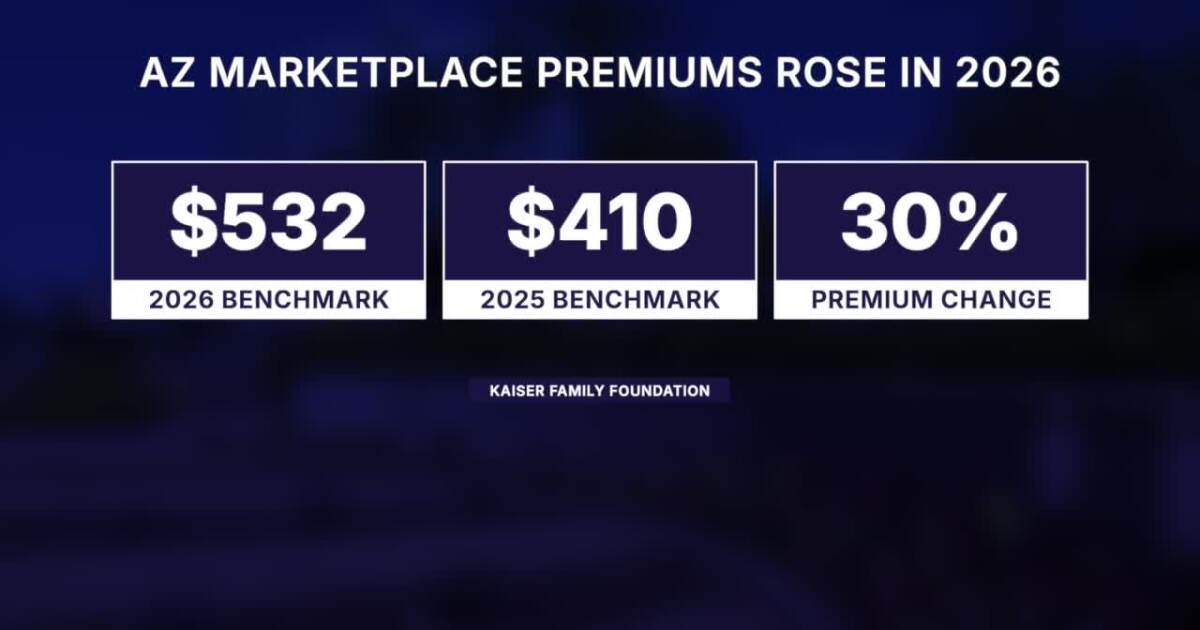
PHOENIX — Arizona’s ACA marketplace enrollment fell from 363,000 to just over 255,000 in a single year — a nearly 30% decline and the third-largest annual drop in the country.
Rising premiums and expired tax credits are driving the trend, with the average benchmark plan premium in Arizona now at $532 — up 30% from 2025.
In the player above, ABC15 Data Analyst Garrett Archer takes a look inside the numbers on how healthcare premiums are impacting health insurance enrollment.
This story was reported on-air by a journalist and has been converted to this platform with the assistance of AI. Our editorial team verifies all reporting on all platforms for fairness and accuracy.
Want more news in your community? Add ABC15 as a preferred source on Google below:

Arizona
Arizona man pleads guilty after illegally living in forest for years among ‘1,000lbs of trash’

A man in Arizona has pleaded guilty to violating federal fire restrictions and unlawfully residing in a national forest, after authorities said he spent years living at a makeshift campsite surrounded by what officials described as “approximately 1,000 pounds of trash”.
Mark Aaron Gatz was arrested on 25 June at his illegal campsite in Arizona’s Tonto national forest, according to court records. A United States Forest Service (USFS) officer wrote in documents submitted to court that Gatz had been operating an “illegal campsite” with a “hot wood burning campfire” despite fire restrictions and that he had told investigators that he had been living in the forest for about eight years.
The officer wrote that a records check found that Gatz had previously received multiple citations and was the subject of six outstanding federal arrest warrants for earlier violations, including for building fires during fire restrictions, constructing on national forest service lands, unsanitary conditions and occupying national forest as a residence.
Gatz “said that he knew about current fire restrictions but had to have fire to eat”, authorities said. The documents show that USFS officers made contact with Gatz multiple times over the last year or so, and issued him warnings as well as a violation notice for having campfires during fire restrictions.
Notes from officers’ previous encounters with Gatz earlier this year, submitted into the court docket, state that authorities observed “trash such as clothing, pans, tools, and plastic cups scattered throughout the campsite along with a structure that was four feet in height build using wood panels”.
During an encounter with Gatz in May, officers reported observing “approximately 1,000 pounds of trash” at the site, which they said included tires, plastic bags, trash bags, aluminum cans and other items. They also wrote that they found that the campfire site had been left unattended by Gatz the previous day while still hot.
In a separate report filed by law enforcement from an encounter in February, one officer wrote that “upon arrival at the camp, I was flabbergasted by the amount of debris in the area”.
Investigators said that during that encounter, the debris consisted of three ladders, six to eight totes “overfilled with debris”, five 55-gallon drums, eight tires, multiple bicycle frames, 5 gallons of motor oil, plywood and other “miscellaneous lumber”, and they wrote that trash was scattered over approximately half an acre of Forest Service land and creating what officers described as public safety concerns.
In a separate report from July 2025, officers said they observed what they described as a “large messy campsite” while patrolling the area due to complaints “from the district office abut one large messy camp”.
“There was roughly half an acre of resources ruined due to so much trash and goods on the ground for an extended period of time,” the officer wrote.
This week, after Gatz pleaded guilty, he was sentenced to time served and three years of probation, according to court records.
A representative for Gatz did not immediately respond to a request for comment.
-

 Indiana35 seconds ago
Attempted murder suspect arrested in Indianapolis for Bloomington shooting
-

 Iowa6 minutes ago
Iowa WWII veteran approaching 100th birthday honored in Cedar Rapids
-

 Kentucky11 minutes ago
Exantus may be subject to involuntary hospitalization due to Kentucky law
-

 Louisiana21 minutes ago
Parasitic stomach illness that can cause explosive diarrhea rises in Louisiana
-

 Maine28 minutes ago
Is prison in play for Graham Platner?
-

 Maryland31 minutes ago
Office building in Glen Burnie evacuated after shift in parking garage floor
-

 Michigan36 minutes ago
Menominee, Michigan man arrested on sexual assault charges involving a minor
-

 Massachusetts43 minutes ago
Healey administration vows to appeal as Trump rejects Massachusetts blizzard aid request – The Boston Globe

