Connect with us

Alaska

On the centennial of the Nome Serum Run, the story of the sordid aftermath for its two most famous dogs, Balto and Togo

Published

on

On the centennial of the Nome Serum Run, the story of the sordid aftermath for its two most famous dogs, Balto and Togo


Part of a continuing weekly series on Alaska history by local historian David Reamer. Have a question about Anchorage or Alaska history or an idea for a future article? Go to the form at the bottom of this story.

As of Feb. 2, it has been 100 years since Gunnar Kaasen drove a dog team into Nome with the medicine that saved lives and staved off a potential diphtheria epidemic. Famously, Balto was in the lead of that team, the dog that became a media sensation, so much so that reporters begged Kaasen into reenacting the entrance into town during daylight so that photographers could, more or less, capture the moment. It was the conclusion of the Nome Serum Run.

Thanks to the 1995 animated movie and countless other retellings, Balto lives on in the American psyche as the toughest of hero dogs. The historical accuracy of these accounts varies wildly, yet one thing is true. People know about Balto. Good Alaskans also know that Togo was the lead dog for the serum run’s longest and most dangerous leg. Less well-known is the aftermath, what happened to Balto and Togo in the following years. Certainly, no one present in Nome that day could have predicted that Balto would be the abused guest of a 10th-rate museum on a Los Angeles backstreet within two short years. Balto’s salvation and Togo’s quieter retirement are their own epic tales.

Advertisement

The backstory is well-repeated history and legend. In January 1925, several children in isolated Nome contracted diphtheria, a highly contagious bacterial infection that targets the respiratory system. The infection was usually treated with an antitoxin — a serum — made from the plasma of immunized horses. However, the isolated town’s only doctor was out of serum after a resupply order went unfilled with the onset of winter. Diphtheria victims can choke to death as infected tissue expands and blocks their airways. Throats fill with a grey mass, swelling as the patient asphyxiates. It is a nasty way to die.

Winter and a nasty approaching storm prevented planes from delivering the serum. Salvation was left to dog sled teams, the one viable method of transportation left. Leonhard Seppala, already a dog racing legend, was the first musher out. His beloved Togo, a husky named for a Japanese admiral, was in the lead. Seppala intended to travel the entire course on his own. After he left Nome, a relay system of relief drivers was organized. Over five and a half days, 20 drivers and 150 dogs traveled almost 700 miles in a relay race against time.

On Feb. 2, 1925, Balto led Kaasen’s team into Nome with the diphtheria serum. Kaasen, Seppala, and Togo suddenly became celebrities, but none were more famous than Balto. The Nome Serum Run was a massive national story in the early days of radio broadcasting. Romantic perceptions of Alaska, sick children, a frantic race through dire weather, and heroic dogs were a compelling combination. People around the country eagerly listened for the outcome. Cheers stabbed out across the country when the run was finished, wherever there were radios.

Within the month, Kaasen had signed a movie deal. Two months to the day after the conclusion of the serum run, Balto arrived in Los Angeles and was heralded as the greatest hero of the age. Mayor George Cryer welcomed Balto, Kaasen, and the rest of the dog team at city hall and presented Balto with the “bone of the city.” Actress Clara Horton placed a floral wreath around the dog’s neck. Multiple modern sources claim the actress was America’s sweetheart Mary Pickford, but contemporary accounts uniformly name Horton as the one at the scene.

Despite the Hollywood pageantry, the ceremony hinted at the future as the Alaskan visitors noticeably faltered in the spotlight. Garbed in heavy furs to maintain the far north mystique, Kaasen sweated profusely from the attention and warmer sun. Balto did not react to the wreath and only sniffed at the literal bone. The mayor repeatedly prodded him with little response. The notoriously corrupt Cryer, whose personal fortune mysteriously multiplied during his time in office, craved the positive publicity rub from the noble canine.

Advertisement

In May, their first movie was released, the 30-minute short “Balto’s Race to Nome.” As Balto and his entourage toured the West Coast to support the film, a statue was announced for New York’s Central Park. Designed by Frederick Roth, the bronze sculpture was unveiled with Kaasen and Balto in attendance on December 15, 1925. As the New York Times noted, Balto was “unmoved” by the spectacle.

That heady spring of 1925, with its movie shoots and tours, represented the peak for Balto, his driver, and the team. After the statue was dedicated, Kaasen returned to Alaska, discouraged by the lifestyle Outside and disagreements with his producer. There would be no second movie. The dogs were sold to a different promoter, who took them on another round of touring. But all glory eventually fades, and by the end of 1926, Balto and the remaining dogs from the team had been sold again and were the property of a shabby Los Angeles dime museum.

For several months, Balto and his team were chained in a backroom. Once kings of the Alaska trails, the only time the dogs saw the sun were the brief visits to an alley for their “daily dozen.” No exercise. Snow was a fading memory. Per the Oakland Tribune, “There probably was never a more dejected, sorrowful looking lot.” The Oakland Post-Enquirer declared, “There is a bronze statue of Balto in Central Park, New York, in commemoration of his great feat. But he and his dog companions are living a bleak existence here.”

Cleveland businessman George Kimble visited Los Angeles in February 1927 as attention to the dogs’ plight peaked in the local press. He happened upon the museum and was disgusted by the sight of Balto and his team chained to a sled inside a cage. Right away, he offered to buy the lot. He just needed $2,000, about $35,000 in 2025 money, to complete the purchase and transport the dogs to their forever home in Cleveland. There were two problems. Kimble didn’t have anything like that kind of cash at hand and had just two weeks to raise the funds.

Kimble directed a plea for support back home, and a Cleveland Balto Committee was instantly formed. Kimble told the Cleveland Plain Dealer, “There should be enough dog owners and public minded citizens in Greater Cleveland to subscribe a dime apiece to bring these heroic dogs here.” Committee chair James B. Ruhl said, “It is a humane cause. It is an educational cause. Cleveland boys and girls will have probably the most heroic dog in history here as an example of dog life and man’s companions in the northlands.” Park Director Frank Harmon promised the dogs would become pampered residents of the Brookside Zoo.

Advertisement

The campaign went public on March 1, 1927. Within 24 hours, more than $200 was raised. A day later, they were up to $306. The day after that, it was $679. Models in fur coats drove around town with a placard: “Bring Balto to Cleveland!” Small, polite offerings gathered like the first claps after a performance. They poked and prompted each other until there was a great din of thunderous applause. On March 5, the count was at $1,111.

Radio stations in New York and Detroit picked up the story and amplified the call for donations. One response came in from Japan. Children sent their pocket change. Patients in hospitals gave what they could. Some gave a penny. One person gave $100.

Polar explorer Roald Amundsen reached out to the Plain Dealer. He wrote, “Your Balto campaign has my highest sympathy. Having done nearly all my polar work assisted by these faithful dogs, my heart is quite naturally with them … Do what you can for these brave dogs and secure them a bright future. They certainly deserve it.”

On March 7, they reached $1,382 but were running out of time. The Cleveland option to buy Balto and the rest of his team was set to expire on March 9. For the sake of their bid, the publicity had been a double-edged sword. Contributions continued to pour in, but other groups, organizations with ready funds, expressed interest in purchasing Balto. As of March 8, the total stood at $1,517; they needed another $500, or the effort was lost.

Clevelanders went to sleep on the 8th with uncertainty but awoke to the best of news. With a burst of generosity, the goal was surpassed that very morning. At the end of the day, they had collected $2,245.88, with more offerings still coming. Payment was rendered at noon, and the dogs were immediately crated and shipped east.

Advertisement

The reasonable modern Alaskan will wonder, where were the contemporary Alaskans in all this? Largely absent and unaware until the entire incident had passed. The slow passage of news north meant that most Alaskans heard of Balto’s transfer to Cleveland after the fact. There had been no real time for Balto’s dreadful existence at the Los Angeles museum to garner any real attention or support in Alaska. Still, the Seward Daily Gateway expressed something like sour grapes when they described Balto and his teammates as “inmates of Cleveland zoo.” Of course, there was no zoo in Alaska then and wouldn’t be for another 40 years.

Balto arrived in Cleveland on March 19. He was accompanied by six serum run teammates: Alaska Slim, Billie, Fox, Old Moctoc, Sye, and Tillie. The other six dogs from the team had previously passed or been sold off. In a parade through town, the dogs once again pulled a sled, albeit in rain, not snow. Still, the once stoic Balto who spurned movie starlets, politicians, and all other pomp now eagerly pulled in his harness. Thousands attended, in a throng lining the road five people deep. Songs supposedly popular in Alaska were sung. And they even dug up a few former Klondike gold rushers who took turns at the sled. Around 15,000 people visited the zoo on the first day of the dogs’ residence.

Mission accomplished, the dogs reportedly settled into their retirement with ease, their pen a frequent stop for locals and visitors alike. Balto passed in 1933. He was 11 to 14 years old, depending on which source you want to believe. By then, Alaska Slim, Billie, Fox, Old Motoc, and Tillie were already gone. Sye, the last of Balto’s 1925 team, died in 1934 at the age of 17.

While Togo received a decent amount of praise and commendation after the serum run, he was nonetheless overshadowed by Balto, much to Seppala’s dismay. The Norwegian musher bred, named, raised, and trained Balto but did not race with him. Of the Central Park statue, Seppala wrote in his memoir, “I resented the statue to Balto, for if any dog deserved special mention, it was Togo.” He more generously noted, “I hope I shall never be the man to take away credit from any dog or driver who participated in that run” but maintained that Balto was only a “scrub dog.” Seppala would have also resented Anchorage’s Balto Seppala Park, which was developed several years after his death.

At the least, Togo enjoyed a more straightforward and relaxing retirement. Seppala, Togo, and a full herd of other dogs launched their own national tour in 1926. In 1927, Seppala was racing and winning in New England. When he had to return to Alaska later that year, Togo stayed in Maine with Elizabeth Ricker, with whom Seppala had opened a kennel. Over the next two years, Seppala traveled back and forth, maintaining the connection between the things he loved most, his wife and home in Alaska and Togo in Maine. By late 1929, Togo was mostly blind and pained by his joints. On Dec. 5, Seppala put Togo to sleep. The great dog was 16 years old.

Advertisement

For Seppala, it was just a break from each other. Decades later, approaching his own end, he wrote in his journal, “While my trail has been rough at times, the end of the course seems pretty smooth, with downhill going and a warm roadhouse in sight. And when I come to the end of the trail, I feel that along with my many friends, Togo will be waiting and I know that everything will be all right.”

• • •


Source link

Alaska

Man with same name as Alaska Sen. Dan Sullivan can appear on GOP primary ballot, state’s Supreme Court rules

Published

on

Man with same name as Alaska Sen. Dan Sullivan can appear on GOP primary ballot, state’s Supreme Court rules


The battle of the Dan Sullivans is on. 

The Alaska Supreme Court ruled Monday that a man with the same name as Republican Sen. Dan Sullivan can challenge the sitting lawmaker in the state’s GOP Senate primary in August. The high court upheld a ruling from a lower court judge that cleared the way for Daniel J. Sullivan to appear on the primary ballot, reversing a decision by state officials earlier this month that he was ineligible because he was allegedly trying to confuse voters.

The state Supreme Court directed Alaska’s Division of Elections to decide how Daniel J. Sullivan should be listed on the ballot “within the confines of existing Alaska ballot design law.”

The conflict is taking place in one of the country’s most closely watched Senate elections. The sitting Sen. Sullivan is running for a third term, but former Democratic Rep. Mary Peltola is vying to challenge him, setting up what could be an unusually competitive race in a deep-red state that hasn’t elected a Democrat to the Senate in almost 20 years.

Advertisement

The senator has called his same-name competitor a “sham candidate” and accused him of trying to trick voters and help Democrats flip the seat. Daniel J. Sullivan — a retired teacher and former U.S. Forest Service employee from Petersburg, Alaska — has denied those allegations and insisted he is both qualified and genuinely interested in running for Senate.

Daniel J. Sullivan and sitting Sen. Dan Sullivan, both of whom are running in Alaska’s GOP Senate primary.

Karen Dillman via AP / Tom Williams/CQ Roll Call via AP Images


About two weeks ago, the Alaska Division of Elections determined that the challenger Sullivan could not appear on the ballot, arguing his paperwork “was not filed in order to declare an actual good-faith candidacy, but was instead filed with a purpose to confuse or mislead.”

Advertisement

In a letter to the candidate, Director Carol Beecher pointed to the fact that Daniel J. Sullivan had initially requested to appear on the ballot as “Dan Sullivan,” the same name format as the senator. She also wrote that he hadn’t previously been affiliated with the state Republican Party, had a website design that “appears to be deliberate[ly]” similar to the senator’s campaign site and had worked with a political consultant with links to Democratic candidates.

Daniel J. Sullivan asked a state court to reverse the decision. On Friday, Judge Thomas Matthews ruled in his favor, finding the non-senator Sullivan met the requirements to run for U.S. Senate and the state didn’t have the authority to exclude him based on “good faith.”

“The court does not minimize the Division’s concern that voters should not be misled,” the judge wrote. But he added that “Alaska election law gives the Division tools to address that concern,” including regulating how candidates appear on the ballot.

With ballots set to be printed this week, the issue was appealed to the Alaska Supreme Court on an expedited basis, with both sides filing court papers over the weekend.

The state Division of Elections asked the high court to overturn Matthews’ ruling, arguing it would “leave Alaska constitutionally required to permit bad-faith ballot access.” The agency said it reached its conclusion about Daniel J. Sullivan after it received a complaint from the National Republican Senatorial Committee “credibly alleging” he was seeking to “cause voter confusion” and made a “bewildering” request to appear on the ballot with the senator’s middle initial. 

Advertisement

If Daniel J. Sullivan is permitted to remain on the ballot, the state asked the Alaska Supreme Court to allow it to print his full name and list his party affiliation as “nonpartisan” to “ensure voters are not forced to guess between two nearly identical names.”

The Alaska Republican Party and several GOP-led states filed amicus briefs siding with Alaska.

Daniel J. Sullivan’s lawyers, meanwhile, argued the state “lacked any basis in Alaska law to exclude Mr. Sullivan from the ballot” and didn’t have the power to look into his “private motivations.” They wrote that state law doesn’t give officials the power to keep qualified candidates off the ballot due to potential confusion.

“[All] that Mr. Sullivan asks here is to be listed on the ballot, and the Division is obviously empowered to do so in a non-confusing manner,” his lawyers wrote.

Following oral arguments, the high court sided with Daniel J. Sullivan in a two-page order late Monday, and said it would issue a fuller opinion at a later date.

Advertisement

Jeffrey Robinson, an attorney for Daniel J. Sullivan, told CBS News his legal team is “grateful” for the Alaska Supreme Court’s decision to “affirm Judge Matthews’ well-reasoned, thorough order vacating the Division’s unlawful decision to exclude Mr. Sullivan as a candidate.”

“We expect that the Division will act in full compliance with existing Alaska ballot design law in its preparation of the ballots,” Robinson said in an email.

The senator’s campaign spokesperson, Nate Adams, said: “We’re disappointed in the court’s decision because as the sham candidate Dan J. Sullivan’s lawyers made clear in their legal arguments, the only reason he is running is to deceive voters and manipulate Alaska’s election system.”

“However, we are encouraged by the fact that the Director of the Division of Elections will be able to use her expertise to differentiate between the Petersburg fraud and the incumbent — Senator Dan Sullivan — to the benefit of Alaska voters,” Adams said.

Advertisement


Source link

Advertisement
Continue Reading

Alaska

Jesuits say goodbye to Alaska at Bethel ceremony

Published

on

Jesuits say goodbye to Alaska at Bethel ceremony


The first Jesuit missionaries in Alaska sailed up the Yukon River in 1887. By the turn of the 20th century, the religious order of the Catholic Church had as many as 50 Jesuits in the state.

Now, only two remain. And by the end of June, there will be none.

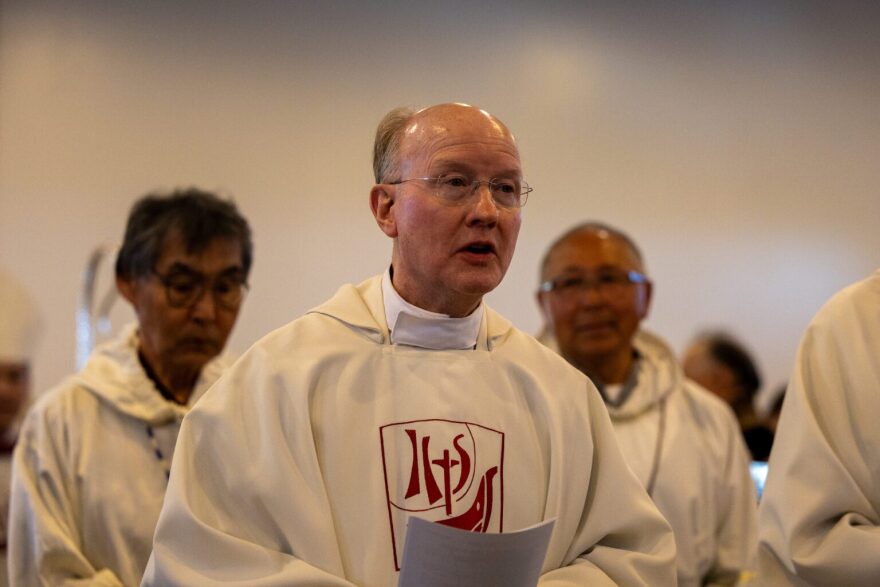
The Jesuits’ nearly 140 years in the state was honored at an event at Bethel’s Immaculate Conception Church on June 16. A procession of priests wearing long white gowns with red hems walked down the aisle to open the event. The Bishop of the Diocese of Fairbanks, Stephen Maekawa, thumped the ground with a shimmering silver staff known as a clozier as he approached the altar.

Bishop of the Diocese of Fairbanks, Steven Maekawa, walks toward the altar at the Immaculate Conception Church in Bethel.

“My brothers and sisters, we gather together to celebrate this wonderful and blessed occasion to acknowledge the love of God and the work of God through the 139 year mission of the Society of Jesus of the Jesuit fathers,” Maekawa said to open the event.

Advertisement

A traditional Catholic mass followed, with readings in both English and Yup’ik. During the sermon, Maekawa acknowledged the vastness of the Fairbanks diocese, and the tremendous amount of work done by the Jesuits to establish it.

“All of the 46 churches of the Diocese of Fairbanks that we currently have were established by either the Jesuit fathers or by direction of a Jesuit bishop,” Maekawa said. “We have a long history of the Society of Jesus’ presence and ministry here in all of Alaska.”

The Jesuits are an order within the Catholic Church, akin to the Dominicans or Franciscans. They have a reputation for taking on some of the Catholic Church’s most remote assignments.

That missionary spirit brought the Jesuits to the Yukon River in 1887, where they built churches, schools, and ministries. Without their work, Catholicism may not have taken root in huge swaths of Alaska, particularly among Alaska Native communities.

The Immaculate Conception Church in Bethel.

But the Jesuits leave a complicated legacy. Their methods of converting Native people to the religion, particularly in the first half of the 20th century, created generational traumas still felt to this day.

Advertisement

Fr. Sean Carroll is the provincial of the Jesuits West Province, which oversees Alaska and nine other states.

Father Sean Carroll, provincial of the Jesuits West Province, speaks at an event recognizing nearly 140 years of Jesuit service in Alaska.
Fr. Sean Carroll, provincial of the Jesuits West Province, speaks at an event recognizing nearly 140 years of Jesuit service in Alaska.

“Thank you for all that you have taught us about who Jesus is and how to love and serve Him wholeheartedly,” Carroll said. “I also thank you for your patience with us. For there have been times when we have sinned and when we have hurt you.”

Missionaries, including the Jesuits, forcefully converted and assimilated Alaska Native people into Western culture and religion. Students at Jesuit-run boarding schools were forced to abandon their Native languages and physically punished when caught speaking languages other than English. Native dancing and drumming were also banned.

The Jesuits West Province maintains a list of 150 Jesuits with credible claims of sexual abuse against minors or vulnerable adults. A quarter of the accused Jesuits served in Alaska at some point in time.

“I ask for your forgiveness for all that we have done that was not rooted in Christ and love for Him, and for when we did not value your culture nor recognize the presence of God in you,” Carroll said.

Advertisement

Carroll gave the order to withdraw from the state last spring. A big issue was the recruitment of Jesuits willing to travel and serve in remote villages. He told the congregation that the Jesuits’ work would continue, just without a permanent presence.

Father Rich Magner, one of the two remaining Jesuit priests in Alaska, attends a ceremony in Bethel.
Fr. Rich Magner, one of the two remaining Jesuit priests in Alaska, attends a ceremony in Bethel.

Fr. Rich Magner is one of the two remaining Jesuit priests in Alaska. His last day serving Chevak, Hooper Bay, and Scammon Bay is June 30.

“We all always knew coming in, or should have known, that we’re not going to be here forever. It’s going to be mission accomplished at some point,” Magner said. “And then we hand it off to the diocese that we’ve helped create, and so that’s a good feeling.”

Magner’s next stop is a Clinical Pastoral Education residency in Tacoma, Washington.

The other remaining priest, Fr. Tom Provinsal, first came to Alaska in 1968 to teach. A fond memory, he said, was meeting Elders that practiced traditional subsistence lifestyles.

Advertisement

“Some of the grandmothers, their fingers were just all bent with arthritis and stuff like that, you know, their whole lives they’ve been working out in the cold and the wet, doing food, sewing, all that kind of stuff,” Provinsal said. “I’d say I just feel very privileged to have come when I did come and to see that.”

Provinsal returned in 1975 as a priest and has served in the region ever since. After moving away, he plans to take a five month sabbatical. What happens next, he said, is in God’s hands.

Two lines formed in the aisle for communion at the end of the mass. After taking communion, Bethel’s Parish Administrator Susan Murphy gave a final thank you.

“It’s difficult to say goodbye to people who have been a part of our lives for so long,” Murphy said. “We know that you have done what was yours to do, and have taught us to do what is ours to do. We are grateful.”

Jesuit priests form a row along the altar of Bethel's Immaculate Conception Church as members of the congregation lift their arms and pray.
Jesuit priests form a row along the altar of Bethel’s Immaculate Conception Church as members of the congregation lift their arms and pray.

Dominic Hunt, a Yup’ik deacon that flew in from Emmonak for the event, led the congregation through a final prayer.

Advertisement

“Bless them with your wisdom, that they may be a word of hope, a world in need. We ask this through Christ, our Lord. Amen,” Hunt said.

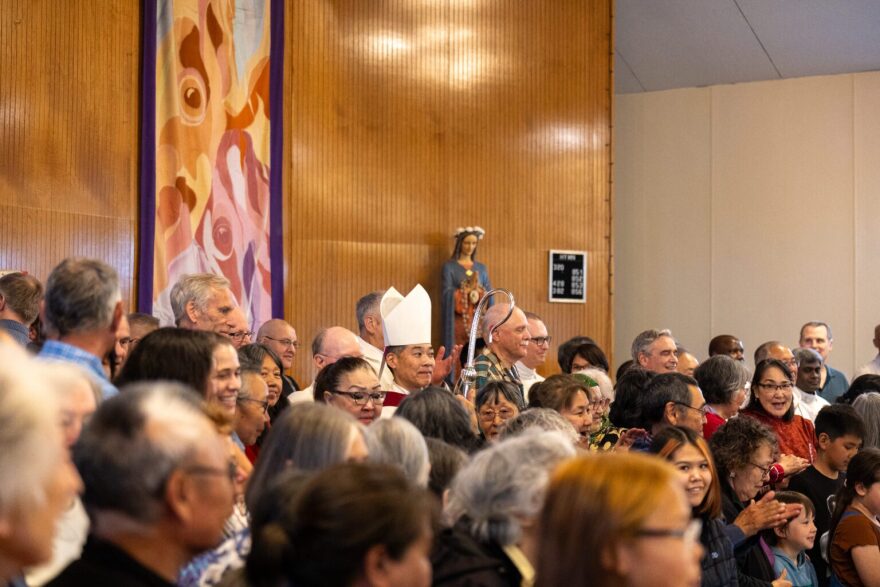
About 70 people posed for a photo on the altar – priests, deacons, parishioners, Elders and children — many of them smiling, some standing quietly.

The photo doesn’t tell the whole story. But it’s a moment when gratitude, grief, and memory all shared the same room.

Bishop of the Diocese of Fairbanks, Steven Maekawa, stands in the middle of a crowd waiting to take a photo at Bethel's Immaculate Conception Church.
Bishop of the Diocese of Fairbanks, Steven Maekawa, stands in the middle of a crowd waiting to take a photo at Bethel’s Immaculate Conception Church.


Source link

Advertisement
Continue Reading

Alaska

Alaska Supreme Court to take up case on Dan J. Sullivan, decision expected by Tuesday

Published

on

Alaska Supreme Court to take up case on Dan J. Sullivan, decision expected by Tuesday


JUNEAU, Alaska (KTUU) – The Supreme Court of Alaska will be taking up the case of the State of Alaska, Division of Elections v. Daniel J. Sullivan, Jr.

The oral arguments will be held Monday at 10 a.m. via Zoom, according to an order and opening notice.

The document also specifies that a decision is expected to be made before noon on Tuesday.

According to documents from the Division of Elections, the state must start printing ballots at noon on the same day.

Advertisement

This comes after an Anchorage Superior Court Judge ordered Dan J. Sullivan on to the ballot Friday.

See a spelling or grammar error? Report it to web@ktuu.com

Copyright 2026 KTUU. All rights reserved.


Source link

Advertisement
Continue Reading
Advertisement

Trending