Alaska
Mary Peltola Has Carved Out Her Own Space in Washington


I
n late July, Mary Peltola scrambled to change her travel plans. The first-term Democratic representative from Alaska had just returned to DC after a trip home to help her family put up salmon for the winter: smoking, salting, drying, canning, and freezing fish for the long, cold months ahead.
She’d missed several votes, drawing criticism from conservative groups, and now—after just five days back in the capital—she was packing again.
Leaders in the House of Representatives had canceled the following week’s agenda, starting summer recess early. For Peltola, that meant another exhausting journey, about 4,000 miles from start to finish. There would be a flight to Seattle, another to Anchorage, then one more, on a cramped, narrow-body jet to Bethel, a town of 6,276 on the banks of the Kuskokwim River in western Alaska.
Peltola’s trip is more than 1,500 miles longer than the distance the representative from the next-farthest-flung district travels. She jets through five time zones, often facing delays, which means that by the time she reaches her bed, it can be the middle of the night on the Yukon Delta. Back in Washington, the sun has already risen.
During her stop in Anchorage in July, Peltola made a Costco run, stocking up on essentials, which tend to be cheaper and more abundant in the state’s most populous city. She picked up Thai food, which is impossible to find in Bethel, and then tucked her bounty into four large suitcases, building an extra link in the state’s tenuous supply chain.
Peltola had arrived in Washington in September 2022 after winning an unusual ranked-choice election, defeating opponents with longer political résumés—including former governor and vice-presidential candidate Sarah Palin. Holding her state’s lone House seat, Peltola represents an electorate whose party lines are more like elaborate squiggles, and from the outset she understood one of her job’s most defining challenges: In a fractured and often hamstrung Congress, she must straddle the partisan divide. Fighting for Alaska’s interests means battling climate change while sometimes supporting drilling for oil and natural gas. It means standing up for abortion rights as well as the Second Amendment. Acclimating to Washington is a tough task for any newcomer. For Peltola, it was uniquely difficult.
But that day at the Anchorage airport, as DC buzzed in the aftermath of President Joe Biden’s suspension of his reelection campaign, she was as off-duty as a congresswoman can be. Wheeling luggage toward a check-in counter, toting noodles, she was nearly a year removed from the most difficult moment of her time in office, a tragedy that had upended her life. Her husband’s sudden death was the one challenge she could never have predicted, and back in Alaska for recess this summer, she would continue to set her family’s new course. She would unpack the goodies in her suitcases, check in on her house, be a mom to her two youngest children, Nora and Job Nelson—a brief window of normalcy before jetting off to shake hands and make promises and campaign, once again, to retain her seat.

I
n March 2022, Don Young, who had held Alaska’s House seat since 1973, died suddenly aboard a flight from Los Angeles to Seattle. In the ensuing days, Alaskans mourned the 88-year-old Republican who had been called the state’s third senator—and then rushed to enter the race to replace him. As the filing deadline approached, the list of candidates swelled past 40 and included a monk who’d legally changed his name to Santa Claus.
At the time, Peltola was 13 years removed from having served in the Alaska state legislature. A mother of four, stepmother of three, and grandmother of two, she worked as executive director of the Kuskokwim River Inter-Tribal Fish Commission, which represents subsistence-fishing interests. The number of salmon on the Kuskokwim had been at or near record-low numbers for years, leaving Alaska Native fishermen with empty freezers. “The river is [Alaska’s] refrigerator,” Beth Kerttula, former minority leader of the Alaska House of Representatives, says. “I mean, we don’t go to a store, we go fish.”


To Peltola, the special election was an opportunity: She could run and use her campaign to raise awareness of fish issues. She floated the idea to confidants, including Ana Hoffman, one of her closest friends. But as the deadline to file approached, Hoffman—who, like Peltola, is an Alaska Native—felt Peltola’s interest had waned. “Who wants to go to Washington, DC?” Hoffman says. “I thought the feeling would pass.”
The day of the deadline, Peltola texted Hoffman: She had filed to run. But even as Peltola submitted her paperwork, she was pessimistic about her chances. “There was a very deep understanding that my path to victory was zero,” Peltola says. “A lot of us, from the big rivers and from parts of Alaska that depended on wild food, we really felt like we’d been beating the bushes and trying to get help and nobody would notice.”
“I think what I liked about Mary almost immediately is that she felt like a regular person. I think a third of Alaska has Mary’s cellphone number.”
Peltola’s campaign was built on a slogan of “fish, family and freedom,” and her positions cut across partisan lines. Nearly 60 percent of Alaskans are unaffiliated—just 12 percent are registered Democrats—and Peltola knew she’d have to win support from a staggering number of voters who at best don’t affiliate with her party and at worst actively disagree with it. To do so, she says, she stuck to specific issues instead of spouting partisan rhetoric. In TV ads, she wore a gray hooded sweatshirt and gutted a salmon.
“People use the word ‘authentic,’ ” says Anton McParland, who managed Peltola’s campaign and is now her chief of staff. “I think what I liked about Mary almost immediately is that she felt like a regular person. Sometimes it drives me crazy how well she remembers people’s names. And if you’re an Alaskan, often it’s your parents’ and your grandparents’ names.”
“I think a third of Alaska has Mary’s cellphone number,” he adds, laughing.
Peltola also benefited from Alaska’s open primary and ranked-choice voting system. Implemented for the first time in the race to replace Young, it frees the state’s many independent voters from having to pick a party primary to participate in, and they can split their tickets as they see fit. Under its rules, voters cast ballots for one candidate in an open primary, and the top four finishers advance to a general election. In the general election, voters rank the candidates from their first choice to fourth, and if no one receives more than 50 percent of the first-place votes, the fourth-place candidate is dropped. That candidate’s first-place votes are reallocated to the second-choice candidates on their ballots, and if a winner fails to emerge, the same process repeats with the third-place candidate.
Among the 48 competitors in the special-election primary, Peltola finished fourth behind Independent Al Gross, Republican Nick Begich, and Palin. Gross subsequently dropped out and endorsed Peltola. Both Republicans remained in the race. “What the system did was put a Democrat on the ballot . . . who would never have won a closed Democratic primary,” says Scott Kendall, an attorney who authored the ballot measure that led to Alaska’s open primary and ranked-choice voting. Coming from a rural district, Peltola didn’t always hew to liberal orthodoxy in her positions. “She squeaked into the top four,” Kendall says. “And then people got to see her on the main stage. And obviously, she was very appealing.”
“Who wants to go to Washington, DC?” Says Peltola’s Close Friend. “I thought the feeling would pass.”
On the day the general-election results were due to be released—15 days after ballots were cast—all three remaining candidates were scheduled to speak at an oil-and-gas conference in Anchorage. A few minutes before the announcement, they left the stage. Begich took the stairs to a room his campaign had set up. Palin and Peltola shared the freight elevator, snapping a selfie together before the doors opened. (The two women did not attack each other while campaigning and had been friendly when they served together in state government—so much so, Peltola has said, that Palin’s family gave her family its backyard trampoline when Palin resigned from the governor’s office.)

Secluded with her staff in a room that Peltola says gave “the very strong sense that we did not expect to be winning,” she squinted at the screen projecting the grainy results, wondering if her glasses were dirty. But it was just a bad internet connection, and soon the pixels sharpened. Begich, who had the fewest first-place votes, was eliminated first. More important: Nearly 30 percent of voters who had ranked him number one cast their second-place votes for Peltola, not Palin.
That was enough to make Peltola, a member of the Yup’ik people, the first Alaska Native to serve in Congress. She’s also the first woman to occupy the state’s House seat and the first Democrat to do so since 1972. “Democrats in Alaska don’t win,” Peltola says of a state Donald Trump won handily in 2016 and 2020. “We don’t have many candidates from the bush, because it’s so cumbersome trying to do anything from the bush. Not a lot of Natives have run for a congressional seat. I don’t think there are a lot of Alaska Natives who want to live in Washington, DC. There was no kind of example of this ever happening.”
T
he night of the special-election victory, Peltola told her husband, Gene “Buzzy” Peltola, that she felt she owed him and her kids an apology. She’d barely considered this outcome, which would force her to relocate, split her attention, and alter their family dynamic.
Before heading to Washington, Peltola flew back to Bethel, where she comforted the families of four missing moose hunters. Then she was off to her inauguration, setting up shop afterward in Young’s empty office. There was no point in redecorating—the general election was in less than two months and Peltola knew she could be back in Bethel by midwinter. “When I would do Zooms with people, it kind of looked like I was calling from jail,” Peltola recalls, so she had an art teacher in Kodiak send something colorful: a stack of pictures of dandelions, drawn by fifth-graders.

Lodging also involved a creative—and supremely Alaskan—solution. Short-term rentals were too expensive, but an old friend offered a guest room. It was Lisa Murkowski, Alaska’s senior Republican senator, who had stood with Peltola during her swearing-in. Fellow Democrats were incredulous, but Peltola stayed with Murkowski until December—through campaigning and again defeating Palin and Begich.
Murkowski, Peltola, and Kerttula, the former Alaska House minority leader, all had begun their terms in the state legislature on the same day in January 1999. Peltola was 25, nearly two decades younger than the other two freshmen, but they bonded and set a precedent for what they believed politics should look like. Kerttula and Peltola flipped a coin when they both wanted a spot on a coveted committee. And Kerttula, who lived in Juneau, let Peltola stay in her unfinished basement when the House was in session. Peltola’s eldest child, Conrad Kapsner, played on a baby mat with Kerttula’s new puppy.
Murkowski went to Washington in 2002. Kerttula followed 12 years later, when she was named director of the National Oceans Council during the Obama administration. Only Peltola remained in Alaska, and Kerttula said she called her friend often as she struggled to acclimate to Washington. “It’s rough on all Alaskans in DC,” Kerttula says. “You’re kind of shocked. Not to mention that it’s hot and it’s crowded and it’s, you know, icky.”
“In Alaska, you go back 50 years and we’re a true wilderness,” she adds. “We’ve all learned: If it’s freezing out and the car stops, you’ve got to stop and help people, because they will die. So it’s just a completely different mindset.”
B
y the time Peltola signed a lease on a place of her own on Capitol Hill, she’d found some community in DC—largely through the Alaska State Society, a nonprofit that hosts happy hours, cornhole tournaments, and holiday parties and whose members are mostly Alaskan transplants. Each night before bed, she’d call home to speak with her husband, a naturalist who’d worked in the Bureau of Indian Affairs and as manager of the Yukon Delta National Wildlife Refuge. A career public servant, Buzzy would offer advice, analysis, and perspective.
That routine shattered on September 13, 2023, the one-year anniversary of Peltola’s swearing-in. Early that morning in DC, she learned the plane Buzzy was flying had crashed in remote western Alaska. He died before rescuers arrived, and Peltola rushed home.
The following days were a blur. McParland remembers phone calls directing people to the one florist that could get blooms to rural Alaska. There were flowers—vases and vases of them, hauled to Buzzy’s house in Anchorage after the funeral. “[Everyone] just circled the wagons,” McParland says.
Before Mary and Buzzy were married, they served together on the city council in Bethel, where Buzzy was born and spent much of his life. The couple shared a passion for Alaska, and Buzzy was one of his wife’s most trusted advisers. “He was always very calm,” McParland recalls. “He was mathematically inclined. And he always had a perspective of being able to kind of uncharge a situation and look at it analytically.”
In the hours after Buzzy’s death, as Peltola made funeral arrangements and looked after her kids, staffers couldn’t help but wonder if the tragedy might change the course of her political career. They understood, McParland says, that “she might well choose not to run” in 2024.
But a phone call upended that perception. When President Biden called to offer sympathy, he asked a question some might have interpreted as rhetorical: What can I do to help? “Buzzy dedicated his life to the state,” McParland says. “And [she told Biden], ‘I need help with these issues that we both cared about.’ And I think, for her, it was like the first realization that she would keep doing it.”
Peltola remained in Alaska until October, then flew back to Washington as Republicans struggled to select a new speaker. She stayed for only a few days before taking off again to address the Alaska Federation of Natives convention in Anchorage. It was her first major public appearance since Buzzy’s death, and organizers played a slideshow of the Peltolas, set to the tune of “Amazing Grace,” which had played at Buzzy’s funeral. Afterward, many Alaskans joined to sing an Iñupiaq hymn. In her remarks, Peltola encouraged her constituents to keep up “respectful demands for change” as they faced a food-security crisis due to the lack of fish in their rivers, and she shared her take on the House leadership crisis: “With a collaborative approach, we can help people find common ground and get off high-center.”
The crowd applauded. Everyone knew what she meant. In Washington, Peltola sometimes described situations as being “on high-center,” a uniquely Alaskan term for a situation when a snowmobile gets stuck, immobile, with all of its wheels off the ground. It was a perfect metaphor for congressional gridlock. No one on Capitol Hill ever seemed to grasp it.
S
ome House members seek the spotlight, courting controversy in the twin Thunderdomes of cable news and social media. Peltola is different. Wearing glasses and cardigans, she comes across as calm, clear, and thorough, like a favorite high-school teacher. She’s focused on nitty-gritty governance: aviation safety, critical infrastructure, domestic seafood production. Peltola counts among her proudest legislative accomplishments securing a $206.5 million grant to strengthen Alaska’s energy grid and an executive order that bans imports of Russian seafood. In June, she introduced a bill that would over-haul federal management of fisheries, helping ease the crisis in Alaska by addressing overfishing and making fisheries more sustainable.

So far, Peltola has kept her campaign promise not to adhere blindly to her party’s positions. Since the start of 2023, ProPublica reports, she has voted in opposition to fellow Democrats nearly 15 percent of the time. She condemned the Biden administration for not doing more to stop the flow of illegal drugs from Mexico, for example, and she was one of only two Democrats voting to repeal a set of regulations for pistol braces. She also was instrumental in pushing Biden to approve the Willow Project, a plan to drill oil on Alaska’s North Slope that is widely supported in the state and expected to generate billions of dollars.
In November 2023, Peltola was the sole Democratic cosponsor of the Alaska’s Right to Produce Act, which would remove some restrictions on drilling in the Arctic. During debate on the House floor earlier this year, however, she critiqued a minor clause in the bill that ended a designation giving Native tribes sway over policy decisions that affect the ecosystem in the northern Bering Sea. Peltola had worked to strike that language from the legislation, but she couldn’t get support from Republicans who weren’t inclined to reach across the aisle in an election year.
Ultimately, the law passed with support from just five Democrats. Peltola, who voted “present,” was not among them. To non-Alaskans, the clause might have seemed insignificant—but for her, it was kryptonite, pitting two key constituencies, fishing and energy interests, against each other. Her inability to get it removed was a lesson in frustration, a reminder that in polarized Washington, lawmakers don’t stop to help each other when it’s freezing and the car won’t start.
“You want to eliminate red tape or make things, government, work better for people, and there’s just this inordinate amount of headwind, unnecessary headwind, unnecessary roadblocks,” Peltola says. “And that’s the name of the game. If you want to get something done in a system that thrives on dysfunction and gridlock, it’s just hard.”
A
laskan winters are hard, too. In December in Bethel, the sun rises around 11 am and sets before 5 pm. The too-short days drag on, and people avoid the weather by staying inside, keeping to themselves. Newly widowed and still grieving, Peltola took fewer trips home last winter, spending more of her time in Washington. “Without my husband, and it’s so dark and cold, it just seemed like adding fuel to a fire,” she says.
When she wasn’t working, Peltola spent time with her Alaska Society friends and her youngest daughter, Nora, who in the fall of 2023 moved to DC and enrolled in high school. “She’s my girl, and we need each other,” Peltola says. “We’ve had a lot of family changes. And, you know, being the youngest of seven, and everybody is now out of the house, it’s tough being the caboose.”
Despite the difficulties of her first term, Peltola is eyeing reelection. In late August, she won 50.9 percent of the vote in the state’s primary. Begich, who polled well all summer, won 26.6 percent. Another Republican, Alaska lieutenant governor Nancy Dahlstrom, placed third, with 19.9 percent, and subsequently dropped out of the race to help consolidate GOP support behind Begich in November.
In mid-September, the Cook Political Report labeled the race a “toss-up” in a state Trump is expected to win with ease. But Peltola “has the highest net positives of any public official in the state, even though she’s a Democrat and even though it’s a presidential [election] year,” says Kendall, the lawyer behind ranked-choice voting in Alaska. “She’s delivered some atypical things for a Democrat. . . . She’s a sportswoman. She owns many guns. She fishes. So it’s really kind of a total package.”
Back home during Congress’s summer break, Peltola was scheduled to campaign, with visits to towns up and down the Alaska coast. But before all that, there were pressing tasks in Bethel. Taking advantage of the nearly 18 hours of daylight shining on western Alaska, she taught Nora to drive and accompanied her to the doctor to get the vaccines she’d need before starting her junior year of high school. She helped her father-in-law with a boat in the shop. She towed her kids’ skiff out of the harbor. She cleaned a broken freezer full of “fermented food,” she says, and another that contained “a glacier.”
“It’s hard labor,” Peltola jokes. “It makes Congress seem fun.”
I
n late July, Mary Peltola scrambled to change her travel plans. The first-term Democratic representative from Alaska had just returned to DC after a trip home to help her family put up salmon for the winter: smoking, salting, drying, canning, and freezing fish for the long, cold months ahead.
She’d missed several votes, drawing criticism from conservative groups, and now—after just five days back in the capital—she was packing again.
Leaders in the House of Representatives had canceled the following week’s agenda, starting summer recess early. For Peltola, that meant another exhausting journey, about 4,000 miles from start to finish. There would be a flight to Seattle, another to Anchorage, then one more, on a cramped, narrow-body jet to Bethel, a town of 6,276 on the banks of the Kuskokwim River in western Alaska.
Peltola’s trip is more than 1,500 miles longer than the distance the representative from the next-farthest-flung district travels. She jets through five time zones, often facing delays, which means that by the time she reaches her bed, it can be the middle of the night on the Yukon Delta. Back in Washington, the sun has already risen.
During her stop in Anchorage in July, Peltola made a Costco run, stocking up on essentials, which tend to be cheaper and more abundant in the state’s most populous city. She picked up Thai food, which is impossible to find in Bethel, and then tucked her bounty into four large suitcases, building an extra link in the state’s tenuous supply chain.
Peltola had arrived in Washington in September 2022 after winning an unusual ranked-choice election, defeating opponents with longer political résumés—including former governor and vice-presidential candidate Sarah Palin. Holding her state’s lone House seat, Peltola represents an electorate whose party lines are more like elaborate squiggles, and from the outset she understood one of her job’s most defining challenges: In a fractured and often hamstrung Congress, she must straddle the partisan divide. Fighting for Alaska’s interests means battling climate change while sometimes supporting drilling for oil and natural gas. It means standing up for abortion rights as well as the Second Amendment. Acclimating to Washington is a tough task for any newcomer. For Peltola, it was uniquely difficult.
But that day at the Anchorage airport, as DC buzzed in the aftermath of President Joe Biden’s suspension of his reelection campaign, she was as off-duty as a congresswoman can be. Wheeling luggage toward a check-in counter, toting noodles, she was nearly a year removed from the most difficult moment of her time in office, a tragedy that had upended her life. Her husband’s sudden death was the one challenge she could never have predicted, and back in Alaska for recess this summer, she would continue to set her family’s new course. She would unpack the goodies in her suitcases, check in on her house, be a mom to her two youngest children, Nora and Job Nelson—a brief window of normalcy before jetting off to shake hands and make promises and campaign, once again, to retain her seat.
I
n March 2022, Don Young, who had held Alaska’s House seat since 1973, died suddenly aboard a flight from Los Angeles to Seattle. In the ensuing days, Alaskans mourned the 88-year-old Republican who had been called the state’s third senator—and then rushed to enter the race to replace him. As the filing deadline approached, the list of candidates swelled past 40 and included a monk who’d legally changed his name to Santa Claus.
At the time, Peltola was 13 years removed from having served in the Alaska state legislature. A mother of four, stepmother of three, and grandmother of two, she worked as executive director of the Kuskokwim River Inter-Tribal Fish Commission, which represents subsistence-fishing interests. The number of salmon on the Kuskokwim had been at or near record-low numbers for years, leaving Alaska Native fishermen with empty freezers. “The river is [Alaska’s] refrigerator,” Beth Kerttula, former minority leader of the Alaska House of Representatives, says. “I mean, we don’t go to a store, we go fish.”

To Peltola, the special election was an opportunity: She could run and use her campaign to raise awareness of fish issues. She floated the idea to confidants, including Ana Hoffman, one of her closest friends. But as the deadline to file approached, Hoffman—who, like Peltola, is an Alaska Native—felt Peltola’s interest had waned. “Who wants to go to Washington, DC?” Hoffman says. “I thought the feeling would pass.”
The day of the deadline, Peltola texted Hoffman: She had filed to run. But even as Peltola submitted her paperwork, she was pessimistic about her chances. “There was a very deep understanding that my path to victory was zero,” Peltola says. “A lot of us, from the big rivers and from parts of Alaska that depended on wild food, we really felt like we’d been beating the bushes and trying to get help and nobody would notice.”
“I think what I liked about Mary almost immediately is that she felt like a regular person. I think a third of Alaska has Mary’s cellphone number.”
Peltola’s campaign was built on a slogan of “fish, family and freedom,” and her positions cut across partisan lines. Nearly 60 percent of Alaskans are unaffiliated—just 12 percent are registered Democrats—and Peltola knew she’d have to win support from a staggering number of voters who at best don’t affiliate with her party and at worst actively disagree with it. To do so, she says, she stuck to specific issues instead of spouting partisan rhetoric. In TV ads, she wore a gray hooded sweatshirt and gutted a salmon.
“People use the word ‘authentic,’ ” says Anton McParland, who managed Peltola’s campaign and is now her chief of staff. “I think what I liked about Mary almost immediately is that she felt like a regular person. Sometimes it drives me crazy how well she remembers people’s names. And if you’re an Alaskan, often it’s your parents’ and your grandparents’ names.”
“I think a third of Alaska has Mary’s cellphone number,” he adds, laughing.
Peltola also benefited from Alaska’s open primary and ranked-choice voting system. Implemented for the first time in the race to replace Young, it frees the state’s many independent voters from having to pick a party primary to participate in, and they can split their tickets as they see fit. Under its rules, voters cast ballots for one candidate in an open primary, and the top four finishers advance to a general election. In the general election, voters rank the candidates from their first choice to fourth, and if no one receives more than 50 percent of the first-place votes, the fourth-place candidate is dropped. That candidate’s first-place votes are reallocated to the second-choice candidates on their ballots, and if a winner fails to emerge, the same process repeats with the third-place candidate.
Among the 48 competitors in the special-election primary, Peltola finished fourth behind Independent Al Gross, Republican Nick Begich, and Palin. Gross subsequently dropped out and endorsed Peltola. Both Republicans remained in the race. “What the system did was put a Democrat on the ballot . . . who would never have won a closed Democratic primary,” says Scott Kendall, an attorney who authored the ballot measure that led to Alaska’s open primary and ranked-choice voting. Coming from a rural district, Peltola didn’t always hew to liberal orthodoxy in her positions. “She squeaked into the top four,” Kendall says. “And then people got to see her on the main stage. And obviously, she was very appealing.”
“Who wants to go to Washington, DC?” Says Peltola’s Close Friend. “I thought the feeling would pass.”
On the day the general-election results were due to be released—15 days after ballots were cast—all three remaining candidates were scheduled to speak at an oil-and-gas conference in Anchorage. A few minutes before the announcement, they left the stage. Begich took the stairs to a room his campaign had set up. Palin and Peltola shared the freight elevator, snapping a selfie together before the doors opened. (The two women did not attack each other while campaigning and had been friendly when they served together in state government—so much so, Peltola has said, that Palin’s family gave her family its backyard trampoline when Palin resigned from the governor’s office.)

Secluded with her staff in a room that Peltola says gave “the very strong sense that we did not expect to be winning,” she squinted at the screen projecting the grainy results, wondering if her glasses were dirty. But it was just a bad internet connection, and soon the pixels sharpened. Begich, who had the fewest first-place votes, was eliminated first. More important: Nearly 30 percent of voters who had ranked him number one cast their second-place votes for Peltola, not Palin.
That was enough to make Peltola, a member of the Yup’ik people, the first Alaska Native to serve in Congress. She’s also the first woman to occupy the state’s House seat and the first Democrat to do so since 1972. “Democrats in Alaska don’t win,” Peltola says of a state Donald Trump won handily in 2016 and 2020. “We don’t have many candidates from the bush, because it’s so cumbersome trying to do anything from the bush. Not a lot of Natives have run for a congressional seat. I don’t think there are a lot of Alaska Natives who want to live in Washington, DC. There was no kind of example of this ever happening.”
T
he night of the special-election victory, Peltola told her husband, Gene “Buzzy” Peltola, that she felt she owed him and her kids an apology. She’d barely considered this outcome, which would force her to relocate, split her attention, and alter their family dynamic.
Before heading to Washington, Peltola flew back to Bethel, where she comforted the families of four missing moose hunters. Then she was off to her inauguration, setting up shop afterward in Young’s empty office. There was no point in redecorating—the general election was in less than two months and Peltola knew she could be back in Bethel by midwinter. “When I would do Zooms with people, it kind of looked like I was calling from jail,” Peltola recalls, so she had an art teacher in Kodiak send something colorful: a stack of pictures of dandelions, drawn by fifth-graders.

Lodging also involved a creative—and supremely Alaskan—solution. Short-term rentals were too expensive, but an old friend offered a guest room. It was Lisa Murkowski, Alaska’s senior Republican senator, who had stood with Peltola during her swearing-in. Fellow Democrats were incredulous, but Peltola stayed with Murkowski until December—through campaigning and again defeating Palin and Begich.
Murkowski, Peltola, and Kerttula, the former Alaska House minority leader, all had begun their terms in the state legislature on the same day in January 1999. Peltola was 25, nearly two decades younger than the other two freshmen, but they bonded and set a precedent for what they believed politics should look like. Kerttula and Peltola flipped a coin when they both wanted a spot on a coveted committee. And Kerttula, who lived in Juneau, let Peltola stay in her unfinished basement when the House was in session. Peltola’s eldest child, Conrad Kapsner, played on a baby mat with Kerttula’s new puppy.
Murkowski went to Washington in 2002. Kerttula followed 12 years later, when she was named director of the National Oceans Council during the Obama administration. Only Peltola remained in Alaska, and Kerttula said she called her friend often as she struggled to acclimate to Washington. “It’s rough on all Alaskans in DC,” Kerttula says. “You’re kind of shocked. Not to mention that it’s hot and it’s crowded and it’s, you know, icky.”
“In Alaska, you go back 50 years and we’re a true wilderness,” she adds. “We’ve all learned: If it’s freezing out and the car stops, you’ve got to stop and help people, because they will die. So it’s just a completely different mindset.”
B
y the time Peltola signed a lease on a place of her own on Capitol Hill, she’d found some community in DC—largely through the Alaska State Society, a nonprofit that hosts happy hours, cornhole tournaments, and holiday parties and whose members are mostly Alaskan transplants. Each night before bed, she’d call home to speak with her husband, a naturalist who’d worked in the Bureau of Indian Affairs and as manager of the Yukon Delta National Wildlife Refuge. A career public servant, Buzzy would offer advice, analysis, and perspective.
That routine shattered on September 13, 2023, the one-year anniversary of Peltola’s swearing-in. Early that morning in DC, she learned the plane Buzzy was flying had crashed in remote western Alaska. He died before rescuers arrived, and Peltola rushed home.
The following days were a blur. McParland remembers phone calls directing people to the one florist that could get blooms to rural Alaska. There were flowers—vases and vases of them, hauled to Buzzy’s house in Anchorage after the funeral. “[Everyone] just circled the wagons,” McParland says.
Before Mary and Buzzy were married, they served together on the city council in Bethel, where Buzzy was born and spent much of his life. The couple shared a passion for Alaska, and Buzzy was one of his wife’s most trusted advisers. “He was always very calm,” McParland recalls. “He was mathematically inclined. And he always had a perspective of being able to kind of uncharge a situation and look at it analytically.”
In the hours after Buzzy’s death, as Peltola made funeral arrangements and looked after her kids, staffers couldn’t help but wonder if the tragedy might change the course of her political career. They understood, McParland says, that “she might well choose not to run” in 2024.
But a phone call upended that perception. When President Biden called to offer sympathy, he asked a question some might have interpreted as rhetorical: What can I do to help? “Buzzy dedicated his life to the state,” McParland says. “And [she told Biden], ‘I need help with these issues that we both cared about.’ And I think, for her, it was like the first realization that she would keep doing it.”
Peltola remained in Alaska until October, then flew back to Washington as Republicans struggled to select a new speaker. She stayed for only a few days before taking off again to address the Alaska Federation of Natives convention in Anchorage. It was her first major public appearance since Buzzy’s death, and organizers played a slideshow of the Peltolas, set to the tune of “Amazing Grace,” which had played at Buzzy’s funeral. Afterward, many Alaskans joined to sing an Iñupiaq hymn. In her remarks, Peltola encouraged her constituents to keep up “respectful demands for change” as they faced a food-security crisis due to the lack of fish in their rivers, and she shared her take on the House leadership crisis: “With a collaborative approach, we can help people find common ground and get off high-center.”
The crowd applauded. Everyone knew what she meant. In Washington, Peltola sometimes described situations as being “on high-center,” a uniquely Alaskan term for a situation when a snowmobile gets stuck, immobile, with all of its wheels off the ground. It was a perfect metaphor for congressional gridlock. No one on Capitol Hill ever seemed to grasp it.
S
ome House members seek the spotlight, courting controversy in the twin Thunderdomes of cable news and social media. Peltola is different. Wearing glasses and cardigans, she comes across as calm, clear, and thorough, like a favorite high-school teacher. She’s focused on nitty-gritty governance: aviation safety, critical infrastructure, domestic seafood production. Peltola counts among her proudest legislative accomplishments securing a $206.5 million grant to strengthen Alaska’s energy grid and an executive order that bans imports of Russian seafood. In June, she introduced a bill that would over-haul federal management of fisheries, helping ease the crisis in Alaska by addressing overfishing and making fisheries more sustainable.

So far, Peltola has kept her campaign promise not to adhere blindly to her party’s positions. Since the start of 2023, ProPublica reports, she has voted in opposition to fellow Democrats nearly 15 percent of the time. She condemned the Biden administration for not doing more to stop the flow of illegal drugs from Mexico, for example, and she was one of only two Democrats voting to repeal a set of regulations for pistol braces. She also was instrumental in pushing Biden to approve the Willow Project, a plan to drill oil on Alaska’s North Slope that is widely supported in the state and expected to generate billions of dollars.
In November 2023, Peltola was the sole Democratic cosponsor of the Alaska’s Right to Produce Act, which would remove some restrictions on drilling in the Arctic. During debate on the House floor earlier this year, however, she critiqued a minor clause in the bill that ended a designation giving Native tribes sway over policy decisions that affect the ecosystem in the northern Bering Sea. Peltola had worked to strike that language from the legislation, but she couldn’t get support from Republicans who weren’t inclined to reach across the aisle in an election year.
Ultimately, the law passed with support from just five Democrats. Peltola, who voted “present,” was not among them. To non-Alaskans, the clause might have seemed insignificant—but for her, it was kryptonite, pitting two key constituencies, fishing and energy interests, against each other. Her inability to get it removed was a lesson in frustration, a reminder that in polarized Washington, lawmakers don’t stop to help each other when it’s freezing and the car won’t start.
“You want to eliminate red tape or make things, government, work better for people, and there’s just this inordinate amount of headwind, unnecessary headwind, unnecessary roadblocks,” Peltola says. “And that’s the name of the game. If you want to get something done in a system that thrives on dysfunction and gridlock, it’s just hard.”
A
laskan winters are hard, too. In December in Bethel, the sun rises around 11 am and sets before 5 pm. The too-short days drag on, and people avoid the weather by staying inside, keeping to themselves. Newly widowed and still grieving, Peltola took fewer trips home last winter, spending more of her time in Washington. “Without my husband, and it’s so dark and cold, it just seemed like adding fuel to a fire,” she says.
When she wasn’t working, Peltola spent time with her Alaska Society friends and her youngest daughter, Nora, who in the fall of 2023 moved to DC and enrolled in high school. “She’s my girl, and we need each other,” Peltola says. “We’ve had a lot of family changes. And, you know, being the youngest of seven, and everybody is now out of the house, it’s tough being the caboose.”
Despite the difficulties of her first term, Peltola is eyeing reelection. In late August, she won 50.9 percent of the vote in the state’s primary. Begich, who polled well all summer, won 26.6 percent. Another Republican, Alaska lieutenant governor Nancy Dahlstrom, placed third, with 19.9 percent, and subsequently dropped out of the race to help consolidate GOP support behind Begich in November.
In mid-September, the Cook Political Report labeled the race a “toss-up” in a state Trump is expected to win with ease. But Peltola “has the highest net positives of any public official in the state, even though she’s a Democrat and even though it’s a presidential [election] year,” says Kendall, the lawyer behind ranked-choice voting in Alaska. “She’s delivered some atypical things for a Democrat. . . . She’s a sportswoman. She owns many guns. She fishes. So it’s really kind of a total package.”
Back home during Congress’s summer break, Peltola was scheduled to campaign, with visits to towns up and down the Alaska coast. But before all that, there were pressing tasks in Bethel. Taking advantage of the nearly 18 hours of daylight shining on western Alaska, she taught Nora to drive and accompanied her to the doctor to get the vaccines she’d need before starting her junior year of high school. She helped her father-in-law with a boat in the shop. She towed her kids’ skiff out of the harbor. She cleaned a broken freezer full of “fermented food,” she says, and another that contained “a glacier.”
“It’s hard labor,” Peltola jokes. “It makes Congress seem fun.”
This article appears in the November 2024 issue of Washingtonian.

Alaska
Man with same name as Alaska Sen. Dan Sullivan can appear on GOP primary ballot, state’s Supreme Court rules

The battle of the Dan Sullivans is on.
The Alaska Supreme Court ruled Monday that a man with the same name as Republican Sen. Dan Sullivan can challenge the sitting lawmaker in the state’s GOP Senate primary in August. The high court upheld a ruling from a lower court judge that cleared the way for Daniel J. Sullivan to appear on the primary ballot, reversing a decision by state officials earlier this month that he was ineligible because he was allegedly trying to confuse voters.
The state Supreme Court directed Alaska’s Division of Elections to decide how Daniel J. Sullivan should be listed on the ballot “within the confines of existing Alaska ballot design law.”
The conflict is taking place in one of the country’s most closely watched Senate elections. The sitting Sen. Sullivan is running for a third term, but former Democratic Rep. Mary Peltola is vying to challenge him, setting up what could be an unusually competitive race in a deep-red state that hasn’t elected a Democrat to the Senate in almost 20 years.
The senator has called his same-name competitor a “sham candidate” and accused him of trying to trick voters and help Democrats flip the seat. Daniel J. Sullivan — a retired teacher and former U.S. Forest Service employee from Petersburg, Alaska — has denied those allegations and insisted he is both qualified and genuinely interested in running for Senate.
About two weeks ago, the Alaska Division of Elections determined that the challenger Sullivan could not appear on the ballot, arguing his paperwork “was not filed in order to declare an actual good-faith candidacy, but was instead filed with a purpose to confuse or mislead.”
In a letter to the candidate, Director Carol Beecher pointed to the fact that Daniel J. Sullivan had initially requested to appear on the ballot as “Dan Sullivan,” the same name format as the senator. She also wrote that he hadn’t previously been affiliated with the state Republican Party, had a website design that “appears to be deliberate[ly]” similar to the senator’s campaign site and had worked with a political consultant with links to Democratic candidates.
Daniel J. Sullivan asked a state court to reverse the decision. On Friday, Judge Thomas Matthews ruled in his favor, finding the non-senator Sullivan met the requirements to run for U.S. Senate and the state didn’t have the authority to exclude him based on “good faith.”
“The court does not minimize the Division’s concern that voters should not be misled,” the judge wrote. But he added that “Alaska election law gives the Division tools to address that concern,” including regulating how candidates appear on the ballot.
With ballots set to be printed this week, the issue was appealed to the Alaska Supreme Court on an expedited basis, with both sides filing court papers over the weekend.
The state Division of Elections asked the high court to overturn Matthews’ ruling, arguing it would “leave Alaska constitutionally required to permit bad-faith ballot access.” The agency said it reached its conclusion about Daniel J. Sullivan after it received a complaint from the National Republican Senatorial Committee “credibly alleging” he was seeking to “cause voter confusion” and made a “bewildering” request to appear on the ballot with the senator’s middle initial.
If Daniel J. Sullivan is permitted to remain on the ballot, the state asked the Alaska Supreme Court to allow it to print his full name and list his party affiliation as “nonpartisan” to “ensure voters are not forced to guess between two nearly identical names.”
The Alaska Republican Party and several GOP-led states filed amicus briefs siding with Alaska.
Daniel J. Sullivan’s lawyers, meanwhile, argued the state “lacked any basis in Alaska law to exclude Mr. Sullivan from the ballot” and didn’t have the power to look into his “private motivations.” They wrote that state law doesn’t give officials the power to keep qualified candidates off the ballot due to potential confusion.
“[All] that Mr. Sullivan asks here is to be listed on the ballot, and the Division is obviously empowered to do so in a non-confusing manner,” his lawyers wrote.
Following oral arguments, the high court sided with Daniel J. Sullivan in a two-page order late Monday, and said it would issue a fuller opinion at a later date.
Jeffrey Robinson, an attorney for Daniel J. Sullivan, told CBS News his legal team is “grateful” for the Alaska Supreme Court’s decision to “affirm Judge Matthews’ well-reasoned, thorough order vacating the Division’s unlawful decision to exclude Mr. Sullivan as a candidate.”
“We expect that the Division will act in full compliance with existing Alaska ballot design law in its preparation of the ballots,” Robinson said in an email.
The senator’s campaign spokesperson, Nate Adams, said: “We’re disappointed in the court’s decision because as the sham candidate Dan J. Sullivan’s lawyers made clear in their legal arguments, the only reason he is running is to deceive voters and manipulate Alaska’s election system.”
“However, we are encouraged by the fact that the Director of the Division of Elections will be able to use her expertise to differentiate between the Petersburg fraud and the incumbent — Senator Dan Sullivan — to the benefit of Alaska voters,” Adams said.

The first Jesuit missionaries in Alaska sailed up the Yukon River in 1887. By the turn of the 20th century, the religious order of the Catholic Church had as many as 50 Jesuits in the state.
Now, only two remain. And by the end of June, there will be none.
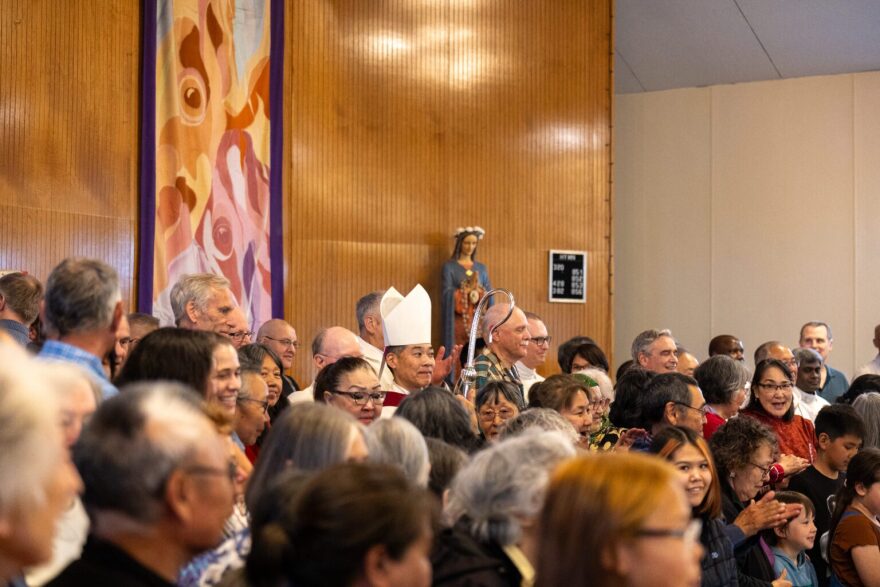
The Jesuits’ nearly 140 years in the state was honored at an event at Bethel’s Immaculate Conception Church on June 16. A procession of priests wearing long white gowns with red hems walked down the aisle to open the event. The Bishop of the Diocese of Fairbanks, Stephen Maekawa, thumped the ground with a shimmering silver staff known as a clozier as he approached the altar.
“My brothers and sisters, we gather together to celebrate this wonderful and blessed occasion to acknowledge the love of God and the work of God through the 139 year mission of the Society of Jesus of the Jesuit fathers,” Maekawa said to open the event.
A traditional Catholic mass followed, with readings in both English and Yup’ik. During the sermon, Maekawa acknowledged the vastness of the Fairbanks diocese, and the tremendous amount of work done by the Jesuits to establish it.
“All of the 46 churches of the Diocese of Fairbanks that we currently have were established by either the Jesuit fathers or by direction of a Jesuit bishop,” Maekawa said. “We have a long history of the Society of Jesus’ presence and ministry here in all of Alaska.”
The Jesuits are an order within the Catholic Church, akin to the Dominicans or Franciscans. They have a reputation for taking on some of the Catholic Church’s most remote assignments.
That missionary spirit brought the Jesuits to the Yukon River in 1887, where they built churches, schools, and ministries. Without their work, Catholicism may not have taken root in huge swaths of Alaska, particularly among Alaska Native communities.

But the Jesuits leave a complicated legacy. Their methods of converting Native people to the religion, particularly in the first half of the 20th century, created generational traumas still felt to this day.
Fr. Sean Carroll is the provincial of the Jesuits West Province, which oversees Alaska and nine other states.

“Thank you for all that you have taught us about who Jesus is and how to love and serve Him wholeheartedly,” Carroll said. “I also thank you for your patience with us. For there have been times when we have sinned and when we have hurt you.”
Missionaries, including the Jesuits, forcefully converted and assimilated Alaska Native people into Western culture and religion. Students at Jesuit-run boarding schools were forced to abandon their Native languages and physically punished when caught speaking languages other than English. Native dancing and drumming were also banned.
The Jesuits West Province maintains a list of 150 Jesuits with credible claims of sexual abuse against minors or vulnerable adults. A quarter of the accused Jesuits served in Alaska at some point in time.
“I ask for your forgiveness for all that we have done that was not rooted in Christ and love for Him, and for when we did not value your culture nor recognize the presence of God in you,” Carroll said.
Carroll gave the order to withdraw from the state last spring. A big issue was the recruitment of Jesuits willing to travel and serve in remote villages. He told the congregation that the Jesuits’ work would continue, just without a permanent presence.
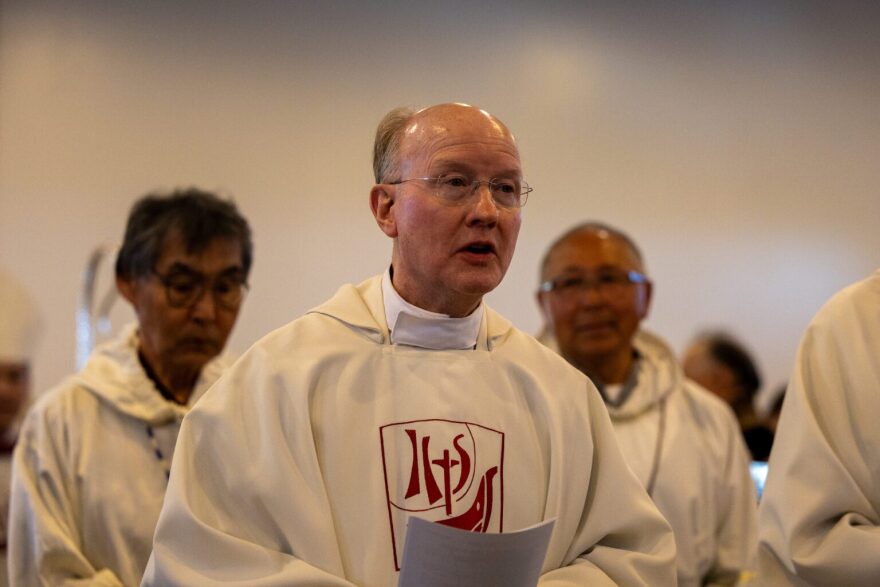
Fr. Rich Magner is one of the two remaining Jesuit priests in Alaska. His last day serving Chevak, Hooper Bay, and Scammon Bay is June 30.
“We all always knew coming in, or should have known, that we’re not going to be here forever. It’s going to be mission accomplished at some point,” Magner said. “And then we hand it off to the diocese that we’ve helped create, and so that’s a good feeling.”
Magner’s next stop is a Clinical Pastoral Education residency in Tacoma, Washington.
The other remaining priest, Fr. Tom Provinsal, first came to Alaska in 1968 to teach. A fond memory, he said, was meeting Elders that practiced traditional subsistence lifestyles.
“Some of the grandmothers, their fingers were just all bent with arthritis and stuff like that, you know, their whole lives they’ve been working out in the cold and the wet, doing food, sewing, all that kind of stuff,” Provinsal said. “I’d say I just feel very privileged to have come when I did come and to see that.”
Provinsal returned in 1975 as a priest and has served in the region ever since. After moving away, he plans to take a five month sabbatical. What happens next, he said, is in God’s hands.
Two lines formed in the aisle for communion at the end of the mass. After taking communion, Bethel’s Parish Administrator Susan Murphy gave a final thank you.
“It’s difficult to say goodbye to people who have been a part of our lives for so long,” Murphy said. “We know that you have done what was yours to do, and have taught us to do what is ours to do. We are grateful.”

Dominic Hunt, a Yup’ik deacon that flew in from Emmonak for the event, led the congregation through a final prayer.
“Bless them with your wisdom, that they may be a word of hope, a world in need. We ask this through Christ, our Lord. Amen,” Hunt said.
About 70 people posed for a photo on the altar – priests, deacons, parishioners, Elders and children — many of them smiling, some standing quietly.
The photo doesn’t tell the whole story. But it’s a moment when gratitude, grief, and memory all shared the same room.

JUNEAU, Alaska (KTUU) – The Supreme Court of Alaska will be taking up the case of the State of Alaska, Division of Elections v. Daniel J. Sullivan, Jr.
The oral arguments will be held Monday at 10 a.m. via Zoom, according to an order and opening notice.
The document also specifies that a decision is expected to be made before noon on Tuesday.
According to documents from the Division of Elections, the state must start printing ballots at noon on the same day.
This comes after an Anchorage Superior Court Judge ordered Dan J. Sullivan on to the ballot Friday.
See a spelling or grammar error? Report it to web@ktuu.com
Copyright 2026 KTUU. All rights reserved.
-
 News6 minutes ago
Michigan governor threatens to pull troops from D.C. if used for Trump task force
-

 New York1 hour ago
Metropolitan Diary Challenge Day 2: How to Write Your N.Y. Story
-

 Los Angeles, Ca1 hour ago
Company has weeks to complete cleanup of Boyle Heights warehouse fire, officials announce
-

 Detroit, MI2 hours ago
18 New Kid-Friendly Places That Opened in Metro Detroit in 2026 (So Far!)
-

 San Francisco, CA2 hours ago
Anza expedition celebrates 250th anniversary in San Francisco
-

 Dallas, TX2 hours ago
Preston Hollow residents oppose proposed $800 million mixed-use development in Dallas, survey reveals
-

 Miami, FL2 hours ago
Bradley Beal to Miami Heat rumors draw skepticism
-

 Boston, MA2 hours ago
Boston Pops surprise travelers at Logan Airport with July 4th preview performance

