West
Actor James Woods recalls chaotic moments as Palisades fire gained momentum, praises 'good' neighbors for help

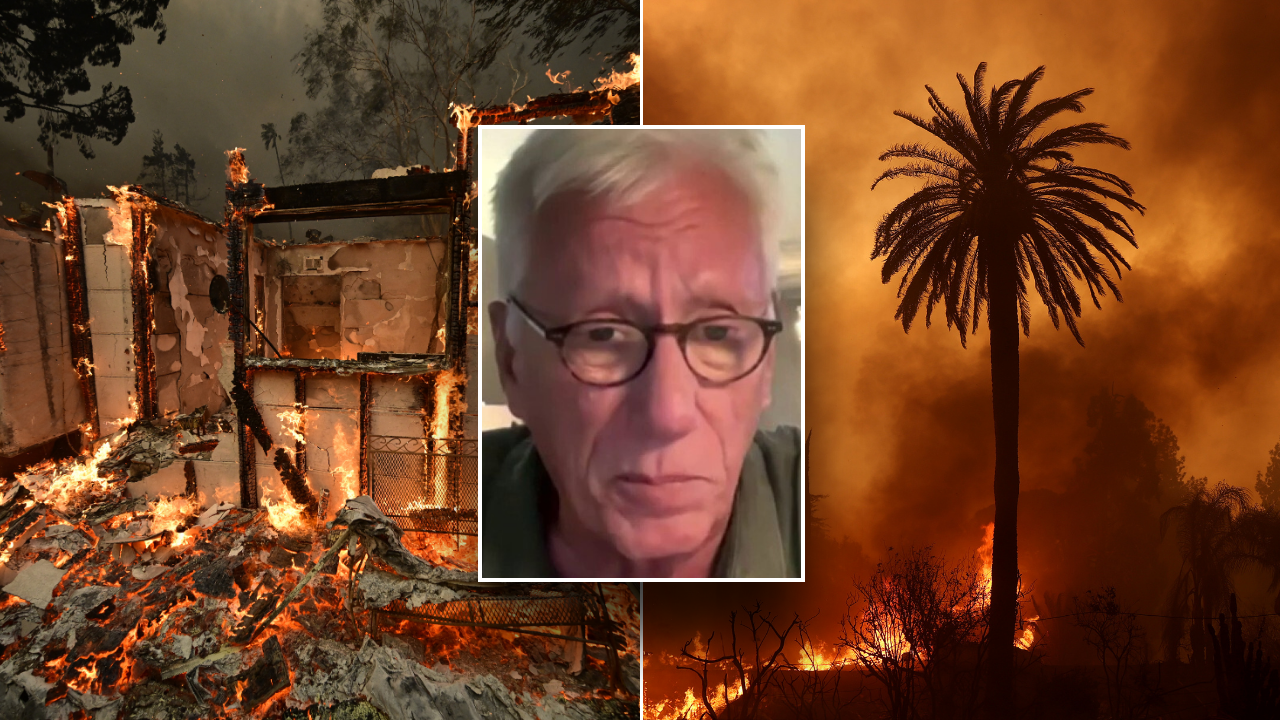
Actor James Woods recalled the chaotic moments Tuesday afternoon in Pacific Palisades as a deadly wildfire began sweeping across his neighborhood, destroying home after home.
Woods and his family fled their house as the flames inched closer and closer. He’s unsure if his house is still standing but told “The Ingraham Angle” Wednesday “it’s possible.”
“It’s astonishing that what happened during this experience was that we found out that none of us is a celebrity. None of us is a poor person or a rich person, a Democrat or a Republican. We were just neighbors, just really helping each other,” said Woods.
RAGING PALISADES FIRE DESTROYS HIGH SCHOOL FEATURED IN MULTIPLE HOLLYWOOD FILMS
A structure burns during the Palisades Fire in the Pacific Palisades neighborhood of Los Angeles, California, US, on Tuesday, Jan. 7, 2025. Uncontrolled wildfires tore through parts of the Los Angeles region, fanned by extreme winds, forcing thousands of residents to flee and grounding firefighting aircraft. Photographer: Kyle Grillot/Bloomberg via Getty Images
The multiple-time Emmy Award winner added that his neighbor ran over to his house after he and his family had evacuated to try and stop the flames from coming onto his deck, even staying overnight to fight the blaze.
“It was an extraordinary experience of realizing how essential good neighbors, good friends, good relative[s] [are],” said Woods.
His neighbor told him Wednesday morning that the houses to the left and right of him had burned down, as well as “every house” across the street, but Woods’ roof was still visible.
PHOTO GALLERY: PALISADES FIRE BEFORE AND AFTER
A fire-damaged Bank of America branch is seen after the Palisades Fire swept though in the Pacific Palisades neighborhood of Los Angeles, Wednesday, Jan. 8, 2025. (Eugene Garcia/AP)
Officials estimated Wednesday morning that more than 1,000 structures had burned as the wildfire continues to besiege Los Angeles County.
Woods told Fox News host Laura Ingraham he saw a firetruck parked in front of his house as the blaze started growing, but the firefighters couldn’t pump any water because “there was none.”
Erik Scott, the public information officer for the Los Angeles Fire Department, acknowledged in a post on X that there were indeed challenges with regard to water pressure.
“LADWP [Los Angeles Department of Water and Power] proactively filled all available water storage tanks, including three 1-million-gallon tanks located in the Palisades area,” Scott wrote. “However, water availability was impacted at higher elevations, which affected some fire hydrants due to limited replenishment of water tanks in those areas. The extreme demand caused a slower refill rate for these tanks which created a challenge for our firefighting effort.”
An airtanker made a drop on the Palisades Fire. (Brian van der Brug / Los Angeles Times via Getty Images)
Woods called out California Gov. Gavin Newsom for his alleged fire mismanagement and said the ongoing aftermath of the wildfire is more than a “wake-up call.”
“If it is true that things were handled this way. If it is true that Gavin Newsom is the absolute blithering idiot that I believe he is in the way he has handled fire management in this state again and again and again and again, this isn’t a wake-up call. This is the kind of thing they have tribunals for – where they try people and say, you had an oath of office to perform certain duties,” said Woods.
“When you’re the fire chief, this isn’t a social justice exercise that you’re in charge of. This is you getting water to areas that need water because there are fires in hundred-mile-an-hour winds burning houses to the ground.”
Read the full article from Here


How Fourth of July became a celebration of history and hope
From revolution to massive fireworks, July Fourth evolved into a celebration of history, heritage and America’s values.
With 150,000 people expected to attend Saturday’s Fourth of July festivities on the National Mall in Washington DC, locals and tourists alike may be looking for alternative options to view fireworks on America’s 250th birthday.
Washington DC will offer a secondary firework show on the 4th, and there will be plenty of areas in the city and surrounding neighborhoods to catch the big firework display at the National Mall.
Here’s a look at some of the best places to watch the July 4 fireworks in Washington DC.
Where can you watch fireworks in Washington DC on July 4th?
The National Mall will be the most popular area to watch fireworks, with President Donald Trump promising “the largest fireworks show in history.” Officials say 850,000 firework shells will be launched, potentially breaking a Guinness World Record.
But you don’t need to be at the crowded mall and its strict security measures in order to watch the display.
The organizers of the firework show, Freedom 250, say there will also be viewing spots at Hains Point, Columbia Marina, Gravelly Point, RFK Stadium, Meridian Hill Park, Union Station, Lower Senate Park and Upper Senate Park.
Other popular areas to watch the fireworks include the Cardozo Education Campus in Columbia Heights, the Washington National Cathedral in northwest DC, Lady Bird Johnson Park off the Potomac River and the steps of the U.S. Supreme Court Building on Capitol Hill.
Washington DC officials have also released an interactive map that allows you to see your view of the fireworks from any place in the city.
Are there any other fireworks shows in Washington DC on July 4th?
Anacostia Park will serve as the viewing area for a separate fireworks display that will be concurrent with the National Mall fireworks, which are expected to begin at 11 p.m.
DC officials say you can enter the park through Marion Barry Ave. SE, Nicholson St. SE or the Anacostia Riverwalk Trail near the Skate Pavilion.
The event is free to the public, as is the National Mall’s show.

LARAMIE, Wyo. — A bull moose was spotted roaming the streets of Laramie early Tuesday morning before being safely tranquilized and relocated by the Wyoming Game and Fish Department.
Photos from the University of Wyoming Police Department and Laramie residents show the creature curiously wandering through the university campus, where he was tranquilized before heading to a strip mall along Grand Avenue and taking a nap.
“Biologists got the call this morning that the moose was wandering in the UW Apartments neighborhood,” Laramie Region Game and Fish Information and Education specialist Hannah Smith said. “They responded to the scene and were able to dart the moose.”
While he was darted near the apartments, he didn’t stand around and wait for the tranquilizer to take effect. Smith said he worked his way east for about 20 minutes before ending up, coincidentally, in front of Sportsman’s Warehouse.
Lilly Avila, a Laramie resident working at a nearby coffee shop, told Cap City News the animal was sluggishly wandering the parking lot and rubbing against cars before the tranquilizer got to him.
“They brought him to the office and got him cooled down,” Smith said. “They don’t want to be in town. It’s a stressful situation for them, too. They can overheat really easily, so we get them cooled down before we transport them.”
Game and Fish couldn’t say as of Tuesday where the moose came from. Smith said he could have come east from the Pole Mountain area between Laramie and Cheyenne or up the Laramie River from the Snowy Range. Either way, his new home will be around Medicine Bow Mountain.
He also shouldn’t be feeling the effects of the tranquilizer for too much longer. Biologists gave him a reversal drug that should have prepared him to return to the wild.
“He should be pretty normal in terms of the medication. I think, in terms of his day, hopefully he goes back to living his happy moose life munching on some willows and doesn’t go for too many more walkabouts,” Smith said.


Related

2026
The bells atop the Mission of Our Seraphic Father San Francisco de Asís, better known as Mission Dolores, have names. From north to south, they are San Jose, San Francisco, and San Martin.
“These are the original bells,” Mission Dolores curator Andrew Galvan told a group of Catholic school fourth graders in smart tartan uniforms on a Friday morning in April. Galvan is an elfin man with a preference for Johnny Cash–black outfits who, after suffering a stroke last year, often uses a wheelchair. Seated beneath the bells, he flashed a mercurial grin: “They are old and tired. Just like me.”
The students were neither old nor tired, and they clearly anticipated ringing those bells. They were here because fourth graders in California study state history, and the missions, erected by forced Indian labor under Spanish friars before the state was a state, are a keystone of the curriculum. Field trips to missions are a part of most every California childhood.
San Jose, San Francisco, and San Martin crown the oldest surviving structure in the city that grew around it. Newer buildings crumbled in the 1989 quake, and much of the city crashed and burned in the Big One in 1906. The adobe walls of Mission Dolores—which are four feet thick except along the section beneath these three bells, where they reach a full ten feet thick—stood firm. It’s cool and dark in here, even on this unseasonably sunny and glorious San Francisco morning.
One by one, the students from Good Shepherd School in nearby Pacifica step forward to yank the bell ropes. If Quasimodo had worked at Mission Dolores, his hearing would’ve remained immaculate; it’s hard to imagine anyone detecting the bells’ mild plinking even two blocks away at Dolores Park. But in 1794, when Galvan says these bells first arrived, there were no buildings, no cars, no trees, no earbuds, and no boisterous fourth graders. These bells towered over the desertic landscape and could be heard nearly four miles off at the Presidio. Their pealing carried over the shrubs and dunes and indicated a shift change—it was time for the Indians working there to tread back to the mission. They walked a winding trail largely recapitulated today by “the Wiggle,” a circuitous route taken by cyclists to bypass San Francisco’s hilliest hills. In the morning, they’d do it all again.
Now, as the children step forward to ring the bells, a man like Galvan, with the right kind of ears, can hear San Francisco’s history in their tones.
A tall South Asian girl takes a rope in hand. Plink!
The ’49ers rush west.
A stocky Latino boy ambles up. Plink!
The Great Quake and fire raze 80 percent of the city.
Plink!
Irish nationalists cruise through “Da Mish.”
Plink!
Fourth grader Andy Galvan takes a field trip to Mission Dolores.
Plink!
Lowriders cruise through La Misión.
Plink!
The dot-com boom.
Plink!
The dot-com bust.
Plink! Plink! Plink! Tech workers with a city-issued permit boot Latino pickup-soccer players off Mission Playground; a solitary sunbather graces Dolores Park on the first day of the pandemic lockdown; the city awaits potential trillion-dollar AI IPOs.
Within earshot of these bells, change has been a constant. Natural forces have compelled San Francisco to rebuild itself. Market forces have compelled it to remake itself. The city has assumed a role as a serial boomtown, a place spawned by lust for gold and sustained by lust for everything else. If you’re running from something, this is about the furthest west you can go without getting wet. But it’s also a place to run to, with big ideas, for a big job, or simply to be who you are.
And all of that history is wrapped up in the mission. “Everything in San Francisco,” Galvan says, “takes its name from this place.” Honorees awarded the key to San Francisco, he notes, were actually given a gussied-up replica of the key to the mission’s hulking front door. The history of San Francisco’s mission and the surrounding Mission District that sprouted beneath these tolling bells is the story of an American city—and, in many ways, America. The bells arrived in 1794, but the mission was founded in 1776. It is as old as the country, but it tells a different story from the one emanating from Independence Hall in Philadelphia. The story of the East—the one they teach fourth graders, at least—is about religious refugees establishing a new, enlightened form of government that would stamp out the incivilities of monarchy and tyranny. This story? This is a story about seizing and repurposing resources: land, mineral, even—and especially—human. About staking one’s claim. Constant disruption. Moving fast and breaking things. Generating immense wealth and advancement, with cost a secondary concern. Which one, in 2026, feels more in line with the American character?
Truth be told, the children eagerly taking the bell ropes are probably not thinking about the iterations of America that have come and gone beneath these bells. They just seem thrilled to pull those ropes before the grown-ups think better of it and make them stop.
But Galvan thinks about these things. That’s his job.
He arrived, officially, as the curator twenty-two years ago, the first Indian to ever hold such a position at a California mission. He often jokes that he considered draping a banner on the facade of the mission, reading “UNDER NEW MANAGEMENT.” This did not happen. But it didn’t need to: Whether it’s acquiring artifacts for the church museum, leading visitors through the grounds, or donning a curator’s Mickey Mouse gloves to pore over leather-and-parchment archival records—births, baptisms, marriages, burials—under lock and key on-site, Galvan’s raison d’être, he says, is “putting the Indian into the story.”
This is a part of the story the fourth graders Galvan interacts with don’t necessarily know. It’s not the only part: On one recent tour, a boy nodded at an altar and asked, “Is that Jesus up there?” Galvan took a moment with that one. “Are you asking me,” he said, forming his words slowly, “if that’s Jesus on the cross?” The church felt unusually silent for the next few moments. “Yes,” Galvan finally replied. “Yes it is.”
One day, that little boy may grow up to be president of these United States. He might already be overqualified. What else, Galvan wonders, do tomorrow’s leaders not know—what do they not even think to know?
So that’s what Galvan thinks about. He is seventy-one years old now and often finds himself resting in his wheelchair near his favorite part of the mission, the baptismal font. He sits and he thinks, back, back, back through the history echoing around him, history that belongs to the city but also belongs to him, by job and by right.
Galvan understands, as few living people can, that long ago, in this very place—in this very room—things happened that set the tone for all that would follow. The establishment of Mission Dolores and San Francisco are intertwined; through a calendrical quirk both are tied to the founding of the United States itself. To understand who we are in the present—in San Francisco, in America—you need to start with the mission’s past.

A mural commemorating the arrival of BART, the San Francisco Bay Area’s transit system, only deepened local fears that the train would be the city’s latest agent of displacement: it depicts the rails running heavy over people’s backs.
2018
In March, a Mission District house on Hampshire Street came on the market advertising itself as potentially the oldest in San Francisco. Its owner had evicted four generations of a Salvadoran family from their residence of thirty-two years, including a bedridden ninety-four-year-old matriarch. San Francisco and its Mission District have spun many stories through the years. But this is one on heavy rotation. Other than their living in what may have been the city’s oldest home, a lawyer for the evicted family described his clients’ ordeal as typical—and even “not particularly vicious” by neighborhood standards.
It felt like the symbolic end of a mop-up action that had been happening for a long time. Latinos made up 60 percent of this neighborhood in 2000. By 2015 it was 48 percent. By 2023 it was 33 percent. Many saw it coming. In the early 1970s, when Bay Area Rapid Transit (BART) was on the verge of opening, the majority-Latino district interpreted the new train system as an imposition not meant for its benefit but to expedite its displacement. The year before Mission Dolores’s bicentennial, a mural was installed several blocks south commemorating, if not celebrating, BART’s opening. The mural depicts the train rolling over the backs of brown-skinned people hoisting it like Atlas.
Not long before that, “The Good Time Manual,” a 245-page San Francisco guidebook catering to hip, young—and, likely, white—readers listed zero places of interest in the overwhelmingly Latino neighborhood. Two generations on, the Mission District is both one of the city’s coolest and hottest, and a place to which young people flock. Many have money and may, soon, have vastly more—there are more than 20 AI companies sited in the Mission alone, including some of the biggest. Like the generations of San Francisco arrivistes before them, they, too, are single-mindedly pursuing their dreams. And their fortunes.
But the Hampshire Street house had played its role in this story for far longer. It was erected as early as 1855 by the Treat brothers, hustlers of the sort who’d thrive in any iteration of San Francisco. The Treats had taken vast swaths of the Mission off the hands of its feudal Mexican land barons—who had, previously, dispossessed the Indians who Junípero Serra, the polarizing paterfamilias of the California mission system, vainly believed would inherit this earth. (Serra was beatified by Pope John Paul II in 1988 and canonized by Pope Francis in 2015.)
With the family evicted, the Hampshire Street home was promptly subdivided into four luxury condominiums listed at nearly $1 million a pop. At least one of the units was soon serving tourists as an Airbnb.
Mission Dolores stands at the head of this neighborhood, and within the cool, dimly lit edifice, outside life can seem far off. But it, too, has felt these changes. It’s not so much what you see here, Galvan could tell you, as what you don’t. The parishioners are still largely immigrants and people of color. There are just so many fewer of them.
2009
San Francisco is an entity with no shortage of process. So is the Catholic Church. For five years as the mission’s curator and for decades beforehand, Galvan had been pushing to bring greater recognition to the legions of native people buried in the mission’s cemetery.
Every plan he proposed was rebuffed, for cost or simply for ruffling feathers with his insistence on representing the Indians. In 2009, the mission hired Galvan’s cousin as an assistant curator, and the two relatives decided to expedite the proceedings. They bought planks of redwood, the region’s iconic tree, at Home Depot and carved conjoining headstones for two early Indian burials.

The marker still stands, the Indians’ names more prominent than many of the European names on the older tombstones. Galvan shows it off on every tour.

Pope John Paul II embraces Brendan O’Rourke, a four-year-old with AIDS.
1987
The Mission Dolores basilica was completed in 1918 after its predecessor was mortally wounded in the Big One. It adjoins the Old Mission, which houses Galvan’s museum. Galvan leads visitors through the basilica too, and when he does he’ll usually stop at a pew around ten rows back. That’s the Brendan O’Rourke pew.
This is where John O’Rourke stood with his four-year-old son in his arms. And as Pope John Paul II slowly made his way forward toward the altar, he came face-to-face with the boy. The pontiff held and embraced Brendan. In a pre-Internet age, the moment went viral; San Francisco is a city that thinks highly of itself, but September 17, 1987, was a day on which it lived up to its own ideals.
Brendan O’Rourke, who had contracted AIDS from a blood transfusion he received as an infant, was one of more than one hundred people with AIDS or AIDS-related conditions in the church that day. President Ronald Reagan had, only months before, deigned to make a speech about AIDS after years of declining to even mention the word. But at the Mission of Our Seraphic Father San Francisco de Asís, Pope John Paul II told men and women—and children—suffering from AIDS that they had value.
“God loves you all, without distinction, without limit,” he said. “He loves those of you who are sick, those who are suffering from AIDS and AIDS-Related Complex. … He loves all with an unconditional and everlasting love.”
It was a moment Galvan witnessed with his own eyes. It was a moment when San Francisco did good for the world.
Galvan befriended the O’Rourke family. They began praying for a miracle for Brendan, praying to Junípero Serra. One year later, the O’Rourkes traveled to Rome for Serra’s beatification and took communion with the Pope. Two years after that, Brendan died. He was seven years old.
1959
By night, future San Francisco State political-science professor Bill Issel studied the work of Randolph Bourne, an early twentieth-century essayist who had called for “trans-nationalism”: Rather than assimilating into Anglo-Saxon norms, immigrants would retain their own cultures and help form a “cosmopolitan America.”
Many years in the future, Issel would be an emeritus professor and one of the foremost historians of the city. But in 1959 he survived as a student by working a trade during the day, where he saw that trans-nationalism was, essentially, what was happening in the Mission District. The story of the American city has been told and retold in the shadow of Mission Dolores: Throughout the nineteenth and early-to-mid twentieth centuries, a smorgasbord of white ethnics from Scandinavia, Germany, and Ireland arrived in generational waves. (Issel’s great-grandfather came from Germany in 1881.) They pulled shifts in the wool mills, factories, and chemical plants mushrooming in a neighborhood the Irish, in a Brooklyn-like brogue, called “Da Mish”—a neighborhood marked, to this day, as a place for work. (Whatever you think about the tech barons and workers of the present, you can’t say they aren’t pulling long hours.)
There are neighborhoods like this in every major American burg. But on the East Coast, the class and ethnic boundaries feel more static. In the serial boomtown of San Francisco, however, the character of the Mission changed with most every boom as the revolving door into American society kept revolving. In a historic time frame, if not a human one, the Mission District never stays one thing for long.
And as in other American cities, when nonwhite ethnics showed up, the whites of yore decamped. They sold their homes for prices that, today, leave their grandchildren resentful. They relocated to the placid suburbs south of San Francisco or the sandy, low-slung Outside Lands of the city’s Westside. It would be left to their descendants to embrace the allure of more centrally located urban realms like the Mission District.
In 1964, when Andy Galvan’s fourth-grade class made its pilgrimage to Mission Dolores, he found a neighborhood in the midst of transformation, from what it was to what it would be. Only five years prior, apprentice electrician Bill Issel would hear his fellow white ethnic union men offer up their own assessment as Da Mish was rapidly becoming La Misión: “The Mission is going to hell.”
1922
Marie Bernal Buffet, the granddaughter of a Yelamu man named Pedro Alcantara, died penniless, just south of the San Francisco border. She was the last known member of the Yelamu line. “Her little home is mortgaged for $500, which has long since been expended for medicine and doctor’s bills,” reads a jarringly brief 1922 article in the San Francisco Examiner. Its headline: “LAST OF INDIANS IN S.F. IS DYING AMID POVERTY.”

San Francisco’s map was redrawn yet again when a 7.9 magnitude earthquake struck in 1906. Mission Dolores, already more than a century old, survived.
1906
The Big One struck at 5:12 a.m. on April 18. It was a 7.9 magnitude quake that destroyed nearly the entire city thanks largely to a series of fires it precipitated that burned for days. Much of the Mission District’s adjacent neighborhoods burned. Much of the Mission District did not, in large part thanks to a single, functioning fire hydrant on Church and Twentieth streets overlooking Dolores Park. Mission Dolores itself, already a relic in the early twentieth century, was preserved at the cost of dynamiting the Notre Dame Academy across the street.
Every year on April 18, city officials dutifully apply a coat of gold paint to “the Little Giant,” the heroic hydrant, a solemn predawn celebration marking the functionality of an inanimate object. It might as well also mark the commencement of another wave of change—to tech and plague add natural disaster. Families burned out of other neighborhoods crowded into the Mission, squeezing multiple generations into single domiciles, just like the family unceremoniously booted from the house on Hampton Street more than one hundred years later.
The families that scored lodging here were the lucky ones. There’s a 1906 photo on display at Mission Dolores depicting hearses lined up in front of the building like taxicabs at the airport. The funerals were coming in shifts, and the Old Mission sent off not only Catholics but Protestants and Jews as well.
It’s not something you’ll find in the church’s archives, however. They only wrote down the names of the Catholics.
1850
“I am very old. My people were once around me like the sands of the shore … many … many. They have all passed away,” Pedro Alcantara told a federal Indian Agent in 1850, the year California became a state. (California’s first governor, in January 1851, used the occasion of his State of the State address to plainly declare: “that a war of extermination will continue to be waged between the races until the Indian race becomes extinct must be expected.”) Alcantara was one of the few Mission Dolores–born Indians to live long enough to have children of his own. “They have died like the grass,” he said of his people. “They have gone to the mountains. I do not complain, the antelope falls with the arrow.”

Mission Dolores at the turn of the 20th century.
1849
In the years after Samuel Brannan jolted San Franciscans with his cries of “Gold! Gold from the American River!” all roads did not lead to Mission Dolores. But the best one did: the terminus of a wooden-plank road that began in the city’s Downtown put you right at Mission Dolores’s front door. San Francisco is perhaps the most successful city ever built on the extraction industry, and men with money in their pockets were soon walking the wooden planks to the Mission District in search of places to spend it.
They found them.
Only fifteen years earlier, the Mexican government had “secularized” the state’s missions, seizing the lands from the padres and sparking one of the world’s great land grabs. Huge tracts were awarded to self-made Spanish colonial soldiers—a tale of hustlers on the make that would come to typify the future Golden State. Their names still adorn Bay Area neighborhoods and cities—Castro, Noe, Bernal, Vallejo. The Indians who lived long enough to potentially reclaim their land often ended up as serfs on the ranchos of newly minted feudal barons. At the end of the plank road, the first of so many moneyed newcomers to come here found the former Mission Dolores with its structures repurposed to include a saloon. Not far off, you could find gambling, dancing, and, of course, brothels.
The riches that flowed into San Francisco from the gold country transformed a remote port with a population that could squeeze into a few train cars into an imperial city and created generational wealth for those prescient enough to sink their gold back into the earth. “This is what always happens,” says historian Gray Brechin. “If you make your initial money in mining—or in tech—if you’re smart you invest in land.” Smart people did. Smart people do. Every land-owning San Francisco business is also in the real estate business.
Gold-rush-era San Francisco became the repository of fabulous riches, while the consequences were suffered by others elsewhere. Mercury, used to isolate gold from ore, continues to ooze into northern California waters, and the toxin can even be detected in the region’s ubiquitous fog. In 1917, a U.S. Geological Survey report estimated that hydraulic mining had washed 1.5 billion cubic yards of sediment into the Sacramento River system—some eight times the soil displaced to create the Panama Canal. Today we see much the same. Anthropic and OpenAI in June filed paperwork for IPOs that will make thousands of San Franciscans unfathomably wealthy. But no one would think to locate a data center here.
1814
“Today I buried Viridiana, one of the last adults who witnessed the founding of the mission,” wrote Padre Ramon Abella in the Mission Dolores burial register on July 22. “Everyone who saw the arrival of the missionaries … have died; and those who have been born since that time, rare are those who live.”
1794
In the same year that the bells San Jose, San Francisco, and San Martin arrived at Mission Dolores, so did the Indian named Poylemja. It was not a voluntary move: The mission required an influx of 200 new Indians a year to offset its mortality rate, and Poylemja was seized by Spanish soldiers from his home in the Miwok village of Saklan, near the present-day city of Moraga, across San Francisco Bay.
The mission brought about San Francisco’s first disruption. It established a pattern that continues today, one in which people have descended upon San Francisco to single-mindedly pursue big dreams, big fortunes, or both and, often, achieved them—but not without unleashing strange and terrible consequences in the process.
As with social media’s promise to connect the world or AI’s lure of the bounty of superintelligence, the disruption came with ostensibly noble aims. The missionaries’ goal was to convert Indians into gente de razón, “people of reason.” Poylemja was baptized in 1794. He was renamed Faustino; he married an Ohlone woman named Jobocme, who had been rechristened Obdulia after her baptism in 1802. (The spellings of their names have been revised since Galvan made the redwood grave marker.)
The way the missionaries drew it up, they would put the Indians back in charge of their own lands as civilized Catholics—and do so within just a decade. That was the intention. It didn’t work out that way, and few Indians brought into the missions would even live that long: An analysis by the Ohlone scholar Jonathan Cordero reveals that the average span between an Indian’s entry on Mission Dolores’s baptismal record and their subsequent entry in its burial record was just four and a half years.
Poylemja and Jobocme lived here, worked here, and had children here—Liberato and Roverta. And they died here: Poylemja in 1804 at age forty and Jobocme in 1807 at age forty-one. They are buried here. Andrew Galvan visits them every working day.
1776
On April 5, searching for a site for the mission, future colonial governor Juan Bautista de Anza found himself alongside a shallow lake, which sat on around five square blocks between present-day Fifteenth and Twentieth streets and Guerrero and Howard. It was fed by a creek running down Twin Peaks and flowing along present-day Eighteenth Street. If you were to take a crowbar to the sewer covers along Eighteenth, you could hear the creek even today.
History doesn’t record de Anza asking the Indians of the nearby village of Chutchui what they called the lake and creek. It was the Friday before Palm Sunday, which in his Catholic tradition was the Feast of Our Lady of Sorrows. So he christened the waters as such. Sorrows. Dolores.
That summer, members of the Yelamu people witnessed foreigners erecting a pair of settlements on their lands. Along the northern tip of the sandy, windswept San Francisco peninsula, Spaniards were breaking ground on what would become the Presidio, a military garrison that today is a national park, golf course, and repository of tall trees utterly alien to San Francisco’s natural landscape. In a sheltered valley several miles off, in went Mission Dolores.
It was late June when Father Francisco Palóu held the first mass, on the feasts of saints Peter and Paul, somewhere near the present-day mission. That mass, arguably, marked the beginning of San Francisco and, one might say, the history of the western United States. It was June 29, 1776.
Five days later and very far away, a group of white men adopted the Declaration of Independence.

The Old Mission and the basilica today.
2026
After the children finally finish pulling the bell ropes of San Jose, San Francisco, and San Martin, Andrew Galvan begins talking about the area’s original inhabitants. The bones of more than five thousand of them rest underfoot not twenty-five yards off. This is, rather literally, a settled subject.
It was at this point, however, that a fourth grader tells Galvan that he’d heard it was, actually, the Vikings who “discovered” the New World. Galvan offers a wan smile. He tells the boy that he eschews the word discovered. And, as an Indian, Galvan feels that we are living in the Old World. It’s Europe that’s the New World.
When the boy presses his case, Galvan, not unkindly but firmly, cuts him off: “Don’t disagree with me.”
On the way out, they pass the baptismal font where Galvan’s great-grandnephew was recently baptized. The water from Dolores Creek, eons ago, filled the baptismal font at Mission Dolores. It no longer does, and it’s not the same font: The present edition hails from 1995, old for a Toyota Celica but not for a church relic. No matter. Galvan’s connection runs deeper: “It takes me back to the River Jordan, where Jesus was baptized.”
The baptismal font of Mission Dolores is the center of Andrew Galvan’s spiritual and temporal worlds. And from here you can see everything within the adobe of Old Mission Dolores. It offers a stunning view of the church’s reredos—the massive, baroque wooden altar that arrived here from Mexico in 1797. But, Galvan says, it’s not so much what you see here as what you don’t. Behind the reredos and hidden from the general public for centuries is a mural, painted by the mission’s original inhabitants. The work of Poylemja may be on that wall.

The San Francisco skyline from Dolores Park, a beloved public space named for the same waters as the mission, which sits two blocks away.
The waters and the font have changed, but Galvan’s great-grandnephew was recently baptized in the same place as Poylemja and Jobocme. The connection runs deep: He is their direct descendant. So is Andrew Galvan. Poylemja and Jobocme were his great-great-great-great-grandparents.
There is unease and rootlessness today among arrivistes and the most long-standing San Franciscans alike. There is always a gnawing fear that unseen hands will yank a bell rope and the shifts will change and you will be forced to move on. Galvan, however, has no such anxieties. His ancestors suffered through unimaginable sorrows to bequeath him his serenity.
“I belong to this place,” Galvan says. “It does not belong to me. But I belong to it.”
These days, sitting by the font, Galvan can’t help but think about the near-concurrent birthdays of Mission Dolores and the United States of America. “It’s always there,” he says. He is careful to use the term commemorate and not celebrate when he mentions the forthcoming anniversary—the bones of too many people who lived painful and truncated lives are buried here in unmarked graves. History is complicated. But 1776 was as clear an inflection point as any, and attention must be paid. “We acknowledge there was a moment in time when it was just Indians in San Francisco,” Galvan says. “And our world changed.”
So the revolving door began. Always someone else coming in—and someone else moving out. It’s not so much what you see as what you don’t.
Some things change. Some never will. The bells at Mission Dolores are the same. Little else is.
-
Washington2 seconds ago
Where can you watch fireworks in Washington DC on the Fourth of July?
-

 Wisconsin3 minutes ago
9-year-old drowns at western Wisconsin water park, sheriff says
-

 West Virginia8 minutes ago
Save Women’s Sports Act now the law of the land – WV MetroNews
-

 Wyoming15 minutes ago
Young bull moose captured wandering Laramie, relocated by Game and Fish
-

 Crypto18 minutes ago
Webinar: Crypto and public pensions—risks, rewards, and fiduciary duties
-

 Finance23 minutes ago
Wednesday’s Campaign Round-Up, 7.1.26: Justices help GOP with campaign finance ruling
-

 Fitness30 minutes ago
I’ve been doing the bird dog exercise instead of planks to improve my core strength – it’s even better for beginners
-

 Movie Reviews38 minutes ago
Neil’s Movie Reviews

