Sports
Why some of California's most outdoorsy people are moving to…Las Vegas?

For many, the lure of Las Vegas is the near complete immersion in a man-made world.
Visitors bury themselves deep inside temperature-controlled casinos, surrounded by artificial lights and sounds, with no windows or even clocks to remind them that the outside world still exists.
It’s one of the indoors-iest places on the planet.
But just outside the city, about 20 minutes from the bachelor parties and slot machines, a growing number of elite outdoor athletes are buying homes, starting families and declaring Las Vegas the adventure sports capital of the United States.
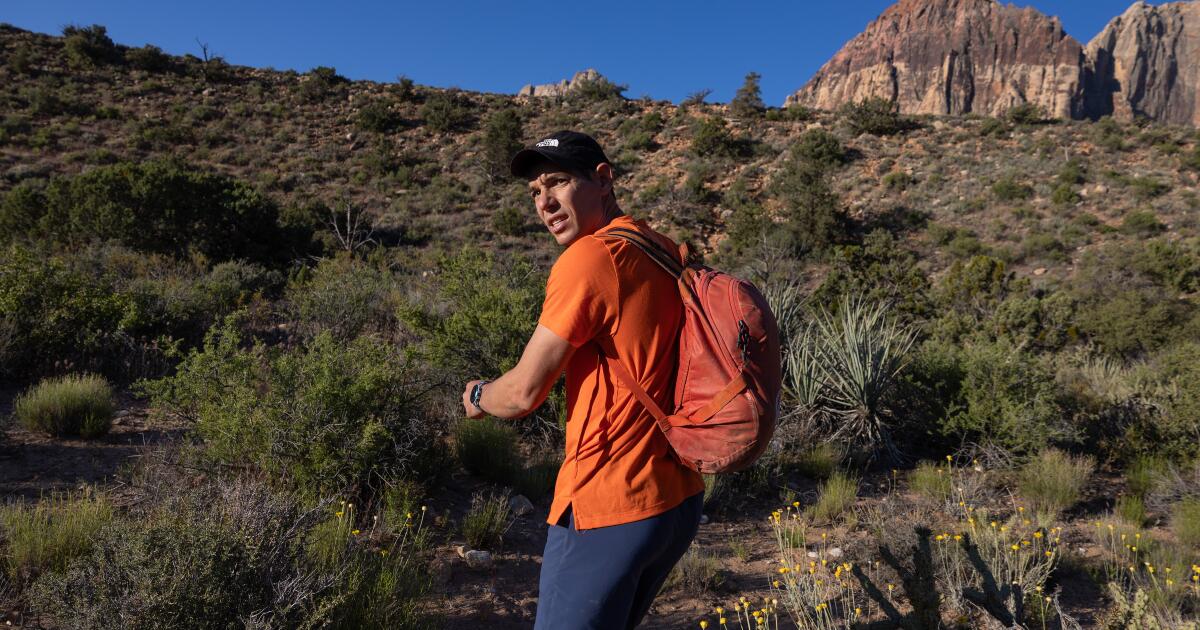
Alex Honnold, right, and climbing partner Joey Latina pause on the approach to the Rainbow Wall in Red Rock Canyon just outside Las Vegas.
“It just has unparalleled access to the outdoors,” gushed Alex Honnold, the world’s most famous rock climber and subject of the Academy Award-winning documentary, “Free Solo,” about his breathtaking 2017 ascent of Yosemite’s El Capitan, a nearly vertical granite wall that rises 3,000 feet above the valley floor.
It was first climbed in 1958 by a team who took 18 months searching for tiny protrusions and cracks to use as holds and driving heavy metal spikes into the rock where no natural holds existed. Honnold shocked the climbing world by using only his hands and feet — no safety equipment of any kind — and completing the ascent in just under four hours, a new speed record for the route.
In early May, as light from the rising desert sun seemed to set fire to the towering cliffs of Red Rock Canyon National Conservation Area just west of Las Vegas, Honnold pulled up in his electric truck ready to sprint up another sheer rock face. This one, known as the Rainbow Wall, rose about 1,000 feet above the desert floor.
Honnold, 38, who is of medium height and build and graying slightly at the temples, was dressed in a T-shirt, shorts and running shoes. At first glance, there was little to set him apart from a dozen or so other hikers and climbers lined up to enter the park at 6 a.m.
But then he tossed a small pack over his shoulder and started moving, eager to cover several miles of brush and boulder-strewn landscape between him and the base of the climb before the day got too hot. His small entourage, which included a climbing partner and two Times journalists, struggled to keep up.
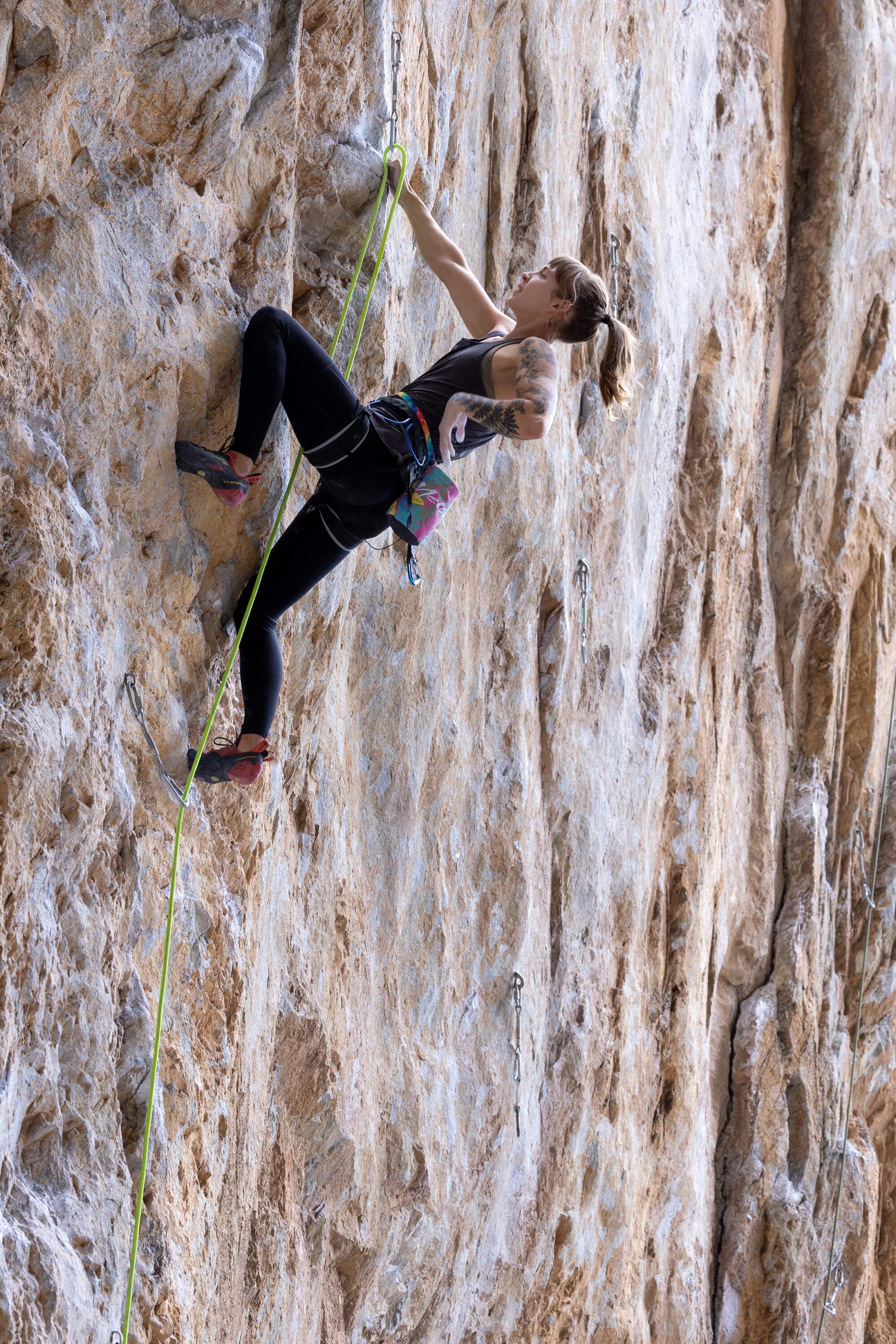
Climber Shaina Savoy ascends a limestone wall at Robbers Roost in the Spring Mountains National Recreation Area near Las Vegas.
“Honestly, I would say Las Vegas is better than any of the other cities in the country that have a reputation for being outdoorsy,” Honnold said. “People go to Denver because they say they want to be near the outdoors. But it’s at least an hour’s drive away from the real mountains.”
“In Vegas, you can live in the middle of suburbia and be 15 minutes from trailheads where you can be completely alone and feel like you’re gonna die,” he said as two of his companions hunched over and gasped for breath.
What sets Vegas apart is the unexpected geographic diversity, making world-class climbing easily accessible year-round. In the winter, there are the endless routes in Red Rock, the canyon that begins just beyond the suburbs. Its sandstone walls start at about 3,000-feet elevation, which means they’re low enough to remain warm and pleasant even in December and January.
When spring and summer roll around, and the valley becomes a furnace, 12,000-foot Mt. Charleston is less than an hour’s drive away and the upper reaches can be 30 degrees cooler. There, towering limestone walls offer some of the toughest technical climbs in the world, and there are enough routes to keep a professional climber busy for a lifetime, Honnold said.
Even Yosemite, long regarded as Mecca for rock climbers from all corners of the globe, where Honnold and so many other professionals made their reputations, can’t match that.
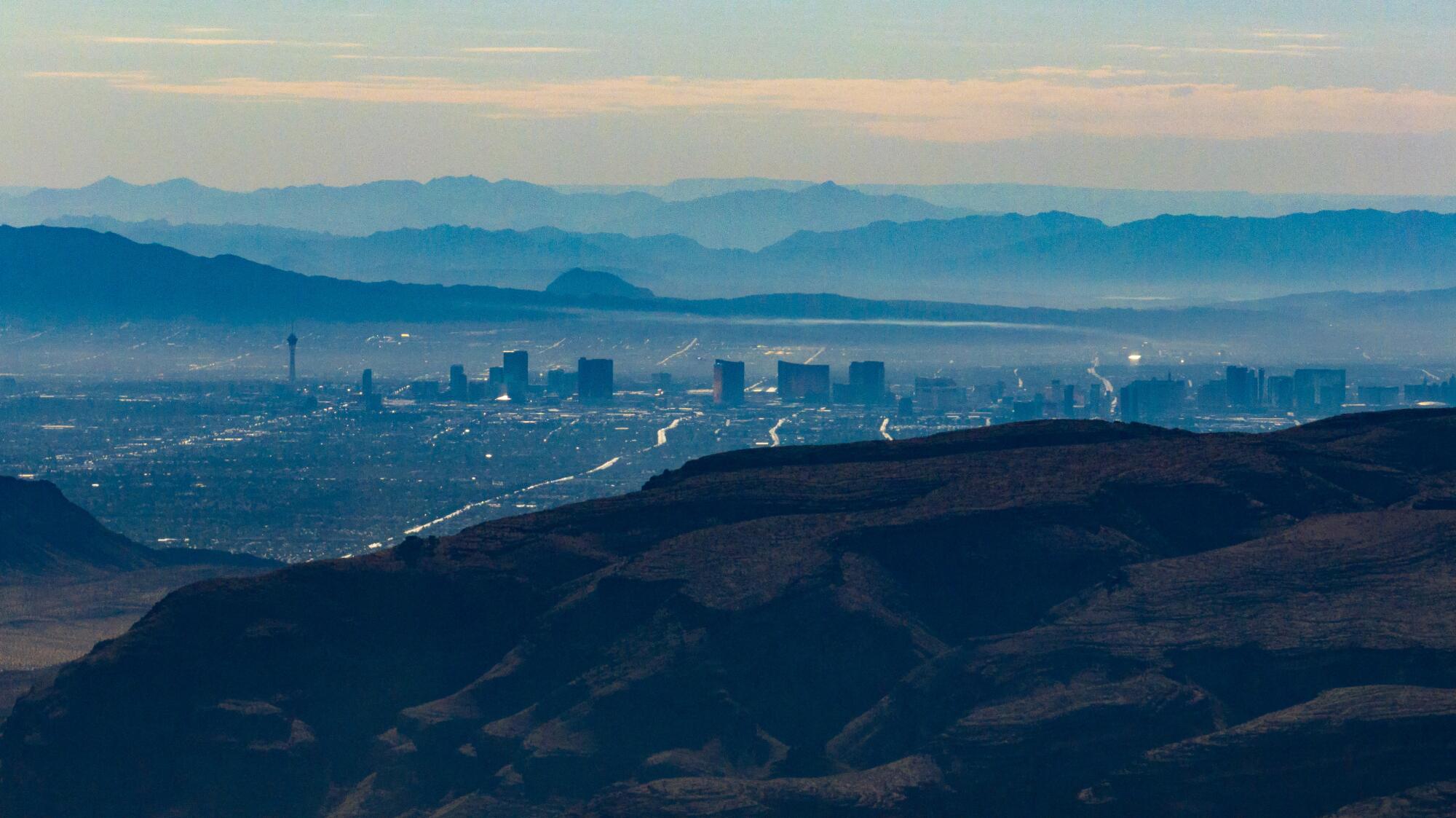
The Las Vegas Strip viewed from Red Rock Canyon National Conservation Area about 20 miles west of the city.
“Yosemite is a world destination in the spring and fall,” Honnold said. “But in the summer, it’s way too hot and way too crowded.” And in the winter, at 4,000 feet and directly exposed to Pacific storms, “it’s too wintry.”
And even when the weather is good, day-to-day life for climbers in Yosemite looks more romantic in old documentary films, and on Instagram, than it is in real life. Routes on its biggest and most famous walls, El Capitan and Half Dome, were pioneered by mostly unemployed self-proclaimed “dirtbag” climbers in the late 1950s and early 1960s, who built a fierce and defiant counterculture in the nearby campgrounds.
Among them was Yvon Chouinard, a tinkerer whose small climbing gear business grew into the billion-dollar retailer Patagonia, but who spent years living hand to mouth with fellow climbers in tents and out of their cars. He has told more than one interviewer that, at times during his early climbing days, he was so broke he subsisted on canned cat food because, “it was better than dog food.”
That underlying ethos had mellowed a bit, but still existed when Honnold first drove the family minivan down from Sacramento in the early 2000s. He was still living in a van in 2017 when he made the career-defining climb of El Capitan.
But ask anyone who has done it for long and they’ll tell you, van life gets old, even in a place as beautiful as Yosemite.

Emily Harrington says climbers of her generation are looking to buy homes and settle down. She and her husband recently had a son, Aaro, adding urgency to their quest.
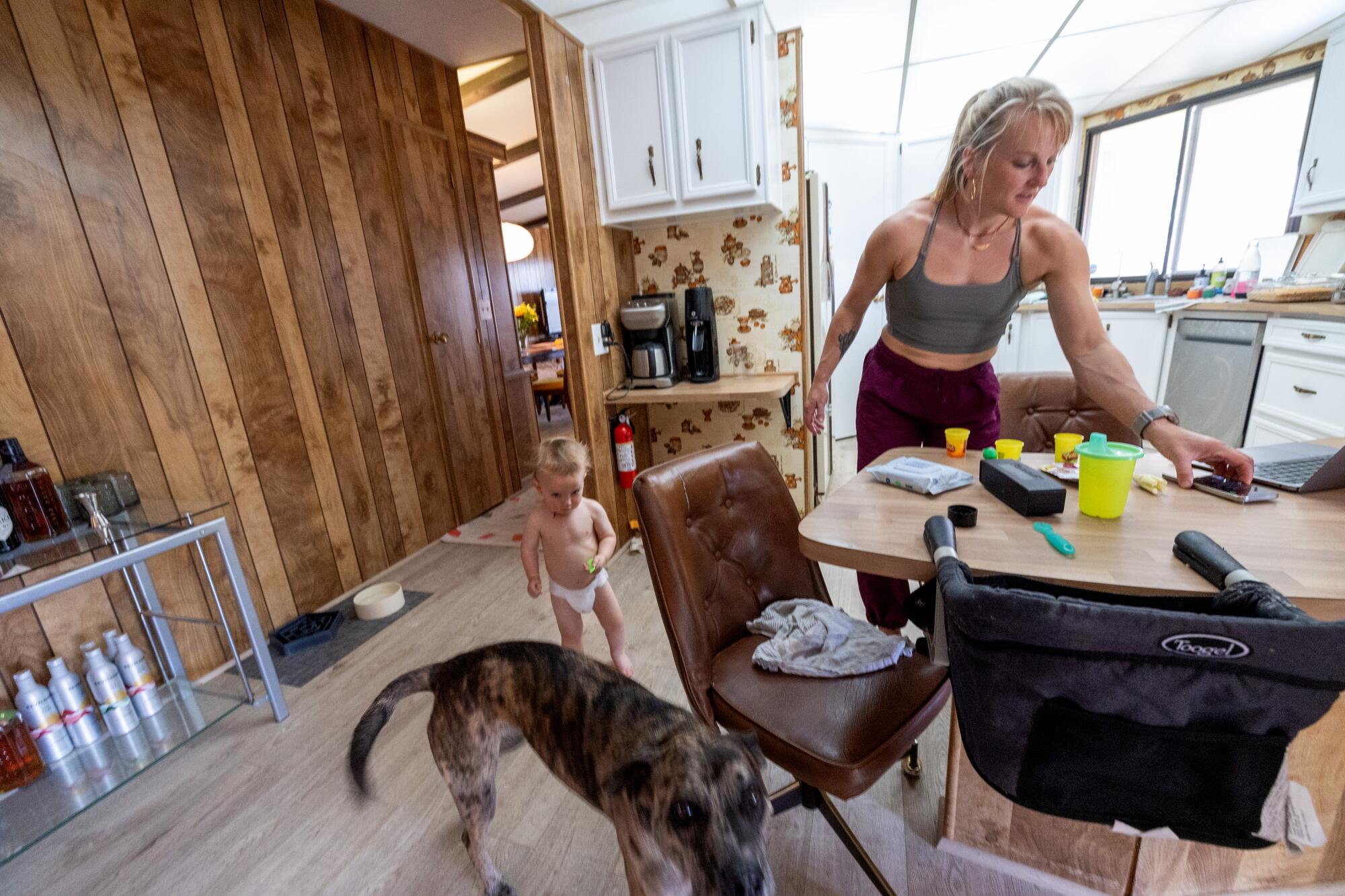
Hot showers. Good climbing. Great food. Climber Emily Harrington’s joy and relief are palpable as she lists the upsides of moving to the Las Vegas suburbs with her husband and son.
Emily Harrington, a five-time U.S. national champion in sport climbing and one of Honnold’s good friends, knows it all too well.
“Yosemite is just a hard place to exist,” she said. You spend all day pushing yourself to mental and physical exhaustion on the climbing walls, but there’s no rest when you come down. You have to find a place to camp, or park the van, or drive the van on long, crowded, windy roads to find a place outside the park. And even when you find a place, you’re still stuck in a van.
“It’s quite stressful,” Harrington said.
At 37, Harrington says climbers of her generation are looking to settle down. She and her husband, fellow climber Adrian Ballinger, recently had a son, which added real urgency to their quest.
That’s why they bought a place in Vegas not far from Honnold, his wife and their two young kids.
Harrington’s joy and relief are palpable as she lists the upsides of the new arrangement. “I can go out, drive five minutes to the trailhead, climb big routes all day, and then come back to my house and my kid and put him to bed, and I don’t have to live in a van!”
Hot showers. Soft beds. Great food. She rattled off about half a dozen of her favorite restaurants that are only a few minutes away. “It’s just so nice,” she said.
Jonathan Siegrist, 38, who is regarded as one of the world’s greatest technical climbers, couldn’t agree more.
While Honnold was battling the Rainbow Wall and nearly 90 degree heat in Red Rock last week, Siegrist and his wife, Shaina Savoy, huddled in puffy jackets between pitches on the cool limestone of nearby Mt. Charleston.
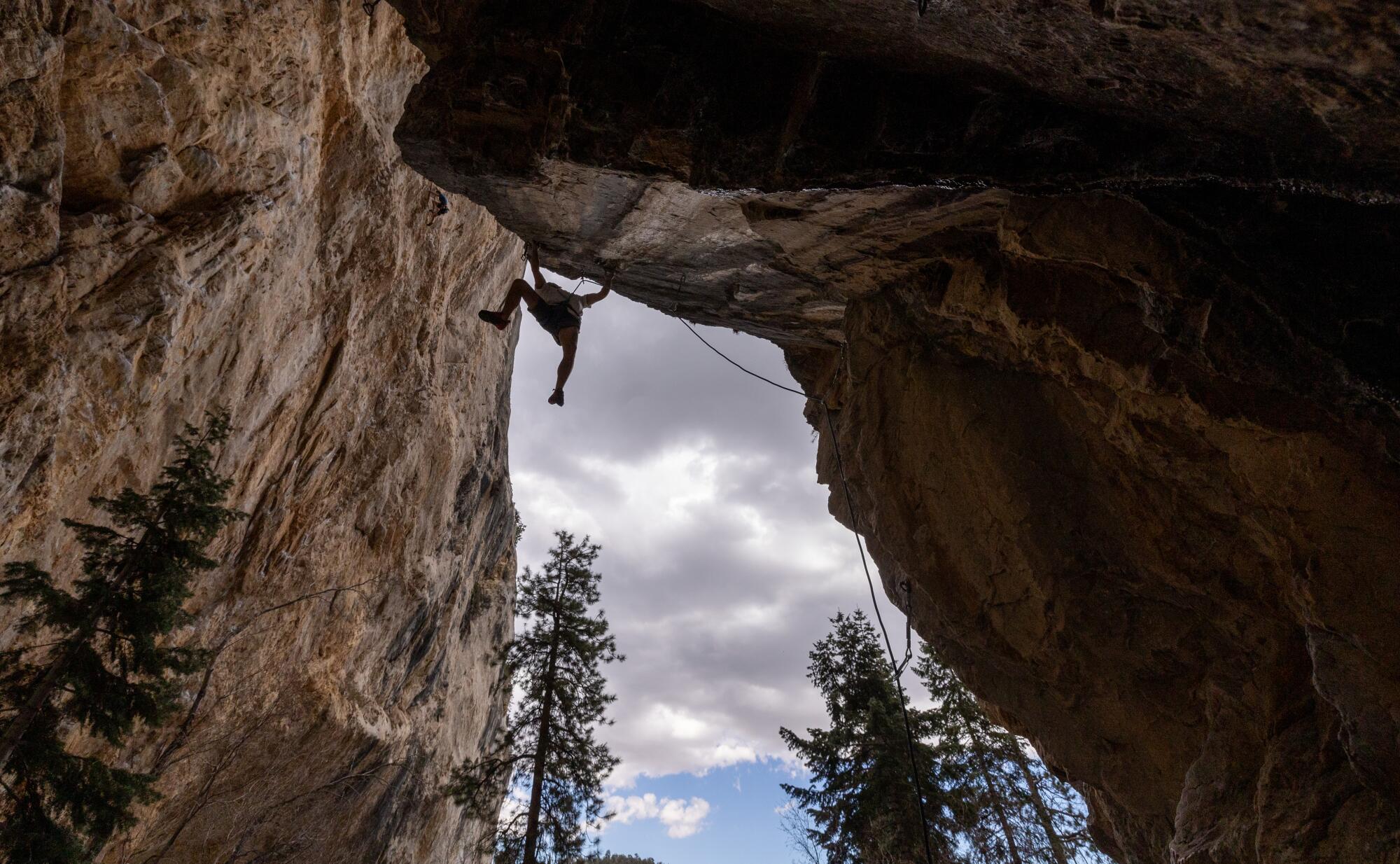
Jonathan Siegrist tackles Robbers Roost, a world-class rock-climbing destination in the Spring Mountains National Recreation Area.
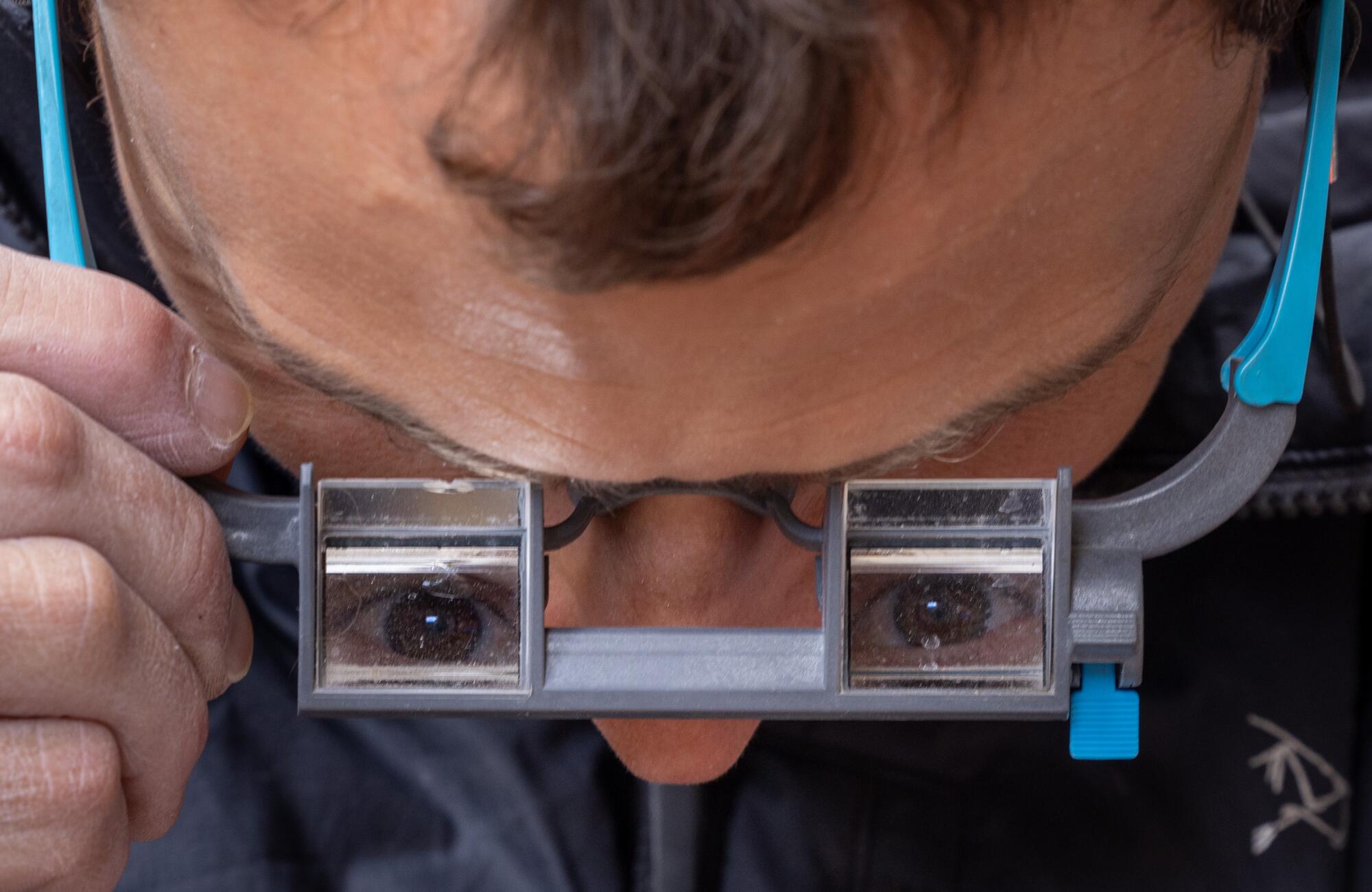
Jonathan Siegrist wears belay glasses, which give climbers a 90-degree view without craning their neck, during a climb at Robbers Roost.
Siegrist is unassuming when you first meet him: 5-foot-6, a firm handshake, a friendly smile. But then he pulls off his warm outer layer and starts climbing. Supporting his entire body with just his fingertips and the points of his toes on microscopic holds, he ascends the wall in precise choreographed movements, his progress as fluid and inevitable as flowing lava.
Despite the intense effort, which would leave most people gasping and single-minded, Siegrist had the aerobic and mental capacity to carry on a normal conversation.
He lived in his truck, off and on, for seven years. He settled down in Vegas because the climbing is better than anywhere else in the country and because the cost of living is much more reasonable than trendier climbing spots like his hometown of Boulder, Colo.
Even so, he struggles to convince young climbers, who are still trying to make names for themselves, that Vegas is the place to be.
“This city still has a really bad reputation in the outdoor community,” he said. “A lot of outdoor people would never stoop so low as to walk into a casino and enjoy themselves, or shop at a strip mall,” he said. “That’s a huge contributing factor as to why Vegas has stayed under the radar.”
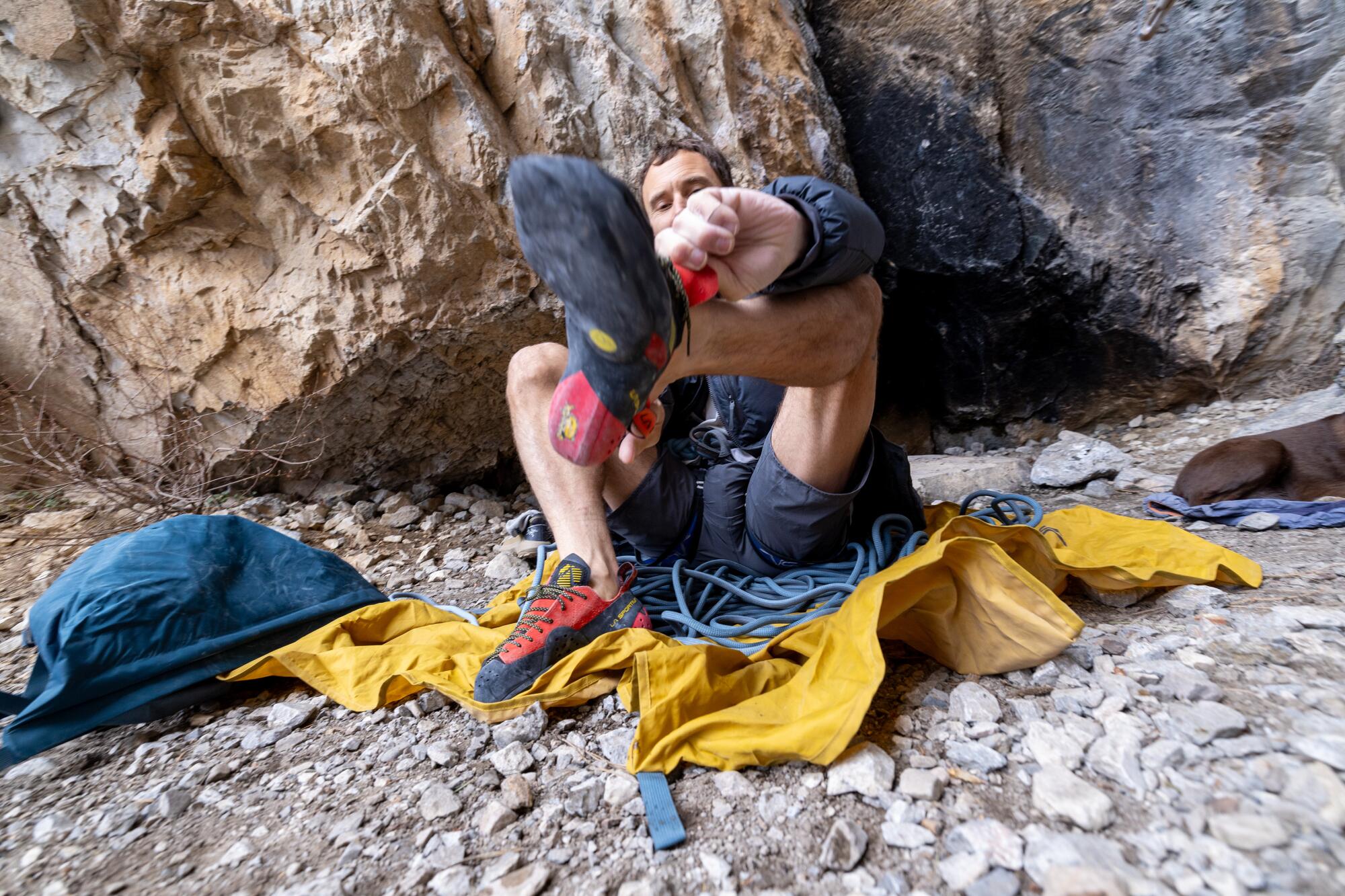
After living in his truck for years, Jonathan Siegrist said he settled in Las Vegas because the climbing is great and the cost of living more reasonable than in many trendy mountain towns.
But it’s actually one of the perks, he said.
Fashionable mountain towns are full of people trying to fit in, Siegrist said, to conform to a pretty strict outdoorsy aesthetic. They tend to look, dress and think the same way.
Freedom from that is one of the things he loves about Vegas.
“I’m not just talking about racial diversity. I’m talking about economic diversity, diversity of ideas and diversity of interests,” he said. On rest days, when he’s not climbing, “I can be a totally different version of myself.”
The difference can show in something as simple as walking his dogs off leash. If he tries that in Boulder, where his parents still live, “I’ll get yelled at by, like, six people in the first 30 seconds, even though the dogs are really obedient,” he said.
In Vegas, “nobody gives a s— what your dogs are doing as long as they’re not hurting anyone.”
Honnold, whose parents were teachers and who supports strong public services, confessed he, too, was pleasantly surprised by the lower cost of living in Nevada.
“I mean, there’s no income tax! And the house was so cheap, it nearly paid for itself in tax savings,” he said. All those years on the road, living in vans, he had listed his mom’s house in Sacramento as his address.
“That was crazy,” he said, “I was like, why didn’t I move to Vegas sooner?”
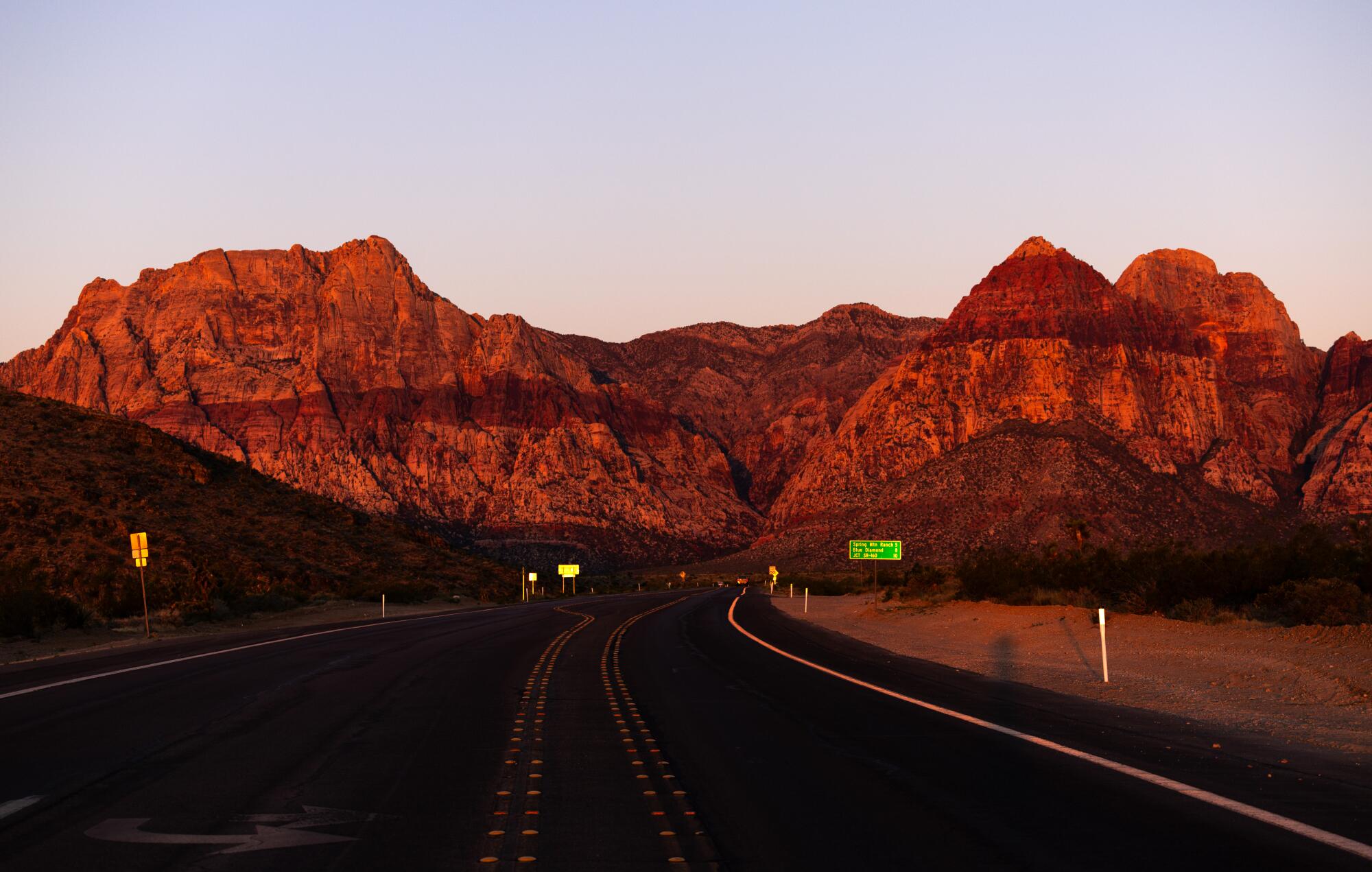
Sunrise at Red Rock Canyon National Conservation Area.
The Vegas airport is another huge draw for people whose profession demands they travel the world in search of adventure. It’s 20 minutes from Honnold’s house, the security lines are usually a breeze and, because of all the tourists, it has direct flights almost anywhere you’d want to go.
One day, when he was splitting time between training and promoting “Free Solo,” he climbed a 2,000-foot wall in the morning, showered at home, then caught a noon flight to London.
“Where else in the world can you do that?” he asked.
But what about that other side of Vegas, the strip? Honnold said he and his wife go there once or twice a year to catch a show and otherwise avoid it as much as possible.
Does he ever sit down at a slot machine and start pulling the lever?
“If a game is designed for you to lose, why play?” he asked. “I’ve actually never tried it. I like to joke that I only gamble with my life.”


NEWYou can now listen to Fox News articles!
Back in January, the odds that King James would retire before the beginning of the 2026-27 season were slightly longer than the odds that he would give it another go.
But as of now, it looks like LeBron will, in fact, give it another go but with a team other than the Lakers.
Here are the latest odds for where James could land next season at DraftKings Sportsbook as of June 30.
This page may contain affiliate links to legal sports betting partners. If you sign up or place a wager, FOX Sports may be compensated. Read more about Sports Betting on FOX Sports.
LeBron James Next Team Odds
Golden State Warriors: -115 (bet $10 to win $18.70 total)
Los Angeles Lakers: +105 (bet $10 to win $20.50 total)
Cleveland Cavaliers: +600 (bet $10 to win $70 total)
Miami Heat: +1000 (bet $10 to win $110 total)
New York Knicks: +3000 (bet $10 to win $310 total)
Detroit Pistons: +3000 (bet $10 to win $310 total)
Dallas Mavericks: +3000 (bet $10 to win $310 total)
San Antonio Spurs: +3500 (bet $10 to win $360 total)
Milwaukee Bucks: +4000 (bet $10 to win $410 total)
Brooklyn Nets: +4000 (bet $10 to win $410 total)
Washington Wizards: +5000 (bet $10 to win $510 total)
NBA free agency begins on June 30 at 6 p.m. ET. However, hours before its official start, LeBron James’ agent, Rich Paul, made a jaw-dropping announcement.
According to ESPN reporting, Paul notified the Lakers that the franchise could move on without LeBron because he plans to play elsewhere for the 2026-27 season.
James played for the organization for eight years — the longest he’s played for any other team. While in L.A., King James broke the all-time scoring record, won an NBA title and earned his fourth NBA Finals MVP.
The imprint he’s left on the league in his more than 20 years has been immeasurable.
Where will LeBron land next season now that his time in Los Angeles is over?
In addition to his tenure in Los Angeles, he’s played for the Cavaliers and the Heat, winning titles with all three franchises. He won Rookie of the Year, has four regular-season MVPs and is a 22-time All-Star.
James has averaged 26.8 points, 7.5 boards and 7.4 assists over the course of his career.
During the 2025-26 season, he helped lead the Lakers to a 53-29 record in the regular season. The team secured the No. 4 seed in the Western Conference and defeated Houston 4-2 in the first round.
Eventually, Los Angeles got bounced by Oklahoma City in the conference semifinals, 4-0, which marked LeBron’s last dance in Hollywood.
Sports
Contributor: U.S.-born Brian Gutiérrez and Obed Vargas signal a new era for Mexico’s national team

After the total failure that was Mexico’s participation in the Qatar 2022 World Cup, where they were eliminated in the group stage, the future looked very dire for “El Tri.” By 2024, the situation had worsened after another international failure at the Copa América. The 2026 World Cup co-hosts had even more pressure now. In a crisis-control move, the Mexico Football Federation opted to bring back its proven problem solver, head coach “El Vasco” Javier Aguirre, for a third stint.
In a short time, Aguirre was able to shape “El Tri” into a competitive squad by breaking from his usual approach. The man who shockingly demoted then-24-year-old goalkeeper Guillermo “Memo” Ochoa in favor of a more experienced player prior to the 2010 World Cup was now relying on upstarts.
Aguirre’s 26-man roster for the 2026 World Cup features 14 debutants on soccer’s grandest stage.The crown jewel of this nucleus is undoubtedly 17-year-old wonderkid Gilberto Mora, but there are also two American-born players who are also expected to become pillars of the team: Brian Gutiérrez, from Berwyn, Ill., and Obed Vargas, from Anchorage, Alaska.
Under Article 30, Section A, Part II of the Mexican Constitution, individuals born abroad are considered Mexican by birth if they are children of Mexican parents — a Mexican mother or a Mexican father. Gutiérrez’s parents are from San Juan de los Lagos, Jalisco, while Vargas’ father is a native of Morelia, Michoacán, and his mother was raised in Mexico City.
“Obviously, I’m taking it day by day and just trying to enjoy the experience,” said Gutiérrez about the opportunity to play for Mexico at the World Cup. “I talk about it a lot with my friends and family. Honestly, it’s amazing… I’m just living in the moment.”
Gutiérrez, 22, and Vargas, 20, are not the first players born in the United States to represent Mexico in a World Cup. That distinction belongs to Miguel Ponce and Isaac Brizuela, who were both born in California and part of the 2014 squad. But the comparisons largely end there.
Unlike Ponce and Brizuela, Gutiérrez and Vargas were fully raised in the United States and went through their entire soccer development on American fields. Ponce and Brizuela were also fringe contributors; they didn’t see any minutes in Brazil 2014.
Meanwhile, Gutiérrez and Vargas are already getting important playing time with the national team. Both were part of Mexico’s historic group stage where, for the first time in history, the team won all three of its games. Gutiérrez was a starter against South Africa and South Korea, while Vargas came off the bench to help preserve the 1-0 lead over South Korea.
Their protagonism in Aguirre’s squad could also signal another new era for the Mexican national team — one in which Mexican American players are just as vital as those born on Mexican soil.
“Brian and Obed are two young players of Mexican heritage. They are very talented players who have made great progress recently. We called them up, and they convinced us with their performances,” said Aguirre prior to the tournament. “I believe there are many Mexican American players who, in the future, will continue strengthening Mexico’s youth national teams, including the women’s side. That makes me happy because they were not born in Mexico, yet they have a deep love for the country and have shown it by choosing to represent us.”
Both Gutiérrez and Vargas are also products of MLS academies.
Gutiérrez, a skillful and dynamic attacking midfielder, rose through the ranks of Chicago Fire’s youth system and made his senior debut in 2020. In December, he moved to storied Liga MX club Chivas, his childhood team. It took time for Gutiérrez to establish himself as a starter for Gabriel Milito’s squad, but his game-changing talent was there — enough to catch the eye of “El Vasco.”
Vargas, a box-to-box midfielder, developed through the Seattle Sounders youth system and debuted with the senior team in 2021. A strong showing against Atlético de Madrid in the 2025 Club World Cup led to the Spanish club adding him to its roster this February. This move also put him in Aguirre’s World Cup plans.
“Playing for Mexico at the World Cup is a dream come true for all Mexican American kids,” said Vargas. “Obviously, with the World Cup being in both countries, it’s special to me. I have connections and ties to both countries.”
For so long, it was said Mexican American players just could not earn a place with Mexico at the international level. Players like Édgar Castillo and Alejandro Zendejas — born in Juárez but raised in El Paso — represented “El Tri” up to the U-23 level, then switched and played for the U.S. Jonathan González (Santa Rosa, Calif.) represented the U.S. at youth level and then chose Mexico, but after a few call-ups he fell out of the picture.
But in this World Cup cycle, Mexican American players have stood out more than ever.
Aguirre’s preliminary 55-man World Cup roster included six Mexican American players. Richard Ledezma (Phoenix), Efraín Álvarez (Los Angeles), Jorge Ruvalcaba (Rialto), and Julián Araujo (Lompoc, Calif.) ultimately missed the final cut. Of the four, Ledezma and Araujo came closest to making the team, but for different reasons fell short.
Vargas believes it was only a matter of time before the talent broke through.
“I think Mexican American players have always been there. The quality has always been there. Obviously, the growing passion for the sport in the United States has helped fuel the development of many of those players,” said Vargas. “I think it’s amazing to see so many Mexican Americans doing well with the national teams of both the United States and Mexico. Dreams come true for kids, and that continues to inspire the next generation of Mexican American players coming through in the U.S.”
Gutiérrez and Vargas, like many standout Mexican American players over the last 15 years, began their paths with “El Tri” amid a long-standing tug-of-war between their birth country and the country of their parents. The Mexico men’s national team and their U.S. counterparts have increasingly become rivals, both on the field and in recruiting dual-national players.
For Mexico, the United States now represents a prime area for scouting outside its territory. According to the Migration Policy Institute’s (MPI) tabulation of data from the U.S. Census Bureau’s 2022 American Community Survey, approximately 38.8 million U.S. residents were either born in Mexico or reported Mexican ancestry or origin.
Not only do Mexican American players expand the national team’s talent pool, but as some argue, they also bring a different element that can be a major advantage for the program.
Former Mexico youth coach and current Guatemala coach Luis Fernando Tena recently raised eyebrows in an interview with ESPN Deportes by stating that Mexican American players possess qualities that can set them apart from homegrown Mexican players.
“They have an American mindset. They grew up with that mentality and with good nutrition, and that makes them different,” said Tena, who led Mexico’s U-23 team to the gold medal at the 2012 London Olympics. “They are more disciplined, work harder, and are more focused — something that we sometimes don’t always find in many Mexican-born players.”
Gutiérrez and Vargas started their international careers representing Team USA at youth level, but FIFA’s one-time switch rule allowed them to change allegiances.
Vargas said he chose Mexico because he simply “followed his heart.” His love for his heritage and the Mexican national team outweighed everything else.
As for Gutiérrez, he was motivated to make the change because his time at Chivas convinced him. In Liga MX, the club has been at the forefront of tapping into the Mexican diaspora in the U.S. Their long-standing “Mexicans-only” policy limits the club’s talent pool when acquiring players. Because of this, Mexican American players are becoming a vital lifeline for Chivas.
“As soon as I arrived at Chivas, I knew my decision was to represent Mexico because we play with 100% Mexicans, that’s just how it is,” said Gutiérrez.
Opportunity may have also played a major role in Gutiérrez’s and Vargas’s “one-time switch” decisions. Both had no clear pathway into the U.S. senior squad, while Mexico offered a clearer route — and a chance at the 2026 World Cup.
In a 2023 interview, El Paso native Ricardo Pepi, who made the one-time switch from Mexico to the U.S., said on the Men in Blazers podcast that his decision was influenced by the fact that the U.S. had him in mind for the senior squad, while “El Tri” did not.
“It was just easy to decide. The U.S. wanted me to join them in World Cup qualifiers, which is a big deal,” said Pepi. “It’s a unique opportunity, being at a World Cup, and something I didn’t even have to think about because Mexico wanted me for the U-20s and eventually the first team. I was like, ‘I’m past that.’”
Although Gutiérrez and Vargas chose Mexico and embrace their parents’ culture, their duality is still present. They carry their communities with them.
A year ago, when aggressive ICE raids and mass deportations swept through many immigrant communities in the United States, particularly Mexican immigrant communities, a visibly frustrated Aguirre refused to comment on the situation, saying he was “apolitical” and not “a spokesperson” for the Mexican people.
This was not the case with Gutiérrez and Vargas, who both addressed questions about the ICE raids during Mexico’s World Cup media day in Pasadena, where they switched seamlessly between English and Spanish.
Gutiérrez answered without hesitation. His hometown of Berwyn is a suburb of Chicago, a city that in September was targeted by “Operation Midway Blitz,” a major federal immigration enforcement surge. According to the Chicago Tribune, between 3,800 and 4,500 individuals were detained or arrested during the operation.
Gutiérrez’s words reflected the strain felt throughout his community.
“It’s been a hard, hard year for us,” Gutiérrez said. “It’s affected a lot of families, and I take playing for Mexico with great pride and hope to show it on the field.”
It’s no secret that a large part of Mexico’s fanbase is composed of Mexican Americans. They are the ones who help fill massive NFL stadiums for “El Tri’s” annual MexTour, a slate of mostly inconsequential friendly matches that are often seen as a cash grab for the Mexican Football Federation. The presence of standout players like Gutiérrez and Vargas is a major development for this segment of the fanbase.
By featuring players with shared cultural experiences and struggles, the connection between the Mexican diaspora in the U.S. and “El Tri” can only strengthen. The ties now go beyond simply sharing the same roots; Mexican Americans can now gravitate toward a team with players who represent their dual identity. And this can bring a true sense of belonging.
Sports
Paraguay stuns four-time World Cup champions Germany in penalty shootout after controversial call

NEWYou can now listen to Fox News articles!
Paraguay stunned Germany, the four-time FIFA World Cup champions, after moving on to the round of 16 after winning 4-3 in a penalty shootout on Monday in an absolutely thrilling match with a key controversial moment sprinkled in.
That moment came in extra time, which was needed after a 1-1 draw after 90 minutes plus stoppage time between these two opponents.
Germany had dominated throughout this match, but Paraguay had made the best of their grade-A chance in the first half when Julio Enciso buried a header in the 42nd minute. The Germans were able to finally get on the board, though, in the 54th minute when Kai Havertz saw his own header flick into the back of the net.
Julio Enciso of Paraguay celebrates with teammate Gustavo Gomez after scoring the team’s first goal during the FIFA World Cup 2026 Round of 32 match against Germany at Boston Stadium in Foxborough, Mass., on June 29, 2026. (Alexander Hassenstein/Getty Images)
From there, Germany was on the offensive, getting chance after chance with some from Paraguay tossed in. But when extra time began, it seemed only a matter of time before Germany would pot another and take the lead.
It appeared to happen when Jonathan Tah rose up and smashed a header on a corner kick past Paraguay keeper Orlando Gill. The German faithful inside Boston Stadium went ballistic, but that was short-lived after the head official went to the VAR screen to review a potential foul.
CURACAO STUNS GERMANY AT WORLD CUP WITH HISTORIC GOAL THAT SENDS SUPPORTERS INTO UNDERSTANDABLE FRENZY
During the corner kick, Germany’s Waldemar Anton seemed to obstruct Gill’s movement toward the ball, and ultimately to defend Tah’s header. And if he was simply trying to sell the foul, it worked.
After review, the goal was annulled with the referee explaining that Anton’s actions had prevented Gill from properly getting the chance to stop the header.
After the 30 minutes of extra time, neither side was able to break the 1-1 tie. As a result, the tournament’s first penalty shootout was set to determine who would move on to the round of 16, and who would be heading home.
Things did not start off on the right foot for Germany when Havertz stepped up to the ball and saw Gill make a save. Maurício used that momentum and scored his first to immediately put Paraguay in a good position to win.
Both sides would ace their next two penalties apiece before Nick Woltemade’s attempt was saved by Gill. Paraguay, now, had a chance to win it all, but Antonio Sanabria missed the team’s fourth penalty.
Orlando Gill of Paraguay celebrates after Julio Enciso scored the team’s first goal during the FIFA World Cup 2026 Round of 32 match against Germany at Boston Stadium in Foxborough, Mass., on June 29, 2026. (Michael Reaves/Getty Images)
Nadiem Amiri kept Germany’s hopes alive with a made shot on the team’s fifth attempt, but being that penalties are determined by five shots, Fabián Balbuena had the opportunity to win it all. However, Manuel Neuer, one of the most decorated goalkeepers in soccer history, let alone Germany’s squad, kept up clutch with a save to force another round.
With slight momentum on their side, Tah stepped up to the penalty area with the chance to get another game-winning goal, this time with his boot. But his attempt was a miserable one, belting it over the crossbar and into the stands.
Paraguay, elated after the miss, sent José Canale to the box and he didn’t disappoint. Neuer guessed the wrong way and Canale tucked his shot under the bar and Paraguay celebrated as you’d expect: pure joy.
It’s the first time ever Germany has lost in penalties at the FIFA World Cup.
Germany was left shocked on the pitch, as their 2026 World Cup journey comes to a close. And it’s hard not to think what-if when they appeared to have the game-winner on the scoreboard only for it to be taken away by a call that will certainly be debated for some time.
Paraguay’s midfielder Julio Enciso celebrates scoring his team’s first goal during the 2026 World Cup round of 32 match against Germany at Boston Stadium in Foxborough on June 29, 2026. (Odd Andersen/AFP via Getty Images)
CLICK HERE TO DOWNLOAD THE FOX NEWS APP
Meanwhile, Paraguay will now await the winner of the round of 32 match between France and Sweden, which will be played at 5 p.m. ET on Tuesday at New York/New Jersey Stadium.
Follow Fox News Digital’s sports coverage on X and subscribe to the Fox News Sports Huddle newsletter.
-

 Wyoming6 minutes ago
Free Crow Culture Program at Fort Phil Kearny
-

 Crypto9 minutes ago
UK investors sue Binance in London for £150 million
-

 Finance14 minutes ago
What the Supreme Court’s campaign finance ruling means for the 2026 election
-

 Fitness21 minutes ago
I pushed myself too hard at the gym – and ended up in the hospital
-

 Movie Reviews29 minutes ago
Young Washington (Christian Movie Review) – The Collision
-

 World39 minutes ago
Neon Closing in on Luca Guadagnino’s Sam Altman Open AI Movie ‘Artificial’ After Amazon Drops Controversial Film
-
 Lifestyle1 hour ago
‘Dead but Dreaming of Electric Sheep’ is full of beautifully written grotesqueries
-

 Technology1 hour ago
Google’s NotebookLM can sum up your research in a TikTok-style clip

