Sports
What I learned from Netflix’s ‘The Kiss That Changed Spanish Football’ documentary


From July-August last year, I was in Australia and New Zealand covering Spain’s Women’s World Cup win — and the scandal that followed when the country’s now-disgraced federation president Luis Rubiales gave striker Jenni Hermoso an unsolicited kiss.
From months before the tournament to returning to my home in Barcelona, the experience was surreal. A new Netflix documentary called #SeAcabó: Diario de las campeonas (It’s All Over: The Kiss That Changed Spanish Football) made me relive the calm before the storm I experienced at La Roja’s base in Palmerston North, New Zealand, and the frustration that followed.
It’s worth remembering the turbulence of Spain’s World Cup preparations. When their squad was announced, it didn’t include some of the game’s best players. Fifteen internationals had declared themselves ineligible for mental health reasons until the federation (RFEF) made changes to the way it treated women’s football. Some players went to the World Cup after a nine-month absence from the national team.
There were many internal divisions: between ‘Las 15’, as the players who had sent emails declaring themselves ineligible became known in the media, and others who did not. And also between those who sent the email and decided to go to the tournament anyway, and those who did not.
You would think that climate would make it impossible to win anything but, strangely enough, the opposite happened. Spain made history by winning a knockout game in a major competition for the first time — and went all the way to the final, where they beat England 1-0.
But that was just the beginning. After full time, coach Jorge Vilda pointed to Rubiales in the stands, who responded by grabbing his crotch and pointing to Vilda, as if the success was theirs alone. That ignored the fact this was an exceptional generation and showed the players had been right to say that people did not believe in them. It was disrespectful to everyone, including England’s Lionesses.
Then came Rubiales’ kiss on Hermoso, his non-apology, the pressure on Hermoso to downplay the seriousness of the incident in a proposed video with him, and a speech from Rubiales in which he blamed “false feminism” for how he had been treated and repeated “I’m not going to resign” five times.
GO DEEPER
Spain won the Women’s World Cup – but Luis Rubiales has made me ashamed to be Spanish
Rubiales eventually resigned 21 days after the final following a provisional sanction from world governing body FIFA (it then banned him from football for three years). The legal case over the kiss continues, with Spanish prosecutors seeking a two-and-a-half year prison sentence for him, consisting of a one-year sentence for a charge of alleged sexual assault and a further one-and-a-half years for alleged coercion. The trial will start on February 3 next year.
Rubiales has always claimed Hermoso gave consent for him to kiss her. Hermoso has testified the kiss was not consensual and that attempts were made to force her into saying the opposite. Various Spanish outlets reported that Rubiales denied coercing Hermoso in his testimony before a judge in September last year.

Rubiales will stand trial in February next year (Alberto Gardin/SOPA Images/LightRocket via Getty Images)
The main focus of the documentary is on Alexia Putellas, Hermoso and Irene Paredes. Aitana Bonmati, Laia Codina, Teresa Abelleira, Ivana Andres, Sandra Panos, Olga Carmona and Lola Gallardo also feature.
It goes in chronological order from before those 15 emails were sent, explaining how, even after the 2022 European Championship in England, this talented generation felt as if they were being wasted and that Vilda was not giving them solutions when games were not going well.
As The Athletic has reported, and the players discuss in the documentary, Vilda asked them to leave the door to their hotel rooms open until midnight. He stopped them at points to ask them to show them the inside of their bags — to see if they had bought anything. They reproached him for what they perceived as lazy coaching and a lack of professionalism in training.
In a press conference in September 2022, after he had omitted the 15 players from his squad, Vilda said: “I challenge anyone to come out and say there hasn’t been respect or that there’s been a bad mark in my behaviour with them (the players) in all my career.”
The players say in the documentary that Paredes spoke to Vilda and Rubiales in August 2022 to explain the players’ feelings, and the full conversation was leaked a few days later in the press.
“I was shocked because that conversation was only between me and him (Rubiales),” Paredes explains in the documentary. “He went after us.”
In many stories at the time, Paredes was portrayed as the instigator of a campaign against Vilda. She gave a press conference on September 1 with Guijarro and Hermoso — alongside Vilda — in which they explained they only wanted basic improvements.
“Between games, we were travelling five hours by bus,” Paredes says in the documentary. “We didn’t have our own dressing room. We couldn’t use the gym, the only one we had, because it belonged to the boys, even if they weren’t there. It was a lot of things.”
The documentary details another national team training camp in September 2022. Following the first lunch, all the players were gathered by Vilda. Chairs were put in a circle and the women were encouraged to air their concerns, according to everyone interviewed in the documentary. The Barca contingent was the most vocal at that meeting, and this is where the division between players started.

Vilda after the World Cup final (Joe Prior/Visionhaus via Getty Images)
Those who later declared themselves ineligible, such as Bonmati, felt everything had been said unanimously by the players — but were then disappointed by how others didn’t speak up or contradicted them in the meeting.
“We were asked if we wanted to continue defending that shirt,” says Abelleira. “You were in front of someone who was going to decide whether to call you up or not depending on what we said.”
“In that meeting, I had something inside, I was telling myself that I had to speak up,” Ivana Andres, who was Spain’s captain for the World Cup, says. “But there were very radical positions (being taken) that said they couldn’t take it any more and I thought it was a very high price to pay and I didn’t want to miss a World Cup. In the end, I finished that meeting and I didn’t speak.”
“I was in a very different position to the rest of my team-mates because I had been in the national team for less time,” Carmona adds.
“I feel bad that they all couldn’t say what they felt because we all had the same opinion,” Bonmati says.
“I understood that meeting (was used) as a way of dividing us further,” Paredes says.
It is the first time the players have publicly expressed the divisions that existed within the group. We see how temporary bridges were built between the players and the RFEF — which gave them the minimum guarantees so they would go to the World Cup.
But we also see how Panos was excluded by Vilda despite being the starting goalkeeper for the reigning Spanish and European champions, Barca. Panos says she sent an email asking Vilda to come back for the World Cup and never received a response. Vilda then told a press conference that she had not been called up for sporting reasons.
But what moved me the most — and what makes the documentary so important — is how the aftermath of the kiss on Hermoso is shown.
In a moment of maximum euphoria, at the peak of happiness in her sporting career, having achieved something she thought would never happen, Hermoso stood on the stage to be given her winner’s medal. Rubiales took full advantage of that moment of weakness to ruin it forever, kissing her on the lips.

GO DEEPER
Jenni Hermoso: Record goalscorer, serial swearer and icon of Spanish sport
In Hermoso’s head, something started to feel wrong. She was happy about the win, but something wasn’t right. Putellas and Paredes say Hermoso approached them to tell them about the kiss, looking for someone to tell her if it was right or wrong.
Hermoso is always the dressing-room joker, the one who is always in a good mood, the DJ, the one who makes her colleagues laugh. In the adrenaline of the moment, Putellas says she thought Hermoso was joking when she said Rubiales had kissed her.
The striker didn’t get the answers she was looking for at first and opted to say no more and keep celebrating — nobody wants to be the party pooper when you have won a World Cup. Then some of the players began to echo what had happened in a live broadcast on social media.
“Who kissed?,” goalkeeper Misa Rodriguez asked during the celebrations, as captured in a live stream from the time.
“Eh, but I didn’t like it,” Hermoso responded, still celebrating but making clear it wasn’t about her. “And what do I do? Look at me, just look at me (in that moment).”
During the celebrations, Rubiales went down to the dressing room. He came in, made jokes, said they all had a trip to Ibiza paid for when they returned from the tournament and that his wedding to Hermoso would take place there, as multiple videos from the players’ live streams showed. Thinking it was all a joke, the players celebrated. Rubiales went to grab Hermoso to recreate the image of a bride and groom at a wedding, while she made a face of clear discomfort.
The jokes continued until Paredes came down from the World Cup cloud and warned the others. “Girls, this is serious,” she said, as she details in the documentary.

Hermoso was awarded the Socrates Award at the recent Ballon d’Or ceremony for her humanitarian efforts (Jose Breton/Pics Action/NurPhoto via Getty Images)
The different recordings and testimonies show the different phases Hermoso went through.
According to the documentary, a pivotal moment for Hermoso came in Ibiza. While the team were enjoying a well-deserved holiday as world champions, Hermoso and the players who accompanied her describe how she went through hell, as she felt she was put under pressure by the RFEF to make a statement saying everything was fine.
As Hermoso, Bonmati and Andres describe, Rubiales tried to pressure her on the plane home from the World Cup, attempting to record a video first with her and then with one of the captains to say everything was fine. Bonmati says she was even asked to appear on TV to reduce tensions, but they all refused.
“Rubiales, Jenni and I had a chat,” Codina says. “He told us that he was meeting a woman and that this woman had spoken to him and told him that nothing was wrong with the kiss, that she should just make the video and that was it.”
The pressure increased. Hermoso received messages from then-national team director and former Newcastle United striker Albert Luque saying that Rubiales didn’t deserve that and that she should take a stand. Those are messages the player herself shows in the documentary, including ones sent to a friend of hers when Hermoso stopped responding.
Prosecutors are seeking a one-and-a-half-year sentence for Luque for the charge of alleged coercion. He denied coercing Hermoso when he testified as a defendant in the Rubiales case in October 2023, according to several Spanish media reports, but admitted to having sent her messages.
GO DEEPER
Rubiales: Prosecutors seeking two-and-a-half-year prison sentence for ex-RFEF president
“They told me that it wasn’t going to stay like this,” Hermoso explains to Putellas and Paredes. “Threats. There came a point when I was walking and I had to turn around and look. I was afraid.”
Hermoso says the RFEF’s marketing director, Ruben Rivera, told her to call the federation’s integrity department to say “nothing” had happened. She says: “I didn’t want to, I didn’t know what I was signing”. Prosecutors are also looking to charge Rivera for alleged coercion. In March, he told radio station Cadena SER, “I have never coerced anyone in my life”.
While Hermoso was in Ibiza, Putellas and the other players told her it was better not to think about it, telling her to disconnect and enjoy the holiday. Then, Hermoso started crying.
“When I found out about everything in Ibiza, I felt terrible,” Putellas says. “You were telling us without saying it directly: ‘Help me’. And we were like, forcing you to think that nothing was happening, to say: ‘Forget about it, you’ve had a great World Cup, celebrate’.”
Hermoso faced harassment on social media. When she left her house, photos of her were posted on the internet with comments asking how things could be so bad if she was going for an ice cream.
The most striking thing about the documentary is that many women, to a greater or lesser extent, may identify with what happened to Hermoso. That goes beyond football, her or Rubiales.
What Hermoso goes through, from the time the medal is hung around her neck until she makes a complaint, is perceived in the documentary as a typical pattern of a woman who has been harassed by her superior at work. You convince yourself that everything is fine and try to continue celebrating, then you break down and cry because you realise that the best day of your life has been tarnished forever.
But it also shows that there are many friends like Putellas and Paredes ready to help someone fight. To help them say “It’s over — se acabó”.
(Top photo: Putellas, Hermoso and Paredes lift the World Cup; Jose Breton/Pics Action/NurPhoto via Getty Images)



Sports
Pirates star pitcher makes unfortunate history after being taken out in middle of perfect game bid

NEWYou can now listen to Fox News articles!
Jared Jones was flirting with Major League Baseball history on Wednesday night — he got it, but it was not what he originally envisioned.
The Pittsburgh Pirates pitcher retired the first 18 batters he faced, but he was taken out in the middle of his perfect game bid after six innings.
Now, the Pirates certainly have their reasons — the 24-year-old Jones hasn’t thrown more than 81 pitches in eight starts since returning May 20 after missing all of last season while undergoing ulnar collateral ligament internal brace surgery on May 21, 2025. He was yanked with 77 pitches and likely would have needed more than 100 pitches to record the 25th perfect game in MLB history.
Jared Jones of the Pittsburgh Pirates pitches during the first inning against the Atlanta Braves at PNC Park on July 8, 2026, in Pittsburgh, Pennsylvania. (Photo by Joe Sargent/Getty Images)
However, Jones left the game after getting zero run support, so when the Atlanta Braves tacked on three runs late for a 3-0 victory, Jones instead found himself in the wrong chapter of the history books.
According to Opta Stats, Jones became the first pitcher in the modern era (since 1920) to pitch at least six perfect innings and not record a win.
“It does suck. Something’s cool coming on, but I’m on what? My eighth start off of surgery? I completely understand it, and it is what it is,” Jones told reporters after the game.
Pittsburgh Pirates starting pitcher Jared Jones (17) makes his way to the field to warm up before pitching against the Atlanta Braves at PNC Park. (Charles LeClaire/Imagn Images)
JUSTIN VERLANDER ANNOUNCES HE WILL RETIRE AFTER THIS SEASON: ‘I’VE REALIZED THAT TIME HAS COME’
Jones said he didn’t entertain attempting to complete the perfect game.
“Not with the pitch count,” he said. “Not really ever expecting to go nine right now, so that was never in my head.”
Joey Bart, traded to the Braves from the Pirates on June 18, followed a double by Mike Yastrzemski with a 422-foot, two-run homer to left-center field off a slider from Dennis Santana. Drake Baldwin added an RBI single to center in the ninth for good measure.
It was the second time in less than a week that a pitcher was taken out of the game with a perfect bid through six innings — the Miami Marlins took Eury Perez out after seven innings in which he had 92 pitches. Perez, too, is in the midst of returning from injury and has surprisingly found himself right in the postseason mix.
He was pulled for Lake Bachar to start the eighth, and the Marlins allowed eight runs to the Athletics in the final two innings, but held on to win 9-8.
Jared Jones (17) of the Pittsburgh Pirates delivers a pitch during a MLB game against the Cincinnati Reds on June 27, 2026, at PNC Park in Pittsburgh, Pennsylvania. (Joe Robbins/Icon Sportswire via Getty Images)
CLICK HERE TO DOWNLOAD THE FOX NEWS APP
The Pirates are 4.0 games out of the final wild card spot, which is held by the Marlins.
The Associated Press contributed to this report.
Follow Fox News Digital’s sports coverage on X, and subscribe to the Fox News Sports Huddle newsletter.
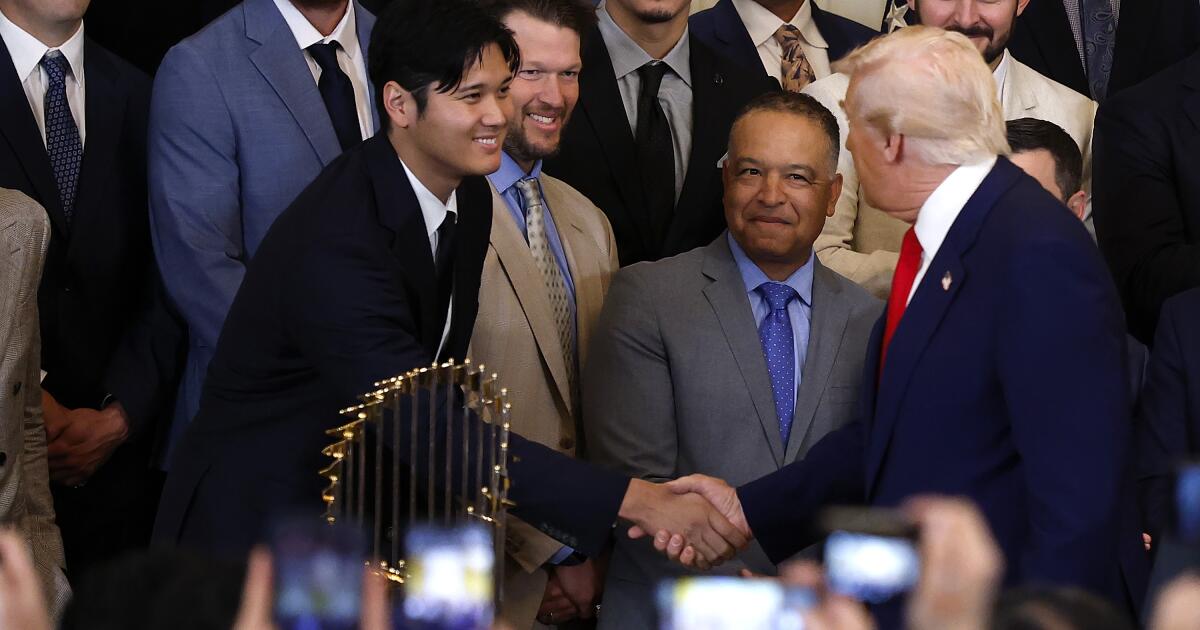
WASHINGTON — The Dodgers are scheduled to visit the White House on July 23 to celebrate their latest World Series title.
“President Trump is excited to welcome the Los Angeles Dodgers BACK to the White House to celebrate their World Series championship!,” White House spokesperson Taylor Rogers said in a statement to The Times.
The date falls on a scheduled off day in the middle of a nine-game East Coast road trip for the Dodgers. The team will play three games in Philadelphia against the Phillies July 20-22 before ending the trip with a three-game series against the New York Mets July 24 to 26.
The visit continues a tradition from the Dodgers’ two previous World Series championships. They were hosted by President Biden in 2021 and President Trump in April 2025.
After the Dodgers claimed their second consecutive World Series title with a dramatic Game 7 victory over the Toronto Blue Jays, a visit to the White House was planned, but it wasn’t until Thursday that a date was officially booked and confirmed.
Questions swirled around whether players would decline the visit this year after it did not happen during a scheduled visit to Washington in April.
Kiké Hernández said in 2018 he was unsure he would have gone had the Dodgers won the World Series the previous year. Mookie Betts said he was undecided and needed to talk it over with his family when last year’s visit was announced. After winning his first World Series with the Boston Red Sox in 2018, Betts skipped their trip to the White House the following year during Trump’s first term.
Both players, along with every returning member of the 2024 team who was with the team during its road trip, participated in the visit. The only notable absence was first baseman Freddie Freeman, who remained in Los Angeles to nurse an ankle injury.
Manager Dave Roberts, who indicated in comments to The Times in 2019 he might not go to the White House if Trump was president, also participated in last year’s ceremony.
Asked at the Dodgers’ fan festival in January about the possibility of returning to the White House, Roberts told The Times’ Bill Shaikin: “For me, I stand by: I’m a baseball manager. That’s my job.”
“I was raised — by a man who served our country for 30 years — to respect the highest office in our country,” Roberts said. “For me, it doesn’t matter who is in the office, I’m going to go to the White House. I’ve never tried to be political. … For me, I am going to continue to try to do what tradition says and not try to make political statements, because I am not a politician.”
Clayton Kershaw, who retired after last season but was on Team USA for this year’s World Baseball Classic, told The Times in the spring that he was aware Dodgers fans are split over whether the team should visit the White House again this year, but he said he is looking forward to it.
“I went when President Biden was in office. I’m going to go when President Trump is in office,” Kershaw said. “To me, it’s just about getting to go to the White House. You don’t get that opportunity every day, so I’m excited to go.”
Times deputy sports editor Ed Guzman contributed to this report.

NEWYou can now listen to Fox News articles!
All eyes were on Caitlin Clark on Wednesday night as she made her anticipated return from injury in a road matchup in Los Angeles.
But instead of a triumphant comeback, the Fever spent the entire night chasing the Sparks as Clark’s rough return fueled a 106-92 rout.
The superstar never found a groove, looking completely out of sync in her return from a back injury.
STEPHANIE WHITE GIVES CAITLIN CLARK STATUS UPDATE AHEAD OF FEVER-SPARKS, BUT HER NEXT MOVE RAISES QUESTIONS
Caitlin Clark huddles with teammates as the Indiana Fever battle the Sparks. (Photo by Katelyn Mulcahy/Getty Images) ((Photo by Katelyn Mulcahy/Getty Images))
Much of that disjointed performance falls squarely on head coach Stephanie White, who kept Clark on a ridiculously tight leash by limiting her to just 16 minutes. The stop-and-go approach could have sabotaged any chance for the phenom to establish a rhythm.
Clark finished with just 9 points, 4 rebounds and 3 assists. Her minus-16 plus-minus told the story.
The Los Angeles Sparks were severely shorthanded, taking the floor without stars Kelsey Plum and Cameron Brink.
MERCURY’S NOW-DELETED SOCIAL MEDIA POST MOCKING CAITLIN CLARK DRAWS SCRUTINY AFTER STAR’S INJURY
Yet while a depleted Sparks roster played to win, Indiana spent the night over-managing its biggest asset.
With Clark on a minutes restriction and Aliyah Boston out of the lineup, Kelsey Mitchell was forced to shoulder the entire offensive burden.
Mitchell did her part, pouring in 29 points while shooting 5-of-9 from beyond the arc.
Caitlin Clark orchestrates the Fever offense as Indiana battles the Los Angeles Sparks in primetime action. (Photo by Katelyn Mulcahy/Getty Images) ((Photo by Katelyn Mulcahy/Getty Images))
But one hot hand couldn’t stop an efficient LA squad.
The Sparks shot 45% from three-point range, going 9-of-20 from deep to cruise to the 106-92 victory.
White’s next move is to sit Clark against the Mercury on Thursday while Boston returns.
CLICK HERE TO DOWNLOAD THE FOX NEWS APP
After Wednesday’s loss to a shorthanded Sparks team, it’s fair to question whether Indiana’s cautious approach is working. The Fever dropped to 12-9.
Caitlin Clark and Dearica Hamby face off as Fever and Sparks battle at Crypto.com Arena in Los Angeles. (Photo by Tyler Ross/NBAE via Getty Images) ((Photo by Tyler Ross/NBAE via Getty Images))
Send us your thoughts: alejandro.avila@outkick.com / Follow along on X: @alejandroaveela
-
World5 minutes ago
AI notetakers promise easy meeting recaps, but some professionals question their use
-
Culture47 minutes ago
Which Version of the ‘Odyssey’ Should You Read?
-
 Lifestyle50 minutes ago
Terry Tempest Williams on why women with big ideas get labeled ‘crazy’ : Wild Card with Rachel Martin
-

 Technology1 hour ago
Google’s Nest Thermostat has hit its best price of the year
-

 World1 hour ago
Argentinian flight instructor jumps to death from plane, 22-year-old student forced to land alone
-

 Politics1 hour ago
Omar’s disclosures erased millions, leaving her with potential negative net worth. She won’t explain why.
-

 Health1 hour ago
Dr Oz links obesity to chronic disease surge, says GLP-1s can ‘jumpstart’ better health
-

 Sports1 hour ago
Pirates star pitcher makes unfortunate history after being taken out in middle of perfect game bid


