Sports
The tricky game of evaluating QBs out of the transfer portal: ‘So many things you don’t know’


David Yost has been coaching quarterbacks at college football’s highest level since 1996.
His method of evaluating the sport’s most important position has not changed much over the years.
The former offensive coordinator at FIU, Texas Tech, Utah State and Missouri has a checklist he uses to identify players he would like to coach.
Does the height and weight match what is listed? Does his athleticism match my team’s needs? Can I live with the way the ball gets released from his hand? Does he complete deep passes?
What’s changed over time for Yost is the importance he’s put on accuracy and the ability to make anticipatory throws into tight windows — something he learned while working for Mike Leach as the wide receivers coach at Washington State from 2013-15.
“Coach (Leach) wanted to know what the guy’s completion percentage was,” Yost said. “So what I want to see is the last 100 plays of whatever season you just completed. Of that, I’m hoping to get 75 throws to try to get what I refer to as a true completion percentage. Not screens. What’s your completion percentage when you’re throwing the ball down the field? If you hit the guy in the hands, but he dropped it, I call it a completion. If you throw it badly and he makes an incredible catch, it’s an incompletion. If you find a QB above 50, 55 percent, that’s a pretty accurate thrower at the high school level to me.
“The guys who hit that number or above, they usually end up becoming guys who complete everything when they get to college. The guys I didn’t take who didn’t hit that number, most don’t ever end up becoming accurate throwers.”
The problem for Yost and other longtime coaches is that high school recruiting and player development are no longer the primary methods employed by college football teams to fill their quarterback needs. That’s given way to the transfer portal.
Of the 141 FBS quarterbacks who started at least five games this season, more than half (76) were plucked out of the portal. And 30 of the top 50 quarterbacks in passing efficiency were on their second (at least) stop in college.
So, how do coaches identify the right guys, put them in the right system and avoid a big swing-and-miss that can sabotage a season and set a program back financially due to misappropriated NIL funds?
Yost typically prefers a quarterback who has played a lot of snaps.
“The guys who have played, no matter what level they’ve played at, they may not be a great quarterback, but they’re probably a pretty good player,” he said. “If you’re a pretty good player at D2, FCS or Group of 5, it’ll probably translate at the next stop up. It does translate. Like what Indiana did with (Kurtis) Rourke. He was a good player at Ohio. Guess what, he was a good player at Indiana. The risk is taking the guy who hasn’t played as much.”
There is ample evidence that supports Yost’s theory.
• Rourke started 34 games at Ohio and was named 2022 MAC Offensive Player of the Year before earning second-team All-Big Ten honors in his only season at Indiana.
• Cam Ward was a second-team FCS All-American at Incarnate Word before starring at Washington State and Miami.
• Dillon Gabriel threw for 7,223 yards in his two healthy seasons at UCF before moving on to Oklahoma and Oregon.
• Diego Pavia guided New Mexico State to 10 wins before leading Vanderbilt to a 6-6 record in 2024 — highlighted by a win over Alabama — and its first bowl game since 2018.
Diego Pavia was a second-team All-SEC pick by the AP in 2024. (Butch Dill / Imagn Images)
When coaches recruit a quarterback who has not played much at his previous stop, it’s important to talk to as many people as possible to find answers for the following questions:
Did he have a bad attitude? Did he practice hard? Did he continue to compete even after he failed to earn the starting role?
“It doesn’t matter if it’s college or the NFL, it’s hard,” said a Group of 5 offensive coordinator who was granted anonymity so he could speak candidly. “It’s hard to know exactly what you’re getting from a talent standpoint, from a mental make and all those types of things. It’s hard. You just never know what habits they form from a year at a program. There are so many things you don’t know.”
The coordinator said his program took two quarterbacks out of the portal last cycle, but they were players he was familiar with from camps and the high school recruiting trail.
He also made the point that the sport’s newfound reliance on transfers has affected the way some programs build an offense.
“One thing I think and it sucks because it hurts the long-term development of these quarterbacks — it forces you as coordinators and play callers, you’ve got to stay simple,” he said. “Very rarely are you going to be able to build a system and have multiple players, quarterback included, in it for two or three years. So you’ve got to simplify things. … Some of these people who run pro-style stuff, they’ve got to rethink or retool some of the stuff they do and believe in because if they don’t, you’re putting a lot on these guys. It’s basically asking a rookie quarterback to go play in the NFL while learning a difficult system. That’s not going to go well.”
To mitigate further risk, another ex-G5 coordinator said he usually targets more athletic quarterbacks in the portal.
“You’re always a little bit safer to take an athletic kid,” he said. “Even if he can’t throw it that great, he can do something for you at that position. You can have a package for him to run. That’s the safer thing. That’s why so many people are looking for dual-threats now, whereas the pure pocket passer that doesn’t work out is sort of stuck in the mud. There’s still a lot of kids that can throw the ball and work in your system, but you’re less likely to make a mistake in terms of value by taking the more athletic guy.”
Yost’s last quarterback, FIU’s Keyone Jenkins, ranked 21st nationally in passing efficiency in 2024. Jenkins entered the portal after coach Mike MacIntyre was fired along with Yost but decided this week to return to school.
Yost didn’t have a lot of time to develop Jenkins. He was FIU’s starting quarterback by his second game as a true freshman. Jenkins beat out veteran Grayson James, who transferred to Boston College and took over as the Eagles’ starter late in the 2024 season. James forced Thomas Castellanos out. Castellanos is now at Florida State, which is hoping to bounce back after a disastrous season that went off the rails due in large part to a poor evaluation (DJ Uiagalelei) out of the portal.
Will Castellanos be the answer? Who knows.
But one thing is clear: The game of quarterback musical chairs is not slowing down.
Coaches will continue to search for answers. And many will continue to swing-and-miss.
“Fit and system matters,” a Big 12 offensive coordinator said. “But to me, not everyone is going to bat 100 percent. Regardless of how you do it, at times you are going to (misevaluate) that position.”
(Top photo of Kurtis Rourke: Jason Mowry / Getty Images)



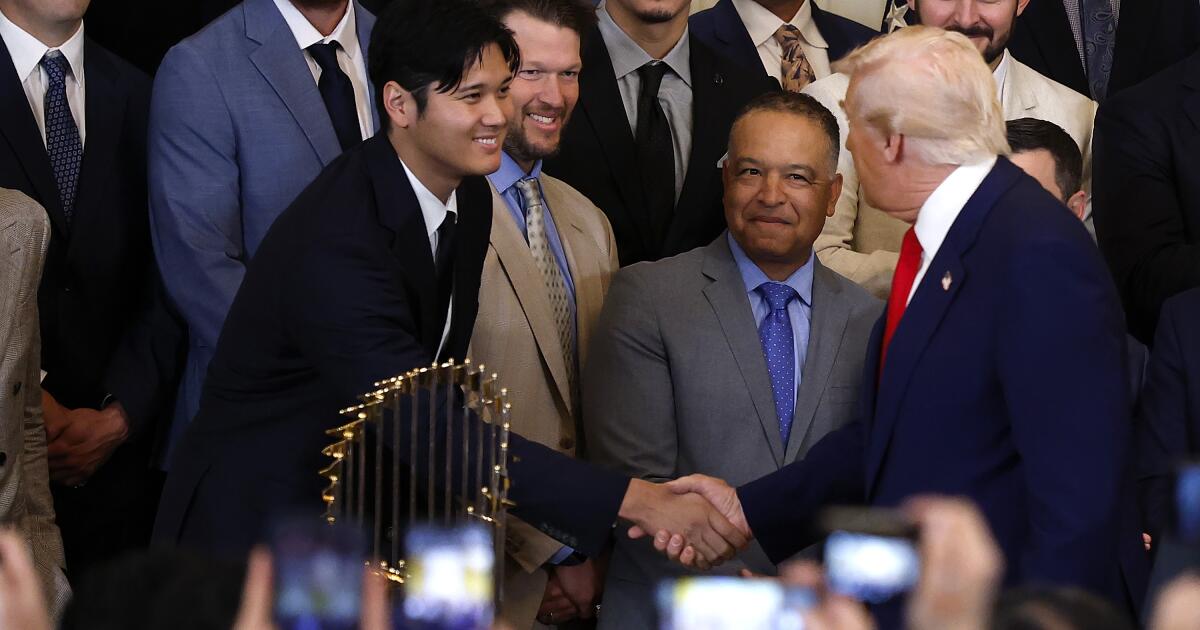
WASHINGTON — The Dodgers are scheduled to visit the White House on July 23 to celebrate their latest World Series title.
“President Trump is excited to welcome the Los Angeles Dodgers BACK to the White House to celebrate their World Series championship!,” White House spokesperson Taylor Rogers said in a statement to The Times.
The date falls on a scheduled off day in the middle of a nine-game East Coast road trip for the Dodgers. The team will play three games in Philadelphia against the Phillies July 20-22 before ending the trip with a three-game series against the New York Mets July 24 to 26.
The visit continues a tradition from the Dodgers’ two previous World Series championships. They were hosted by President Biden in 2021 and President Trump in April 2025.
After the Dodgers claimed their second consecutive World Series title with a dramatic Game 7 victory over the Toronto Blue Jays, a visit to the White House was planned, but it wasn’t until Thursday that a date was officially booked and confirmed.
Questions swirled around whether players would decline the visit this year after it did not happen during a scheduled visit to Washington in April.
Kiké Hernández said in 2018 he was unsure he would have gone had the Dodgers won the World Series the previous year. Mookie Betts said he was undecided and needed to talk it over with his family when last year’s visit was announced. After winning his first World Series with the Boston Red Sox in 2018, Betts skipped their trip to the White House the following year during Trump’s first term.
Both players, along with every returning member of the 2024 team who was with the team during its road trip, participated in the visit. The only notable absence was first baseman Freddie Freeman, who remained in Los Angeles to nurse an ankle injury.
Manager Dave Roberts, who indicated in comments to The Times in 2019 he might not go to the White House if Trump was president, also participated in last year’s ceremony.
Asked at the Dodgers’ fan festival in January about the possibility of returning to the White House, Roberts told The Times’ Bill Shaikin: “For me, I stand by: I’m a baseball manager. That’s my job.”
“I was raised — by a man who served our country for 30 years — to respect the highest office in our country,” Roberts said. “For me, it doesn’t matter who is in the office, I’m going to go to the White House. I’ve never tried to be political. … For me, I am going to continue to try to do what tradition says and not try to make political statements, because I am not a politician.”
Clayton Kershaw, who retired after last season but was on Team USA for this year’s World Baseball Classic, told The Times in the spring that he was aware Dodgers fans are split over whether the team should visit the White House again this year, but he said he is looking forward to it.
“I went when President Biden was in office. I’m going to go when President Trump is in office,” Kershaw said. “To me, it’s just about getting to go to the White House. You don’t get that opportunity every day, so I’m excited to go.”
Times deputy sports editor Ed Guzman contributed to this report.

NEWYou can now listen to Fox News articles!
All eyes were on Caitlin Clark on Wednesday night as she made her anticipated return from injury in a road matchup in Los Angeles.
But instead of a triumphant comeback, the Fever spent the entire night chasing the Sparks as Clark’s rough return fueled a 106-92 rout.
The superstar never found a groove, looking completely out of sync in her return from a back injury.
STEPHANIE WHITE GIVES CAITLIN CLARK STATUS UPDATE AHEAD OF FEVER-SPARKS, BUT HER NEXT MOVE RAISES QUESTIONS
Caitlin Clark huddles with teammates as the Indiana Fever battle the Sparks. (Photo by Katelyn Mulcahy/Getty Images) ((Photo by Katelyn Mulcahy/Getty Images))
Much of that disjointed performance falls squarely on head coach Stephanie White, who kept Clark on a ridiculously tight leash by limiting her to just 16 minutes. The stop-and-go approach could have sabotaged any chance for the phenom to establish a rhythm.
Clark finished with just 9 points, 4 rebounds and 3 assists. Her minus-16 plus-minus told the story.
The Los Angeles Sparks were severely shorthanded, taking the floor without stars Kelsey Plum and Cameron Brink.
MERCURY’S NOW-DELETED SOCIAL MEDIA POST MOCKING CAITLIN CLARK DRAWS SCRUTINY AFTER STAR’S INJURY
Yet while a depleted Sparks roster played to win, Indiana spent the night over-managing its biggest asset.
With Clark on a minutes restriction and Aliyah Boston out of the lineup, Kelsey Mitchell was forced to shoulder the entire offensive burden.
Mitchell did her part, pouring in 29 points while shooting 5-of-9 from beyond the arc.
Caitlin Clark orchestrates the Fever offense as Indiana battles the Los Angeles Sparks in primetime action. (Photo by Katelyn Mulcahy/Getty Images) ((Photo by Katelyn Mulcahy/Getty Images))
But one hot hand couldn’t stop an efficient LA squad.
The Sparks shot 45% from three-point range, going 9-of-20 from deep to cruise to the 106-92 victory.
White’s next move is to sit Clark against the Mercury on Thursday while Boston returns.
CLICK HERE TO DOWNLOAD THE FOX NEWS APP
After Wednesday’s loss to a shorthanded Sparks team, it’s fair to question whether Indiana’s cautious approach is working. The Fever dropped to 12-9.
Caitlin Clark and Dearica Hamby face off as Fever and Sparks battle at Crypto.com Arena in Los Angeles. (Photo by Tyler Ross/NBAE via Getty Images) ((Photo by Tyler Ross/NBAE via Getty Images))
Send us your thoughts: alejandro.avila@outkick.com / Follow along on X: @alejandroaveela
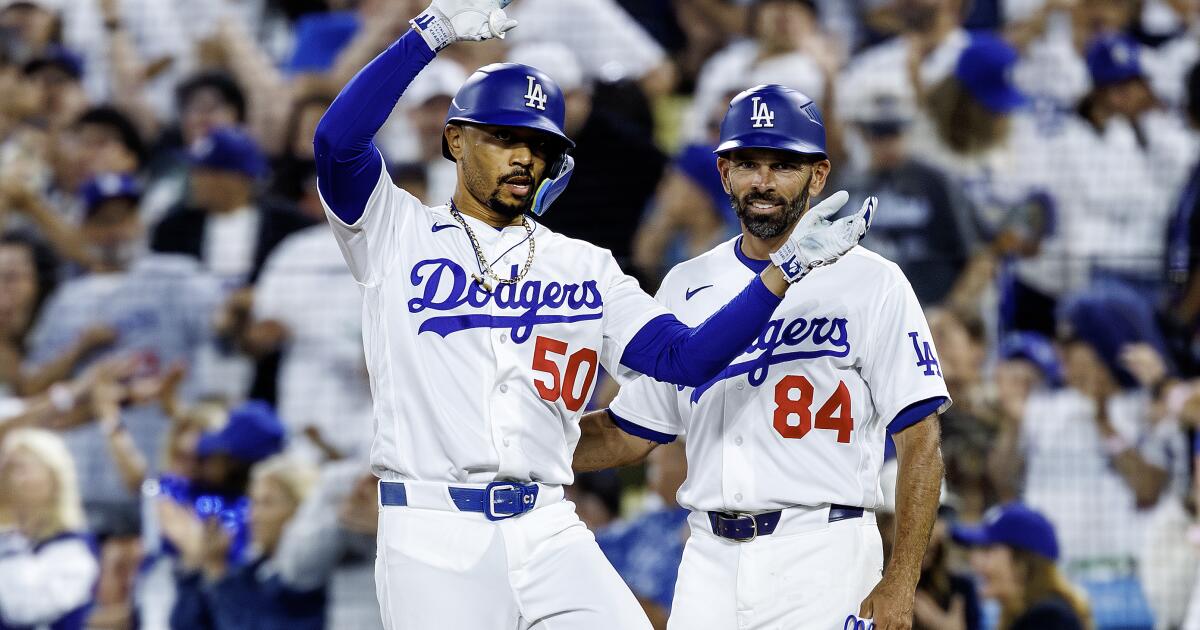
Mookie Betts’ first hit this series against the Rockies couldn’t have come at a more opportune time. With the crack of the ball against his bat, Tommy Edman scored from third, giving the Dodgers the lead.
And as Betts reached first, he pointed to Freddie Freeman, whose single put Edman in scoring position. It had taken a team effort to overcome another middling start from Roki Sasaki, and Betts, who had little to show before his game-winning hit, took the chance to highlight the joint contribution in the Dodgers’ 4-3 rubber-match win over Colorado (38-56).
“It feels great,” Betts said of his nine-pitch battle. “Helping the boys win, that’s really all it is. We play the game to win, and coming through in a big moment is kind of what, when you’re a kid, playing in the backyard, getting that hit is what you always strive to do, and fortunately, I was able to do it.”
Given a three-run lead in the first inning, brought to the Dodgers by a wild pitch and Kyle Tucker’s two-run, line-drive single to left field, Sasaki seemed set up for success.
Still, he gave away the lead as quickly as it came. In the second inning, he left a fastball too far over the plate, and third baseman Kyle Karros drove the ball over the left-center wall. The slider he dealt two batters later to second baseman Edouard Julien also crossed the zone too far over the plate, and Julien rounded the bases with another homer. In the third, a sacrifice fly by Mickey Moniak evened the scored, 3-3.
Sasaki’s troubles this season have been hard to pin down since his last win on May 23, as Sasaki tries to claw back the triple-digit velocity that’s escaped him as of late.
Against the Rockies, his fastball topped out at 99.1 miles per hour before steadily dropping to 98. He had managed five strikeouts in his six innings when manager Dave Roberts replaced him with Jack Dreyer, though the three earned runs couldn’t be ignored.
But Roberts also acknowledged the possibility that the pitcher had been tipping his pitches, possibly since he was playing in Japan, and Sasaki has tried to address it after a three-inning, six-run start last week. Even if he had fully self-corrected, his control issues remain. In the third inning, he walked the tying runner, Brett Sullivan.
“I’ve been working on a lot of things like the tipping stuff,” Sasaki said through interpreter Kensuke Okubo. “Also, I need to make quality pitches.”
Sasaki regained some of his confidence in the fourth when he worked out of a two-base jam with two strikeouts and a flyball to right, something that didn’t go unnoticed by Roberts.
“You can see the demeanor walking off the mound, the confidence,” Roberts said. “For me, it was more of let him end on a high note, feeling good about his outing, and then go from there.”
The Dodgers’ problems were compounded by Alex Call wasting the team’s two challenges in his at-bat in the first inning when the team had already taken the lead. And maybe it would’ve been excusable if Call had driven in the runners on first and second, but instead he ended the inning on a strikeout, stranding both. Roberts called the situation an “outlier” and didn’t feel as though he needed to have a conversation with Call regarding the situation.
After the three-run first, the Dodgers (61-33) remained hitless until Max Muncy laced a double down the right-field line in the sixth, though to little avail. As the innings ticked forward, Colorado’s chances seemed to increase. The Rockies hold the best league batting average (.297) in the eighth and ninth innings (the Dodgers are fourth with .268). And the Dodgers relievers, within the same constraints, have a 3.83 ERA — not bad, but not in the top 10 either.
Third baseman Max Muncy can’t get his glove on a line-drive double by Kyle Karros in the fourth inning.
(Gina Ferazzi/Los Angeles Times)
So when Alex Vesia struggled against the Rockies in the eighth inning and Muncy suffered a throwing error, Colorado seemed in position to score with the bases loaded and one out. Vesia struck out TJ Rumfield and Edgardo Henriquez (4-0), his replacement, retired Karros on a fly ball to right.
After Betts’ single allowed the Dodgers to take the lead, Tanner Scott (13) shut down the Rockies with back-to-back strikeouts, avoiding the team’s eighth series loss of the season.
“Didn’t feel great,” Roberts said. “Fortunately, we won a series, but that’s not the kind of way you want to do it.”
-
 Lifestyle3 minutes ago
Meow Wolf taps famed L.A. animation house for its new Los Angeles venue
-
Politics10 minutes ago
Column: Trump decries ‘communism’ while his government takes ownership of companies
-
 Science13 minutes ago
‘I’d rather my house burn down than get cancer’: Herbicide use upends California’s fight to save forests
-
Sports18 minutes ago
Dodgers scheduled to visit White House in late July to celebrate 2025 World Series win
-

 World28 minutes ago
Former US Olympian pleads not guilty in DC reflecting pool vandalism case
-
 News55 minutes ago
Former Olympian pleads not guilty in reflecting pool vandalism charges
-

 Los Angeles, Ca2 hours ago
Heat advisory, beach hazards in effect as Southern California sizzles
-

 Detroit, MI3 hours ago
Teen on moped hit by car after cruising through stop sign in Detroit


