Sports
The tragic death of George Baldock in Greece: Loss and confusion after ‘one of the darkest days’


At Astakos restaurant in Glyfada, on the edge of the promenade in this quiet Athens suburb, a waiter is busy laying the tables for lunch.
It’s Saturday morning, shortly before midday, and the sun is breaking through the clouds as a steady stream of people stroll by on the seafront.
Glyfada is only a 20-minute drive from downtown Athens, but the relaxed pace of life feels a million miles away from the hustle and bustle in the heart of the Greek capital. There are fishing boats gently swaying in the marina, couples walking hand in hand on the beach, and children dipping their toes in the water.
The town has been described as Athens’ best-kept secret and it’s easy to see why George Baldock was attracted to the idea of living here after swapping Sheffield United for Panathinaikos in the summer. His apartment is directly opposite Astakos, only a stone’s throw from the beach. Tragically, it is also where he was found dead last week.
Aged 31, Baldock drowned in his swimming pool in circumstances that remain a mystery. Police have ruled out any criminal activity at the property but an investigation into exactly what happened on Wednesday, October 9 is ongoing and unlikely to end anytime soon. Toxicology reports could take as long as 45 days to come back, meaning that there are more questions than answers right now.
His death has shaken people in Greece, where the profound sense of sadness among those who spent time in Baldock’s company reflects the way that he connected with a country that became his adopted home. Born in England and a product of the MK Dons academy, Baldock qualified to play for Greece through his late grandmother. He won 12 caps since making his debut in June 2022 and cherished every one of them.
The Greece team at Wembley hold up a shirt with Baldock’s name and number on (Charlotte Wilson/Offside/Offside via Getty Images)
There could, and surely would, have been many more. Instead, the doorway to his apartment in Glyfada is filled with flowers and messages that tell a very different story.
“Starman. From Sofia, your Athens Blade,” reads one card — a reference to the David Bowie song that Sheffield United fans dedicated to Baldock as he was “running down the right”.
That beautiful little note, which is accompanied by a drawing of Baldock’s No 2 shirt, peers out of the top of a bouquet of lilies, along with a single white rose.
Another message next to it says, “Yesterday’s Greek win was all for you”.

“Yesterday” was Thursday, October 10, 24 hours after Baldock passed away and the same day that Greece beat England 2-1 at Wembley in the Nations League. It was also when Baldock was due to fly home to England to celebrate his son Brody’s first birthday.
His passing is a heartbreaking story in so many ways and it’s impossible to imagine what Baldock’s family — in particular his fiancee Annabel, his parents Basil and Jacqueline, and his brothers Sam and James — have been going through over the past week or so.
Baldock’s team-mates — past and present — have found it difficult enough. Listening to them talking about him is extremely moving and, at times, upsetting. There is a mixture of pain, anguish and disbelief in their voices as they try to make sense of a story that makes no sense at all.
Several of them attempted to call Baldock that Wednesday night because they refused to accept the awful news that they were hearing was true.
Some still wake up in the morning waiting for the video call that never comes.
Others sound lost. “I still feel his presence,” Erik Palmer-Brown, the Panathinaikos and former USMNT defender, says. “I feel like he’s watching over me. His locker was right next to mine; it still is. But he’s just not there.”
On the Sunday evening before last, Sotiris Souchleris was waiting outside the VIP gate at the Olympic Stadium in Athens. Panathinaikos had drawn 0-0 at home against Olympiacos and Souchleris, who is a journalist for the Greek sport website Pao Pantou, was hoping to speak to one or two of the players. A couple of them had politely declined when he saw Baldock approaching.
“George, can you answer a couple of questions, please?” Souchleris asked, hoping rather than expecting Baldock would stop.
“Of course, mate,” Baldock replied.
Souchleris quickly set up his camera and pressed record. He remembers thinking that Baldock looked a little tired as well as a bit disappointed that Panathinaikos had failed to beat Olympiacos. But there was also a lot of positivity in Baldock’s voice when he talked about his performance and the future.
“Anyone who knows me, and who has watched me, will know that’s a lot more like me,” Baldock told Souchleris. “It’s been unfortunate I got a very bad injury with the national team. I was out for many, many months, and I’ve been trying to come back, and this is the first time I feel more like myself.”
“I thanked him, shook hands and said goodbye,” Souchleris adds.
“It was the first and the last time we spoke.”
Although Baldock made just four appearances for Panathinaikos and only signed in July, he was already a hugely popular figure inside the club. Some of the Panathinaikos squad had known him for a couple of years, ever since he was called up to the Greece squad for the first time. Others immediately warmed to a man who always had a smile on his face, loved telling a story, and went out of his way to talk to people.

Baldock with Greece team-mate Giorgos Masouras (Photo: Seb Daly/Sportsfile via Getty Images)
“The day he walked into our pre-season (camp) in Austria, he sat next to me at the lunch table and I just felt his English energy,” Palmer-Brown says.
“I’ve been in England before (with Manchester City) so I knew I would click on with his banter. But he just made everything easier — he was an open book, just so honest with everyone around him. He was able to bring a room together. If you weren’t in the conversation, say you had just walked in, he would throw a little joke out there to make you feel welcome.
“Obviously, we have a bunch of different nationalities at the club and to see him mix in with any group of people, it was such a special thing. I can’t even describe it. I envy him for being able to do that, and that’s one of the reasons why I know everyone loves him.”
Baldock got on well with all the players at Panathinaikos but he was close to five or six team-mates in particular. Palmer-Brown, who spent time at the apartment in Glyfada, playing Uno with Baldock and his fiancee and meeting his mother-in-law-to-be, was one of those players and the Iceland international Hordur Magnusson was another.
A former Bristol City player, Magnusson had played against Baldock in the Championship in England and was delighted when he heard that he was signing for Panathinaikos. He rated Baldock as a player and he knew people in England who spoke highly of him as a team-mate.
In the early days at Panathinaikos, when Baldock was still trying to sort out a lease car, Magnusson drove him back and forth to training and also helped his family settle into their apartment in Glyfada. “When we came back from Austria, I went straight to Zara Home (around the corner from the property) and the other stores with George to buy everything for the house so that Annabel and Brody could just take it easy and enjoy the days,” he says.

‘I went there to try to help because I didn’t believe that George was dead,’ said Magnusson (Jose Manuel Alvarez/Quality Sport Images/Getty Images)
Magnusson shrugs when it’s put to him that it was a nice thing for him to do for Baldock. “I knew that George would have done the same for me,” he replies.
The two of them were the same age and both had young children, but Baldock was operating on a totally different body clock to Magnusson.
“He was the type of player who went to sleep early and woke up early. He had so much energy!” Magnusson says, laughing about the phone calls he would receive before his alarm had gone off. “It would be, ‘Good morning, Maga, do you want to come to eat something now?’ I’d say, ‘Georgey, let me sleep a little bit more and then we can go!’”
On Wednesday morning last week, Baldock reported for treatment after picking up a slight knock in the Olympiacos game. Magnusson, who has been recovering from a cruciate knee ligament injury that he suffered last season, remembers Baldock walking into the physio’s room and giving him a warm embrace.
After receiving treatment, Baldock did some light running outside in the sunshine. Palmer-Brown and the Swedish forward Alexander Jeremejeff had already finished training and sat on the grass watching Baldock before all three got in the sauna together.
“It was his son’s birthday,” Palmer-Brown explains. “And we always have this inside joke about ‘Father of the Year; I don’t have a kid but they (Baldock and Jeremejeff) do. So we were like, ‘Congratulations — Father of the Year’, because of the birthday. He said, ‘Yeah, but it’s a bit s*** I’m not there’, and that’s when he told us he had a flight home the next day after training.”
Palmer-Brown pauses for a moment. “That’s my last memory of him,” he says.
After showering, Baldock got a lift back to his apartment with Bart Schenkeveld, a 33-year-old Dutchman who was one of the last people to have any contact with him.
Trying to work out exactly what happened next is like putting together a jigsaw puzzle that has some of the pieces missing.
All that can be said for sure is that, later in the evening, Baldock’s fiancee Annabel became concerned that something wasn’t right. She had been unable to get in touch with her partner and reached out for help.
“So she called the landlord and asked him to go to the property,” Andreas Vlachopoulos, who brokered the rental agreement for the apartment with Baldock in the summer, says.
Nothing could have prepared anyone for what followed.
“When he went there, he found him drowned in the pool,” Vlachopoulos says.
According to the police, they received a phone call from the landlord shortly after 10pm on Wednesday. The first officers on the scene at the apartment removed Baldock from the pool to check whether he was still alive. It was clear, however, that he had been in the water for some time. When an ambulance arrived shortly afterwards, medics performed their own checks and Baldock was pronounced dead at 10.25pm.
The Panathinaikos players quickly found out the news.
“I got a call from Magnusson asking if I knew his fiancee’s number, because I’d hung out with them,” Palmer-Brown says. “I asked why, and he told me. I was like, ‘There’s no way. What do you mean, he drowned? What are you saying?’
“I was lost, really confused. He (Magnusson) said he was going to the property now — he lived pretty close to Baldock. I said, ‘I’m going to call Baldock.’ So I phoned him. Then I called Magnusson again when he got there, and then I heard it in his voice.”
It would soon be public knowledge. At 11.10pm, the Greek newspaper Proto Thema reported online that there had been an incident involving Baldock and a swimming pool. Within 10 minutes, the story had been updated to say that Baldock was dead.
The Greece players, who were training on Wednesday night at Wembley in preparation for their Nations League game against England the following evening, returned to the dressing room to see a flurry of messages and missed calls on their phones.
Some of Baldock’s team-mates responded incredulously, almost angrily, to the people who were contacting them, assuming there was a terrible misunderstanding. Others convinced themselves that Baldock had just fainted and that everything would be fine.
Oli McBurnie, a former Sheffield United teammate who is now playing for Las Palmas in Spain, was so certain that it wasn’t true that he did the same thing as Palmer-Brown and called Baldock, fully expecting him to answer. When Baldock’s phone rang out, McBurnie sent a few messages. Then he called John Lundstram, another ex-Sheffield United player and, in McBurnie’s words, “probably George’s best friend”. Lundstram, who had spoken to Baldock earlier in the day, was totally in the dark too.

Baldock, left, and McBurnie, centre, during their time together at Sheffield United (George Wood/Getty Images)
Soon, though, the people who were sure to know the truth confirmed the worst possible news.
A number of Panathinaikos staff and players — Schenkeveld, Magnusson, Zeca, Ruben Perez and Tonny Vilhena among them — went to Baldock’s apartment that evening and waited outside.
Magnusson was the first player to arrive. “I went there to try to help because I didn’t believe that George was dead,” he says. “I thought that they (the emergency services) could still help and revive him. But when I saw 20 police guys on motorbikes outside his house, and the ambulance as well, the staff members (from the club), and the investigative police going inside, then I realised: ‘F***. He’s gone.’”
A team of detectives from two separate police units were called in to take fingerprints and check for any other DNA. But there was no evidence of any disturbance, or signs that anything had been tampered with inside the property, and a forensic scientist quickly ruled out any criminal activity.
A bottle of some description was found at the apartment, as well as two glasses, but the significance of either is unclear and also easy to overanalyse without any context. Several news outlets in Greece reported that alcohol had been found at the property — something that Vlachopoulos had mentioned in an earlier interview — but police have neither confirmed nor denied that is the case.
Football was the last thing on anyone’s mind at Panathinaikos. Thursday’s training session was cancelled but the club still wanted everyone to report to the training ground.
Diego Alonso, the head coach, and Giannis Papadimitriou, the club’s technical director, addressed all the staff and players in a meeting that lasted no longer than 10 minutes. People were tearful, still in a state of shock and, more than anything, struggling to process what had happened.
“I remember Papadimitriou saying, ‘Good morning. As you know, George Baldock is no longer with us…’ and that’s the last words I heard from him,” Magnusson says. “I felt like there was a stone in my throat. I couldn’t hold my feelings. I stood up from my seat and I just went further and further away, next to the wall (at the back of the room), because at that time I couldn’t listen to anything that he was going to say about George. I had been there the night before and… I knew more than a lot of the other players.”
Palmer-Brown puffs out his cheeks. “That was one of the darkest days of my life going in there and seeing everyone. There were no words that could be said that would make anyone feel any differently.”

Palmer-Brown became close friends with Baldock after his move to Greece (Nick Tre. Smith/Icon Sportswire via Getty Images)
The Panathinaikos players were told to forget about football, go home, spend time with their families and hug their loved ones.
By that stage, there was already anger among staff and players about some of the media coverage of Baldock’s death — and that was about to get worse. As the Panathinaikos players were leaving the training ground on Thursday, a popular television show in Greece was broadcasting live outside Baldock’s home and turning the death of a 31-year-old man into a story about the size and cost of his apartment.
ANT1 TV, a free-to-air television channel in Greece that is operated by the broadcaster Antenna, also used footage of Baldock’s apartment that had been sent in by a viewer and filmed with a drone in the wake of his death. The video showed the area around the swimming pool, where everything remained untouched from the night before. At one point a still image was used to circle a bottle on an outside table.
All the while, Giorgos Liagas, the show’s presenter, talked about the property’s views, the number of rooms and its value.
“The house where he lived, by the beach in Glyfada, is one of the more expensive residential locations of both Greece and Europe,” Liagas said, before talking about the value of the home, the rental costs and who paid for it.
Aside from inaccuracies in the reporting, the tone of that whole segment of the show, not to mention the use of the drone footage, felt deeply insensitive. It upset people at Panathinaikos as well as members of the Greece national team, and prompted a public backlash on social media.
Liagas issued an apology 24 hours later, when he admitted to a “grave mistake”. He said that he took full responsibility for his actions on the show and described his reporting as “a completely wrong journalistic assessment”.
By that point, Tasos Bakasetas, the Panathinaikos and national team captain, had already publicly called out some of the Greek media for disrespecting Baldock’s family and “telling lies”.
Bakasetas made those comments after a night of high emotion at Wembley, where Greece pulled off one of the greatest victories in their history in the most difficult circumstances imaginable.
The fact that the England game went ahead seems remarkable, bearing in mind Baldock’s relationship with the Greece players. Baldock had played for his country as recently as March in the Euro 2024 play-off tie against Georgia, when he picked up a serious calf injury that sidelined him for the rest of the season, and all but three of Greece’s match-day squad for the England game had been with Baldock at one point or another with the national team.
Those numbers only tell part of the story, though. Baldock — and this really shines through when you talk to the Greece players — connected with his team-mates on a human level. The Greek players didn’t just like Baldock; they loved him.
“George was a great person inside and outside of the pitch,” Pantelis Chatzidiakos, the Greece international and Copenhagen defender, says, “We could see how much it meant to him to play for Greece. We saw him fighting for us, for the national team, like he’s always been a Greek. Sometimes he played games when he was not 100 per cent fit, taking huge risks, and if you do this as a player for the national team we appreciate it a lot.”

Baldock representing Greece in June 2023 (Seb Daly/Sportsfile via Getty Images)
Amid so many difficult conversations in London after Baldock’s death, Greece approached UEFA verbally, and informally, to ask about the England fixture being moved to another date. Although there were huge question marks about the players being in the right frame of mind to play against England, Greece’s primary reason for wanting the match to be cancelled was as a mark of respect to Baldock.
UEFA’s decision to press ahead with the game is not something that the Greece Football Federation wishes to spend any time discussing now, purely because that debate overlooks the only thing that really matters to them. “We lost a team-mate. We lost a friend,” says one senior figure, who asked to speak anonymously due to the sensitive nature of the issue.
At around 7.30pm on Thursday, shortly before the England-Greece game kicked off, the Baldock family released a statement. “We are heartbroken with the sudden passing of our beloved George. We can confirm that a post-mortem examination has found that George tragically drowned whilst swimming in the pool at his home in Glyfada, Athens.
“George, you were the most special father, fiancee, son, brother, uncle, friend, teammate and person. Your enthusiasm and infectious personality brought so much love to those that were fortunate enough to know you and those that adored you from the stands. We will forever cherish the special memories we have of you, and you will continue to live on in your beautiful son. You were due to fly home today for us to celebrate his first birthday together, but instead we mourn your loss.”

(Ryan Pierse/Getty Images)
The Greece players were unaware of those deeply moving words until later in the evening, when they returned to the away dressing room at Wembley with tears in their eyes and Baldock’s No 2 shirt in their hands after parading it around the pitch at the final whistle on the back of a poignant and dramatic 2-1 victory. It was the perfect tribute.
“Georgey — for you,” Lazaros Rota, the Greece and AEK Athens defender, said, pointing into the television camera.
Three days later, Greece followed that up with another emotional win, this time against the Republic of Ireland in Athens, where Baldock’s name reverberated around the stadium before kick-off after a beautiful montage was played on the screen while the players gathered around the centre circle.
Bakasetas kissed and removed his black armband after opening the scoring and Petros Mantalos did the same when he added a late second.
“The win against England and today against Ireland is absolutely for George,” Chatzidiakos said afterwards. “We miss him a lot.”

Bakasetas after scoring against the Republic of Ireland (Milos Bicanski/Getty Images
How on earth do Panathinaikos return to playing football and get through the rest of the season?
“That’s a very good question because it’s been two days of training since and it feels nowhere near the same,” says Palmer-Brown, who was talking on Tuesday afternoon.
The Panathinaikos first-team squad returned on Monday, when Papadimitriou, the club’s technical director, lit a candle and placed it on the centre spot of one of the training pitches, where all the staff and players gathered to observe two minutes of silence.
Training went ahead afterwards, but it’s totally understandable that some players are still struggling to focus on football. “Obviously, everyone mourns and grieves in their own way and, in reality, football goes on,” Palmer-Brown says.
“But it doesn’t feel right, at least to me. I know my team-mates and I will do our best to go forward. But, for me, I don’t see myself just moving on and playing football happily ever again. I’ve never felt like this before.”
Palmer-Brown admits he is struggling to sleep at night, when his “thoughts just run”. He also keeps thinking about Baldock’s fiancee.
“I haven’t even found the words to reach out (to her),” he says. “I know I need to say something. I just don’t know what to say.”
Some moments are more difficult than others and bring home the sobering reality of what has happened. “George sat between me and Erik in the dressing room,” Magnusson explains. “I came in for treatment the day after the meeting with the players and at 10 o’clock in the morning I saw his name (above his locker), all his stuff — his shoes and his flip-flops — were still there next to me. Then at 12 o’clock, I saw nothing. Everything was gone.”
None of this is easy for anyone. Coaches and players, past and present, are going through emotions that they’ve never experienced in football before.
Chris Wilder, the Sheffield United manager, gave a moving interview on the club website last week when he talked about feeling stunned, devastated and numb. At the same time, Wilder expressed concern that his own sadness felt “selfish” in the context of what the Baldock family are going through.
McBurnie feels exactly the same way. “George loved his missus and his little boy so much,” he says. “And, for me, they’re the people in this that I really feel sorry for. I know how hard it’s been for me and some of the other boys (at Sheffield United) who love him, but little Brody is going to grow up and never know what a top man his dad was. Me and the boys have said that it’s our duty to be part of his life and try to remind him at every opportunity how much of an amazing person his dad was.”
Panathinaikos have vowed to be there for the Baldock family too. The club’s owner Giannis Alafouzos feels a personal responsibility and a duty of care to support them not just now but in the longer term. Conversations are ongoing in relation to Baldock’s three-year contract — something that is more complex than people might imagine — and there is the possibility of a charity game too.
In the meantime, Panathinaikos have a football match to play on Sunday, away against OFI Crete, followed by Chelsea at home in the Europa Conference League four days later.
Magnusson, who makes a point of saying at the end of our interview that he would like his condolences to be passed onto Baldock’s family and friends through this article, is desperate to be back out on the pitch.
“I haven’t played one minute this season (because of injury) but I really want to play the next game, just for George. I’m ready for that,” he says. “I want to show George that we did it for him, and not just one game but for the rest of the season and for the years to come.”
(Top image: Dan Goldfarb for The Athletic)



Sports
Pirates star pitcher makes unfortunate history after being taken out in middle of perfect game bid

NEWYou can now listen to Fox News articles!
Jared Jones was flirting with Major League Baseball history on Wednesday night — he got it, but it was not what he originally envisioned.
The Pittsburgh Pirates pitcher retired the first 18 batters he faced, but he was taken out in the middle of his perfect game bid after six innings.
Now, the Pirates certainly have their reasons — the 24-year-old Jones hasn’t thrown more than 81 pitches in eight starts since returning May 20 after missing all of last season while undergoing ulnar collateral ligament internal brace surgery on May 21, 2025. He was yanked with 77 pitches and likely would have needed more than 100 pitches to record the 25th perfect game in MLB history.
Jared Jones of the Pittsburgh Pirates pitches during the first inning against the Atlanta Braves at PNC Park on July 8, 2026, in Pittsburgh, Pennsylvania. (Photo by Joe Sargent/Getty Images)
However, Jones left the game after getting zero run support, so when the Atlanta Braves tacked on three runs late for a 3-0 victory, Jones instead found himself in the wrong chapter of the history books.
According to Opta Stats, Jones became the first pitcher in the modern era (since 1920) to pitch at least six perfect innings and not record a win.
“It does suck. Something’s cool coming on, but I’m on what? My eighth start off of surgery? I completely understand it, and it is what it is,” Jones told reporters after the game.
Pittsburgh Pirates starting pitcher Jared Jones (17) makes his way to the field to warm up before pitching against the Atlanta Braves at PNC Park. (Charles LeClaire/Imagn Images)
JUSTIN VERLANDER ANNOUNCES HE WILL RETIRE AFTER THIS SEASON: ‘I’VE REALIZED THAT TIME HAS COME’
Jones said he didn’t entertain attempting to complete the perfect game.
“Not with the pitch count,” he said. “Not really ever expecting to go nine right now, so that was never in my head.”
Joey Bart, traded to the Braves from the Pirates on June 18, followed a double by Mike Yastrzemski with a 422-foot, two-run homer to left-center field off a slider from Dennis Santana. Drake Baldwin added an RBI single to center in the ninth for good measure.
It was the second time in less than a week that a pitcher was taken out of the game with a perfect bid through six innings — the Miami Marlins took Eury Perez out after seven innings in which he had 92 pitches. Perez, too, is in the midst of returning from injury and has surprisingly found himself right in the postseason mix.
He was pulled for Lake Bachar to start the eighth, and the Marlins allowed eight runs to the Athletics in the final two innings, but held on to win 9-8.
Jared Jones (17) of the Pittsburgh Pirates delivers a pitch during a MLB game against the Cincinnati Reds on June 27, 2026, at PNC Park in Pittsburgh, Pennsylvania. (Joe Robbins/Icon Sportswire via Getty Images)
CLICK HERE TO DOWNLOAD THE FOX NEWS APP
The Pirates are 4.0 games out of the final wild card spot, which is held by the Marlins.
The Associated Press contributed to this report.
Follow Fox News Digital’s sports coverage on X, and subscribe to the Fox News Sports Huddle newsletter.
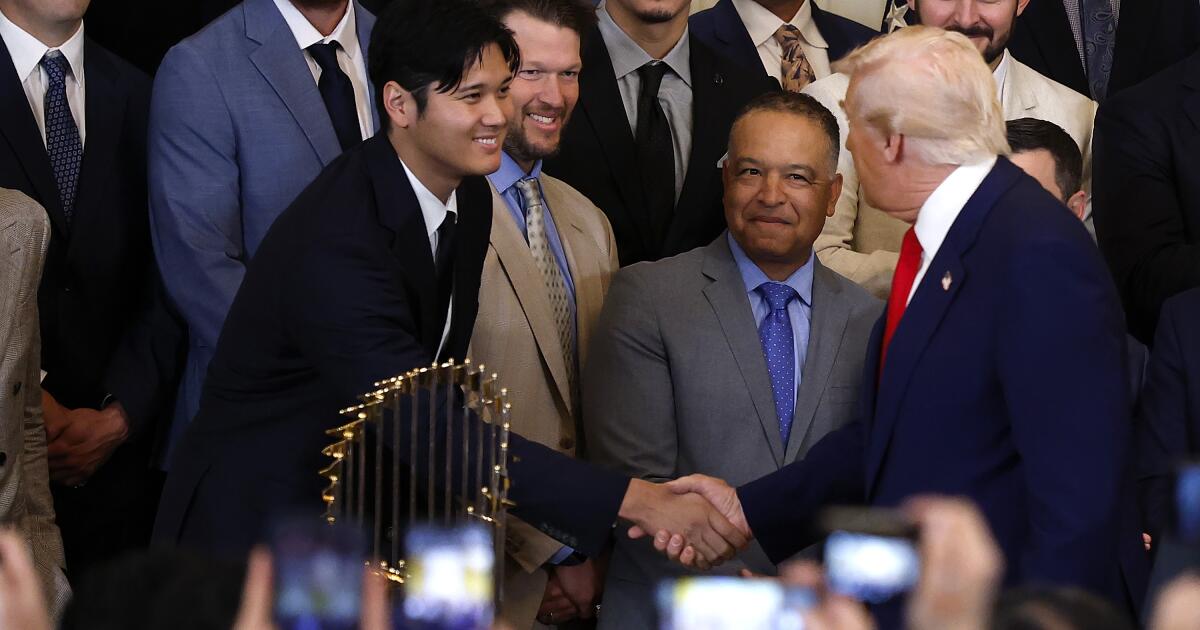
WASHINGTON — The Dodgers are scheduled to visit the White House on July 23 to celebrate their latest World Series title.
“President Trump is excited to welcome the Los Angeles Dodgers BACK to the White House to celebrate their World Series championship!,” White House spokesperson Taylor Rogers said in a statement to The Times.
The date falls on a scheduled off day in the middle of a nine-game East Coast road trip for the Dodgers. The team will play three games in Philadelphia against the Phillies July 20-22 before ending the trip with a three-game series against the New York Mets July 24 to 26.
The visit continues a tradition from the Dodgers’ two previous World Series championships. They were hosted by President Biden in 2021 and President Trump in April 2025.
After the Dodgers claimed their second consecutive World Series title with a dramatic Game 7 victory over the Toronto Blue Jays, a visit to the White House was planned, but it wasn’t until Thursday that a date was officially booked and confirmed.
Questions swirled around whether players would decline the visit this year after it did not happen during a scheduled visit to Washington in April.
Kiké Hernández said in 2018 he was unsure he would have gone had the Dodgers won the World Series the previous year. Mookie Betts said he was undecided and needed to talk it over with his family when last year’s visit was announced. After winning his first World Series with the Boston Red Sox in 2018, Betts skipped their trip to the White House the following year during Trump’s first term.
Both players, along with every returning member of the 2024 team who was with the team during its road trip, participated in the visit. The only notable absence was first baseman Freddie Freeman, who remained in Los Angeles to nurse an ankle injury.
Manager Dave Roberts, who indicated in comments to The Times in 2019 he might not go to the White House if Trump was president, also participated in last year’s ceremony.
Asked at the Dodgers’ fan festival in January about the possibility of returning to the White House, Roberts told The Times’ Bill Shaikin: “For me, I stand by: I’m a baseball manager. That’s my job.”
“I was raised — by a man who served our country for 30 years — to respect the highest office in our country,” Roberts said. “For me, it doesn’t matter who is in the office, I’m going to go to the White House. I’ve never tried to be political. … For me, I am going to continue to try to do what tradition says and not try to make political statements, because I am not a politician.”
Clayton Kershaw, who retired after last season but was on Team USA for this year’s World Baseball Classic, told The Times in the spring that he was aware Dodgers fans are split over whether the team should visit the White House again this year, but he said he is looking forward to it.
“I went when President Biden was in office. I’m going to go when President Trump is in office,” Kershaw said. “To me, it’s just about getting to go to the White House. You don’t get that opportunity every day, so I’m excited to go.”
Times deputy sports editor Ed Guzman contributed to this report.

NEWYou can now listen to Fox News articles!
All eyes were on Caitlin Clark on Wednesday night as she made her anticipated return from injury in a road matchup in Los Angeles.
But instead of a triumphant comeback, the Fever spent the entire night chasing the Sparks as Clark’s rough return fueled a 106-92 rout.
The superstar never found a groove, looking completely out of sync in her return from a back injury.
STEPHANIE WHITE GIVES CAITLIN CLARK STATUS UPDATE AHEAD OF FEVER-SPARKS, BUT HER NEXT MOVE RAISES QUESTIONS
Caitlin Clark huddles with teammates as the Indiana Fever battle the Sparks. (Photo by Katelyn Mulcahy/Getty Images) ((Photo by Katelyn Mulcahy/Getty Images))
Much of that disjointed performance falls squarely on head coach Stephanie White, who kept Clark on a ridiculously tight leash by limiting her to just 16 minutes. The stop-and-go approach could have sabotaged any chance for the phenom to establish a rhythm.
Clark finished with just 9 points, 4 rebounds and 3 assists. Her minus-16 plus-minus told the story.
The Los Angeles Sparks were severely shorthanded, taking the floor without stars Kelsey Plum and Cameron Brink.
MERCURY’S NOW-DELETED SOCIAL MEDIA POST MOCKING CAITLIN CLARK DRAWS SCRUTINY AFTER STAR’S INJURY
Yet while a depleted Sparks roster played to win, Indiana spent the night over-managing its biggest asset.
With Clark on a minutes restriction and Aliyah Boston out of the lineup, Kelsey Mitchell was forced to shoulder the entire offensive burden.
Mitchell did her part, pouring in 29 points while shooting 5-of-9 from beyond the arc.
Caitlin Clark orchestrates the Fever offense as Indiana battles the Los Angeles Sparks in primetime action. (Photo by Katelyn Mulcahy/Getty Images) ((Photo by Katelyn Mulcahy/Getty Images))
But one hot hand couldn’t stop an efficient LA squad.
The Sparks shot 45% from three-point range, going 9-of-20 from deep to cruise to the 106-92 victory.
White’s next move is to sit Clark against the Mercury on Thursday while Boston returns.
CLICK HERE TO DOWNLOAD THE FOX NEWS APP
After Wednesday’s loss to a shorthanded Sparks team, it’s fair to question whether Indiana’s cautious approach is working. The Fever dropped to 12-9.
Caitlin Clark and Dearica Hamby face off as Fever and Sparks battle at Crypto.com Arena in Los Angeles. (Photo by Tyler Ross/NBAE via Getty Images) ((Photo by Tyler Ross/NBAE via Getty Images))
Send us your thoughts: alejandro.avila@outkick.com / Follow along on X: @alejandroaveela
-

 Connecticut7 minutes ago
CBIA BizCast: Snapshot of Connecticut’s Economy » CBIA
-

 Delaware10 minutes ago
Delaware will collab with 2 Chainz, years after huge event canceled
-

 Florida15 minutes ago
Florida Airport Officially Renamed After Trump. Here’s What to Know
-

 Georgia22 minutes ago
West Nile infections starting to raise concerns in Georgia
-

 Hawaii25 minutes ago
First 5 Hawaii is a comprehensive online resource that helps families with young children find and connect to state and federal programs and services.
-
 Idaho30 minutes ago
Brush fire prompts GO NOW evacuations near Mesa in Adams County
-

 Illinois37 minutes ago
Illinois waives tax penalties for 11 counties hit by storms, including Stephenson and Winnebago
-

 Indiana40 minutes ago
Attempted murder suspect arrested in Indianapolis for Bloomington shooting

