Sports
The hockey brawl that changed the NHL forever, told by those who lived it


It looked for a while that the game between the Philadelphia Flyers and Ottawa Senators on March 5, 2004, might come and go without incident.
That was a bit surprising because eight days earlier, Ottawa’s Martin Havlat whacked the Flyers’ Mark Recchi in the face with his stick and afterward, heated words and insinuations flew. The Flyers were irate about the play and Havlat was suspended two games.
“Someday someone’s going to make (Havlat) eat his lunch,” Flyers coach Ken Hitchcock said.
“It might not come from our team,” Recchi said, “but he better protect himself.”
In the rematch, though, the first 58 minutes passed quietly as the Flyers built a multi-goal lead on the way to a 5-3 victory. But those last minutes were anything but quiet. And when it was over, officials tallied up a record number for penalty minutes in an NHL game (419) that still stands.
Another lasting outcome from that night: New league rules were implemented for the start of the 2005-06 season, the first after a lockout killed the 2004-05 season. Players who instigated a fight with fewer than five minutes to go were given a one-game suspension and the coaches of those players would be fined $10,000.
Twenty years later, fights in the waning minutes of games are almost non-existent. Here’s how it all went down.
Senators forward Martin Havlat, speaking about the previous game that started it all: I had a forearm into Mark Recchi. I don’t think I hit his face, but I hit him for sure. I kind of lost it a little bit, so I got suspended for two games. My first game back after the suspension was of course in Philly. (Hitchcock) said someone would make me eat my lunch, right? I remember that quote.
Flyers forward John LeClair: That’s what started it, obviously. Nobody forgets that kind of stuff.
Flyers forward Mark Recchi: I remember Havlat got suspended, and they suspended him (two) games and we played them the (third). (League disciplinarian) Colin Campbell did a good job there.
Flyers goalie Robert Esche: There was bad blood going in.
Senators forward Daniel Alfredsson: We talked about it, but we didn’t think anything was going to escalate to that extent. Would something happen? Probably.
Havlat: I remember being in Philly the day before and I was sick. I wasn’t feeling well. I was like, “If I call in sick and don’t show up, everyone is going to think that I’m a loser and I’m scared.” I wasn’t feeling well, but I knew I had to play.
The first fight takes place at 18:15 of the third period, when respective tough guys Donald Brashear of the Flyers and Rob Ray of the Senators drop the gloves. Other fights broke out during the stoppage, including goalies Robert Esche (Flyers) and Patrick Lalime (Senators).
Esche: Brash had it made up in his head how that night was going to go. He went up and down the ice and then he started fighting (Rob Ray). It was a good fight. Brash was doing a great job. Everybody is kind of watching the fight … and then all hell broke loose.
Flyers forward Donald Brashear: Like any other game where guys’ emotions run up, you want to make something happen or you want to get respect back. Something had to be done. I fought Ray a few times. He was a good fighter. He was doing his job and I was doing mine, and we both tried to do the best we can. Sometimes it gets ugly, but that’s the name of the game.
Flyers coach Ken Hitchcock: Everybody knew how tough Brash was but I always thought that Brash was a way better player than people thought. Way better. … I thought he was really a dependable player that could manage the puck and manage the game properly. I had a lot of trust in Donald.
Senators forward Rob Ray: If I remember correctly it was just us battling in front of the net. And then it just escalated into a fight. It was just two guys looking to get their teams fired up. Then everybody jumped in. It seemed like that sparked everything. It was just an emotional roller coaster from that point on.
Senators forward Shaun Van Allen: I couldn’t believe Brian Pothier jumped in and went after Donald Brashear after he fought Ray. I don’t know what set him off. It got out of control fast.
Flyers forward Patrick Sharp: I was on the ice just kind of chillin’, and found myself in a 6-on-6 brawl. I was in the first wave of the brawls. I actually got pounded pretty good. Todd Simpson grabbed me. There’s a fight between Brash and Rob Ray, and another one escalated. That’s when Eschey and Patty Lalime went at it.
Esche: I remember Danny Markov laying on the ice and there was a scrum going on, I went over to go pick somebody up, and I turn around and Patrick Lalime is right there — no helmet, no nothing. I was like, “What are you doing here?”
Senators goalie Patrick Lalime: Esche was in the middle of it all. That’s when I said, ‘I’m going down there.’ And I didn’t care. I knew he was a tough guy. But I got rid of all my stuff because I didn’t want to be weighed down by my glove, blocker and mask. And I knew I had to get his mask off.
Senators forward Chris Neil: Patty Lalime was awesome. For him to come down and do what he did, he’s just a great team guy. For him, he had a big smile on his face.
Lalime: After we were done fighting each other, we were just along the boards. I was just exhausted. I said to Esche, “I’m dead.” He said, “Me too.” So we made an agreement. No cheap shots. Nothing dirty. And I think that was a sign of respect. And every time I passed him after that, we always said hi to each other.

After play resumed came another series of fights. In a 6-second span on the game clock, six players were issued fighting majors: Chris Neil, Zdeno Chara and Mike Fisher from Ottawa, and Radovan Somik, Mattias Timander and Michal Handzus from the Flyers.
Esche: Once it got to a tipping point, which it clearly did the next shift, it was just going to continue to unravel.
Hitchcock: It was an emotional time, they were emotional games. Two really good teams. But I was really angry (because) the players that were being attacked, they weren’t scrappers or fighters or anything.
Flyers GM Bob Clarke: I was watching from the press box obviously as the manager. For me, Jacques Martin premeditated that. He had all tough players on the ice and the Flyers had four Europeans. As it turned out, our Europeans got beat up.
Senators coach Jacques Martin: I’ve never sent a guy out to fight in my entire career. I don’t believe in sending a guy over. When there are fights in hockey, I think that’s fine. But I don’t think I’ve ever been a proponent of going after people.
Van Allen: That would have been out of Jacques’ character to do that. I played for him for about six years. And he never asked anybody to fight – ever.
Neil: We made that decision as players. I said to Martin Prusek (the Senators backup goalie, who entered the game after the first fight), “As soon as the puck is dropped, skate down and grab their goalie. Because we’re all going.” We all knew what we were doing. Then after my fight I looked down the ice and I see Prusek still standing at his net and his arm over the crossbar. He didn’t understand a word I said because he didn’t fight.
Lalime: I think Prusek was being smart. Sean Burke was their other goalie. And I think Burkie was ready to go.
Another wave of fights came at 18:45 of the third. Recchi fought with Ottawa’s Brian Smolinski, while LeClair and Wade Redden paired off.
LeClair: Some of it was guys picking the wrong guys to dance with. So, all right, you’re going to do that, and the next shift up we’re going to do this.
Recchi: I saw Johnny (LeClair) all of a sudden was fighting somebody and I just turned around and grabbed the first guy, and, let’s go. And everybody else was going, as well. It’s what you do as teammates, and we were a team, and we wanted to show that.
Havlat: Zdeno Chara got an instigator penalty and Jacques saved my life that night. He sent me to the penalty box to serve that instigator. And that way I was safe. So that was my participation in the fight. Smolinski fought Recchi right in front of the penalty box and I thought, that could have been me. And I don’t think I would have done as well as Smoke.
Lalime: I think they really wanted to get at Marty. But he was inside the box.
Flyers defenseman Chris Therien: It’s one of those things where it gets crazy, but it gets to a point where it ends up being more like a WWE event than an actual hockey game, and that’s what happened.
Alfredsson: Well, I didn’t have a fight in that game. And the last minute and a half probably took about a half hour to actually play. I remember looking up during one of the faceoffs and we have four coaches and three players on the bench.
Neil: Guys were coming off and high-fiving each other inside the locker room. The adrenaline was going. Behind the scenes, it was really intense.
The final fight happened on the ensuing face-off, at 18:47 of the third, when Patrick Sharp and Jason Spezza dropped the gloves.
Senators forward Jason Spezza: I was thinking, ‘Who am I going to fight? When am I going to fight? And I better make sure I fight because in a game like that, you don’t want to be the only guy who doesn’t fight.
Sharp: The building was rocking. They’re sorting out the penalties, and Hitch came over and tapped me on the shoulder and said, “When 39 gets on the ice, you’re up.” And I’m thinking, who the heck is 39? Is that Dominik Hasek? Then I looked over and it’s Jason Spezza. … It’s one thing to fight when you’re in the NHL when it’s spur of the moment, but when you have time to sit there and think about what’s coming, you get little butterflies in the stomach. I looked over and saw Simon Gagne and he just gave me a look, like, good luck man.
Spezza: Jacques was much quieter. He didn’t say anything about it, but I remember the refs coming to our bench and saying, “That’s it. No more fights.” And I’m thinking to myself, “No way am I done. I have to fight in this game.” When I got out to that draw, Sharpie said to me, “We’re going.” And I felt like we were the two young guys who didn’t want to get left out.
Hitchcock: (Martin’s) bench was shorter than mine. I just said to myself, screw it. … I’m going to try to run him out of players.
Clarke: Patrick Sharp was going against Jason Spezza. He’s a Canadian, he could fight. Jason Spezza got the short end of that one. He was the only one we won.
Neil: Spezz getting 35 minutes in penalties, we use that as a trivia question sometimes. But he got all those minutes because he had no tie down (as required by league rules to prevent the jersey from coming off), he was the instigator and he fought with a visor. I wish I had that on my card, but I didn’t wear a visor.
Spezza: I used to joke with Neiler about it. I think he has every other fighting record in team history. I don’t think I have any other Sens records, but I got that one.
After the game, Clarke was so upset that he attempted to find Martin in the visitors’ dressing room.
Clarke: Foolishly, I was so mad at what Jacques Martin did, because he had planned it. … I was pissed and I went down (to the visiting dressing room). I said to their PR guy, could I see Jacques Martin? He said, “I don’t work for you.” And he was right. So, I left.
Martin: I guess they wouldn’t let him in. I think our coaches office at that time was actually part of the visiting dressing room. Just a little office. And someone told me afterwards that Bobby was trying to get in. And he was trying to get at me.
Ray: I heard about him coming down and being pissed off and blaming our side for everything. But you know what? Bobby Clarke has done some things over the years. I remember playing against the Flyers in the playoffs one year with Buffalo. And he wouldn’t turn the lights on in the arena for our practice. Another time, we broke a cheap fan in our dressing room and he sent us a bill for like $2,500 to replace it. I appreciate him, but he always took things to extremes. So I think this was him just trying to be a part of it.
Recchi: To me, fighting is fighting, but the way we handled it as a team and the way Ottawa handled it, I think it hurt Ottawa. They kind of went one direction and we went the other because of the way we handled it, and the way everybody was involved. Everybody. Every top skilled guy, to our role guys. They didn’t do that, and I think it kind of divided their dressing room a little bit and brought us even closer. I really feel that way.
Alfredsson: We stood our own ground and pushed back. I think it was something that helped us as a team for sure.
Ray: There was only one person pissed off and I think that was Jacques. He hated that stuff. I could see in his face, he didn’t like that stuff. I think he was the only one in the group who didn’t like it. I think for so long that group was pushed around. And that night, the players learned they could push back. And that did a lot for them.
Esche: We thought it was comical, we thought it was awesome, entertaining. Fun to be a part of.
Lalime: I don’t like fighting, but that whole night was a great hockey moment.
Clarke: It was just foolishness. They all laughed about it after. But I didn’t think it was much fun.
Neil: At the end of the day, we had four guys getting stitched up. They had six, so I think we won the war.
(Illustration: Daniel Goldfarb / The Athletic. Photos: George Widman, H. Rumph Jr. / Associated Press; Dave Sandford / Getty)



NEWYou can now listen to Fox News articles!
LAS VEGAS – Finn Balor and Dominik Mysterio were once brothers in arms in the Judgment Day. The two helped the faction run “Monday Night Raw” for several years.
As championships and opportunities came and went, the rift between Balor and Mysterio grew. It came to a head when Balor caused Mysterio to lose the Intercontinental Championship to Penta. Balor leaving the Judgment Day left Mysterio and Liv Morgan as the leaders with JD McDonagh, Raquel Rodriguez and Roxanne Perez sticking around.
Finn Balor is introduced before his match against Dominik Mysterio during WrestleMania 42 at Allegiant Stadium in Las Vegas, Nev., on April 19, 2026. (Ethan Miller/Getty Images)
The latter four chose to ride with Mysterio and attacked Balor on one episode of Raw.
The bitter war led to a match Sunday night at WrestleMania 42. To make matters more interesting, Raw General Manager Adam Pearce made the match a street fight hours before the show was set to begin.
Balor had vowed to bring the “Demon” out and he certainly did.
JACOB FATU PUTS DREW MCINTYRE IN THE ‘REAR VIEW’ IN UNSANCTIONED MATCH AT WRESTLEMANIA 42
Finn Balor is introduced before his match against Dominik Mysterio during WrestleMania 42 at Allegiant Stadium in Las Vegas, Nev., on April 19, 2026. (Ethan Miller/Getty Images)
Balor made his way to the ring in his “Demon” gear, dripping with red and black paint. Mysterio was in a mask with other Mysterio supporters.
The two then proceeded to beat the crud out of each other.
Mysterio wrapped Balor’s head in between a chair and hit a 619 on him. He tried to pin Balor, but to no avail. At another point, Mysterio tossed Balor through a table set up in the corner.
As many have learned, it’s hard to keep your demons down. Mysterio learned the hard way.
Balor would not give up. Balor clotheslined Mysterio, hit him with a chair multiple times before wrapping his head in between the chair and drop-kicking him into the corner. Balor put Mysterio onto a table and hit the Coup de Grâce for the win.
Dominik Mysterio is introduced before his match against Finn Balor during WrestleMania 42 at Allegiant Stadium in Las Vegas, Nev., on April 19, 2026. (Ethan Miller/Getty Images)
CLICK HERE TO DOWNLOAD THE FOX NEWS APP
Balor excised his own demons, while Mysterio is still haunted.
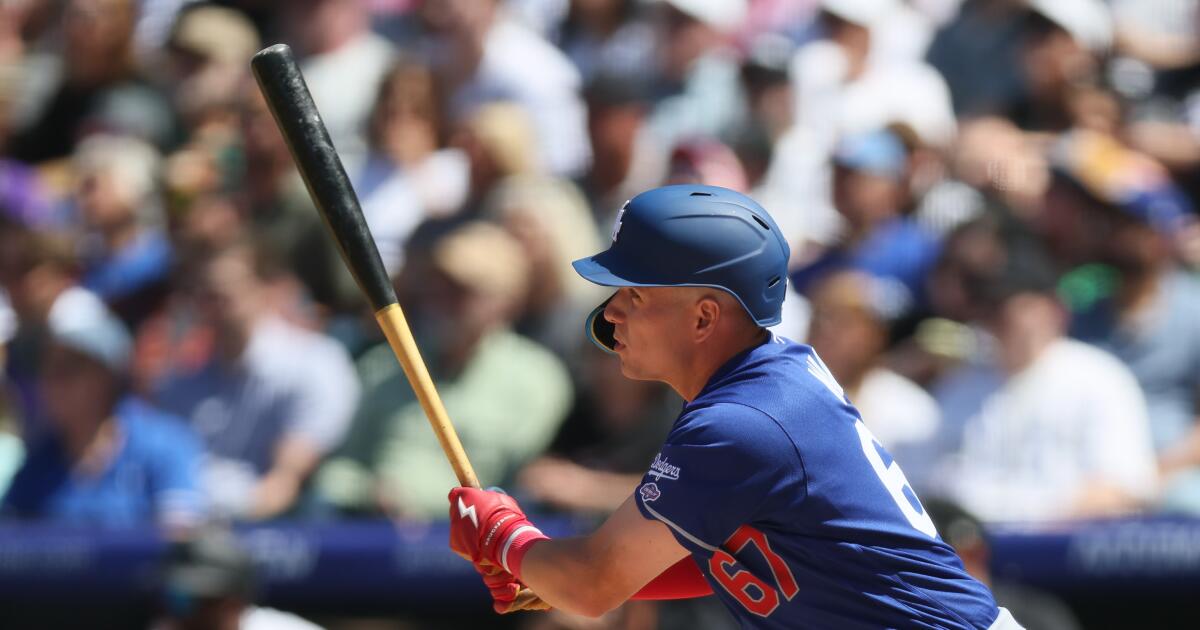
DENVER — What do you know? The once-stampeding Dodgers have been caged by the Colorado Rockies.
With a 9-6 loss Sunday at Coors Field, the two-time defending World Series champions lost back-to-back games for the first time this season. The Dodgers again couldn’t hold a lead, letting the Rockies tee off for 15 hits.
Nor could the Dodgers keep up offensively at the hitter-friendly park — though they put some pressure on in the ninth inning, when Shohei Ohtani led off with a ground-rule double and the Dodgers scored twice to cut the lead to three runs. Then the new guy, Ryan Ward, made the final out in his big league debut, robbed of a hit and a chance to keep chipping away by a diving Troy Johnston in right field.
Before that, the Rockies — who beat the Dodgers twice in 13 meetings all of last season — chased starter Roki Sasaki from the game in the fifth inning and then ruffled the Dodgers’ relievers. That included closer Edwin Díaz, who came on in the eighth and promptly gave up three singles, a walk and two runs before being pulled with the Dodgers trailing 8-4.
Dodgers starting pitcher Roki Sasaki gave up three runs on seven hits in 4-2/3 innings Sunday against the Rockies in Denver.
(David Zalubowski / Associated Press)
He and Blake Treinen combined to face eight batters without getting an out.
“They both weren’t sharp,” said manager Dave Roberts, who had theories but not many answers — though he did have real concern, especially about Díaz, who recently had his right knee checked out by the medical staff.
Roberts said the closer wanted to pitch after nine days off, even though it wasn’t a save situation. But his velocity was slightly down (95.4 mph vs. 95.8) and so, “today was a tough evaluation,” the manager said.
“It really was,” Roberts said. “Because, you know, I know what it’s supposed to look like, and when it doesn’t look like that, it gets a little concerning, really.”
And losing for the second time to the Rockies, who are now 9-13? Being in danger of losing their four-game series, after arriving in Denver without having lost to a National League opponent, against a club that hasn’t made the postseason since 2018?
It’s well below the bar the Dodgers have set, and it added a bitter note to Ward’s otherwise sweet debut.
Ward punched a big league clock for the first time wearing No. 67 and cranked his first hit off Rockies starter Michael Lorenzen in the fourth inning, lining a changeup to right field for a single that scored Andy Pages, made it 3-0 and got the 20-some members of Ward’s party up, jumping in place, hugging and high-fiving.
“When I was on first base, I got to see them all jumping around up there,” Ward said. “That was a pretty special moment.”
He also singled in the sixth and swung on the first pitch in his first at-bat, a fly out in the third inning.
The Dodgers gave Sasaki a 2-0 lead in the third. Alex Freeland drove in Hyeseong Kim, and Shohei Ohtani doubled in Freeland — and extended his career-best on-base streak to 51 games, moving past Willie Keeler into third place in Dodgers history.
Sasaki went 4-2/3 innings, threw 78 pitches and gave up three runs on seven hits, striking out two and walking two. His ERA after his fourth start: 6.11, worst in the six-man rotation.
The Dodgers fell behind 6-5 in the seventh when Treinen — who was cleared Friday after he was struck in the head by a batted ball during batting practice — gave up four consecutive hits, including a two-run home run by Mickey Moniak.
The result likely will be a minor detail when Ward tells the story years from now about getting the call after first baseman Freddie Freeman was placed on the paternity list.
The Dodgers’ No. 19 prospect and reigning Pacific Coast League MVP spent the last seven years in the minors. Last season, he hit 36 home runs and drove in 122 runs with a .937 on-base-plus-slugging percentage for triple-A Oklahoma City, and he has a 1.020 OPS and four homers this year.
Ward made it a point to improve his chase rate, draw more walks and get on base more frequently, everything the Dodgers asked of him. He also passed the broadest patience test.
“The plate discipline, being a better hitter … he’s done all that,” Roberts said. “He’s improved his defense. But honestly, for me, just not to let his lack of opportunity in the big leagues deter him. That’s easy when you get frustrated and let it affect performance, and he hasn’t done that.”
If anything, Ward said, the waiting made him better.
“I used it to keep going. ‘OK, if I’m not there yet, what do I have to do to get there?’” he said. “‘What part of my game do I need to work on to keep getting better?’
“I used it as fire to keep working.”
That will be the Dodgers’ assignment too.
In the finale of the four-game series Monday, the Dodgers are expected to start left-hander Justin Wrobleski (2-0, 2.12) against Colorado left-hander Jose Quintana (0-1, 5.63).

NEWYou can now listen to Fox News articles!
LAS VEGAS – Danhausen’s curse may be real after all – just ask Stephen A. Smith and the New York Mets.
While the latter dropped their 10th game in a row, Smith got his share of the curse on Saturday night during Night 1 of WrestleMania 42. Smith was in attendance for WWE’s premier event of the year and heard massive boos from the crowd.
Stephen A. Smith attends WrestleMania 42: Night 1 at Allegiant Stadium in Las Vegas, Nevada, on April 18, 2026. (Andrew Timms/WWE)
Smith was sitting ringside to watch the action. The ESPN star appeared on the videoboard above the ring at Allegiant Stadium in Las Vegas. He appeared to embrace the reaction and smiled through it.
The boos came after Danhausen appeared on “First Take” on Friday – much to the chagrin of the sports pundit. Smith appeared perplexed by Danhausen’s appearance. Smith said he heard about Danhausen and called him a “bad luck charm.”
Danhausen said Smith had been “rude” to him and put the dreaded “curse” on the commentator.
WWE STAR DANHAUSEN SAYS METS ‘CURSE’ ISN’T EXACTLY LIFTED AS TEAM DROPS NINTH STRAIGHT GAME
Stephen A. Smith attends WrestleMania 42: Night 1 at Allegiant Stadium in Las Vegas, Nevada, on April 18, 2026. (Andrew Timms/WWE)
Smith is far from the only one dealing with the effects of the “curse.”
Danhausen agreed to “un-curse” the Mets during their losing streak. However, he told Fox News Digital earlier this week that there was a reason why the curse’s removal didn’t take full effect.
“I did un-curse the Mets. But it didn’t work because, I believe it was Brian Gewirtz who did not pay Danhausen. He did not send me my money so it did not take full effect,” Danhausen said. “Once I have the money, perhaps it will actually work because right now it’s probably about a half of an un-cursing. It’s like a layaway situation.”
Danhausen enters the arena before his match against Kit Wilson during SmackDown at SAP Center in San Jose, Calif., on April 10, 2026. (Eakin Howard/Getty Images)
CLICK HERE TO DOWNLOAD THE FOX NEWS APP
On “Friday Night SmackDown,” WWE stars like The Miz and Kit Wilson were also targets of Danhausen’s curse.
-

 Culture6 minutes ago
Poetry Challenge: Memorize “The More Loving One” by W.H. Auden
-
 Lifestyle12 minutes ago
Photos: How overfishing in Southeast Asia is an ecological and human crisis
-

 Technology24 minutes ago
Blue Origin successfully reused its New Glenn rocket
-

 World30 minutes ago
Distress call captures tanker under fire, Iran shuts Hormuz trapping thousands of sailors
-

 Politics36 minutes ago
Trump ally diGenova tapped to lead DOJ probe into Brennan over Russia probe origins
-

 Health42 minutes ago
Experts reveal why ‘nonnamaxxing’ trend may improve mental, physical health
-

 Sports48 minutes ago
‘Demon’ Finn Balor settles score with Dominik Mysterio at WrestleMania 42
-

 Technology54 minutes ago
iPhone and Samsung flashlight tricks you should know