Sports
The Golden At-Bat rule could give MLB a new shine. But is it worth it?


When the commissioner of baseball speaks, we listen.
So we were listening a few weeks ago when Rob Manfred stopped by the podcast of Puck’s John Ourand and dropped this giant breadcrumb about a rule change that seems like it might be coming someday to a ballpark near you — and a mobile device even closer to you:
“There are a variety of (rule change ideas) that are being talked about out there,” Manfred said. “One of them — there was a little buzz around it at an owners’ meeting — was the idea of a Golden At-Bat.”
The Golden At-Bat? What the heck is that? That’s what you’re thinking, right? I can help with that.
First off, it’s not to be confused with the Golden Goose, the Golden Retriever or even the Golden Arches. It won’t set you up for life, bark at the mail truck or add 1,500 calories to your digestive system in the next seven minutes.
But it is an idea that would change everything about how baseball — the ultimate team sport — has always worked. So what the heck is it? I’ve been asking that question — and others about this rule idea — for months. So let’s try to explain every golden little thing about it … not to mention how it’s likely to be received, by players, front offices and the baseball gods.
OK, what is a Golden At-Bat?
What if a team could choose one at-bat in every game to send its best hitter to the plate even if it wasn’t that guy’s turn to hit? That’s the Golden At-Bat concept in a nutshell.
Say there are two outs in the 10th inning in October. The Yankees and Guardians are tied. Does this ring a bell at all? But in this alternate October universe, it’s not Juan Soto who is due up. It’s, say, Oswaldo Cabrera. Except the Yankees say: No, no, no. We’re going to use our Golden AB here … and send up Soto. Then home run magic happens.
“Wouldn’t that have been the (ultimate) Golden At-Bat homer?” one front-office executive mused, as we were talking about this concept. “Can we send Juan Soto up there to do that? He actually did hit that homer in that moment.”
He did. And that’s the goal. So should baseball change the rules to attempt to create more of those moments? That’s the question.
How would the rule work?
How would this rule be worded? Sorry. That’s a mystery nobody can answer yet. The truth is, baseball hasn’t settled on those details. And MLB officials declined to speak with The Athletic about any possible future rule changes. But lots of variations have been tossed around. Here are some that I’ve heard.
• Each team gets to pick one at-bat — at any point in the game, but only once — to play its Golden AB card. So would it save that card for The Juan Soto Moment? Or would it play it in the second inning, with the bases loaded and a chance to blow up a game? Strategy alert!
• Or there’s this option: Each team gets one Golden AB per game — except only in the seventh inning or later.
• Or there’s the variation I’d vote for — where only a team that is trailing (or tied) in the ninth or later gets to use a Golden AB. I’m a fan of less is more, and two Golden ABs every game (one per team) might be overkill.
• There’s also this potential wrinkle: The Royals use their Golden AB to let Bobby Witt Jr. lead off the ninth. He makes an out. But who’s batting second? Whaddaya know, it’s Witt’s turn in the lineup. So here he comes again. Yes, that could be a thing.
So what variation will actually end up happening (if any of them do)? We have many golden miles to travel before we can answer that.
The Royals could send Bobby Witt Jr. to the plate in a key spot even though it wasn’t his turn. The specifics of the Golden At-Bat rule — and how teams would use it — are unclear. (Jay Biggerstaff / Imagn Images)
Why would MLB want to mess with the baseball gods?
For almost 150 years, the epic late-inning moments in this sport have all happened organically. So you’d be messing with some seriously embedded forces in the universe if you suddenly drop in a rule change that practically scripts them to happen. Why would the powers that be even want to go there?
All right, let’s think this through. How heart-pounding was that Soto at-bat in the ALCS that ended with a homer? How unforgettable was the final at-bat of the 2023 World Baseball Classic, Mike Trout versus Shohei Ohtani?
They made for mesmerizing baseball theater, right? So if you were designing the sport from scratch, would you want more of those moments or fewer? I won’t even answer for you. Just think about it.
But while you’re thinking, let’s go beyond baseball. If it’s the Super Bowl, Patrick Mahomes is going to have the ball in his hands with 47 seconds to play. Is that a problem? Ho, ho, ho. It’s a reason — THE reason — to watch.
Or if it’s the NBA Finals, you think there’s any chance that Steph Curry … or LeBron James … or Nikola Jokić might have a chance to do something special as the clock ticks down? Oh, only every possession. Is that a problem? Let’s say no.
So why would Manfred’s sport want to mess with the baseball gods? That’s why. Why should only those other sports get to have their games decided by their biggest stars?
His sport isn’t there yet. The pros are still duking it out with the cons. The details aren’t even set in pencil, let alone in stone. But if the goal is to create moments and memories, the Golden At-Bat could be a vehicle to create more of those. So who could possibly complain?
Ha. Don’t answer that … yet!
C’mon, could this really happen?
Is the Golden AB really going to happen? Who the heck knows — but let’s still go with this guess, of … yes!
On Ourand’s podcast, Manfred described this idea (and others) as being “in the conversation-only stage right now.” So that makes it sound iffy — except for one thing:
He chose to talk about this out loud, where everyone could hear it.
He also used the word “buzz” to describe the response. Which is interesting, because from what I can discern, it’s not the buzziest buzz in the baseball cosmos at the moment.
It’s clearly not as buzzy as the electronic strike zone anyway. It wasn’t a topic at the owners’ meetings that were held in the past two weeks. And there is no evidence that this concept has even been presented to the players at any meeting of the competition committee.
But despite all that, it wouldn’t be a shock to see the sport test this soon — possibly even as soon as … (drum roll, please) next year!
Where would the test be?

A Golden AB for Shohei Ohtani? MLB could experiment with the rule in the midsummer classic. (Tim Heitman / Imagn Images)
Over on the minor-league side of this sport, folks have heard “buzz” that the league would like to test the Golden AB in some form in the minors sometime in the next couple of years. But would that test be coming as soon as 2025? Can’t answer that, but I’d lean toward no.
So if any variation of the Golden AB does surface next year, here’s where I’d guess you’d see it:
In the MLB All-Star Game.
Manfred also dropped that breadcrumb on Ourand’s podcast. When the conversation veered toward possible tweaks to that game, Manfred tipped his golf cap to his TV partners at Fox Sports, saying: “They’re always thinking. They’re never short of ideas. And they are reasonable.”
So what All-Star Game ideas had gotten his attention? See if this sounds familiar.
“Most of the changes we have discussed,” he said, “involve producing the matchups, in the context of an exhibition game, that the fans want to see the most. You know, more freedom in terms of substitution and whatnot. I am receptive to those ideas, in the context of an exhibition game.”
Does that sound Golden-AB-ish to you? It does to me, except that if baseball goes down that trail in the All-Star Game, it might not stop at just one at-bat.
Several years ago, Fox tossed out a slightly different concept that went nowhere at the time — but since has gotten enough traction that someone asked me what I thought of it a few months back. Since it’s the All-Star Game and the biggest stars aren’t on the field after the fourth or fifth inning, how about this fun idea to keep you tuned in:
Before the game, each team could designate three All-Star starters who could re-enter the game in the seventh inning or later. Then you might see something like this:
Emmanuel Clase enters to nail down another American League win … but wait. Here come Ohtani, Bryce Harper and Mookie Betts back into the game for the National League to face him. I’d watch!
Or maybe each team could throw out five names … and then fans could vote on which three could return.
Or … you could just limit this fun to one Golden AB.
I was so curious about this idea, I asked a bunch of players what they thought of it at this summer’s All-Star Game. We’ll get to those entertaining exchanges shortly. Just know this, for now: If the league wanted to try this next July, I don’t think they would get furious blowback from the players.
But before we roll out that player reaction, you might be wondering …
Who thinks of this stuff?
Would it surprise you to know that this brainstorm goes back well before the 2020s? David Samson, the former Marlins president who now hosts the popular “Nothing Personal” podcast, has said on his show that he brought it up as far back as a decade ago.
Back then, he was a member of a previous version of MLB’s competition committee. Nothing formal was ever proposed. It was more like: What about this idea …
So how’d that go? About how you’d expect.
“The view was, you are basically ruining the sanctity of the game,” Samson told The Athletic. “The brilliance of the history of the game is that, hey, if the right guy’s up, the right guy’s up — and if not, he’s not. And many times, there are heroes that are made by people who otherwise are not heroes, because they had an opportunity, as a big-league player, to have a big at-bat.”
Brett Phillips, Rajai Davis and Bucky Dent second that motion! So that idea went nowhere at the time. Samson laughed as he recalled: “I didn’t take it personally.”
But now rock your time machine forward and think about what’s happened in this sport over the past couple of years. By which we mean … the pitch clock happened. And shockingly, the Baseball Earth did not stop spinning.
So what’s possible after your sport has successfully challenged the sanctity of another age-old baseball adage, The Game Without a Clock?
“It makes people in the game more comfortable talking about change,” Manfred told Ourand.
So suddenly, those ideas from partners like Fox, which used to be met with Ummm, not yet, are now viewed as Not Even Totally Crazy. But now can those ideas make the big leap from the whiteboard to the emerald ballfields of real life? I asked that question to a bunch of people in the game. Let’s hear from them.
Are the players ready for the Golden At-Bat?
As I mentioned earlier, I surveyed players about this five months ago at the All-Star Game. I shrewdly asked them first about trying it in the All-Star Game, then smoothly glided into What About the Real Games mode. Let’s roll the highlights.
Brewers outfielder Christian Yelich — When I asked Yelich about how he felt about three starters re-entering the All-Star Game in the late innings, his face lit up.
“That would be kind of cool,” he said. “I mean, it’s an exhibition game after all, right? So you want to keep it to where it’s a game, but also, if you want to add a wrinkle that makes it more entertaining, or do stuff geared for the fans and keep the entertainment value high, I’m all for it.”
But when I asked if he’d be open to something like the Golden AB in regular-season games — in the vein of Steph Curry having the ball in the last minute of a hoops game — his wheels started spinning.
“I’d have to see it more,” he replied, but didn’t rule anything out.
“Do you think it’s too gimmicky?” I asked.
“No,” he said. “I mean, look, we’re doing stuff to change the game up a little bit and make it exciting. So I’m open to any idea, and you kind of just see how it works out. And if it’s good, it stays. If it’s not, you kind of just keep going.”
I didn’t hear a “no way” in there. On to the next player!
Twins shortstop Carlos Correa — Correa was equally cool with the All-Star Game version.
“You’re onto something right there,” he said. “It’s fun, right? Just put whoever you want in the ninth inning to hit. That would be great. I love it.”
But what about the regular season? He looked directly into my eyeballs, as if he was searching for a window into what kind of trouble I was trying to lure him into.
“My relievers are going to hate me if I say I agree with that one,” he replied, finally. “I can’t agree with that one because the relievers are going to be under really, really high stress all the time, and then the injuries are going to go even higher.”
We went back and forth a couple of times. Then I pointed out that he was down with making the All-Star Game as entertaining as possible. So if we brought this idea to the late innings of real games, wouldn’t that be like LeBron taking the last shot?
“OK, I agree with you,” he said. “But I think you should be able to bring in whatever pitcher you want then.”
“You could do that, too,” I replied, grateful for any meeting of the minds.
“You can’t do that now,” he said.
Actually, you can, I think. But again, that wasn’t a complete shutdown. So since he’d raised a new concern, it was time to ask a relief pitcher about this.
Phillies reliever Matt Strahm — Strahm, like Yelich, is a free thinker who always sees the big picture. Not surprisingly, he agreed instantly that the All-Star Game idea was a good one. That was great to hear, I told him, because a hitter had theorized earlier that relievers would get mad if baseball did that.
“I mean, some of them probably, yeah,” he said. “But as a reliever, you know what the fans are here for. Every time I’m wearing a gray uniform, they all want to see me get taken deep or walked off or whatever. That’s one of the most exciting plays in the game. So I understand it. And I think we can maybe sacrifice that for a game that doesn’t count.”
All right, but what about in a game that does count?
“I wouldn’t like that,” he said, without hesitation. “Nah, that messes with baseball history too much. I don’t like that one. Say you have a guy like Craig Kimbrel, who is going to be chasing 500 saves. Then he’s got to do it at the end of his career against Aaron Judge and Juan Soto for every save? Nah. That’s not right.”
Hey, I told him, if you want to be the best, don’t you have to beat the best? He laughed, but he wasn’t falling for my little trap.
“A hundred percent,” he said. “I agree with that statement, but I don’t agree with that rule.”
Got it. So, relief pitchers: Not all in.

Matt Strahm liked the idea of the Golden At-Bat in the All-Star Game, but not in the regular season. (Kevin Jairaj / Imagn Images)
Dodgers first baseman Freddie Freeman — Almost every time I see Freeman, he knows I have some inspired idea to run by him. So he was ready to poke holes in this one, in that good-natured Freddie Freeman way of his. We began with the All-Star scenario — three stars coming back out of the cornfield to bat in the ninth.
“Well, they’re all All-Stars, you know,” he said. “So I think we all would be OK with whoever goes up in the ninth inning. You just want Shohei and Aaron Judge to hit every single time? I totally understand. I would, too. I’d rather just watch them hit nine times.
“Look, I like your idea, Jayson. But I’m gonna fight against that, because they’re all All-Stars, and I wouldn’t mind anybody hitting.”
I knew where this was going next, but I went there anyway. How about the regular season, I asked.
“No, no, no,” he said. “I’m old school, you know, even as a young guy. I like baseball. I’m a baseball purist. So I’m gonna go no.”
“Let me play devil’s advocate here,” I told him. “Steph Curry always has the ball at the end of the game in basketball, right? Why doesn’t that work in baseball?”
“I get it,” he said. “I would rather watch Shohei hit 20 times a game. It would be really good for the Dodgers if he did that too.”
“So as long as it’s Shohei, you’re fine with it?” I kidded him.
“No, I’m good with Mookie,” he said. “I’m good with Will Smith. I’m good with pretty much our whole team. Look, as long as it doesn’t mean anything — like the All-Star Game now is just for fun — you can do whatever you want.”
“But what about the actual game?” I asked.
“Let’s just play six innings and do a Home Run Derby for the last three,” he bantered, playfully.
“No, let’s not do that,” I said.
“Why?” he said, laughing. “So you don’t like my ideas, but I’ve got to like all of yours?”
We were having such a good time at this point, it almost didn’t matter how this wound up. But then, in a shocking twist, it turned out I’d worn him down.
“Oh, I don’t care,” he said, finally. “You know me. Whatever the rules are, just tell me, and I’ll abide by them.”
That’s the spirit. So the verdict from the players: Not in, but not 100 percent out. So it’s time to survey another important demographic …
Are front offices ready for the Golden At-Bat?
This was not what you’d call a scientific poll. It was more like a mission to find somebody — anybody — inside an MLB front office who even knew what a Golden At-Bat was. Turns out that was a short list.
But I found one exec who loves this idea and one who hates it. They were each granted anonymity so they could speak freely about prospective rule changes, always a sensitive topic for people at their level.
Not a fan of the Golden AB — The club official who is skeptical wanted to make it clear he’s not one of those old-school execs who hates every new rule. The last wave of rule changes — pitch clock, stolen-base incentives, etc. — were great, he said.
“With the other rule changes … you’re trying to create the best version of baseball,” he said. “But with this rule, the Golden At-Bat, it’s like you’re trying to create a different sport. You’re trying to create something else that’s kind of like baseball, but not really.”
I gave him a rundown of every possible selling point for the Golden AB. He wasn’t budging.
“I understand the value of Mike Trout versus Shohei Ohtani to decide the WBC,” he replied, “and if we can create that every day, you have a reason for people to tune in. Yes, that’s great. It’s just not baseball.
“It is fundamentally changing the character of the sport and the batting order, which is a huge function of how the sport lives. Just to change that, to try to make the eighth or ninth inning more interesting, I don’t know. That one is hard for me, in ways that changing the infield shift rules and other things are not. Those rules are about returning the game to the way it was meant to be played. That is not this. This is like the opposite of that.”
I laid out the potential upside one more time. No dice.
“It’s not for me,” he said. “I feel like it’s (Savannah) Banana Ball-type stuff, as opposed to how baseball should be played.”
Big fan of the Golden AB — So how many people, in front offices across North America, think the way that last exec thinks? I’d guess most of them — and who’s to say they’re wrong? But for the other side of this argument, let’s listen to an official of a different team who has come to recognize that his sport needs to serve its audience — or, even more importantly, its future audience.
“The world is changing,” this official said. “Look at the way entertainment is consumed now. Look who you’re competing with. Today’s fans have grown up on their phones. … They’re used to getting exactly what they want, what they like, what they find engaging and compelling — and they want it now. And they want to watch it for a few minutes and move on. So the Golden At-Bat accomplishes all those things.”
But there’s also an important baseball reason, he went on. At a time when the league batting average and on-base rates have sunk to levels we haven’t seen in half a century, the sport should be thinking outside the box to find ways to create not just more drama but also more runs.
“Hitting is so hard,” he said. “So why would we not want to give more plate appearances to the best hitters? Something like the Golden At-Bat gives one of your highest-leverage appearances in a game to one of your most talented hitters. I like it. I think that’s another small thing you can do to help offense.”
Excellent point — but not one that impressed the next guy we surveyed …
Joe Maddon: Not a fan

Joe Maddon: “Who are we trying to serve with this? And what is the purpose of the whole thing? I don’t quite understand that.” (Darren Yamashita / Imagn Images)
So what would managers think of the Golden AB?
It would be one more pivotal chess move that would get dropped on their game board every night. So would they enjoy the strategic component of it? Or do they already have enough on their plates, their lineup cards and their spreadsheets?
I went looking for the most candid response possible. So I chose a former manager, not a current manager, because he could speak more openly. But I also wanted an innovator and someone not far removed from the dugout. So I called the ex-manager of the Rays, Cubs and Angels, Joe Maddon. Turns out this was one innovation he wanted no part of.
“You’re starting to play this game with a joystick, and not human beings,” he said, pithily.
That sounded like a vote for humans over joysticks. But just so it was clear, Maddon kept laying out his issues with this rule. Let’s sum up three of them.
This isn’t basketball — So LeBron has the ball at the end of every basketball game — and there were 120 Dodgers games this year in which Ohtani didn’t get a swing in the ninth inning? That’s not a good enough reason, Maddon said, to mess with such a fundamental part of baseball.
“That’s just how that game’s built,” he said. “Our game is not built that way. Why do we want to bastardize our game and make it like everybody else?”
I decided again to play devil’s advocate. Wasn’t Trout versus Ohtani awesome baseball theater? Of course, Maddon said. So if the sport, with this rule, could create the ability to have more moments like that, what’s the downside?
“The more we see things, the less impact they have.” Maddon said. “The Trout-Ohtani thing was outstanding because you rarely see it. You don’t see Halley’s Comet every night.”
It’s anti-“team” — As I was outlining the reasoning behind the Golden AB, I could hear Maddon scribbling on a sheet of paper.
“As you were explaining that,” he said, “I wrote down the word ‘team.’ What is that anymore?”
As a manager, Maddon said he was constantly concerned about keeping his entire roster connected, not just his stars. So if one of those stars was going to bat every night in place of the same group of non-stars, there’s danger in that.
“There’s no way you can convince me that you’re going to take this (non-star) part of the team and kind of make them moot in tough situations,” he said. “After all, when a team succeeds in those circumstances (and the non-stars come through), it really builds a lot within the group.”
I asked if he would find it more palatable if the league tried it out in the All-Star Game.
“They could do whatever they want,” he said. “I don’t care. To me, it’s not interesting at all, not even a little bit. I find nothing interesting about it. I find it totally counter to the team concept in the game, everything you preach on a daily basis.”
It’s pseudo-strategy — Lots of changes in baseball were good and important, Maddon said. The pitch clock. The wild card. Lowering the mound in the 1960s.
“Those were needs — things the game needed,” he said. “Needs that were implemented to make the game more watchable. But needs should never impact strategy (so significantly).”
“Don’t ever confuse the word ‘change’ with the word ‘progress,’” he said later. “Change does not necessarily equal progress. Change could be regress. And in this situation, it may be totally regressive, because the game no longer becomes the game when you start messing with strategy on that level.”
Then he asked this:
“Who are we trying to serve with this? And what is the purpose of the whole thing? I don’t quite understand that.”
I’m glad he posed those questions. It’s an important aspect of this. So let’s spin off that thought and ask a question of our own:
This is interesting — but are we sure it’s worth it?

“We should not be afraid of doing something that is entertainment-based, but also competitive-based,” David Samson said. “Aaron Judge is not going to hit a home run every at-bat.” (Robert Deutsch / Imagn Images)
Earlier in this discussion, I posed a question I knew the answer to: Who could possibly complain? Ha. We’ve learned exactly who could possibly complain. Managers. Club officials. Players. And, of course, fans. That isn’t the entire population of the planet. But it sure covers every possible voting bloc.
It’s so easy to poke holes in an idea like the Golden AB. Here’s another one: Wouldn’t it throw all of baseball history out of whack?
Depending on which version of the Golden AB you chose, it could get Judge an extra 120 at-bats a year — many of them with lots of runners on base. So if he hit 82 homers and drove in 170 runs some year, are there enough asterisks in the world to slap on the record books? Maybe not.
But is that really going to be how this goes? Baseball could make sure it doesn’t just by limiting the Golden AB to only the ninth inning and only when a team is trailing. Voila! That problem is solved. Then it’s a much more limited number of at-bats. And what’s the problem?
“We should not be afraid of doing something that is entertainment-based, but also competitive-based,” Samson said. “Aaron Judge is not going to hit a home run every at-bat. Could he hit one every three at-bats? I don’t think so, because then he’d hit 200 home runs a year. So just by giving him the Golden At-Bat every ninth inning, the Yankees are not going to win 150 games. And of course, he’s not going to hit a home run every time.”
But what about the box scores? Wouldn’t this wreak havoc with the box scores? How would they deal with this: Bryce Harper batted in the three-hole and the seven-hole in this game? And he hit a home run from both of them? Wouldn’t that break every computer in America?
I asked that question of Tom Thress, the president of Retrosheet, which has a database of box scores dating back more than a century. He didn’t sound worried.
“Back in the day,” he said, “there used to be the occasional ‘courtesy runner’ — usually after a batter was hit by a pitch — where someone pinch-ran for the player but the player was allowed to return to the field in the next inning. … The parallel here is that sometimes the ‘courtesy runner’ was a guy who was already in the game.”
If you click on Retrosheet, you’ll notice that those courtesy runners did not crash their site. It’s still up and running, despite that affront to the rules and norms of baseball. So if the Golden AB becomes one of those rules and norms, everyone will figure that out, too, he predicted.
And how about the unraveling of the team concept that Maddon was highly agitated about? It’s an issue. But even Maddon conceded it could be dealt with by adopting the Golden AB in the minor leagues first.
“You’d just say, ‘Listen, you want to win, right? You’re part of the team, so if this guy gets this at-bat for you, the team has a better chance to win again,’” Maddon said. “That could be so brainwashed in the minor leagues. I could totally see that happening. That would be part of it, where you convince young players of that.”
So for every problem, there’s a possible solution — if you want to seek one. The question everyone has to answer is: Is it worth it?
“That’s the whole thing,” Maddon said. “What is worth it? What are they trying to accomplish? What is the end game right here? How is it going to benefit the game now and in the future? That’s where you have to convince me, because I don’t see it.”
He’s living proof that the Golden AB is not for everyone. But for the people in the sport who are warming to it rapidly, it’s worth fighting for.
“Those of us who love the game, we all have the same goal,” Samson said. “We’re looking for viral moments. Some people say: ‘Let’s just let it happen — and if it never happens, it never happens.’ But if you could create it, it’s not clickbait, because that is too insulting a word to put to this. If you can, it’s creating a memory — which is what we’re in the business of, is creating memories and entertaining people.
“And if you can do it in a way that is only helpful,” he said, “there is zero downside.”
Well … what about all those people who see all downside and no upside? We should listen to their voices, too. So it might take a while to sort all that out. Which means I don’t know if you’ll ever see the Golden AB come to a big-league game — unless it’s the All-Star Game. I also don’t know who’s right or wrong in this debate.
I just know the commissioner of baseball threw this out there for all of us to ponder. So we’re pondering. And even the people who hate it are already pondering how they’d react if it actually happens someday.
“I can say now I think that’s a terrible idea,” said the skeptical exec quoted earlier. “But then, if they put it in play, I’m like everyone else. I’d say: ‘OK, how do we use it to take the most advantage of it?’”
(Top image: Dan Goldfarb / The Athletic. Photo of Vladimir Guerrero Jr.: Mark Blinch / Getty Images)



Sports
England’s Jordan Henderson officially ruled out after freak fall causes fracture, opts for surgery

A freak mishap Sunday night abruptly ended England midfielder Jordan Henderson’s 2026 World Cup.
Henderson, 36, spent the match on the bench in England’s 3-2 win, but quickly drew attention after falling over an advertising board, leaving him writhing in pain during a moment of victory for England.
England’s Jordan Henderson is stretchered off after suffering an injury during World Cup Round of 16 victory. (Photo by Bradley Collyer/PA Images via Getty Images) ((Photo by Bradley Collyer/PA Images via Getty Images))
Harry Kane celebrates with Jordan Henderson after England’s thrilling World Cup victory over Mexico Sunday. (Photo by Michael Steele/Getty Images) ((Photo by Michael Steele/Getty Images))
On Monday, Henderson opted to undergo surgery, bringing an unusual ending to the World Cup campaign of one of England’s veteran leaders.
ENGLAND PLAYER INJURES WRIST HOPPING OVER AD BOARD DURING TEAM’S WORLD CUP VICTORY CELEBRATION VS MEXICO
As the stadium speakers blasted Oasis, Henderson tried to climb over a pitch-side advertising board to celebrate with the traveling supporters. He lost his footing and landed awkwardly on his wrist.
WATCH:
England captain Harry Kane reacted to Henderson’s injury Sunday night after the match.
ENGLAND STUNS MEXICO 3-2 IN INSTANT WORLD CUP CLASSIC, HANDS TEAM FIRST WORLD CUP LOSS AT ESTADIO AZTECA
“Yeah Hendo just fell over there. I think he’s OK. Something to do with his arm,” Kane said, unaware of the severity of Henderson’s injury at the time.
Dan Burn helps injured Jordan Henderson during England’s World Cup victory celebrations over Mexico Sunday. Surgery required for English vet. (Photo by Martín Fonseca/Eurasia Sport Images/Getty Images) ((Photo by Martín Fonseca/Eurasia Sport Images/Getty Images))
The celebrations quickly turned to concern as medical staff rushed onto the field, administered oxygen, and stretchered Henderson off the pitch.
Before the accident, Estadio Azteca hosted a World Cup classic. Jude Bellingham sparked England with a first-half brace before Harry Kane added a penalty. Mexico answered through Julian Quinones and a late Raul Jimenez penalty.
ENGLAND STUNS MEXICO 3-2 IN INSTANT WORLD CUP CLASSIC, HANDS TEAM FIRST WORLD CUP LOSS AT ESTADIO AZTECA
Henderson watched the thriller from the bench, picking up a yellow card in the 98th minute for his touchline protests. The match fell into chaos when England defender Jarell Quansah was shown a straight red card, forcing the Three Lions to desperately hang on.
While manager Thomas Tuchel and the squad flew to Kansas City to prepare for a quarterfinal clash against Norway, Henderson remained hospitalized in Mexico City. England next faces Erling Haaland’s Norway on Saturday without the suspended Jarell Quansah.
CLICK HERE TO DOWNLOAD THE FOX NEWS APP
Henderson’s World Cup had its ups and downs. The last one ended it.
Send us your thoughts: alejandro.avila@outkick.com / Follow along on X: @alejandroaveela
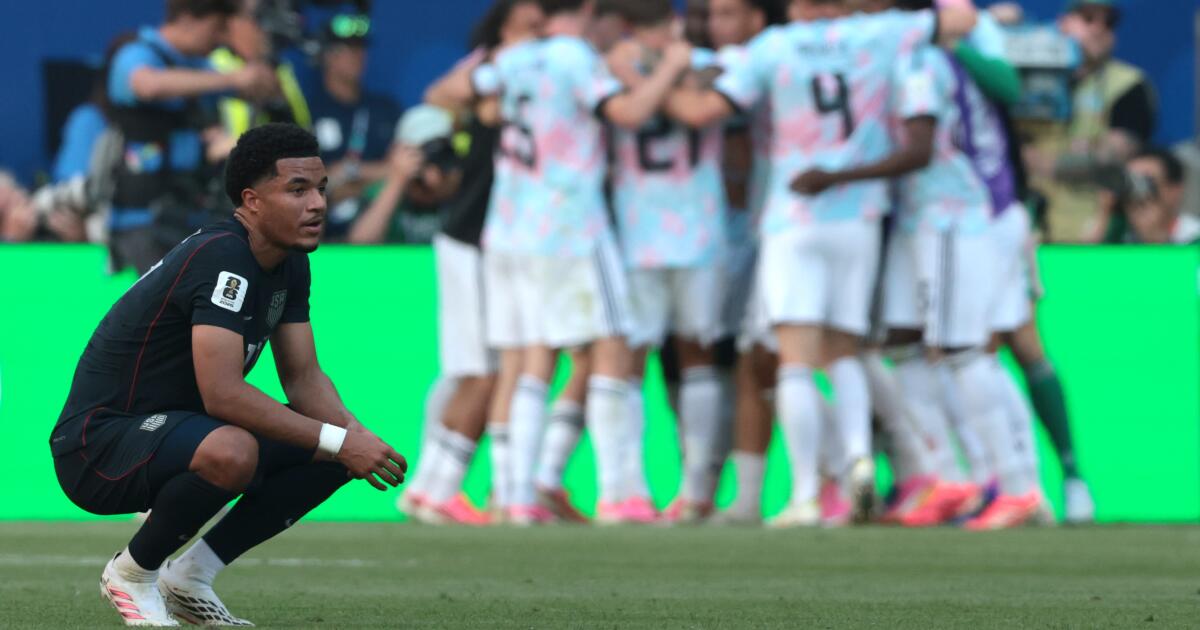
SEATTLE — For three weeks, it was the best World Cup ever for the U.S.
The Americans scored more goals, won more games and generated more interest than any U.S. team in history. But all that glory gave way to grief Monday when a 4-1 loss to Belgium brought the U.S. crashing back to Earth.
Belgium never trailed, getting two first-half goals from Charles De Ketelaere and two in the second half from Hans Vanaken and Romelu Lukaku to clinch a spot in the tournament quarterfinals, where it will face Spain on Friday at SoFi Stadium in Inglewood. For the U.S., whose lone goal came from Malik Tillman, its World Cup ended in the round of 16 for a fourth straight time.
U.S. players Tim Ream, center, Malik Tillman, left, and Folarin Balogun react after Belgium’s third goal on Monday.
(Robert Gauthier / Los Angeles Times)
The U.S. did win a knockout round game in the tournament for just the second time, but that came in a round of 32 necessitated by the World Cup’s expansion to 48 teams. All three tournament hosts, the U.S., Canada and Mexico, were eliminated in the round of 16.
The run-up to Monday’s game was clouded by the controversy surrounding U.S. striker Folarin Balogun, the Americans’ leading scorer, who wasn’t officially cleared to play until about seven hours before kickoff after FIFA rejected an appeal from the Royal Belgium Football Assn. The association was seeking to overturn an unusual ruling from the FIFA disciplinary committee, which on Sunday made Balogun eligible to play despite the fact he was shown a red card and expelled from his team’s previous game.
The red card also carried with it a ban from the team’s next game — in this case, the Belgium match — but FIFA suspended that penalty and imposed a one-year probation instead. It was just the second time in World Cup history — and the first since 1962 — that FIFA has held a red-card suspension in abeyance and allowed a player to participate in his team’s next game.
Balogun was active Monday, going the full 90 minutes, but Belgium kept him from getting on the scoreboard.
Belgium, in fact, was on the front foot from the start, taking six shots and putting two on target in the first eight minutes before going ahead on De Ketelaere’s first goal in the ninth minute. De Ketelaere, starting over the more physical Lukaku, Belgium’s all-time leading scorer, got free on the edge of the six-yard box and ran onto a centering pass from Nicolas Raskin, then made the easy tap-in for his first World Cup goal.

The sequence followed Sergiño Dest’s decision to let a headed clearance attempt from Chris Richards bounce inside the penalty area, allowing Raskin to scoop up the loose ball and send it on to De Ketelaere, whose goal marked the first time the U.S. trailed in the first half hour of a game in this tournament. It was also the earliest goal the U.S. had allowed in a World Cup game since Nani scored for Portugal in the fifth minute of the second group stage game in Brazil in 2014.
The U.S. matched that in the 31st minute when Tillman deflected a free kick in off the head of Vanaken following a foul on Balogun. It was Tillman’s second free-kick goal in as many games, making him the second player since 1966 to score twice off direct free-kick goals in the same World Cup.
But the draw was short-lived, with De Ketelaere putting Belgium in front, where they would stay, two minutes later with his second score of the first half, this one a header over the back of U.S. captain Tim Ream. Leandro Trossard got the assist, bending a perfect back-post cross from the end line to his waiting teammate.
Belgium dominated the opening half, outshooting the Americans 11-3 and putting five of those tries on goal, an edge U.S. coach Mauricio Pochettino tried to address by subbing Dest off at halftime for Gio Reyna. It didn’t work, however, with Belgium expanding its lead on a major gaffe from U.S. keeper Matt Freese in the 57th minute.
Freese, who had given up just one goal in his first three starts, came well off his line to beat De Ketelaere to a loose ball, chesting it to the turf. But De Ketelaere poked a toe out to knock the ball back to Vanaken, who skipped a shot from about 30 yards past a retreating Ream and into the vacant goal.
After the goal, U.S. star Christian Pulisic was subbed out after sustaining an apparent leg injury while attempting a shot. He was limping on the field before being replaced by Sebastian Berhalter.
Lukaku, who came on in the 67th minute, closed out the scoring with a goal in stoppage time.
The U.S., which was eliminated by Belgium in the round of 16 of the 2014 World Cup, hasn’t beaten the Red Devils since its opening match of the first World Cup in 1930.

U.S. goalkeeper Matt Freese reacts after Belgium midfielder Hans Vanaken (not shown) scored against him in the second half of Belgium’s 4-1 win at the World Cup on Monday.
(Allen J. Schaben / Los Angeles Times)

NEWYou can now listen to Fox News articles!
FIFA President Gianni Infantino released a statement on Monday addressing his interactions with President Donald Trump amid USA World Cup star Folarin Balogun’s suspended one-game ban.
Trump told reporters he asked Infantino if FIFA would review the play. Infantino said in his release that “FIFA’s judicial bodies are independent” and “operate autonomously, apply the FIFA Disciplinary Code, and decide cases based on the applicable regulations and the specific facts before them.”
ZERO BS. JUST DAKICH. TAKE THE DON’T @ ME PODCAST ON THE ROAD. DOWNLOAD NOW!
FIFA President Gianni Infantino answers questions during a 2026 soccer World Cup news conference Thursday, June 16, 2022, in New York. (AP Photo/Noah K. Murray)
“Yes, I regularly discuss matters related to the FIFA World Cup with the President of the United States, and on this matter, I did receive a call from President Donald Trump, just as I receive calls from heads of state, government officials, football stakeholders and business executives from around the world on many different issues,” he said. “During our conversation, I explained that there was an ongoing legal process involving FIFA’s independent judicial bodies and that the case would be decided in due course by the competent bodies. That is how FIFA’s system works, and it is a principle that I will always uphold.
“I read the decisions of the FIFA Disciplinary Committee when they are issued. Sometimes I am surprised by them. Sometimes I agree with them, and sometimes I disagree.
“What I always do, however, is respect those decisions and the autonomy of the bodies that make them. Whether we personally like a decision or not is irrelevant. Respect for independent institutions and the rule of law is what protects the integrity of our competitions and the credibility of FIFA at all times.”
Gianni Infantino, President of FIFA, shakes hands with U.S. President Donald Trump as he receives the FIFA Peace Prize during the FIFA World Cup 2026 Official Draw. (Hector Vivas – FIFA/FIFA via Getty Images)
Balogun was given a red card after a VAR review to look at a play in which Balogun stepped on the ankle of a Bosnia and Herzegovina defender. He would have been suspended for the team’s match against Belgium but FIFA decided to suspend the one-game ban.
Trump addressed the controversy in the Oval Office.
“All I did was, I asked for a review, because I didn’t think it was a foul,” the president said. “And again, I’m good at this stuff. I didn’t think it was a foul. I thought it was two great athletes who crashed into each other and got entangled. That was not a guy punching somebody in the face or anything that would be different.
“I think it’s a terrible … if they wouldn’t allow a top player, maybe the best, maybe among the best on the team, to play, I think it would have had a big stain. I relayed it. I didn’t tell him what to do. I don’t believe he made the decision. I think it was a committee that made the decision and they made the right decision because, No. 1, it wasn’t a foul and you want to see a game with your best players.”
Trump said the feeling would be the same if Lionel Messi, Cristiano Ronaldo or Harry Kane would have been given a red card in a similar way.
He also took issue with the call itself.
FIFA President Gianni Infantino speaks during a news conference at the stadium in Mexico City on June 10, 2026, a day before the opening FIFA World Cup match between Mexico and South Africa. (Eduardo Verdugo/AP)
“If you would have taken him out, I think it would have really stained this incredible championship,” Trump continued. “We gotta have our best players and Belgium, Belgium’s got a great team by the way. We have our best players and they have to have their best. If we win or we lose, it’s fair. Otherwise, let’s say we lost to them, then we lost the game. It would be a terrible thing. I think they made a really brilliant decision.
CLICK HERE TO DOWNLOAD THE FOX NEWS APP
“I think the referee’s call was horrible and nobody talks about that. They talk about the red card like it’s fine. The referee’s decision to red card, I didn’t know what the hell a red card was and when I found out I said, ‘You gotta be kidding.’ … I said, ‘Wow, that’s a lot of power, that’s terrible.’ And then I looked at his past and it wasn’t so great.”
Belgium’s appeal was dismissed later Monday.
-

 Wisconsin14 minutes ago
Wisconsin DOT begins $6.87M I-41 ramp deck overlay upgrades in Brown County Tuesday
-

 West Virginia19 minutes ago
11 Marshall student athletes suing NCAA over new rule – WV MetroNews
-

 Wyoming26 minutes ago
Election Q&A: Qwenton Eagle Oviatt for Wyoming secretary of state
-

 Crypto29 minutes ago
An Easy-to-Miss Radio Traffic Jam Is Behind Many Home WiFi Slowdowns
-

 Finance34 minutes ago
Fayette County Public Schools Board of Education approves audit contract, new finance director position
-

 Fitness41 minutes ago
Caroline Idiens and Jenni Falconer’s time-efficient 9-exercise workout builds full-body strength in 30 minutes
-

 Movie Reviews49 minutes ago
Film reviews: ‘The Invite’ and ‘Minions & Monsters’
-

 World59 minutes ago
Feds Detail Hoopster Kerr Kriisa’s Alleged $2.2M Criminal Side Hustle

