Sports
Potential NFL salary-cap cuts for all 32 teams: From Cooper Kupp to Davante Adams and more


Not every NFL team is blessed with cap space this offseason. The New England Patriots, for example, have little worry and plenty incentive to spend at an estimated $119 million in cap space, according to Over The Cap. Other teams, such as the New Orleans Saints, with a $51 million hole to climb out of, have plenty of cap gymnastics ahead over the next few months.
But no matter where any team falls on the cap space spectrum, everyone could stand to create some room for themselves as free agency revs up. That’s where The Athletic’s NFL beat writers come in. Which players could be salary-cap casualties in the coming months? We have one for all 32 teams below.
Arizona Cardinals: Jalen Thompson, S
GM Monti Ossenfort has avoided big swings, which often frustrates the fan base. But it has put the Cardinals in a good place and positioned them to improve the roster. Per Over The Cap, Arizona ranks fourth in the NFL with $71.3 million in available cap space. There’s not an obvious potential cap casualty on the roster. Thompson is a possibility. He has started for most of his six seasons. He’s dependable. He’s also entering the final year of his contract. The Cardinals in December locked up safety Budda Baker. They drafted Dadrion Taylor-Demerson in the fourth round of last year’s draft. This might be the place. Releasing Thompson, 27 in July, would save Arizona nearly $6.6 million in cap space. — Doug Haller
Atlanta Falcons: David Onyemata, DT
Financially, it makes more sense to move on from fellow defensive tackle Grady Jarrett, but he seems untouchable in Atlanta even though he and Onyemata both will be 32 when the season begins. The Falcons would incur an $8.8 million dead-cap hit, but releasing Onyemata would save the same amount in total cap dollars, and while his play has been solid in the two years (seven sacks, 14 TFLs) since signing as a free agent in 2023, it hasn’t been stellar, and the Falcons need to get younger up front (releasing Jarrett would save $16 million on the cap and result in just $4.1 million in dead-cap hit). — Josh Kendall
Baltimore Ravens: Marcus Williams, S
This has been viewed as a formality since the free-agent acquisition from 2022 was benched and made a healthy scratch for the final seven games. Williams restructured his contract last month to make it easier for the Ravens to move on as both sides understand the need for a fresh start for the 28-year-old safety who will likely be a post-June 1 release. Veteran cornerback Arthur Maulet is another potential salary-cap casualty for the Ravens, whose cuts could go deeper than they’d like because of a tight cap situation. — Jeff Zrebiec
Buffalo Bills: Von Miller, Edge
The Bills don’t have many obvious cap casualty candidates this offseason, but they must do something about Miller’s contract. The now rotational pass rusher is entering his age-36 season, and carries the second-biggest cap hit on the team at $23.8 million. That’s an untenable situation, given his small role. If the Bills cut him, they would save $8.4 million on the 2025 salary cap. But because he’d still hold a $15.4 million dead cap hit if released, the Bills could negotiate a pay cut with Miller equal to or greater than how much they’d save on the cap to cut him. However, without a pay cut, Miller is likely to be released. — Joe Buscaglia
Buffalo Bills pass rusher Von Miller, who turns 36 in March, could be a salary-cap casualty this offseason. (Timothy T Ludwig / Getty Images)
Carolina Panthers: Miles Sanders, RB
The writing has been on the wall for Sanders since 2023 when Frank Reich and Duce Staley — Sanders’ two biggest supporters — were fired after 11 games. Sanders, who signed a four-year, $25.4 million deal that year, took on a reduced role behind Chuba Hubbard. Even with backup Jonathon Brooks likely sidelined for 2025 after a second ACL surgery, the Panthers can find cheaper options than the 27-year-old Sanders. The Panthers will create $5.23 million in cap space by cutting Sanders, who will always have his two-touchdown game at Atlanta in Week 18 when Hubbard and Brooks were out. — Joseph Person
Chicago Bears: Gerald Everett, TE
After signing a two-year, $12 million contract to be the pass-catching tight end to complement Cole Kmet, Everett fell into the Bears’ No. 2 tight end curse. He finished with only eight catches for 36 yards. With a $6.5 million cap hit in 2025 and only $1 million of dead cap if he’s cut, it’s hard to see Everett sticking around to be part of Ben Johnson’s offense. He’ll be 31 in June, and while the Bears’ coaches clearly struggled last year to incorporate the tight end position, Everett’s poor production and high cap charge are a bad combo. — Kevin Fishbain
Cincinnati Bengals: Sheldon Rankins, DT
Rankins is one of many veterans on the Bengals roster likely to be let go this offseason (OL Alex Cappa, DL Sam Hubbard, LB Germaine Pratt). He’s the most certain of the group. The 31-year-old disappointed when healthy this season, only managing one sack and four pressures, then missed the second half of the year with an illness. Cincinnati gave Rankins a two-year, $24.5 million deal last year but will save $9.6 million against the cap. He has a roster bonus due March 17 that he will not see. — Paul Dehner Jr.

GO DEEPER
Watch: What would a perfect offseason look like for the Bengals?
Cleveland Browns: Ogbo Okoronkwo, Edge
The Browns face a series of important salary cap-related decisions, and they could save $3 million by designating Okoronkwo as a post-June 1 cut ahead of his age-30 season. They also need to make difficult decisions on the future of veteran defensive tackles Dalvin Tomlinson and Shelby Harris — while also dealing with Myles Garrett’s trade request. It’s not been a fun few months for the Browns in just about any capacity. — Zac Jackson
Dallas Cowboys: Donovan Wilson, S
It’s more likely that Wilson remains on the team, but if there was going to be a salary-cap cut in Dallas, the safety position stands out. Wilson’s 2025 base salary is $6.5 million. Cutting him would leave $3.3 million in dead money. Wilson started every game last season, finishing third on the team in tackles and fifth in sacks. He ranked 61st among all safeties on Pro Football Focus.
The other option would be safety Malik Hooker, who also started every game last season. Hooker, who finished fourth in tackles and tied for the team lead with two interceptions, has a base salary of $5.5 million in 2025 and $6.5 million in 2026. Cutting him would leave Dallas with $4 million in dead money. Hooker finished 41st among all safeties, according to PFF. There is also a slight age difference. Wilson turns 30 this month. Hooker turns 29 in April. Again, the Cowboys will probably keep both, but the two starting safeties would be candidates if a cut had to happen. — Jon Machota
Denver Broncos: Alex Singleton, LB
This won’t be the same seismic offseason for the Broncos as in 2024, when they traded wide receiver Jerry Jeudy and cut safety Justin Simmons. Those moves were made, at least in part, to account for the financial ramifications of cutting quarterback Russell Wilson. The Broncos are operating with more than $50 million cap space and won’t be forced into cost-saving moves.
Still, the Broncos may take a look at Singleton’s contract as they reshape the inside linebacker room. The 32-year-old is coming off an ACL injury he suffered early last season and has no guaranteed money remaining on the three-year contract he signed in 2023. The Broncos would save $5.6 million by releasing him, according to Over The Cap, with only $1.3 million in dead money left behind. Safety P.J. Locke ($4.2 million savings if released) is another candidate to watch. — Nick Kosmider
Detroit Lions: Za’Darius Smith, Edge
It’s certainly possible Smith finds his way back to Detroit next season, but it’s hard to see it happening on the contract Detroit inherited via last year’s trade with Cleveland. Cutting Smith prior to June 1 would give the Lions nearly $6 million in cap savings without any dead-money penalties. Smith, 32, was a perfect fit with Detroit down the stretch last season and was the team’s best pass rusher after Aidan Hutchinson’s injury. Even if Smith is cut, look for Detroit to explore bringing him back on a new deal. — Nick Baumgardner
Green Bay Packers: Jaire Alexander, CB
Alexander has played in only seven games each of the last two regular seasons because of four separate injuries. There may be a disconnect off the field that hasn’t become public, too, despite general manager Brian Gutekunst saying otherwise. Cutting or trading the two-time second-team All-Pro before June 1 would free up about $6.8 million in cap space. Alexander has the third-highest cap number on the team for 2025 behind quarterback Jordan Love and defensive end Rashan Gary. That may not be worth it for how little he’s been available and whatever else might be going on with the 28-year-old. — Matt Schneidman
Houston Texans: Denico Autry, DT
Autry never lived up to the expectations the Texans had for him when he inked a two-year, $20 million deal last season. Autry, 34, wound up starting just two of the 10 games he appeared in and had 13 tackles and three sacks. Cutting him with a post-June 1 designation would translate into a savings of $9 million for the Texans, who are projected to have just more than $3 million in cap space entering the 2025 league year. — Mike Jones
Indianapolis Colts: Braden Smith, RT
Smith, who is entering the final year of a four-year, $70 million contract extension, missed the last five games of the season due to an undisclosed personal matter. Obviously, we can empathize with whatever kept Smith, known for playing through injuries, away from the field. From a football and financial standpoint, however, the writing has been on the wall for Indy to cut ties with him this offseason, even if he had played in every game in 2024. Doing so would save the Colts $16.75 million against the cap with only a $3 million dead cap hit. His salary is not tenable for a player who, aside from the 2024 season, missed seven games in 2023 due to wrist, foot, hip and knee injuries. The 28-year-old is likely past his prime, and it may behoove the Colts to go with 2024 draft pick Matt Goncalves at RT and spend the savings elsewhere. — James Boyd
Jacksonville Jaguars: WR Christian Kirk
The Jaguars don’t have a lot of options to easily free up chunks of cap space. They could certainly part with a handful of depth players, including wide receiver Josh Reynolds, to save $4 million, but the big moves would come down to Kirk and tight end Evan Engram. Cutting Kirk would save $10.4 million in cap space if the Jags need to make a splash move. His production has declined each of the past two seasons due to injuries. They also could free up $6 million in cap space by parting with Engram, which might be more of a consideration after the draft if the Jaguars tap into the talent at that position. — Jeff Howe
Kansas City Chiefs: Skyy Moore, WR
The Chiefs don’t have an ideal candidate for this category. This offseason will likely be similar to the past two years for the Chiefs. They can create plenty of salary-cap space by converting a large chunk of Mahomes’ $32.3 million roster bonus into a signing bonus. Another way to create a small amount of space is by releasing Moore, the 2022 second-round pick. Moore has struggled in the past three years and hasn’t done enough to have a defined role in the offense. The Chiefs would save $1.6 million by releasing him, according to Over The Cap, with just $467,819 in dead money. — Nate Taylor
Las Vegas Raiders: Gardner Minshew, QB
Minshew was terrible in 10 appearances last season and won’t be in the Raiders’ plans at quarterback. If they cut him straight up, they’ll free just $3 million in cap space while taking a dead money hit of $10.82 million, according to Spotrac. If they cut him with a post-June 1 designation, however, they’ll free up $6 million in cap space. The dead money hit would be spread across the next two seasons, with $7.82 million coming in 2025 and $3 million hitting the books in 2026. — Tashan Reed
Los Angeles Chargers: Joey Bosa, Edge
Bosa has a $36.47 million cap hit for 2025, according to Over The Cap. That is the highest cap hit for any edge rusher in the league this year. Bosa has not been close to that level of player in quite some time, largely due to injury. He has only played in 28 of a possible 51 regular-season games over the past three seasons. He has 14 combined sacks in that span. The Chargers do have cap flexibility this offseason. They have the sixth-most effective cap space in the league. But even with that space, keeping Bosa at this number just does not make sense. The Chargers can save $25.36 million in space by cutting or trading Bosa. — Daniel Popper
Los Angeles Rams: Cooper Kupp, WR
If the Rams can’t trade Kupp, they could cut him. His salary in 2025 is tricky. Cutting Kupp prior to June 1 would incur $22.26 million in dead money, while only saving $7.5 million. His roster bonus of $7.5 million is due March 17. Cutting Kupp after June 1 would incur $14.8 million in dead money while saving $15 million, but the team has made it clear it is ready to move on. The Rams did not ask Kupp to restructure his existing contract, a league source said, although they probably would be willing to eat some of the money owed to him to actually get a trade done. — Jourdan Rodrigue
GO DEEPER
Cooper Kupp trade proposals: 9 teams that could make a play for Rams receiver
Miami Dolphins: Jason Sanders, K
The Dolphins’ salary cap is in rough shape, and unfortunately for them, they don’t have many easy outs to free up space. For the biggest impact, they may wind up restructuring or extending contracts for big-money players such as LT Terron Armstead and LB Bradley Chubb — cutting them would incur huge dead-cap hits ($32.7 million for Armstead and $27.3 million for Chubb) — and push more of their money into the future.
Miami found some relief by cutting a few low-cost veterans in RB Raheem Mostert, CB Kendall Fuller and TE Durham Smythe last week. That, however, doesn’t leave many palatable options left. Sanders is a good kicker and fairly compensated with a cap hit of $4.7 million in 2025. But the Dolphins need cap space, and cutting him would save $3.3 million. — Jim Ayello
Minnesota Vikings: Ed Ingram, G
The Vikings benched Ingram in Week 11 after three seasons as a starter at right guard. A second-round pick in 2022, Ingram struggled in pass protection for the third straight season. Minnesota’s offseason will revolve around revamping the trenches. Ingram is not a viable option if the Vikings are committed to vastly improved play. Cutting him makes sense.
The Vikings could save a minimum of about $3.3 million on the cap with the move. That number could actually increase, depending on whether Ingram receives a proven performance escalator. Minnesota already has close to $60 million in cap space for 2025, so this move is not a necessity. That said, the Vikings need to upgrade their interior offensive line, interior defensive line, cornerback and running back. More money to spend will help. — Alec Lewis
New England Patriots: Kendrick Bourne, WR
It might seem crazy for the Patriots to cut arguably their top player at arguably their biggest position of need, but they could yield $4.9 million in cap savings by cutting Bourne before June 1 (or $6.3 million if they do it with a post-June 1 designation). Bourne missed the start of last season while recovering from a torn ACL and posted 305 receiving yards in 12 games. As he enters his age-30 season, it might be time for the Pats to move on. — Chad Graff
New Orleans Saints: Derek Carr, QB
Carr is the most obvious candidate as the Kellen Moore era begins in New Orleans. During his introductory news conference, Moore was noncommittal about the quarterback’s future with the team. Cutting Carr would add more dead money to the Saints’ league leading total, according to Spotrac.com, but the franchise has a lot of those contracts coming off the books in 2026, which would provide some relief. Even if the Saints stick with Carr, they’ll likely need to restructure his deal as they are roughly $51 million over the projected salary cap in 2025. — Amos Morale III

The New Orleans Saints, who have the league’s worst cap situation, might opt to release Derek Carr this offseason. (Julio Aguilar / Getty Images)
New York Giants: Graham Gano, K
The Giants don’t have any albatross contracts to shed this offseason and they’re in a healthy enough cap situation that they don’t need to make any cap cuts. Still, a $5.7 million cap hit is excessive for the 37-year-old Gano, who has missed 16 games due to injury the past two seasons. The Giants can create $3.2 million in cap savings while eating $2.5 million in dead money by dumping Gano. That’s not an overwhelming financial impetus, but a team in the Giants’ position can allocate that money better. — Dan Duggan
New York Jets: Davante Adams, WR
Now that we know Aaron Rodgers will not be returning (he’ll also likely be cut and designated post-June 1), don’t expect his two running mates — Adams and Allen Lazard — to return either. Adams played well for the Jets but he only came to New York to play with his friend. His contract is mostly non-guaranteed, so cutting or trading him would save $29.8 million in cap space with an $8.3 million dead-cap charge. The Jets don’t have a lot of cap casualty options outside of the two former Packers receivers. — Zack Rosenblatt
Philadelphia Eagles: Darius Slay, CB
The Eagles began their succession plan at cornerback last year by spending their first two draft picks on Quinyon Mitchell and Cooper DeJean. Both were finalists for Defensive Rookie of the Year. Slay, 34, battled multiple injuries during the season. He missed one game with a knee injury, another with a groin injury and sat out the regular-season finale while resting the entire week. The six-time Pro Bowler is still playing well, and perhaps, like Jason Kelce, Fletcher Cox and Brandon Graham before him, Slay will be afforded some say in when it’s time for him to leave. But his cap hit is the sixth highest for an Eagles team that needs a little wiggle room, and a cut with a post-June 1 designation not only saves the Eagles $4.3 million in 2025, but also $17.7 million in 2026. — Brooks Kubena
Pittsburgh Steelers: Larry Ogunjobi, DT
Ogunjobi signed with the Steelers in 2022 after tallying double-digit TFLs and QB hits in three of his first five seasons. But during his three years in Pittsburgh, he’s only once reached double digits in any category (QB hits in 2022), while playing through numerous injuries. The Steelers, who are scheduled to employ the NFL’s highest-paid defense for the fourth consecutive year in 2025, can save $7 million of Ogunjobi’s $10 million cap hit by cutting him. While that would leave a hole on the defensive front, the Steelers can fill it with a younger, less-expensive option in the draft. Whether the Steelers make this move or not, expect them to target a defensive lineman early on draft weekend. — Mike DeFabo
San Francisco 49ers: Javon Hargrave, DT
General manager John Lynch already has said the 49ers will release Hargrave, who missed most of the 2024 season with a triceps tear, and allow him to become a free agent next month. Hargrave, 32, was the team’s big-splash free-agent signing in 2023 when he agreed to a four-year, $84 million deal. But he played only one full season in San Francisco before being injured in Week 3 this past season. Lynch said the 49ers would be interested in re-signing Hargrave, but it would have to be at the right price. Hargrave’s market will be interesting in a year in which the draft is believed to be deep at defensive tackle. — Matt Barrows
Seattle Seahawks: Dre’Mont Jones, LB
Jones signed a three-year, $51 million deal in March 2023, the richest external free-agent deal of the John Schneider era by average annual salary. The contract was restructured last season, increasing Jones’ 2025 cap hit to $25.6 million. Seattle saves $11.5 million by trading or releasing Jones, who might be the team’s fifth-best pass rusher when everyone is healthy. Jones is only 28 and a decent pass rusher, but his current cap figure appears to be untenable. Also, Seattle would save $17 million by trading or releasing Tyler Lockett, who turns 33 in September. — Michael-Shawn Dugar
Tampa Bay Buccaneers: Jamel Dean, CB
Dean’s cap hit in 2025 of $15.2 million ranks eighth highest among NFL cornerbacks. And the Bucs, who reportedly have $11.7 million in cap space, will be looking for ways to trim. Dean is a solid player but he will be 29 in October and never has been a big-play producer or shutdown corner. Over the past two years, he has missed nine games and parts of five others with injuries. Cutting Dean would leave the Bucs thin at cornerback, however. — Dan Pompei
Tennessee Titans: Treylon Burks, WR
The designated replacement for AJ Brown, the other side of one of the worst personnel moves in franchise history and one of the worst in recent NFL memory, needs a fresh start. And the Titans need to stop waiting for him to be a factor. The 2022 first-round pick has been banged up, playing in 27 of 51 possible games. He hasn’t done much with his opportunities — 53 catches for 699 yards and one touchdown. His 2025 cap hit and the dead number if the Titans move on from him are the same, $4.6 million. That’s worth moving on and rebuilding the receiving corps around Calvin Ridley. — Joe Rexrode
Washington Commanders: Jonathan Allen, DT
One season remains on Allen’s four-year, $72 million extension. The terms included a $22.47 million salary-cap hit but only a $6 million dead-cap charge. Washington has significant cap room regardless, but it also has DT Daron Payne counting north of $20 million and an Allen replacement in 2024 second-rounder Johnny Newton on the roster. Allen’s streak of healthy seasons ended with a pectoral tear, though he surprisingly returned before the playoff run. His power and pass rushing would be missed. However, his sack totals have declined annually since recording nine in 2021, and he is entering his age 30-season. — Ben Standig
(Top photos of Cooper Kupp and Davante Adams: Brooke Sutton and Perry Knotts / Getty Images)



Sports
Pirates star pitcher makes unfortunate history after being taken out in middle of perfect game bid

NEWYou can now listen to Fox News articles!
Jared Jones was flirting with Major League Baseball history on Wednesday night — he got it, but it was not what he originally envisioned.
The Pittsburgh Pirates pitcher retired the first 18 batters he faced, but he was taken out in the middle of his perfect game bid after six innings.
Now, the Pirates certainly have their reasons — the 24-year-old Jones hasn’t thrown more than 81 pitches in eight starts since returning May 20 after missing all of last season while undergoing ulnar collateral ligament internal brace surgery on May 21, 2025. He was yanked with 77 pitches and likely would have needed more than 100 pitches to record the 25th perfect game in MLB history.
Jared Jones of the Pittsburgh Pirates pitches during the first inning against the Atlanta Braves at PNC Park on July 8, 2026, in Pittsburgh, Pennsylvania. (Photo by Joe Sargent/Getty Images)
However, Jones left the game after getting zero run support, so when the Atlanta Braves tacked on three runs late for a 3-0 victory, Jones instead found himself in the wrong chapter of the history books.
According to Opta Stats, Jones became the first pitcher in the modern era (since 1920) to pitch at least six perfect innings and not record a win.
“It does suck. Something’s cool coming on, but I’m on what? My eighth start off of surgery? I completely understand it, and it is what it is,” Jones told reporters after the game.
Pittsburgh Pirates starting pitcher Jared Jones (17) makes his way to the field to warm up before pitching against the Atlanta Braves at PNC Park. (Charles LeClaire/Imagn Images)
JUSTIN VERLANDER ANNOUNCES HE WILL RETIRE AFTER THIS SEASON: ‘I’VE REALIZED THAT TIME HAS COME’
Jones said he didn’t entertain attempting to complete the perfect game.
“Not with the pitch count,” he said. “Not really ever expecting to go nine right now, so that was never in my head.”
Joey Bart, traded to the Braves from the Pirates on June 18, followed a double by Mike Yastrzemski with a 422-foot, two-run homer to left-center field off a slider from Dennis Santana. Drake Baldwin added an RBI single to center in the ninth for good measure.
It was the second time in less than a week that a pitcher was taken out of the game with a perfect bid through six innings — the Miami Marlins took Eury Perez out after seven innings in which he had 92 pitches. Perez, too, is in the midst of returning from injury and has surprisingly found himself right in the postseason mix.
He was pulled for Lake Bachar to start the eighth, and the Marlins allowed eight runs to the Athletics in the final two innings, but held on to win 9-8.
Jared Jones (17) of the Pittsburgh Pirates delivers a pitch during a MLB game against the Cincinnati Reds on June 27, 2026, at PNC Park in Pittsburgh, Pennsylvania. (Joe Robbins/Icon Sportswire via Getty Images)
CLICK HERE TO DOWNLOAD THE FOX NEWS APP
The Pirates are 4.0 games out of the final wild card spot, which is held by the Marlins.
The Associated Press contributed to this report.
Follow Fox News Digital’s sports coverage on X, and subscribe to the Fox News Sports Huddle newsletter.
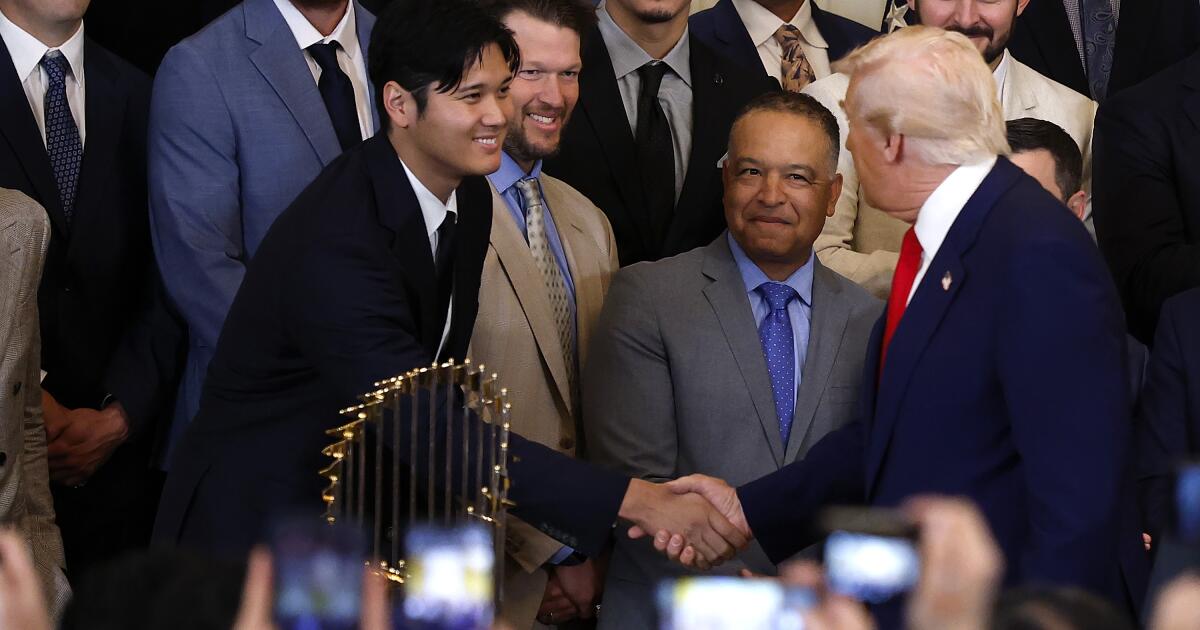
WASHINGTON — The Dodgers are scheduled to visit the White House on July 23 to celebrate their latest World Series title.
“President Trump is excited to welcome the Los Angeles Dodgers BACK to the White House to celebrate their World Series championship!,” White House spokesperson Taylor Rogers said in a statement to The Times.
The date falls on a scheduled off day in the middle of a nine-game East Coast road trip for the Dodgers. The team will play three games in Philadelphia against the Phillies July 20-22 before ending the trip with a three-game series against the New York Mets July 24 to 26.
The visit continues a tradition from the Dodgers’ two previous World Series championships. They were hosted by President Biden in 2021 and President Trump in April 2025.
After the Dodgers claimed their second consecutive World Series title with a dramatic Game 7 victory over the Toronto Blue Jays, a visit to the White House was planned, but it wasn’t until Thursday that a date was officially booked and confirmed.
Questions swirled around whether players would decline the visit this year after it did not happen during a scheduled visit to Washington in April.
Kiké Hernández said in 2018 he was unsure he would have gone had the Dodgers won the World Series the previous year. Mookie Betts said he was undecided and needed to talk it over with his family when last year’s visit was announced. After winning his first World Series with the Boston Red Sox in 2018, Betts skipped their trip to the White House the following year during Trump’s first term.
Both players, along with every returning member of the 2024 team who was with the team during its road trip, participated in the visit. The only notable absence was first baseman Freddie Freeman, who remained in Los Angeles to nurse an ankle injury.
Manager Dave Roberts, who indicated in comments to The Times in 2019 he might not go to the White House if Trump was president, also participated in last year’s ceremony.
Asked at the Dodgers’ fan festival in January about the possibility of returning to the White House, Roberts told The Times’ Bill Shaikin: “For me, I stand by: I’m a baseball manager. That’s my job.”
“I was raised — by a man who served our country for 30 years — to respect the highest office in our country,” Roberts said. “For me, it doesn’t matter who is in the office, I’m going to go to the White House. I’ve never tried to be political. … For me, I am going to continue to try to do what tradition says and not try to make political statements, because I am not a politician.”
Clayton Kershaw, who retired after last season but was on Team USA for this year’s World Baseball Classic, told The Times in the spring that he was aware Dodgers fans are split over whether the team should visit the White House again this year, but he said he is looking forward to it.
“I went when President Biden was in office. I’m going to go when President Trump is in office,” Kershaw said. “To me, it’s just about getting to go to the White House. You don’t get that opportunity every day, so I’m excited to go.”
Times deputy sports editor Ed Guzman contributed to this report.

NEWYou can now listen to Fox News articles!
All eyes were on Caitlin Clark on Wednesday night as she made her anticipated return from injury in a road matchup in Los Angeles.
But instead of a triumphant comeback, the Fever spent the entire night chasing the Sparks as Clark’s rough return fueled a 106-92 rout.
The superstar never found a groove, looking completely out of sync in her return from a back injury.
STEPHANIE WHITE GIVES CAITLIN CLARK STATUS UPDATE AHEAD OF FEVER-SPARKS, BUT HER NEXT MOVE RAISES QUESTIONS
Caitlin Clark huddles with teammates as the Indiana Fever battle the Sparks. (Photo by Katelyn Mulcahy/Getty Images) ((Photo by Katelyn Mulcahy/Getty Images))
Much of that disjointed performance falls squarely on head coach Stephanie White, who kept Clark on a ridiculously tight leash by limiting her to just 16 minutes. The stop-and-go approach could have sabotaged any chance for the phenom to establish a rhythm.
Clark finished with just 9 points, 4 rebounds and 3 assists. Her minus-16 plus-minus told the story.
The Los Angeles Sparks were severely shorthanded, taking the floor without stars Kelsey Plum and Cameron Brink.
MERCURY’S NOW-DELETED SOCIAL MEDIA POST MOCKING CAITLIN CLARK DRAWS SCRUTINY AFTER STAR’S INJURY
Yet while a depleted Sparks roster played to win, Indiana spent the night over-managing its biggest asset.
With Clark on a minutes restriction and Aliyah Boston out of the lineup, Kelsey Mitchell was forced to shoulder the entire offensive burden.
Mitchell did her part, pouring in 29 points while shooting 5-of-9 from beyond the arc.
Caitlin Clark orchestrates the Fever offense as Indiana battles the Los Angeles Sparks in primetime action. (Photo by Katelyn Mulcahy/Getty Images) ((Photo by Katelyn Mulcahy/Getty Images))
But one hot hand couldn’t stop an efficient LA squad.
The Sparks shot 45% from three-point range, going 9-of-20 from deep to cruise to the 106-92 victory.
White’s next move is to sit Clark against the Mercury on Thursday while Boston returns.
CLICK HERE TO DOWNLOAD THE FOX NEWS APP
After Wednesday’s loss to a shorthanded Sparks team, it’s fair to question whether Indiana’s cautious approach is working. The Fever dropped to 12-9.
Caitlin Clark and Dearica Hamby face off as Fever and Sparks battle at Crypto.com Arena in Los Angeles. (Photo by Tyler Ross/NBAE via Getty Images) ((Photo by Tyler Ross/NBAE via Getty Images))
Send us your thoughts: alejandro.avila@outkick.com / Follow along on X: @alejandroaveela
-

 Illinois1 minute ago
Illinois waives tax penalties for 11 counties hit by storms, including Stephenson and Winnebago
-

 Indiana4 minutes ago
Attempted murder suspect arrested in Indianapolis for Bloomington shooting
-

 Iowa9 minutes ago
Iowa WWII veteran approaching 100th birthday honored in Cedar Rapids
-

 Kentucky14 minutes ago
Exantus may be subject to involuntary hospitalization due to Kentucky law
-

 Louisiana24 minutes ago
Parasitic stomach illness that can cause explosive diarrhea rises in Louisiana
-

 Maine32 minutes ago
Is prison in play for Graham Platner?
-

 Maryland34 minutes ago
Office building in Glen Burnie evacuated after shift in parking garage floor
-

 Michigan39 minutes ago
Menominee, Michigan man arrested on sexual assault charges involving a minor

