Sports
NBA Player Tiers: Kevin Durant, Steph Curry hang on in Tier 1, but how much longer?


This is the fifth annual NBA Player Tiers project, in which Seth Partnow names the top 125 players in the league after each season and then separates them into five distinct categories of value, each with their sub-categories to further delineate them. These are not meant to be read as firm 1-125 player rankings. Rather, they’re meant to separate solid starters from the very best superstars, and every level in between. This is how NBA front offices assess player value across the league when building their teams.
NBA Player Tiers: ’20 | ’21 | ’22 | ‘23 | ’24 pre-playoffs | ’24: T5 | T4| T3 | T2
The NBA is undergoing a changing of the guard. While Tier 1 has been relatively stable during the five seasons I’ve done this exercise — only nine players have been in Tier 1 at least once, with the six below plus LeBron James, Kawhi Leonard and James Harden — many of the stalwarts are facing the ticking of the clock, while the next wave, such as Jayson Tatum, Anthony Edwards and, of course, Victor Wembanyama, are knocking on the door.
I could have gone several ways with this group, from having only a super select top three or four making up the entirety of the tier to rewarding some of those up-and-comers at the expense of the old warhorses, and I wouldn’t much argue with those who saw it that way.
But for now, here are the cream of the crop.
Tier 1B (4-6)
Remarkably, a 62.6 true shooting percentage on 29.0 usage represents a down year for Kevin Durant, even compared to just the post-Achilles tear section of his career. The poorly constructed and extremely top-heavy Phoenix Suns roster did him few favors, which raises a question that has only factored tangentially into the tiers over the years: How much should player influence on roster decisions and coaching hires be factored in?
It’s a challenge to do so systematically. At least from the outside, who advocated for what move or how much weight an organization gives to a star’s wishes are difficult to determine. But the balance of reporting indicates that Brooklyn/Phoenix era Durant has demanded many things and received most of them, including the hiring and firing of coaches.
It is often said that coaches shouldn’t be GMs because there isn’t enough time in the day to do both jobs well. This holds even more true for players. But how much is it on the players when it happens? It’s a hard one to judge, but it’s something that likely needs to enter the calculus when considering later career superstars such as Durant, LeBron James or one or two others.
All of this is to note that Durant barely maintained his spot in Tier 1 this year and will need a strong performance — including the playoffs — in 2024-25 to be worthy of staying here.
Another former MVP somewhere on the back nine of his career is Stephen Curry. With the Golden State Warriors missing the playoffs, has Curry’s ability to drag indifferent teammates to success waned, or did Golden State find the bottom edge of overall roster ability at which he could do so? Or was it perhaps some combination of both?
Make no mistake, Curry is still a great, great player. But there are subtle signs of decline. His rim-attempt rate was the lowest of his career by a decent margin. His ability to impact the game as a team defender has dropped off considerably — over the last two seasons, he has averaged 1.2 steals per 100 possessions, precisely half of the 2.4/100 he maintained over the first 13 years of his career.
For the first time other than 2019-20, when he appeared in only five games, 2023-24 was the first time the Warriors were superior in terms of net rating with Curry off the floor than on, with Golden State 0.6 points per 100 possessions better when Curry was on the bench, compared to 14.5 per 100 better with Curry on the floor from his first MVP season in 2014-15 through 2022-23. At 35, there is no shame in acknowledging that Curry is not quite the automatic driver of elite offense that he has been for most of his career, but that dip does move him down from 1A to 1B.
For Joel Embiid, it is seemingly always something: Bad health, be it either his health or his teammates’; a ball bouncing four times on the rim and then dropping to eliminate the Sixers from the playoffs; star players falling out with the organization, requiring trades or other reshuffling of the lineup. All of these and more have conspired to keep Embiid from ever reaching the conference finals, which is unfortunate because by several impact metrics, Embiid has been the second-most-effective regular-season player in the league across the last four seasons, behind only Nikola Jokić’s all-time great run.
This past season, you couldn’t have asked for more from Embiid himself, either in the regular season or in the Sixers’ short playoff run. But he still hasn’t truly stamped his authority on a postseason and has never consistently hit the same level of dominance. His playoff shortcomings have probably been overblown, with a career 58.0 percent true shooting on 31.6 percent usage. But ignoring his abbreviated rookie year, he has 61.6 percent true shooting on 35.5 percent usage. The latter is otherworldly, while the former is merely damn good.
There have been myriad reasons for the lack of extended playoff success, many of them completely outside Embiid’s control. But it has always been something, and that’s enough to keep him in Tier 1B for now.
Tier 1A (1-3)
For all the complexity the NBA game offers, basketball can be pretty simple. Pair an offensive force with the size, vision and ability to draw extra defenders with a dynamic rim threat (or two!) and surround them with shooters, and that’s a hard formula to stop. While Luka Dončić was good all year, the midseason trades that brought in Daniel Gafford and P.J. Washington helped both Dončić and the Mavericks reach exit velocity and launch into orbit.
It wasn’t just a more favorable context. Dončić made some subtle but telling improvements, becoming a more active off-ball participant — a higher percentage of his made 3s were assisted than any season since his rookie year — while also upping his defensive contributions.
The defense was an unsung part of the Mavs’ run to the NBA Finals. While Dončić was rarely if ever tasked with the primary matchup against the opposition’s top weapons, he made more effective use of his size and game-reading ability, particularly against the Oklahoma City Thunder and Minnesota Timberwolves.
While our lasting memory might be the disappointment of Dallas losing the finals, that is as much an illustration of how even top superstars need a bit of good fortune to reach the pinnacle. Not only did the Celtics significantly out-talent Dallas top to bottom, but Boston was as well-equipped to deal with Dončić on its own defensive end while having the range and volume of on-ball creators to attack him in ways other teams couldn’t on defense.
There is still some room for improvement, as Dončić’s conditioning could probably use an upgrade, while his penchant for engaging with officials — occasionally picking up some silly fouls such as in Game 3 of the finals series — could stand to be scaled back significantly. But using those quibbles to keep him out of Tier 1A would be setting a near impossible standard that few players in NBA history, let alone current day, could match.
Giannis Antetokounmpo is the only player who has resided in Tier 1A in every year-end edition of the Tiers. For the first time, I had some slight doubts putting him here. He has missed time in four of the last five postseasons, including the entirety of the Bucks’ stay this year. During that stretch, Milwaukee has lost its first-round series as a higher seed twice, something definitely held against other players, though, of course, his dominance through the 2021 playoffs has and will continue to buy Antetokounmpo good will on that front.
There is also worry about how robust his impact will be as he approaches 30, which he will reach in early December. Some of it was surely because of Milwaukee’s rather disheveled start to the season from a schematic and coaching standpoint, but Antetokounmpo’s struggle to find synergy with Damian Lillard could reflect a degree of inflexibility or stubbornness that could prove challenging as he begins to age and lose some of his athleticism.
There have been suggestions that the Bucks have been somewhat limited in their ability to be tactically versatile; considering how important adjusting and iterating has become in the postseason, limiting those options is a drawback. Antetokounmpo enters next season on the bubble for dropping out of Tier 1A for the first time.
Having gone through 124 players, we are left with the reigning (and should be four-time consecutive, but why relitigate that particularly noxious debate?) MVP Nikola Jokić at the top of the heap. Even though the Nuggets ultimately fell to Minnesota in seven games in what was the best series of this past postseason, Jokić left some indelible memories. His third quarter in Game 5 against the Wolves defies description, for example.
During his three-in-four MVP run, Jokić has averaged a combined 26.1 points, 12.2 rebounds, 8.7 assists, 1.4 steals and 0.8 blocks per game. Even lowering those thresholds to 25/10/7.5/1/0.5, no other player has hit those heights even once.
And he has done it while scoring efficiently enough to lead the league twice and finish second twice in “TS Add” — a metric created by Basketball-Reference indicating the number of points above (or below) a player scores than he would have had he scored at league average on the same number of attempts.
To repeat one last time, these tiers are not rankings.
But if they were, the Joker would be No. 1.
NBA Player Tiers: ’20 | ’21 | ’22 | ‘23 | ’24 pre-playoffs | ’24: T5 | T4| T3 | T2
Loading
Try changing or resetting your filters to see more.
Tier 1

Tier 2
Tier 3
Tier 4
Tier 5
(Illustration: Dan Goldfarb / The Athletic: Photos: Sean Gardner, Noah Graham / NBAE, Jesse D. Garrabrant / NBAE via Getty Images)



Sports
London descends into disorder as Morocco fans flood streets after World Cup elimination by France

NEWYou can now listen to Fox News articles!
Public unrest began in parts of London late Thursday night, and it appears Morocco’s exit from the 2026 FIFA World Cup at the hands of France is the reason.
France took down Morocco 2-0, eliminating the African country for the second consecutive tournament, this time in a quarterfinal match.
As a result, many feared Paris would erupt into riots, especially after the chaos that followed Paris Saint-Germain’s UEFA Champions League victory over Arsenal in May.
Instead, images and videos from Edgware Road in northwest London showed police clashing with large crowds as smoke billowed through the streets and debris littered the roadway.
A police vehicle is parked in a road as people from pro-Palestinian activist groups gather near the Edgware United Synagogue during a demonstration against the “Great Israeli Real Estate Event” organized by real-estate agency My Home in Israel, which markets property in Israeli settlements in the occupied West Bank, in London, Britain, June 14, 2026. (Toby Shepheard)
Riot police, equipped with shields and body armor, tried to contain the crowds as they clashed with people launching fireworks and throwing debris. One video also appeared to show an officer down.
KYLIAN MBAPPÉ, OUSMANE DEMBÉLÉ FIRE FRANCE INTO WORLD CUP SEMIFINALS WITH WIN OVER MOROCCO
It’s unknown what happened to the officer who was down on the asphalt or how he was injured.
Fans waved Moroccan flags in the middle of the streets, which held up traffic. Some even jumped on top of vehicles trying to get through the area.
Moroccan fans in the stands before a FIFA World Cup 2026 quarterfinal match between France and Morocco at Boston Stadium July 9, 2026, in Foxborough, Mass. (Richard Sellers/SportsphotoAllstar)
Similar scenes unfolded after Egypt’s World Cup exit, when Argentina rallied for a controversial 3-2 victory that featured several disputed officiating decisions.
Paris, on the other hand, looked more like a city celebrating than one on the brink of a riot. Supporters of both France and Morocco flooded the streets, slowing traffic in several parts of the city.
One video showed horns blasting from cars with French and Moroccan flags out the windows on the L’avenue des Champs-Élysées in Paris. Supporters on the side of the road, waving their own flags, joined in on the celebration.
France’s Kylian Mbappé scored his eighth goal of this World Cup, which ties him for the most with Argentina’s Lionel Messi. Ousmane Dembélé also scored in the second half for France in the 2-0 win over Morocco.
It’s the third straight semifinal appearance for France, while Morocco still made World Cup history despite the loss. After becoming the first African country to reach the quarterfinals and semifinals in World Cup history in 2022, Morocco added to that by becoming the first-ever African nation to reach more than one quarterfinal.
Moroccan fans react while attending a watch party for the World Cup round of 8 match between France and Morocco in Boston, Massachusetts, on July 9, 2026. (Joseph Prezioso/AFP)
CLICK HERE TO DOWNLOAD THE FOX NEWS APP
Morocco’s exit means there are no more African nations alive in the World Cup. France will be taking on the winner of Spain and Belgium, while England and Norway and Argentina and Switzerland face off in the quarterfinals.
Follow Fox News Digital’s sports coverage on X and subscribe to the Fox News Sports Huddle newsletter.
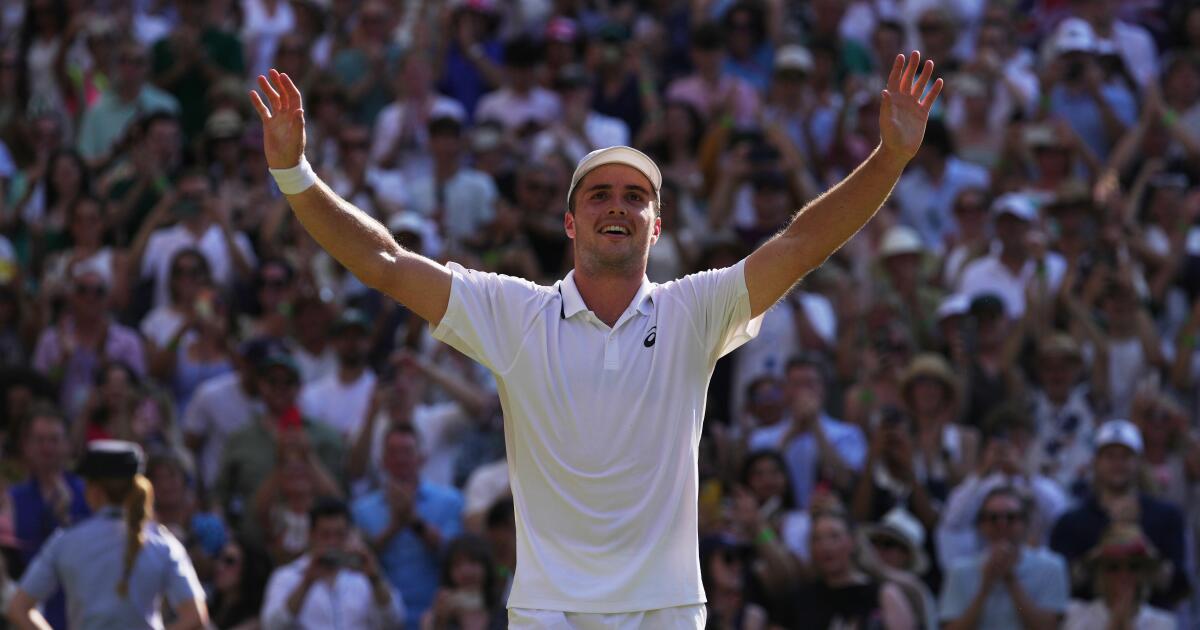
LONDON — A local boy sleeps in his own bed, plays in front of a king and queen and makes a Cinderella run to the Wimbledon semifinals. Sounds like a Hollywood script that might never see the silver screen.
But it’s no fairy tale — it’s Arthur Fery’s out-of-nowhere performance over the last 10 days.
Fery, a virtually unknown British wild card with a triple-digit ranking, has become the emotional heartbeat of Wimbledon while legitimately diverting some national attention from England’s World Cup quest.
The royal treatment at his matches across the All England Club has come in more ways than one.
Fery, who grew up five minutes from Wimbledon and is staying at home during the tournament, first played before grass-court king Roger Federer, Wimbledon’s eight-time singles champion, during Monday’s fourth-round victory. Two days later, he beat No. 9 seed and French Open runner-up Flavio Cobolli of Italy in the quarterfinals 6-4, 7-6 (4), 6-0 in front of Queen Camilla.
Ranked 114th, Fery had never reached the semifinals of an ATP Tour event, let alone a major, before his brief chat with the queen following the match.
“She just said, ‘Congratulations, keep going,’” 23-year-old Fery told reporters later. “I told her it was my birthday on Sunday, so it would be great to play the Wimbledon final on my birthday.”
That’s still a match away. To get there, Fery will have to get past one of the hottest players on tour: No. 2 seed Alexander Zverev, who is fresh off his first Grand Slam title at the French Open. Looming on the other side of the draw is a highly anticipated showdown between defending champion Jannik Sinner against 24-time major winner Novak Djokovic.
If Fery can continue his magical run to the end, he would become the first British wild card to win a Wimbledon title.
Arthur Fery reacts after defeating Flavio Cobolli in the Wimbledon quarterfinals on Wednesday.
(Maja Smiejkowska / Associated Press)
Born in France, Fery’s family moved to Wimbledon when he was an infant. His mother played professional tennis. He was a top British junior but chose to sharpen his game for three years in the U.S. collegiate system at Stanford, as many of his compatriots have done.
“I came out with a lot of hunger coming out of that, and I was ready to attack the pro circuit,” Fery said.
After struggling with bone bruising in his arm that limited him to playing mostly on the lower-tier Challenger circuit in recent years, Fery is finally healthy and playing consistently.
His path to the last four in London has been a masterclass in clutch come-from-behind performances. The Brit has stared down near-certain elimination in multiple matches, repeatedly breaking his opponents’ momentum with Houdini-like on-court acts.
At 5-foot-9, Fery possesses a skill set perfectly suited for low-bounding grass.
His compact strokes, low center of gravity, and elite movement allow him to hug the baseline, take time away from opponents, and confidently execute delicate volleys at the net, according to ESPN analyst Chris Eubanks.
“He defends well,” said Eubanks, a 2023 Wimbledon quarterfinalist. “He can scrap. He can claw. He can dig his way back into points. And when he ventures forward, he’s very, very comfortable at the net. This is a picture-perfect example of someone whose game is built for the surface.”
Still, it’s hard to fathom the multitude of milestones for Fery, who briefly reached the No. 1 ranking in college and earned 2023 Pac-12 Singles Player of the Year honors before leaving early to pursue a pro career.
He arrived at Wimbledon with just one main-draw victory at a major, a losing record as a professional, and only one previous ATP quarterfinal, at Queen’s Club last month. He’s now 11-8, won his first two five-set matches, and is the first British wild card to reach the Wimbledon men’s semifinals in the Open Era. The only other men’s wild-card semifinalist was Goran Ivanisevic, who won the title as a wild card in 2001.
Fery, who started the season ranked No. 185 and will climb to at least No. 36 after the tournament, said there were a “lot of first times” as he reflected on his unprecedented run. “First five-setter, longest match that I’ve ever played, first time breaking into the top 100, first second week in a slam, all at home, five minutes from where I grew up. It’s a great story for me,” he said.
The gap with his fellow semifinalists is understandably massive.
Entering Wimbledon, Djokovic, Sinner and Zverev’s combined records include 29 Grand Slam titles, 2,088 match wins and 155 tour-level titles. Fery was 6-8 in tour-level matches with zero titles.
But he has singlehandedly lifted the tournament for locals. With top hopes Jack Draper and Emma Raducanu withdrawing before the tournament and the rest of Britain’s singles prospects falling one by one — 18 men and women were eliminated by the third round — Fery became the nation’s last knight standing.
If his first name inevitably evokes Arthurian legend, Fery’s march through the draw gave Britain reason to believe again. No sword, no Round Table, just world-class shot-making, a lion’s heart and a Centre Court crowd thrilled to rally behind him.
“This is really quite something to see on home soil,” said Russell Fuller, the BBC’s tennis correspondent, who compared it with Raducanu’s stunning U.S. Open win in 2021 as a qualifier.
Fery earned every bit of it.
In the first round against Damir Dzumhur, Fery dropped the opening set and trailed by a break in the second before surging back. Against Zizou Bergs in the third round, he faced a 4-1 deficit with a double break in the fourth set, and again fell behind 4-1 in the fifth, before somehow surviving.
Then, stepping onto Centre Court for the first time against former top-10 stalwart Grigor Dimitrov of Bulgaria in the fourth round, Fery clawed out of a 2-sets-to-1 hole and a break down in the fourth set to clinch the victory in a fifth-set tiebreak.
“He carries himself with humility, but he’s a fierce competitor, and he’s got a ton of belief in himself,” said Stanford men’s coach and former top-60 player Paul Goldstein, who flew to England Tuesday to see his former charge compete against Cobolli.
While Fery attempts to outmaneuver Zverev on Friday, the other semifinal features a 2025 Wimbledon semifinal rematch between seven-time Wimbledon winner Djokovic and top-ranked Sinner, who defeated the Serb in straight sets on his way to the title. It’s also their second Grand Slam semifinal meeting in 2026. At January’s Australian Open on hard courts, Djokovic bested 24-year-old Sinner in five sets before falling to now-injured Carlos Alcaraz in the Melbourne final.

Arthur Fery hits a return during his Wimbledon quarterfinal win over Flavio Cobolli on Wednesday.
(Clive Brunskill / Getty Images)
Djokovic, 39, enters the match after surviving a grueling five-set, 5-hour-plus quarterfinal slugfest against No. 3 Félix Auger-Aliassime that concluded just minutes before Wimbledon’s 11 p.m. curfew. But the seventh-seeded Serb has a way of defying Father Time and he has had two days to recover on a surface where points are shorter and generally less taxing on the body.
Italy’s Sinner, who defeated Alcaraz in last year’s Wimbledon final, has been efficient if not at the level that saw him capture five consecutive titles before crashing out in the second round at the French Open. After a first-round scare here, the four-time Grand Slam champion has dominated opponents behind his improving serve, winning 80% of his first-serve points. He hasn’t dropped a set since the opening round. Sinner leads the head-to-head with Djokovic 6-5.
According to Eubanks, Djokovic must disrupt Sinner’s movement to break his rhythm, and take his chances.
“He’s got to play similar to how he played in Australia, where it was just all-out aggression,” Eubanks said.
For Sinner, he added: “His serve can be a neutralizing force for what Novak is going to try to do.”
On the other side of the ledger, Fery’s poise under pressure and deft use of the home crowd will be paramount to continue his surprise run against Germany’s Zverev, whom he called a “step up again” from his last five matches. Zverev, 29, is seeking his fifth major final and first at Wimbledon.
“I’m ready for it,” Fery said. “I have nothing to lose. I’m just going to go out there and … put my game on the court, do what I’ve done, believe in myself. We’ll see where that takes me.”
Home has never been closer to Centre Court. Nor has Arthur Fery ever been closer to tennis history.
Sports
Pirates star pitcher makes unfortunate history after being taken out in middle of perfect game bid

NEWYou can now listen to Fox News articles!
Jared Jones was flirting with Major League Baseball history on Wednesday night — he got it, but it was not what he originally envisioned.
The Pittsburgh Pirates pitcher retired the first 18 batters he faced, but he was taken out in the middle of his perfect game bid after six innings.
Now, the Pirates certainly have their reasons — the 24-year-old Jones hasn’t thrown more than 81 pitches in eight starts since returning May 20 after missing all of last season while undergoing ulnar collateral ligament internal brace surgery on May 21, 2025. He was yanked with 77 pitches and likely would have needed more than 100 pitches to record the 25th perfect game in MLB history.
Jared Jones of the Pittsburgh Pirates pitches during the first inning against the Atlanta Braves at PNC Park on July 8, 2026, in Pittsburgh, Pennsylvania. (Photo by Joe Sargent/Getty Images)
However, Jones left the game after getting zero run support, so when the Atlanta Braves tacked on three runs late for a 3-0 victory, Jones instead found himself in the wrong chapter of the history books.
According to Opta Stats, Jones became the first pitcher in the modern era (since 1920) to pitch at least six perfect innings and not record a win.
“It does suck. Something’s cool coming on, but I’m on what? My eighth start off of surgery? I completely understand it, and it is what it is,” Jones told reporters after the game.
Pittsburgh Pirates starting pitcher Jared Jones (17) makes his way to the field to warm up before pitching against the Atlanta Braves at PNC Park. (Charles LeClaire/Imagn Images)
JUSTIN VERLANDER ANNOUNCES HE WILL RETIRE AFTER THIS SEASON: ‘I’VE REALIZED THAT TIME HAS COME’
Jones said he didn’t entertain attempting to complete the perfect game.
“Not with the pitch count,” he said. “Not really ever expecting to go nine right now, so that was never in my head.”
Joey Bart, traded to the Braves from the Pirates on June 18, followed a double by Mike Yastrzemski with a 422-foot, two-run homer to left-center field off a slider from Dennis Santana. Drake Baldwin added an RBI single to center in the ninth for good measure.
It was the second time in less than a week that a pitcher was taken out of the game with a perfect bid through six innings — the Miami Marlins took Eury Perez out after seven innings in which he had 92 pitches. Perez, too, is in the midst of returning from injury and has surprisingly found himself right in the postseason mix.
He was pulled for Lake Bachar to start the eighth, and the Marlins allowed eight runs to the Athletics in the final two innings, but held on to win 9-8.
Jared Jones (17) of the Pittsburgh Pirates delivers a pitch during a MLB game against the Cincinnati Reds on June 27, 2026, at PNC Park in Pittsburgh, Pennsylvania. (Joe Robbins/Icon Sportswire via Getty Images)
CLICK HERE TO DOWNLOAD THE FOX NEWS APP
The Pirates are 4.0 games out of the final wild card spot, which is held by the Marlins.
The Associated Press contributed to this report.
Follow Fox News Digital’s sports coverage on X, and subscribe to the Fox News Sports Huddle newsletter.
-

 Los Angeles, Ca1 hour ago
O.C. police prep for beach, theme park ‘takeovers’ promoted on social media
-

 Detroit, MI2 hours ago
Detroit city leaders to DHS: Stop ICE pursuits which endanger the community
-

 San Francisco, CA2 hours ago
SF Supervisor Jackie Fielder hosts listening session after medical leave
-

 Dallas, TX2 hours ago
The Stewpot artists find healing, purpose and income through art in Dallas
-

 Miami, FL2 hours ago
Can Jason Marshall push for a starting spot – The Splash Zone 7/10/26
-

 Boston, MA2 hours ago
Police investigating shooting in Downtown Crossing – Boston News, Weather, Sports | WHDH 7News
-
 Denver, CO2 hours ago
Denver mayor announces new $100 million plan to bring in 10,000 jobs
-

 San Diego, CA2 hours ago
WEBTOON Brings Top Creators for San Diego Comic-Con Panels

