Sports
MLB offense is nearing all-time lows — hitters have theories: 'Pitching is out of control'


Here’s a thought that defines baseball in 2024: What if the whole sport suddenly turned into Bruce Bochy?
No, not Bruce Bochy, the future Hall of Fame manager. We’re talking about Bruce Bochy, the one-time roving backup catcher from the 1970s and ’80s.
We make this important observation because, as offense in MLB approaches historic lows these days, that Bruce Bochy comes to mind.
BATTING AVERAGE
2024 league AVG — .241
Bochy career AVG — .239
SLUGGING
2024 league SLUG — .390
Bochy career SLUG — .388
After stumbling upon this fascinating revelation, how could we not ask Bochy himself what he thinks this says about offense in 2024?
“I’d say the league is now seeing through my lens how hard hitting is!” the Rangers’ manager deadpanned, in that self-deprecating but dead-on way of his.
Well, isn’t that the truth? Perhaps you hadn’t noticed this trend. So take a look at the state of offense this season. It’s not a pretty picture. If baseball keeps up this pace, it would lead to …
• 39,404 hits — more than 1,400 fewer than last year.
• 21,078 runs — more than 1,300 fewer than last year.
• 5,079 home runs — almost 800 fewer than last year.
• 7,628 doubles — exactly 600 fewer than last year.
But let’s put that in better perspective. At this pace, we would also be heading toward …
• The fewest doubles in a season since before the 1993 expansion. That’s two expansions ago!
• The fewest homers since 2015, just before the baseball got noticeably livelier.
• The fewest hits per game (in a full season) since 1968.
• The lowest batting average on balls in play (.288) since 1992.
So here is what that means as you try to measure what a good offense or good hitter looks like in 2024:
The average hitter now has a Bochy-esque slash line of .241/.311/.390.
Only 25 hitters in the sport are on pace to hit 30 home runs. As recently as 2019, there were 58 of them.
The average lineup now gets just 8.1 hits per game. Yikes! We’ve seen only five full seasons worse than that in the modern era (1901-present) — and four of them were 1906-07-08-09! The other was 1968.
“I’d say the league is now seeing through my lens how hard hitting is!” said Bruce Bochy, pictured in 1987, the final season of his playing career. (Stephen Dunn / Getty Images)
Maybe it’s just early. Maybe it will change when the weather starts to sizzle. Maybe we’re making too much of a small sample. But you would have a hard time convincing most hitters of that.
“This league is so hard right now, man,” Mariners first baseman Ty France said. “Pitchers are throwing hard with command and have three fastballs now: sink; cut; fade. Everything.”
So are the hitters onto something here? Are pitchers really more unhittable than ever? Or is this about the array of unhittable, unpredictable stuff being designed in pitching labs all over baseball?
Or is it about the way defense is being played these days, especially in the outfield, where elite athletes, armed with more information than ever before, are playing deeper than ever and regularly snatching doubles out of the sky?
Or is it the baseball, the humidor, the bats or some other mysterious force that seems to be causing balls to fly differently in 2024 than they did as recently as last year?
Or is it possible it’s all of that — a powerful lineup of offense-depressing forces, all aligning in this moment, to drive the numbers toward historic lows?
It seems like the answer is yes, yes, yes and also yes. So we dug into what’s really happening, because, in the words of the Brewers’ Christian Yelich, “It’s all of that. It’s not just one thing.”
A moment of silence for the meatball
Should we start with technology? Sure. Let’s blame technology. The hitters definitely are.
“With the technology now,” Yelich said, “with the analytics and the high-speed cameras and the TrackMan data and all that stuff, you can tell, as a pitcher, if your pitches are good or bad, and how they work, and which kind of pitches you should throw in the biggest spots.”
Does that seem like anything new? Not to you, the reader, maybe. But to the hitters? They miss those days when hitting was about working their way into a hitter’s count and waiting for that meatball they knew was coming when a pitcher was desperate to get back into the count.
“I think in the past, guys would throw pitches that sucked, and they honestly didn’t know,” Yelich said. “Seriously. There would be no way for you to tell them otherwise, other than relaying info from your catcher to the pitcher that ‘I don’t really like this pitch. This one’s not working.’ So they wouldn’t know it wasn’t good or why it wasn’t good. So they’d still throw it all the time.”
But now, those days feel as ancient as when the fielders played with no gloves. Pitchers head into the pitching lab and see what works and what doesn’t. Then those meatball pitches get tossed right into the dumpster, never to return.
Either that or they get redesigned with shapes, angles and tunneling that make them more effective. That work is being done on every pitch thrown by every pitcher.
We don’t have a pitching lab in our house. But we do have access to Stuff+ — a metric that is publicly available and has been proliferating inside front offices across the game. So as those Stuff+ models improve in their ability to predict a pitch’s effectiveness, teams are employing them more than ever to ensure their pitchers are optimizing their pitch mixes.
“The pitchers are so much better,” the Blue Jays’ George Springer said. “Spin is at its all-time high. Velocity is at an all-time high. They’re throwing over 100 (mph), with 60 percent sliders. There’s never an ‘AB’ when you’re like, ‘I’m cool. This guy throws 92. I’m good.’ They just throw good pitches and really really good pitches now.”
You can see for yourself. Look at the slider-effectiveness leaderboard on FanGraphs for Stuff+ (created by Eno Sarris and Max Bay). It works on a scale of 100, with 100 being an average pitch. But the modern slider is now such a devastating pitch, 29 of the 30 teams have a Stuff+ of more than 100 — and seven teams are at 120 or higher. Whoa.
But what if that FanGraphs Stuff+ model didn’t readjust every year? What if it didn’t keep reclassifying the average pitch back to a grade of 100 every year, even though the unhittability of that pitch gets better every year?
Here is a graph, from Owen McGrattan at Pitching+, that shows how pitch quality has improved (in terms of expected run value allowed) just over the past three years; it also demonstrates how more and more teams are using virtually the same models to narrow the gap between clubs.

So do you feel sorry for the hitters yet? The pitchers don’t. We do.
“I’m just amazed now,” said the Cardinals’ Nolan Arenado, “by how guys that you’ve faced in the past, who would challenge you a certain way, don’t do that anymore. You face them now, and all of a sudden, they have more (velocity) in there. Or they have different types of pitches now. … Pitching right now is just out of control.”
How many pitches can one man throw?
Have we ever seen a pitcher who throws eight pitches before? Well, we have now. Behold the current repertoire of the Royals’ surprise ace, Seth Lugo.
1. Four-seam fastball
2. Two-seam fastball
3. Cut fastball
4. Slider
5. Sweeper
6. Curve
7. Changeup
8. Slurve
According to Statcast, Lugo threw “only” five pitches when he first arrived in the big leagues with the Mets in 2016. That number grew to six when he added a cutter in 2017. He eventually dropped the cutter, but last year in San Diego he incorporated a sweeper and slurve, swelling his pitch mix to seven. Then this year in Kansas City, he brought back the cutter, for pitch No. 8.
So we asked him why he rediscovered that cutter and keeps adding pitches.
“If this guy hammers four-seams and two-seams, what’s the chance he also handles cutters?” Lugo replied. “Slim. And if he’s covering all three fastballs, he won’t hit the breaking balls. Having all that mix and going pitch to pitch and swing to swing, I feel like I’m not predictable.”
Unpredictability is every pitcher’s goal. But here’s the part that’s triggering a volcanic eruption of exasperation from hitters everywhere: Seth Lugo isn’t the only one. In Toronto, Chris Bassitt also throws eight pitches. And Statcast tells us that the Braves’ Max Fried and the Padres’ Joe Musgrove have seven different pitches in their toolbox.
There are 15 more pitchers who throw six different pitches. And the group with five is way too long to mention. You should know that to get a pitch listed on this leaderboard, a pitcher must have used it at least 10 times this season. So this is a realistic depiction of the weaponry pitchers break out nightly.
And have you asked yourself why this is happening? It isn’t because pitchers these days love fiddling with different pitches, just for the cool factor. It’s all by design, literally.
We now live in an age where pitching coaches are pretty much inventing new pitches, shapes and ways of disguising them every few months in a pitching lab near you. Why? To drive hitters wacky, of course. How can those hitters guess what’s coming when that multiple-choice quiz they’re taking has so many different options?
“From a pitching standpoint, it is how do we create different looks?” Dodgers pitching coach Mark Prior told The Athletic’s Fabian Ardaya for a recent story about how guys in their organization are throwing more sinkers. “How do we create doubt in a hitter’s mind? So that it’s not so predictable?”
Well, if doubt is the goal, it’s working.
“These guys are unbelievable now,” Arenado said. “It just seems like guys have more in their repertoire now than ever before. I remember there used to be starters out there who you’d say, like, ‘OK, he’s a heavy sinkerballer.’ But now you face guys that are like, four-seamer, sinker, slider, change. They have two fastballs. They have a slider and a sweeper. And it just seems like they’re building this repertoire of different types of fastballs. I’m just amazed by what we see now.”
It’s those pitchers with two, three, or even four fastballs who are truly making hitters mumble. Imagine one of those smokeballs roaring toward you at 97 mph — and having no way to read the spin and guess which of four different ways it might move at the last second?
“Multiple fastballs is hard,” said Seattle’s Mitch Haniger, “because you can’t put the same swing on each fastball — and so often, you won’t know you had the wrong swing on it until too late.”

Seth Lugo, who has an eight-pitch arsenal, is among the American League leaders in ERA. (Jesse Johnson / USA Today)
As far back as 2021, Rangers offensive coordinator Donnie Ecker told us: “Multiple fastballs is a cheat code.” That, he said, was because they didn’t allow his hitters to “keyhole” a pitcher’s hardest offerings, or anticipate a certain shape on the fastest pitch they would see.
Do the hitters even want to know how hot the multiple-fastball craze has gotten? Since 2021, the number of pitchers with two primary fastballs has jumped 20 percent. And the number with three primary fastballs has jumped 39 percent. Pitchers are on pace to throw nearly 8,000 more sinkers and cutters this year than last year.
And how’s that working out? League batting average against those pitches has dropped 15 points (.292 to .277) in the past 15 years — and the total number of whiffs against sinkers and cutters is on pace to rise by more than 1,500 this season. But that doesn’t capture the biggest impact of those multiple fastballs. What they really do is make the four-seam fastball even more unhittable.
Batting average against four-seamers 15 years ago: .277
Batting average against four-seamers in 2024: .245
(Source: Baseball Savant / Statcast)
Any more questions?
Is it even possible to hit a double anymore?

Orioles outfielder Cedric Mullins makes a diving catch in April. (Mitchell Layton / Getty Images)
It was only a year ago that the league essentially sent a box of chocolates to hitters by finally reining in The Shift in infields across North America. Those hitters appreciate the gesture, of course. But now they have one more request:
How about reining in outfielders, too?
“I can tell you, from a hitter’s standpoint, that there are times where I’ve felt like there’s one big glove in the outfield,” the Brewers’ Rhys Hoskins said. “We’ve got guys out there now that run all over the place. Plus, they know where I’m going to hit it. I think that’s a big part of this.”
He couldn’t be more right. We don’t talk much about how outfield defense has evolved over the past few years. But it’s about time we did.
LEAGUEWIDE SLUG PCT ON BALLS TO THE OUTFIELD
2023 — .952
2024 — .892
(Source: Baseball Reference / Stathead)
An .892 slugging percentage might sound like it’s still impressive enough. But is it? As recently as 2019, the league slugged 1.011 on all balls hit to the outfield! And only once in the past 30 seasons (in the 2014 “dead-ball” mini-era) has leaguewide slugging been lower than it is so far this year.
So how does that play out on the field every day? MLB is on pace for 2,600 fewer extra-base hits this year than in 2019 — and nearly 1,000 fewer doubles. Does anyone miss those gappers? Hmmm, was that the sight of several hundred hitters raising their hands?
“It just seems like some of this has to do with where teams are positioning, especially the outfielders, for (robbing) extra-base hits,” the Cardinals’ Paul Goldschmidt said. “It seems like they’re always going where you’re squaring the ball up.
“I know we took away shifts,” he went on. “And that probably has helped, especially lefties. (Note: It has.) But on the whole, all 30 teams, if not close to all of them, just seem like they’re positioned where we’re all hitting the ball most of the time.”
It’s gotten so tough, Goldschmidt said, that hitters are almost resigned to watching their one-time extra-base hits disappear. Remember those days of yesteryear — by which we mean, like, 2022 — when they rocketed a ball toward the gap and then spiked their helmet at the shock of seeing another Andruw Jones disciple track it down? Now, they ask themselves: What’s the point?
“There’s just not a time now,” Goldschmidt said matter of factly, “when you say, ‘Oh, why is that guy standing there? I normally hit the ball there.’ You just don’t say that anymore.”
The Statcast data backs up that theory, by clearly showing that outfielders now play deeper than at any time since baseball started recording this data. Compared with 2015, the first year of tracking, center fielders set up 11 feet deeper on average. Left fielders: 5 feet deeper. Right fielders: 3 feet deeper.
Why? Because teams fear the double. So if a bloop single drops in there somewhere, they’ll live with that risk.
Plus, outfielders’ defensive skills are prioritized now more than ever before. You may have heard the grousing that OPS by outfielders this year has plunged to its lowest levels in the expansion era (1961-present). But is that a glitch or a trend? There’s growing sentiment that it’s merely a reflection of what teams value now.
“I think there’s more of an emphasis on defense in the game,” Yelich said, “because, once again, you can quantify that now, right? — and understand how big of an impact that is.”
None of this is a deep secret inside the sport, by the way. The league is well aware of how many extra-base hits are vanishing because of these profound changes in outfield defense. As far back as late 2022, Baseball Prospectus documented how these outfield alignments are working better than the infield shift ever did.
So the question is whether — or when — the league will view this as a serious enough problem to think about limiting how deep outfielders can play, the way it concluded last year it was time to limit where infielders could set up.
MLB did experiment with outfield depth limits a couple of years ago in the Florida Complex League. It went as far as drawing circles in the outfield to place boundaries on where the Rookie-ball outfielders could stand before the ball was hit.
Is it time to take that experiment to higher levels in the minors, just to see how it works? The league hasn’t shown much interest in that — yet. But one front office executive we spoke with said we’ve reached the point where it’s time … to do something.
“Balls in play in the outfield used to be among the most exciting plays in baseball — and now they’re one of the most boring,” the exec said, “because these guys just play so deep. So it’s either a little blooper that falls for a single, or it’s caught, or it’s a homer.”

Alec Bohm, who’s leading the majors in doubles, stands on second base after hitting one. Doubles are down across the league this year. (Eric Hartline / USA Today)
So what else could it be?
“Round up the usual suspects.”
— Claude Rains, in “Casablanca”
What’s good enough for Claude Rains is good enough for us. So what else could be stifling offense in 2024? Let’s round up the usual suspects.
IT MUST BE THE BASEBALL! Did we hear the annual grumbling that something is up with the latest batch of baseballs? Of course we did — but we get it. The scientific evidence is there. The ball has not been carrying this year the way it has in years past.
So far this season, according to Statcast, the average distance of a pulled “barrel” — the hardest-hit balls in this sport — was 4 feet shorter than last year, and 12 feet shorter than in 2018. That average distance of those pulled barrels (378 feet) was also the shortest of the Statcast era.
Slugging percentage on pulled barrels is down nearly 150 points from last year — and almost 400 points since 2017.
So is that enough evidence to ask questions? Why not? The sample now consists of more than 330,000 total batted balls and more than 2,000 pulled barrels. But does that mean the baseball itself is now “dead”? We couldn’t find evidence of that.
If the ball was “dead,” the drag coefficient data would be noticeably different, like it was in 2019 when home run records were broken. But the drag data is actually pretty normal. So let’s look at the other usual suspects.
IT MUST BE THE HUMIDOR! It’s not just a Coors Field thing anymore. Since 2022, baseball has required all 30 teams to store baseballs in a humidor. The idea is to have every ball used in a game stored under virtually the same conditions — namely, “average” humidity.
But that means different things in different climates. So you should know that the humidor can have different impacts in different parks and at different times of the year. And that has led to widespread confusion among players and staff about whether humidors help offense, hurt offense or even both — and about whether all teams are actually storing balls the same way.
So what’s the answer to those questions? Sorry. No idea. No publicly available humidor data is out there anywhere. So players will just have to keep wondering what that humidor is up to.
IT MUST BE THE BATS! One hitting coach we spoke with brought this up. He said all the velocity increases from pitchers are making hitters search for any possible way to increase bat speed. And that search has led some hitters to try using bats as light as 30 ounces, an almost unheard-of bat weight in modern times.
“Everybody’s throwing so hard, these guys think you’ve just got to touch the ball with the bat and it’ll go,” he said. “But I’m not sure that’s working.”
IT MUST BE THE WEATHER! When we first spotted those messy offensive numbers in late April, we decided to look the other way — because, well, April! In two-thirds of the country, it’s closer to skiing weather than baseball weather. So nothing to see here — yet.
But then came May, and … the weather? It got better. The offense? It got worse.
| MONTH | AVG | OPS | AVG TEMP |
|---|---|---|---|
|
MARCH/APRIL |
.240 |
.699 |
63.1 |
|
MAY |
.239 |
.695 |
69.6 |
(Source: STATS Perform)
Now in June, we should point out, the weather has finally warmed up — and so has offense.
| MONTH | AVG | OPS | AVG TEMP |
|---|---|---|---|
|
JUNE |
.246 |
.716 |
75.3 |
But the more we delved into the offensive data, the weather does not seem to explain it. The early-season month-by-month temperatures last season were actually colder, but the offensive numbers were higher. And according to FanGraphs, the number of games played at 70 degrees or warmer is going to be similar to last year. But check out how different the offense was under those conditions, at roughly the same stage:
| YEAR | AVG | OPS |
|---|---|---|
|
2023 |
.253 |
.742 |
|
2024 |
.246 |
.717 |
(Source: FanGraphs)
So it’s always fun to blame the weather — for pretty much everything. But is that it? We don’t see it. So …
Is it possible it’s just early?
OK, maybe we’re overreacting. Not just us, of course … but every hitter in the sport. Maybe this is the same stuff we say every year before summer really kicks in … and then the numbers all “normalize” during Hitting Weather.
Is offense clearly down compared to last year … or 2019, when the baseballs were flying like NASA projectiles? Absolutely. Down significantly.
But what about other years? Take 2022: That was the only other year since 2015 when offense declined in a significant way. So why don’t we compare 2024 and 2022, when baseball was emerging from the lockout and coming off an abbreviated spring?
We looked at the numbers through June 19 of both seasons. Turns out, they were incredibly similar.
| YEAR | AVG | SLUG | OPS |
|---|---|---|---|
|
2022 |
.311 |
.392 |
.703 |
|
2024 |
.311 |
.390 |
.702 |
Hits per game were identical: 8.1 per game. Runs per game were identical: 4.3 per game. Extra-base hits per game were identical: 2.8 per game. So how’d that season turn out?
Offense barely heated up with the summer. The final leaguewide slash line wound up at .243/.312/.395/.706. So there was just enough of an uptick that 2022 didn’t turn into a historically awful season. But …
It was still rough enough that the league needed to change the rules last year to get offense back to “normal.”
But what about this year? Are there any rule changes coming to rescue the hitters after this year? Doesn’t look like it. And remember, this downturn came despite the fact that last year’s rule changes were still doing what they do — limiting shifts, incentivizing base stealing and still largely working as intended. So …
Now what?

Don’t blink: Ryan Helsley, the Cardinals’ flame-throwing closer, delivers. (Jeff Curry / USA Today)
Right. Now what? After pitching took over the baseball earth in 1968, the league lowered the mound and restored balance in the sport. Well, this just in: Not this time.
The next wave of rule changes is probably years away. But the lethal combination of technology and supersonic velocity won’t be taking any vacations between now and then. So wherever the numbers land at the end of this season, what are we supposed to tell the hitters, other than … hang in there and try to steal a lot of bases?
“As an industry, we have to do something,” said the same executive who was quoted earlier. “It’s time. Things change fast. A year is a long time to wait. And teams continue to innovate a lot quicker on the pitching side than the hitting side. You could talk all day about hot pitching coaches and trends. But there are no hot hitting coaches. There’s nothing equivalent on the hitting side.
“So I don’t think what we’re seeing is anything new. It’s just moving faster than any efforts anyone has made to suppress it.”
If offense ever plummeted this far in football, the NFL would probably change 12 rules the next offseason. But it’s baseball. Change comes hard, and change is slow. So maybe the question we should be asking is not: Why is this happening? In truth, we already know that. No, what baseball should be asking itself is this:
Is this the kind of sport we want — where pitchers and defenses rule … and offenses just try to survive? How can that answer be yes?
“Offense is a huge part of the game,” Yelich said. “As a fan, you don’t want to come to the game and just watch guys get mowed down for nine straight innings. At the same time, I think it’s still possible — that you can still play offense. It just might not be how it used to be.”
So is offense dead? Not quite. But here’s our message for hitters everywhere: Good luck!
(Top photo of Christian Yelich after a strikeout: Stacy Revere / Getty Images)



Sports
Pirates star pitcher makes unfortunate history after being taken out in middle of perfect game bid

NEWYou can now listen to Fox News articles!
Jared Jones was flirting with Major League Baseball history on Wednesday night — he got it, but it was not what he originally envisioned.
The Pittsburgh Pirates pitcher retired the first 18 batters he faced, but he was taken out in the middle of his perfect game bid after six innings.
Now, the Pirates certainly have their reasons — the 24-year-old Jones hasn’t thrown more than 81 pitches in eight starts since returning May 20 after missing all of last season while undergoing ulnar collateral ligament internal brace surgery on May 21, 2025. He was yanked with 77 pitches and likely would have needed more than 100 pitches to record the 25th perfect game in MLB history.
Jared Jones of the Pittsburgh Pirates pitches during the first inning against the Atlanta Braves at PNC Park on July 8, 2026, in Pittsburgh, Pennsylvania. (Photo by Joe Sargent/Getty Images)
However, Jones left the game after getting zero run support, so when the Atlanta Braves tacked on three runs late for a 3-0 victory, Jones instead found himself in the wrong chapter of the history books.
According to Opta Stats, Jones became the first pitcher in the modern era (since 1920) to pitch at least six perfect innings and not record a win.
“It does suck. Something’s cool coming on, but I’m on what? My eighth start off of surgery? I completely understand it, and it is what it is,” Jones told reporters after the game.
Pittsburgh Pirates starting pitcher Jared Jones (17) makes his way to the field to warm up before pitching against the Atlanta Braves at PNC Park. (Charles LeClaire/Imagn Images)
JUSTIN VERLANDER ANNOUNCES HE WILL RETIRE AFTER THIS SEASON: ‘I’VE REALIZED THAT TIME HAS COME’
Jones said he didn’t entertain attempting to complete the perfect game.
“Not with the pitch count,” he said. “Not really ever expecting to go nine right now, so that was never in my head.”
Joey Bart, traded to the Braves from the Pirates on June 18, followed a double by Mike Yastrzemski with a 422-foot, two-run homer to left-center field off a slider from Dennis Santana. Drake Baldwin added an RBI single to center in the ninth for good measure.
It was the second time in less than a week that a pitcher was taken out of the game with a perfect bid through six innings — the Miami Marlins took Eury Perez out after seven innings in which he had 92 pitches. Perez, too, is in the midst of returning from injury and has surprisingly found himself right in the postseason mix.
He was pulled for Lake Bachar to start the eighth, and the Marlins allowed eight runs to the Athletics in the final two innings, but held on to win 9-8.
Jared Jones (17) of the Pittsburgh Pirates delivers a pitch during a MLB game against the Cincinnati Reds on June 27, 2026, at PNC Park in Pittsburgh, Pennsylvania. (Joe Robbins/Icon Sportswire via Getty Images)
CLICK HERE TO DOWNLOAD THE FOX NEWS APP
The Pirates are 4.0 games out of the final wild card spot, which is held by the Marlins.
The Associated Press contributed to this report.
Follow Fox News Digital’s sports coverage on X, and subscribe to the Fox News Sports Huddle newsletter.
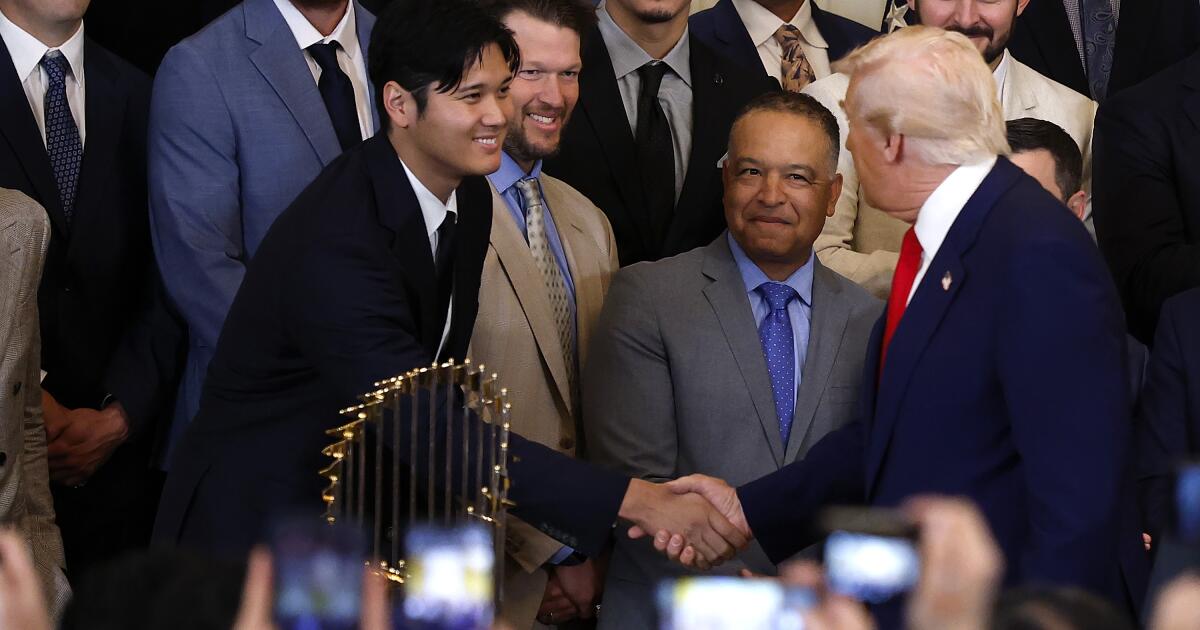
WASHINGTON — The Dodgers are scheduled to visit the White House on July 23 to celebrate their latest World Series title.
“President Trump is excited to welcome the Los Angeles Dodgers BACK to the White House to celebrate their World Series championship!,” White House spokesperson Taylor Rogers said in a statement to The Times.
The date falls on a scheduled off day in the middle of a nine-game East Coast road trip for the Dodgers. The team will play three games in Philadelphia against the Phillies July 20-22 before ending the trip with a three-game series against the New York Mets July 24 to 26.
The visit continues a tradition from the Dodgers’ two previous World Series championships. They were hosted by President Biden in 2021 and President Trump in April 2025.
After the Dodgers claimed their second consecutive World Series title with a dramatic Game 7 victory over the Toronto Blue Jays, a visit to the White House was planned, but it wasn’t until Thursday that a date was officially booked and confirmed.
Questions swirled around whether players would decline the visit this year after it did not happen during a scheduled visit to Washington in April.
Kiké Hernández said in 2018 he was unsure he would have gone had the Dodgers won the World Series the previous year. Mookie Betts said he was undecided and needed to talk it over with his family when last year’s visit was announced. After winning his first World Series with the Boston Red Sox in 2018, Betts skipped their trip to the White House the following year during Trump’s first term.
Both players, along with every returning member of the 2024 team who was with the team during its road trip, participated in the visit. The only notable absence was first baseman Freddie Freeman, who remained in Los Angeles to nurse an ankle injury.
Manager Dave Roberts, who indicated in comments to The Times in 2019 he might not go to the White House if Trump was president, also participated in last year’s ceremony.
Asked at the Dodgers’ fan festival in January about the possibility of returning to the White House, Roberts told The Times’ Bill Shaikin: “For me, I stand by: I’m a baseball manager. That’s my job.”
“I was raised — by a man who served our country for 30 years — to respect the highest office in our country,” Roberts said. “For me, it doesn’t matter who is in the office, I’m going to go to the White House. I’ve never tried to be political. … For me, I am going to continue to try to do what tradition says and not try to make political statements, because I am not a politician.”
Clayton Kershaw, who retired after last season but was on Team USA for this year’s World Baseball Classic, told The Times in the spring that he was aware Dodgers fans are split over whether the team should visit the White House again this year, but he said he is looking forward to it.
“I went when President Biden was in office. I’m going to go when President Trump is in office,” Kershaw said. “To me, it’s just about getting to go to the White House. You don’t get that opportunity every day, so I’m excited to go.”
Times deputy sports editor Ed Guzman contributed to this report.

NEWYou can now listen to Fox News articles!
All eyes were on Caitlin Clark on Wednesday night as she made her anticipated return from injury in a road matchup in Los Angeles.
But instead of a triumphant comeback, the Fever spent the entire night chasing the Sparks as Clark’s rough return fueled a 106-92 rout.
The superstar never found a groove, looking completely out of sync in her return from a back injury.
STEPHANIE WHITE GIVES CAITLIN CLARK STATUS UPDATE AHEAD OF FEVER-SPARKS, BUT HER NEXT MOVE RAISES QUESTIONS
Caitlin Clark huddles with teammates as the Indiana Fever battle the Sparks. (Photo by Katelyn Mulcahy/Getty Images) ((Photo by Katelyn Mulcahy/Getty Images))
Much of that disjointed performance falls squarely on head coach Stephanie White, who kept Clark on a ridiculously tight leash by limiting her to just 16 minutes. The stop-and-go approach could have sabotaged any chance for the phenom to establish a rhythm.
Clark finished with just 9 points, 4 rebounds and 3 assists. Her minus-16 plus-minus told the story.
The Los Angeles Sparks were severely shorthanded, taking the floor without stars Kelsey Plum and Cameron Brink.
MERCURY’S NOW-DELETED SOCIAL MEDIA POST MOCKING CAITLIN CLARK DRAWS SCRUTINY AFTER STAR’S INJURY
Yet while a depleted Sparks roster played to win, Indiana spent the night over-managing its biggest asset.
With Clark on a minutes restriction and Aliyah Boston out of the lineup, Kelsey Mitchell was forced to shoulder the entire offensive burden.
Mitchell did her part, pouring in 29 points while shooting 5-of-9 from beyond the arc.
Caitlin Clark orchestrates the Fever offense as Indiana battles the Los Angeles Sparks in primetime action. (Photo by Katelyn Mulcahy/Getty Images) ((Photo by Katelyn Mulcahy/Getty Images))
But one hot hand couldn’t stop an efficient LA squad.
The Sparks shot 45% from three-point range, going 9-of-20 from deep to cruise to the 106-92 victory.
White’s next move is to sit Clark against the Mercury on Thursday while Boston returns.
CLICK HERE TO DOWNLOAD THE FOX NEWS APP
After Wednesday’s loss to a shorthanded Sparks team, it’s fair to question whether Indiana’s cautious approach is working. The Fever dropped to 12-9.
Caitlin Clark and Dearica Hamby face off as Fever and Sparks battle at Crypto.com Arena in Los Angeles. (Photo by Tyler Ross/NBAE via Getty Images) ((Photo by Tyler Ross/NBAE via Getty Images))
Send us your thoughts: alejandro.avila@outkick.com / Follow along on X: @alejandroaveela
-
World6 minutes ago
AI notetakers promise easy meeting recaps, but some professionals question their use
-
Culture48 minutes ago
Which Version of the ‘Odyssey’ Should You Read?
-
 Lifestyle51 minutes ago
Terry Tempest Williams on why women with big ideas get labeled ‘crazy’ : Wild Card with Rachel Martin
-

 Technology1 hour ago
Google’s Nest Thermostat has hit its best price of the year
-

 World1 hour ago
Argentinian flight instructor jumps to death from plane, 22-year-old student forced to land alone
-

 Politics1 hour ago
Omar’s disclosures erased millions, leaving her with potential negative net worth. She won’t explain why.
-

 Health1 hour ago
Dr Oz links obesity to chronic disease surge, says GLP-1s can ‘jumpstart’ better health
-

 Sports1 hour ago
Pirates star pitcher makes unfortunate history after being taken out in middle of perfect game bid


