Sports
Inside life on the Muss Buss: Eric Musselman's drive to transform USC basketball


“Are you gonna wear those?”
Eric Musselman stares down at a pair of beat-up, brown boat shoes with his eyebrows raised. His smirk suggests I’ve chosen the wrong footwear for my first trip on the Muss Buss.
We’re standing in an auxiliary workout room at Galen Center a few minutes after USC wrapped morning practice in late July. And Musselman, a few months short of 60, looks prepared to run a half-marathon.
His first three months as USC’s men’s basketball coach were a full-on sprint, with a new staff to hire, a roster to rebuild and a hoops program to reinvigorate — not to mention roots to set down in the South Bay. But for Musselman, stamina has never been a question. He’s a workout fiend, just like his father, Bill, was before him. Every day, he walks or jogs or runs upwards of 10 miles, no matter where the job takes him or how packed his day is. And he’s never just walking or jogging or running. He’s always multitasking, sending reminder texts or listening to podcasts or highlighting passages from articles he’s compiled and printed.
USC men’s basketball coach Eric Musselman walks on a treadmill at Galen Center on July 31.
(Dania Maxwell/Los Angeles Times)
The plan was for The Times to join Musselman during his preferred beachside walk along the Strand, a few blocks from where he lives. But practice was moved to the morning, which meant shifting his required steps to a treadmill.
A treadmill feels like an ironic place to meet Musselman, someone who always seems to be moving towards something. To Muss — which is how his family refers to him — standing still is not acceptable. He is constantly seeking answers to new questions that stretch beyond the bounds of his day job. Working with Muss means consenting to more than the normal share of 5 a.m. text messages.
“If I wasn’t there to put a stop to it, he’d be texting people every night until he fell asleep,” his wife, Danyelle, says. She laughs. “Most people are not wired to that level.”
But if you’re a part of his program, you’re expected to keep pace.
“We gotta keep the coffee running, for sure,” said Anthony Ruta, a longtime assistant. “It’s six, seven, eight cups to keep up.”
Muss, meanwhile, has no use for caffeine. Managing every detail of his hoops program keeps him plenty stimulated. And rest assured, he has thoughts on every detail. Marketing. Social media strategy. Student section morale. Michael Musselman, the head coach’s son and assistant, has found crude drawings of team T-shirt designs left on his desk more than once.
One day, at Arkansas, Muss burst into his son’s office wondering if they could conceive and develop a video game for the team in his spare time.
“I can barely play video games, let alone develop one,” Michael says now. “It might sound crazy. But that — isn’t that what makes great coaches great?”
Since he came to the college game a decade ago, Muss has won 236 games — posting a 69.1% career win percentage that nestles him right between Tom Izzo (70.9%) and Mick Cronin (68.3%) among active Big Ten coaches. Four of his six trips to the NCAA tournament have lasted until the second weekend. At the height of his success at Arkansas, he led a long-suffering Razorback hoops program on consecutive trips to the Elite Eight.
He’s been just as successful in selling programs to the public. At Nevada and Arkansas, attendance and season-ticket sales soared after his arrival.

USC men’s basketball coach Eric Musselman, center, poses with his family: mother Kris, son Michael, wife Danyelle and daughter Mariah. They are joined for a photo with USC mascot Traveler before Eric Musselman’s introductory news conference on April 5.
(Myung J. Chun/Los Angeles Times)
“Every place he’s coached,” says Todd Lee, his longtime assistant, “they fill the arena. He always has ideas for making it happen.”
With that in mind, you can see the case for bringing Muss to L.A., where USC hoops struggled to translate some deep tournament runs into fan enthusiasm and championships under previous coach Andy Enfield. In hiring Muss last April, USC athletic director Jennifer Cohen handed the program to a coach on the opposite end of the spectrum from Enfield, who never seemed comfortable commanding attention in a crowded hoops scene.
Musselman is more the type to tear his shirt off after a big win. He’s shirtless more than most major college basketball coaches, a fact that he says he’d probably change about himself if he could. But that intensity has another, uglier side. In 2022, according to the San Diego Union-Tribune, Musselman got into a confrontation after a win at the Maui Invitational during which he cursed at a group of opposing fans. He’s no stranger to being held back from confronting referees either.
That level of passion might not be for everyone but for Muss, it is rooted deep in his DNA. His father, Bill, who had a long, successful career coaching hoops, was known for a similar fervor. A book written about him was entitled “Obsession”, and he once famously said that defeat was worse than death “because you have to live with defeat.”

Cavaliers president Ted J. Stepien introduces new head coach Bill Musselman during a news conference in Cleveland, Ohio, on June 13, 1980. Musselman replaced Stan Albeck, who was released from his Cleveland contract to become head coach of the Spurs.
(Uncredited / Associated Press)
Ask anyone who has spent time in his orbit — players, staff, even immediate family — and they will tell you that Muss, like his father before him, demands a great deal from those around him.
“The expectations are always super high with him,” says Gus Argenal, who worked with Musselman at Arkansas and now coaches at Cal State San Bernardino. “Everybody is operating in that world where every day is kind of the Super Bowl, right?”
To many who have played with him or coached alongside him, that’s precisely what makes Musselman special. Others feel less warm and fuzzy about it. Whispers about Musselman being hard to work with have followed him since his NBA days.
“It’s not always easy to work for people who push you to do more, accomplish more, be more than you’ve ever done in the past,” Michael explains. “That’s not a comfortable feeling. But we don’t want it to be comfortable.”
That drive guided him back to the game after flaming out as a young coach in the NBA. And at USC, it’s the Trojans’ best hope of jump-starting a program that has never quite caught fire.
“Year 1 is always the hardest,” Muss says. “I don’t know when it will be. But my vision is that this building will be sold out.”
Back at Galen Center, months before the season begins, his treadmill roars to life, and I realize I have no other choice but to step onto the machine next to Musselman.
During the next hour, as he lays out how he made it to USC, Muss talks mid-jog, never once slowing down to catch his breath. Meanwhile, walking alongside him — and failing to keep up — I’ve sweat completely through my polo shirt. The sole of my left boat shoe comes loose.
This is a small sample of life on the Muss Bus.
By late February, it feels like the wheels are falling off at USC.
Musselman sits behind a microphone, frustrated after a fourth straight defeat — this one doomed, the coach says, by “the worst defense I’ve ever had a team play in my college tenure.” He spent much of the loss to Ohio State screaming at the refs or throwing his hands up in exasperation.
It has been that kind of season for USC and its coach. Injuries struck early. The Big Ten schedule wore them down late. There were moments, sprinkled throughout, when it seemed USC found something. But then leading scorer Desmond Claude hurt his knee. Two close losses, to Minnesota and Northwestern, let any remaining air out of the Trojans’ tires.
“I told you guys a long time ago about our team,” Musselman said from the podium. “We have to play near-flawless to win basketball games.”

USC men’s basketball coach Eric Musselman shouts during a loss to UCLA at Pauley Pavilion on Saturday.
(Allen J. Schaben/Los Angeles Times)
It’s true — Musselman was honest about his team’s shortcomings from the start. And now most everything he warned of in July had flared up by February. The uncertain frontcourt. The lack of rim protection. The dearth of point guards. Tonight, he’ll lament their lack of lateral foot speed.
What he didn’t anticipate was the toll that Big Ten road travel would exact on his team. A couple days earlier, their flight from New Jersey didn’t arrive back in L.A. until 5 a.m. It felt, to Musselman, like an NBA schedule. Except, his players had to be back at class by 9 that morning.
Two days later, they’re still exhausted. “I feel terrible today,” said Wesley Yates, the Trojans’ breakout guard. The coach looks just as worn down. It’s been a long few weeks.
He hoped to be further along than this by now.
“We’re building,” he assures from the podium. But on a night like this, it’s hard to feel that way.
“We’re not where we want to be right now,” Musselman said. “We’re not where we’ve been in the past.”
Flying high above Mount Rushmore on a helicopter tour in 1988, Pat Hall was trying his best to woo the 23-year old he hoped would take the helm of his South Dakota semi-pro team, the Rapid City Thrillers.
Eric Musselman had hoped to join his father’s staff with the Minnesota Timberwolves. But Bill Musselman wouldn’t hire his son before he blazed his own path, and his mother suggested he try anything but coaching. Which is how he ended up in the plains of South Dakota, laying out for Hall a step-by-step plan to take his Continental Basketball Assn. team to the top.
Hall, who had worked before with Musselman’s father, was blown away by the presentation, which included plans not only to revamp the roster, but also to inject energy into the whole operation, from marketing and media to in-game entertainment.
“This kid was incredibly organized at 23,” Hall said. “And his energy level was so high. It felt like he must stay up 24 hours a day. So I hired him.”
In Rapid City, Musselman learned how to manage every facet of a basketball operation. He turned a losing roster right away into one of the best in the CBA. Then, to save the team money, he took on coaching duties, too. He was the youngest in league history when he was hired in 1989.
Just as quickly, Muss managed to turn the Thrillers into a must-see spectacle. That’s what still sticks with Hall most 40 years later. He was as good at capturing attention as conceptualizing a roster. Maybe better.
“He was just like a bolt of lightning,” said Hall, who still works in real estate in South Dakota. “There was electricity wherever Eric Musselman went.”
So much of what Muss learned about entertaining crowds came from his father, who famously staged his own Harlem Globetrotter-style warm-ups. Following his lead, Muss flew in big-name acts to Rapid City, like the Laker girls or Dallas Cowboy cheerleaders, to perform and came up with outside-the-box promotions to get fans in the door. Before long, they were coming en masse. Muss was always there to greet them.
“People were literally scalping for Thrillers tickets,” he says.

Sacramento Kings coach Eric Musselman talks to Ron Artest during a game against the Golden State Warriors in 2006.
(MARCIO JOSE SANCHEZ / Associated Press)
A few of his promotions made headlines. Once, Hall got a call from NBA commissioner David Stern, whom, he says, was “hotter than a pistol.” Word of Michael Jordan’s gambling habits were circulating, so Musselman put together a “BE LIKE MIKE” promotion: The team would give away season tickets to fans who were still gambling at the local casino at 1:30 a.m.
The league wasn’t happy. Neither was Jordan’s agent. “He called and said the only thing that was going to be left of me when he was done was a pair of cowboy boots,” Hall recalls.
Hall ran to Musselman’s office. The coach started laughing.
“I guess we got the publicity we wanted,” Musselman told him.
Musselman left the CBA with the second-highest winning percentage in league history. But the goal had always been to make it to the NBA. He coached briefly on his father’s staff in Minnesota, only for the Timberwolves to clean house soon after. Bill Musselman spent the rest of his life longing to be an NBA head coach again, while his son chased the same dream, bouncing between Rapid City and another semi-pro league before Chuck Daly hired him to join his Orlando Magic staff in 1998.
Bill died from heart and kidney failure in 2000, two years before his son got the chance both of them were waiting for.
Musselman was only 37 when he was hired to coach the hapless Golden State Warriors. It wasn’t like turning around Rapid City. But he still managed to lead the Warriors to 39 wins in his first season, their best record in a decade. He even finished second in NBA Coach of the Year voting, behind Hall of Fame coach Gregg Popovich.
But the situation went sideways in Year 2. Players clashed with him over playing time. Then, the situation with upper management soured. “Chris Mullin was being groomed to take over [as general manager],” Musselman says now. And Mullin, the recently retired franchise star, had a different vision.
“In the NBA, if you talk and act a certain way, you won’t last a season,” Musselman says. “You want to push and get the most out of your guys and their potential. But there’s a delivery and a way that has to be of a certain temperament.”

Kings coach Eric Musselman leans his head against his hand in the closing moments of the team’s season-ending loss to the Lakers on April 18, 2007.
(Rich Pedroncelli / Associated Press)
He figured that when he got another opportunity as a head coach, the circumstances would be easier to navigate.
Instead his one season in Sacramento, in 2006, proved to be the most stressful of his coaching life. Several Kings players still wanted to play for the previous coach, Rick Adelman, while the general manager, Geoff Petrie, didn’t agree with ownership’s decision to hire Musselman. Then, in the preseason, Musselman was arrested for DUI. All the while, Musselman was navigating a divorce, driving back and forth in traffic to see his kids, who were living with their mother in the Bay Area.
For the first time in his career, he felt worn down. All he ever wanted was to be an NBA coach, but when the Kings fired him, after a 33-49 season, he was certain he needed to step away.
So at 42, for the first time in his life, he set basketball aside. He focused on spending time with his two sons, Michael and Matthew, instead. He married Danyelle, and together, they had a daughter.
Still, he couldn’t stay away. He found his fix in the form of his son’s AAU team. He told Michael that he’d only coach the team until they lost a game … not expecting that they’d win 59 straight.
“By the end, he was working every night, trying to recruit the state’s best talent to his team,” Danyelle says.
He was so caught up in the competition by that point that it took another parent pointing it out to notice his son was no longer cracking his own rotation. It was an eye-opening moment; he never coached another AAU game after that.
He was sitting in the carpool lane at Michael’s school, when he says it hit him like an epiphany. He came home and told Danyelle it was time to get back to coaching.
Musselman wasn’t sure then where that instinct would lead him. At one point, he and Danyelle even found themselves contemplating a new life in Russia.
They flew to St. Petersburg in 2009 for an interview with BC Spartak, a professional team in the Russian Super League. It had been almost three years since he last coached. When they offered him the job, he seriously considered it.
Then, on their last day in Russia, they tried to go out to dinner. The night was a disaster. They couldn’t communicate their order at the restaurant. They could barely get around in a cab. Danyelle, who was pregnant at the time, worried about what that might mean in a totally new world. We can’t do this, they decided.
He wasn’t sure where to turn next. Was the NBA even a real option? Recent history wasn’t exactly encouraging.
“I researched how many coaches got third opportunities,” Musselman said. “It’s not many.”
He took the job in 2011 as head coach of the Reno Bighorns in the NBA’s D-League, hoping it might be enough just to be adjacent to the NBA. And when the Lakers called the next season, asking him to coach their affiliate, the D-Fenders, he wondered if he was getting closer. The D-Fenders set a league record for wins, Musselman was named coach of the year and still no NBA teams came calling.
College basketball had never really been on his radar, even as friends tried for years to convince him he’d be a natural. He’d spent his life laser-focused on the NBA. But the universe was telling him to pivot. He listened.
He took an assistant job at Arizona State in 2012 and moved into a furnished place in Tempe, with only his clothes in tow. He expected to land a head job right away.
“I’m thinking, I’m a two-time NBA head coach, let me get some experience recruiting, and some AD will hire me,” Musselman said. “Never happened.”

Nevada coach Eric Musselman speaks with his players during a game against Tulsa on Nov. 22, 2018 in Las Vegas.
(John Locher / Associated Press)
His resume wasn’t convincing any athletic directors. He couldn’t understand why. Neither could Hall, who tried pleading with the AD at South Dakota, a school with zero NCAA tournament appearances, to consider him.
“He carried this cloud with him,” Hall says. “People were looking for reasons not to hire him.”
One athletic director, Musselman recalls, fell asleep during his interview. But at least that school gave him an interview. Minnesota once canceled his plane ticket the day of his flight. When San Jose State had a vacancy in 2013, he offered to drive over and wait outside of the AD’s office. They told him not to bother. That same spring, he was so desperate that he wrote a letter to the athletic director at Campbell, inquiring about the Camels’ open job. He never got a response.
It was, Musselman admits, “a super humbling time for me.”
“The lack of respect was just mind-boggling,” he said.
After two seasons at Arizona State, he moved back to the Bay Area, unsure of where his career was headed. Then, an old friend called. Flip Saunders, who played for his dad and worked for him in Rapid City, wanted Musselman to join him on the Timberwolves staff. Louisiana State , meanwhile, wanted him as its top assistant, working closely with future No. 1 pick Ben Simmons.
It was a difficult decision. Here was a chance, maybe his last, to return to the NBA ranks. But Musselman chose the college route, hoping a head job would follow close behind. This time he was right.
He returned to Reno a year later as head coach at Nevada. He’d spent his entire coaching career bouncing around, never staying in one place too long. But now the timing felt perfect. His youngest son, Matthew, was just starting high school in the Bay Area.
“Within a year and a half at Nevada, the building was being sold out,” Ruta said.
The one college job he’d always wanted, at his alma mater San Diego, came open around that same time. But he chose to stay in Reno. He’d end up staying four years, longer than any of his previous stops. His son joined the staff, and Nevada made the tournament in three straight seasons. Along the way, he says, he turned down other bigger programs to stay.
“I think about it all the time,” Musselman says now, “What would have happened if I stayed married to my career for those eight years?”
His final season in Reno, one of his star players, Cody Martin, mused about Musselman becoming an NBA coach again. He found himself wondering more and more about it. He still had a chip on his shoulder, from over a decade earlier.
“I didn’t prove what I wanted to prove in the NBA,” Musselman said, “and I thought then if somebody gave me a chance, I’d be so humbled by it, so motivated.”

Arkansas coach Eric Musselman celebrates with fans after a second-round NCAA tournament game March 18, 2023.
(Charlie Neibergall / Associated Press)
But the call never came. He left for Arkansas, where the basketball program had languished for years since winning a national championship in 1994, and in Year 2, Musselman took the Razorbacks to the Elite Eight. Once again, ticket sales soared. When his last season at Arkansas went awry, it felt like a sign. So he canvassed the available jobs last spring.
“I talked to Louisville, talked to DePaul,” Musselman said. “But the minute [USC] came open, if they had interest, we were taking it.”
It felt, to the entire family, like a perfect fit. His mother was already living in Southern California. His daughter, Mariah, was about to start high school. “We didn’t care about years, money,” he says. “We wanted that job.”
It was also another program in desperate need of a spark, struggling to sustain interest. The circumstances felt familiar.
The process moved quickly. Cohen, USC’s athletic director, even made a point to involve Danyelle in the process.
“Within a week, they were at our house picking us up,” Danyelle says.
As far as she is concerned, it’s the last time that they’ll be moving. Their daughter, Mariah, started her freshman year at Mira Costa High in the fall. They have no intention of switching her schools during the next four years.
Though, Danyelle takes it one step further: “I told [Muss], ‘This is it!’” she says. She bought new furniture for the house, just to hammer the point home.

Eric Musselman and USC athletic director Jennifer Cohen hold up his jersey during Musselman’s introductory news conference on April 5.
(Myung J. Chun/Los Angeles Times)
“The stuff she’s doing to the house, I’ll ask her, ‘Why’d you get that?’” Musselman said. “And she’ll say, ‘Well, because we’re not going anywhere.’”
Musselman doesn’t seem to mind that idea. His assistants insist, too, that he fits well in L.A. He loves waking up to walk the Strand. Loves the city’s pro sports scene. Loves the USC brand. Consider then that the area is overflowing with young talent. You can see how someone might settle in. Michael, his son, calls it “a dream job.”
What a dream job means for Musselman has changed considerably since he started coaching, yearning to make it to the NBA. But he’s not chasing the league anymore. His last NBA job in Sacramento was almost 20 years ago. And he has been on this treadmill long enough now to know how valuable it is to find the right job.
It’s a rainy night in Los Angeles, the last at Galen Center this season. The Trojans are limping into March, losers in seven of their last eight games. A month ago, they stood firmly on the NCAA tournament bubble. Now they were tiptoeing along the cutline for the conference tournament.
This, needless to say, is not where Musselman intended his team to be by the end of his first season. All Wednesday night, he seemed to wear that frustration. Even as USC rolled to a much-needed 31-point win over Washington, saving its season for at least a few more nights, Musselman paced the sideline with his arms crossed and his brow furrowed, looking unsatisfied. With 45 seconds left and USC up by 30, he shouted at a walk-on for taking an ill-advised, step-back three-pointer.

USC coach Eric Musselman reacts in the closing moments of the Trojans’ 68-60 loss to Oregon at the Galen Center on Dec. 4.
(Gina Ferazzi/Los Angeles Times)
Asked about his mood later, Musselman said: “I wear my emotions on my sleeve. Pretty evident.”
“The people I’ve worked for and worked around “you try to coach for perfection every possession.”
That notion has driven Eric Musselman all his coaching life, just as it drove his father before him. Nothing has come easy at USC so far. But it didn’t at other stops, either. He has built programs with far less at his fingertips.
“I’ve been through it,” Musselman said. “You can’t let the team see you flinch.”
But there’s no mistaking Musselman’s frustration at the hand he’s been dealt this season. He can’t help but wonder aloud what might have been different if Claude hadn’t gotten hurt. Or Terrance Williams. Or Matt Knowling. What if their travel schedule was more efficient? He says he doesn’t want to make excuses.
But as the season enters its final stretch, he laments not doing enough to energize USC fans. Fewer than 6,000 were in the stands Wednesday night.
“I don’t know if there was much progress,” Musselman said. “There will be next year.”

USC coach Eric Musselman poses for a portrait at the Galen Center on July 31.
(Dania Maxwell/Los Angeles Times)
A top-10 recruit, Alijah Arenas, will join USC then, giving Musselman a star to build around. Rising star Yates said last week that he’s “locked in” with Musselman, while Claude could also return.
“There will be a lot of effort put in by all of us,” the coach promises. “We want to grow next year.”
Building a program, he knows, takes time.
But standing still, for Eric Musselman, is not an option. And at USC, there’s still a lot of ground to cover.

Sports
London descends into disorder as Morocco fans flood streets after World Cup elimination by France

NEWYou can now listen to Fox News articles!
Public unrest began in parts of London late Thursday night, and it appears Morocco’s exit from the 2026 FIFA World Cup at the hands of France is the reason.
France took down Morocco 2-0, eliminating the African country for the second consecutive tournament, this time in a quarterfinal match.
As a result, many feared Paris would erupt into riots, especially after the chaos that followed Paris Saint-Germain’s UEFA Champions League victory over Arsenal in May.
Instead, images and videos from Edgware Road in northwest London showed police clashing with large crowds as smoke billowed through the streets and debris littered the roadway.
A police vehicle is parked in a road as people from pro-Palestinian activist groups gather near the Edgware United Synagogue during a demonstration against the “Great Israeli Real Estate Event” organized by real-estate agency My Home in Israel, which markets property in Israeli settlements in the occupied West Bank, in London, Britain, June 14, 2026. (Toby Shepheard)
Riot police, equipped with shields and body armor, tried to contain the crowds as they clashed with people launching fireworks and throwing debris. One video also appeared to show an officer down.
KYLIAN MBAPPÉ, OUSMANE DEMBÉLÉ FIRE FRANCE INTO WORLD CUP SEMIFINALS WITH WIN OVER MOROCCO
It’s unknown what happened to the officer who was down on the asphalt or how he was injured.
Fans waved Moroccan flags in the middle of the streets, which held up traffic. Some even jumped on top of vehicles trying to get through the area.
Moroccan fans in the stands before a FIFA World Cup 2026 quarterfinal match between France and Morocco at Boston Stadium July 9, 2026, in Foxborough, Mass. (Richard Sellers/SportsphotoAllstar)
Similar scenes unfolded after Egypt’s World Cup exit, when Argentina rallied for a controversial 3-2 victory that featured several disputed officiating decisions.
Paris, on the other hand, looked more like a city celebrating than one on the brink of a riot. Supporters of both France and Morocco flooded the streets, slowing traffic in several parts of the city.
One video showed horns blasting from cars with French and Moroccan flags out the windows on the L’avenue des Champs-Élysées in Paris. Supporters on the side of the road, waving their own flags, joined in on the celebration.
France’s Kylian Mbappé scored his eighth goal of this World Cup, which ties him for the most with Argentina’s Lionel Messi. Ousmane Dembélé also scored in the second half for France in the 2-0 win over Morocco.
It’s the third straight semifinal appearance for France, while Morocco still made World Cup history despite the loss. After becoming the first African country to reach the quarterfinals and semifinals in World Cup history in 2022, Morocco added to that by becoming the first-ever African nation to reach more than one quarterfinal.
Moroccan fans react while attending a watch party for the World Cup round of 8 match between France and Morocco in Boston, Massachusetts, on July 9, 2026. (Joseph Prezioso/AFP)
CLICK HERE TO DOWNLOAD THE FOX NEWS APP
Morocco’s exit means there are no more African nations alive in the World Cup. France will be taking on the winner of Spain and Belgium, while England and Norway and Argentina and Switzerland face off in the quarterfinals.
Follow Fox News Digital’s sports coverage on X and subscribe to the Fox News Sports Huddle newsletter.
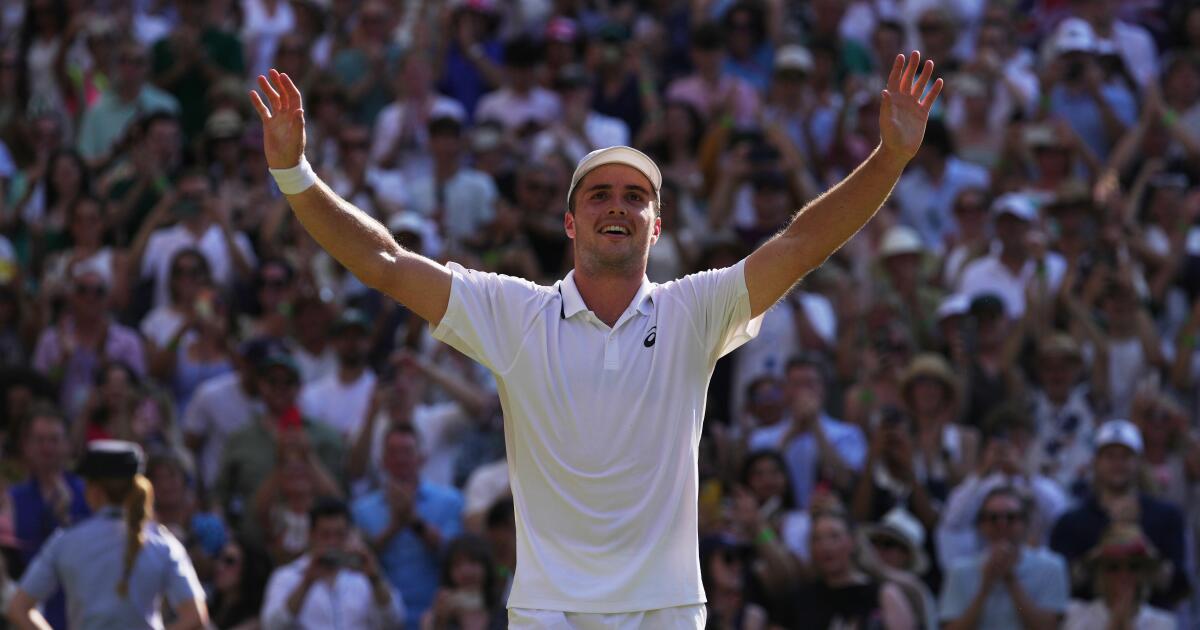
LONDON — A local boy sleeps in his own bed, plays in front of a king and queen and makes a Cinderella run to the Wimbledon semifinals. Sounds like a Hollywood script that might never see the silver screen.
But it’s no fairy tale — it’s Arthur Fery’s out-of-nowhere performance over the last 10 days.
Fery, a virtually unknown British wild card with a triple-digit ranking, has become the emotional heartbeat of Wimbledon while legitimately diverting some national attention from England’s World Cup quest.
The royal treatment at his matches across the All England Club has come in more ways than one.
Fery, who grew up five minutes from Wimbledon and is staying at home during the tournament, first played before grass-court king Roger Federer, Wimbledon’s eight-time singles champion, during Monday’s fourth-round victory. Two days later, he beat No. 9 seed and French Open runner-up Flavio Cobolli of Italy in the quarterfinals 6-4, 7-6 (4), 6-0 in front of Queen Camilla.
Ranked 114th, Fery had never reached the semifinals of an ATP Tour event, let alone a major, before his brief chat with the queen following the match.
“She just said, ‘Congratulations, keep going,’” 23-year-old Fery told reporters later. “I told her it was my birthday on Sunday, so it would be great to play the Wimbledon final on my birthday.”
That’s still a match away. To get there, Fery will have to get past one of the hottest players on tour: No. 2 seed Alexander Zverev, who is fresh off his first Grand Slam title at the French Open. Looming on the other side of the draw is a highly anticipated showdown between defending champion Jannik Sinner against 24-time major winner Novak Djokovic.
If Fery can continue his magical run to the end, he would become the first British wild card to win a Wimbledon title.
Arthur Fery reacts after defeating Flavio Cobolli in the Wimbledon quarterfinals on Wednesday.
(Maja Smiejkowska / Associated Press)
Born in France, Fery’s family moved to Wimbledon when he was an infant. His mother played professional tennis. He was a top British junior but chose to sharpen his game for three years in the U.S. collegiate system at Stanford, as many of his compatriots have done.
“I came out with a lot of hunger coming out of that, and I was ready to attack the pro circuit,” Fery said.
After struggling with bone bruising in his arm that limited him to playing mostly on the lower-tier Challenger circuit in recent years, Fery is finally healthy and playing consistently.
His path to the last four in London has been a masterclass in clutch come-from-behind performances. The Brit has stared down near-certain elimination in multiple matches, repeatedly breaking his opponents’ momentum with Houdini-like on-court acts.
At 5-foot-9, Fery possesses a skill set perfectly suited for low-bounding grass.
His compact strokes, low center of gravity, and elite movement allow him to hug the baseline, take time away from opponents, and confidently execute delicate volleys at the net, according to ESPN analyst Chris Eubanks.
“He defends well,” said Eubanks, a 2023 Wimbledon quarterfinalist. “He can scrap. He can claw. He can dig his way back into points. And when he ventures forward, he’s very, very comfortable at the net. This is a picture-perfect example of someone whose game is built for the surface.”
Still, it’s hard to fathom the multitude of milestones for Fery, who briefly reached the No. 1 ranking in college and earned 2023 Pac-12 Singles Player of the Year honors before leaving early to pursue a pro career.
He arrived at Wimbledon with just one main-draw victory at a major, a losing record as a professional, and only one previous ATP quarterfinal, at Queen’s Club last month. He’s now 11-8, won his first two five-set matches, and is the first British wild card to reach the Wimbledon men’s semifinals in the Open Era. The only other men’s wild-card semifinalist was Goran Ivanisevic, who won the title as a wild card in 2001.
Fery, who started the season ranked No. 185 and will climb to at least No. 36 after the tournament, said there were a “lot of first times” as he reflected on his unprecedented run. “First five-setter, longest match that I’ve ever played, first time breaking into the top 100, first second week in a slam, all at home, five minutes from where I grew up. It’s a great story for me,” he said.
The gap with his fellow semifinalists is understandably massive.

Entering Wimbledon, Djokovic, Sinner and Zverev’s combined records include 29 Grand Slam titles, 2,088 match wins and 155 tour-level titles. Fery was 6-8 in tour-level matches with zero titles.
But he has singlehandedly lifted the tournament for locals. With top hopes Jack Draper and Emma Raducanu withdrawing before the tournament and the rest of Britain’s singles prospects falling one by one — 18 men and women were eliminated by the third round — Fery became the nation’s last knight standing.
If his first name inevitably evokes Arthurian legend, Fery’s march through the draw gave Britain reason to believe again. No sword, no Round Table, just world-class shot-making, a lion’s heart and a Centre Court crowd thrilled to rally behind him.
“This is really quite something to see on home soil,” said Russell Fuller, the BBC’s tennis correspondent, who compared it with Raducanu’s stunning U.S. Open win in 2021 as a qualifier.
Fery earned every bit of it.
In the first round against Damir Dzumhur, Fery dropped the opening set and trailed by a break in the second before surging back. Against Zizou Bergs in the third round, he faced a 4-1 deficit with a double break in the fourth set, and again fell behind 4-1 in the fifth, before somehow surviving.
Then, stepping onto Centre Court for the first time against former top-10 stalwart Grigor Dimitrov of Bulgaria in the fourth round, Fery clawed out of a 2-sets-to-1 hole and a break down in the fourth set to clinch the victory in a fifth-set tiebreak.
“He carries himself with humility, but he’s a fierce competitor, and he’s got a ton of belief in himself,” said Stanford men’s coach and former top-60 player Paul Goldstein, who flew to England Tuesday to see his former charge compete against Cobolli.
While Fery attempts to outmaneuver Zverev on Friday, the other semifinal features a 2025 Wimbledon semifinal rematch between seven-time Wimbledon winner Djokovic and top-ranked Sinner, who defeated the Serb in straight sets on his way to the title. It’s also their second Grand Slam semifinal meeting in 2026. At January’s Australian Open on hard courts, Djokovic bested 24-year-old Sinner in five sets before falling to now-injured Carlos Alcaraz in the Melbourne final.

Arthur Fery hits a return during his Wimbledon quarterfinal win over Flavio Cobolli on Wednesday.
(Clive Brunskill / Getty Images)
Djokovic, 39, enters the match after surviving a grueling five-set, 5-hour-plus quarterfinal slugfest against No. 3 Félix Auger-Aliassime that concluded just minutes before Wimbledon’s 11 p.m. curfew. But the seventh-seeded Serb has a way of defying Father Time and he has had two days to recover on a surface where points are shorter and generally less taxing on the body.
Italy’s Sinner, who defeated Alcaraz in last year’s Wimbledon final, has been efficient if not at the level that saw him capture five consecutive titles before crashing out in the second round at the French Open. After a first-round scare here, the four-time Grand Slam champion has dominated opponents behind his improving serve, winning 80% of his first-serve points. He hasn’t dropped a set since the opening round. Sinner leads the head-to-head with Djokovic 6-5.
According to Eubanks, Djokovic must disrupt Sinner’s movement to break his rhythm, and take his chances.
“He’s got to play similar to how he played in Australia, where it was just all-out aggression,” Eubanks said.
For Sinner, he added: “His serve can be a neutralizing force for what Novak is going to try to do.”
On the other side of the ledger, Fery’s poise under pressure and deft use of the home crowd will be paramount to continue his surprise run against Germany’s Zverev, whom he called a “step up again” from his last five matches. Zverev, 29, is seeking his fifth major final and first at Wimbledon.
“I’m ready for it,” Fery said. “I have nothing to lose. I’m just going to go out there and … put my game on the court, do what I’ve done, believe in myself. We’ll see where that takes me.”
Home has never been closer to Centre Court. Nor has Arthur Fery ever been closer to tennis history.
Sports
Pirates star pitcher makes unfortunate history after being taken out in middle of perfect game bid

NEWYou can now listen to Fox News articles!
Jared Jones was flirting with Major League Baseball history on Wednesday night — he got it, but it was not what he originally envisioned.
The Pittsburgh Pirates pitcher retired the first 18 batters he faced, but he was taken out in the middle of his perfect game bid after six innings.
Now, the Pirates certainly have their reasons — the 24-year-old Jones hasn’t thrown more than 81 pitches in eight starts since returning May 20 after missing all of last season while undergoing ulnar collateral ligament internal brace surgery on May 21, 2025. He was yanked with 77 pitches and likely would have needed more than 100 pitches to record the 25th perfect game in MLB history.
Jared Jones of the Pittsburgh Pirates pitches during the first inning against the Atlanta Braves at PNC Park on July 8, 2026, in Pittsburgh, Pennsylvania. (Photo by Joe Sargent/Getty Images)
However, Jones left the game after getting zero run support, so when the Atlanta Braves tacked on three runs late for a 3-0 victory, Jones instead found himself in the wrong chapter of the history books.
According to Opta Stats, Jones became the first pitcher in the modern era (since 1920) to pitch at least six perfect innings and not record a win.
“It does suck. Something’s cool coming on, but I’m on what? My eighth start off of surgery? I completely understand it, and it is what it is,” Jones told reporters after the game.
Pittsburgh Pirates starting pitcher Jared Jones (17) makes his way to the field to warm up before pitching against the Atlanta Braves at PNC Park. (Charles LeClaire/Imagn Images)
JUSTIN VERLANDER ANNOUNCES HE WILL RETIRE AFTER THIS SEASON: ‘I’VE REALIZED THAT TIME HAS COME’
Jones said he didn’t entertain attempting to complete the perfect game.
“Not with the pitch count,” he said. “Not really ever expecting to go nine right now, so that was never in my head.”
Joey Bart, traded to the Braves from the Pirates on June 18, followed a double by Mike Yastrzemski with a 422-foot, two-run homer to left-center field off a slider from Dennis Santana. Drake Baldwin added an RBI single to center in the ninth for good measure.
It was the second time in less than a week that a pitcher was taken out of the game with a perfect bid through six innings — the Miami Marlins took Eury Perez out after seven innings in which he had 92 pitches. Perez, too, is in the midst of returning from injury and has surprisingly found himself right in the postseason mix.
He was pulled for Lake Bachar to start the eighth, and the Marlins allowed eight runs to the Athletics in the final two innings, but held on to win 9-8.
Jared Jones (17) of the Pittsburgh Pirates delivers a pitch during a MLB game against the Cincinnati Reds on June 27, 2026, at PNC Park in Pittsburgh, Pennsylvania. (Joe Robbins/Icon Sportswire via Getty Images)
CLICK HERE TO DOWNLOAD THE FOX NEWS APP
The Pirates are 4.0 games out of the final wild card spot, which is held by the Marlins.
The Associated Press contributed to this report.
Follow Fox News Digital’s sports coverage on X, and subscribe to the Fox News Sports Huddle newsletter.
-

 Wisconsin3 minutes ago
A Wisconsin family is suing Target after their 10-month-old died from swallowing a water bead
-

 West Virginia10 minutes ago
How midsummer wild berries connect people, wildlife, and West Virginia’s forests – West Virginia Explorer
-

 Wyoming13 minutes ago
Fourth Annual Wyoming Firearms & Outdoor Recreation Expo, Wyoming Governor’s Match returning to Casper July 18, 19
-

 Crypto18 minutes ago
Bitdeer Invests $36 Million in First US Sealminer Factory as Bitcoin Mining Margins Stay Tight
-

 Finance25 minutes ago
How AI Is Evolving in Sage Intacct and What It Means for Finance Teams | CBIZ
-

 Fitness28 minutes ago
Tim Henman, 51, Has Barely Aged Since Retiring – Here’s His Fitness Formula
-

 Movie Reviews40 minutes ago
‘Evil Dead Burn’ Movie Review – Spotlight Report
-

 World48 minutes ago
Hoops Players’ Win Tops Big Day in NCAA Eligibility Litigation

