Sports
How do Premier League teams kick off games in 2024-25?


Plenty of attention has been paid to the new ‘Dynamic Kick-off’ regulations in American football’s NFL in the early days of its 2024 season but even in the fluid realm of the Premier League, how a team begins play is an increasingly-rehearsed process.
And despite the ongoing evolution in intricate tactics, even the greatest of Johan Cruyff’s disciples seem keen to return the game to its roots by hoofing the ball up the pitch from kick-off. Each of last season’s final top six in the Premier League have done so at some point in their first three matches of 2024-25. However, they have also provided variety in the ways they line their players up, and how quickly they get the ball forward.
Below, The Athletic analyses the kick-off routines used by Manchester City, Arsenal, Liverpool, Aston Villa, Tottenham Hotspur and Chelsea (to start either a game or the second half of one) across the first three weeks of the season ahead of the Premier League’s return this weekend.
Manchester City
As you would expect from a Pep Guardiola team, City’s kick-off routines have been attempts to retain control through short passes and plenty of off-ball movement.
Ahead of their first kick-off of the season away at Chelsea, Kevin De Bruyne and Bernardo Silva both lined up close to the ball, with Savinho out wide on the left and Erling Haaland and Jeremy Doku close to each other on the right. Rico Lewis was the sole defensive member of the team to the left with their other defenders forming the final line behind Mateo Kovacic on the edge of the centre circle.
De Bruyne passed the ball back to goalkeeper Ederson, who went long towards Haaland on the right. He flicked it on, but Chelsea ’keeper Robert Sanchez came off his line to collect the ball close to the edge of the box before Doku could reach it. By the time Sanchez caught the ball, City had seven players close to his penalty box to kickstart the press.

At home against Ipswich Town the following weekend, Guardiola opted for a different approach when City kicked off the second half (they were leading 3-1 by then). De Bruyne and Bernardo still stayed close to the ball, but Haaland joined Savinho out wide on the right while Doku was positioned further inside on the other flank. Lewis, on the right, lined up alongside Kovacic, who stood near the edge of the circle again, while the back three were positioned deeper than they had been at Stamford Bridge.
City began the second half with a 14-pass move in which they found both Savinho and Doku at different points, with seven players in total getting a touch. When Ipswich finally cleared the ball for a throw-in, City had De Bruyne and Bernardo in pockets where they could cause damage and both wingers high and wide with limited immediate pressure.

At West Ham, City chose a similar approach to the Ipswich one before the opening kick-off but with Jack Grealish alone on the left while Haaland and Doku went wide on the right. Their back three were much closer together that time and leaned more towards the left, indicating they would channel their first attack of the match to the right.
De Bruyne again passed all the way back to Ederson, who shaped up for a long pass but then went short to left-back Josko Gvardiol, who returned it to him. City then drew West Ham towards the left with De Bruyne dropping deep, as he did against Ipswich, before playing it out to their right and finding Lewis in acres of space. When Lewis received the ball, he was ahead of six West Ham and five City outfield players, giving the champions a chance to cause some early damage.
Arsenal

Arsenal have had a set pattern in place across their three league games so far, passing the ball back to goalkeeper David Raya from kick-off and surging towards the flanks in numbers while leaving central areas open. Raya is then tasked with hitting one of the wings; he went towards the left against Wolves and Brighton, and to the right against Aston Villa.
In the Wolves game, Arsenal had a front five streaming forward even before Thomas Partey knocked the ball back towards Raya. Bukayo Saka and Martin Odegaard made inward runs on the right anticipating a long ball to the left, where Declan Rice is most central with Gabriel Martinelli holding the width and Kai Havertz between them, while Oleksandr Zinchenko stayed back. Arsenal’s defenders stayed in a high final line to ensure they could move further up once Raya, who came well outside his box, launched the ball forward.
By the time Raya readied himself to kick, William Saliba was the lone defender in the final line with Gabriel and Ben White, who also made their way forward.
Wolves stepped forward to try to win the ball just beyond the halfway line, but it came back to Zinchenko. He played it forward to Martinelli, but the Brazilian’s subsequent pass towards the middle was cleared.
Wolves recovered possession quickly but as Arsenal already had men forward, they pressed them to force a long pass and won the ball back by the 34-second mark.
Away to Villa, Arsenal used a different tactic by opting to go to the right flank instead. Havertz moved over to the right to charge forward with Saka, while Odegaard stayed more central. Rice and Martinelli made more conservative runs on the left while the back four stayed high in line with the edge of the centre circle.
When Partey’s pass got to Raya, Saliba was the furthest behind once again while all the runners moved towards the right. Raya’s long ball was nodded on by Havertz, who occupied the same area as Saka, allowing Villa left-back Lucas Digne to get a head start and marshal the ball out for a goal kick. The move mirrors City’s approach against Chelsea the previous weekend.
Finally, against Brighton, Arsenal went to the left again, with Havertz once more drifting over to the other side. This time, they kept two centre-backs in front of Raya, anticipating a higher Brighton press, with Saliba even blocking opposition striker Danny Welbeck. Raya’s pass was met by Jan Paul van Hecke, who headed it out for a throw-in.
By then, nine Arsenal players were in the Brighton half, allowing the home side to establish early territorial dominance.
Winning the initial header doesn’t seem to be Arsenal’s focus from these routines, particularly considering the 5ft 8in (178cm) Leandro Trossard was their left-winger against Brighton, though Havertz’s 6ft 4in height does help, as it did against Villa. The aim is for them to get as many of their players forward as possible, pinning the opposition back rather than prioritising control.
Liverpool

Liverpool huddle before kick-off at Manchester United on September 1 (Paul Ellis/AFP via Getty Images)
Arne Slot’s early months as Liverpool head coach have seen him receive praise for establishing an identity that blends the best qualities of Jurgen Klopp’s 2023-24 squad with his own touches.
Liverpool have continued to use a high line and that has been evident from their kick-off setups, which is similar to Arsenal’s.
On the opening weekend against Ipswich, Dominik Szoboszlai was tasked with kicking off the contest, with four team-mates also close to the halfway line.

Unlike City and Arsenal, who have players starting from wide positions, Liverpool were much narrower. Luis Diaz, Diogo Jota and Alexis Mac Allister lined up on the left while Mohamed Salah took up the sole spot on the right. Behind them, Trent Alexander-Arnold inverted to form a midfield line with Ryan Gravenberch, with Liverpool’s remaining defenders forming the final line just beyond the centre circle. Both the first and final lines compressed space by lining up next to each other.
Below, Szoboszlai passed to goalkeeper Alisson, who went long towards the left. Like Haaland and Havertz from the examples above, the ball was directed towards Jota, who was in the half-space rather than wide, which helped him find Diaz further out. The Colombian received support from Andy Robertson and the latter’s first-time cross was cleared.
Slot went one step further in his official Anfield bow against Brentford the following week. To kick off the game’s second half, the front four remained the same but the midfield two became a trio with Robertson inverting to position himself directly behind Jota on the left. Ibrahima Konate and Virgil van Dijk formed the final line right next to the centre circle.
This time around, Alisson’s long pass was met by Brentford defender Nathan Collins, who was then fouled when he went up for a return header after the ball was sent forward again by Robertson. When the foul occurred, every Liverpool outfield player was in Brentford’s half. With the play drawn towards the left, Szoboszlai, Alexander-Arnold and Salah were in space on the right.
Then, against Manchester United, deemed the first big test of Slot’s tenure, the Dutchman unleashed what looked like an even more daring approach to start the second half, despite holding a 2-0 lead at Old Trafford. The front line of four was backed up by a second line of four with Gravenberch, Van Dijk and Robertson on the left and Alexander-Arnold in the half-space on the right. Konate was furthest back but still higher than he had been against Ipswich or Brentford.
However, as Alisson readied himself to launch one upfield, Van Dijk and Robertson dropped back even as their other team-mates made their way forward. Alisson’s pass was met by Jota, who (after a couple of ricochets) got past United right-back Noussair Mazraoui to the byline. Liverpool were unable to get enough men into the box, though, and Jota’s final pass sailed out for a throw-in on the other side of the pitch. They did, however, have enough players in United’s defensive third to disrupt their restart from the ensuing throw-in.
Liverpool’s approach from kick-offs, while mirroring Arsenal’s on the surface, has the positional interchanges we see from City.
Jota and Diaz are both capable of switching between the left-winger and centre-forward positions and this approach also allows Salah to begin halves with lower intensity and conserve his energy.
Aston Villa

Villa are the first team on this list to start matches off with a forward and use a midfield recipient from kick-off, with an emphasis on control and baiting the opposition’s press.
Away against West Ham on the opening weekend, Morgan Rogers started the second half for Villa with Ollie Watkins and Leon Bailey lining up close to each other on the left and John McGinn tucking inside on the right. Youri Tielemans and Amadou Onana stood right next to each other within the centre circle, while Villa’s back four formed their final line a few yards further back, fanning out to cover the middle of the pitch and both flanks.
Below, Rogers passed the ball to Tielemans, who went back to Pau Torres. As West Ham committed men forward, Villa played it out wide to right-back Matty Cash, who beat his man but then gave the ball away, before Villa won a throw-in in their own half.
Unai Emery’s side were much more conservative when they took on Arsenal at home the following weekend.
This time, Watkins moved to the right, leaving Bailey as the sole runner on the left. Tielemans pushed closer to Rogers while Onana retained his position near the edge of the centre circle. The gap between Onana and the back four was much larger, while the full-backs pushed slightly further ahead of their centre-backs.
Villa passed back to goalkeeper Emiliano Martinez, who, with the team’s overall shape, would have been expected to go towards the left wing. However, Havertz cleverly presses him on that side to force Martinez to pass to the right wing, where Jurrien Timber wins the initial duel but then gives the ball away. From there, Villa worked it back to their defenders before eventually surrendering possession as Arsenal pressure resulted in Torres passing to an offside Bailey.
Against Leicester City in their third match of the season, Emery unleashed another pre-kick-off formation.
This time, Watkins returned to the left alongside McGinn, while Onana moved further up the pitch to join Bailey on the right, so forming a front four. Tielemans stood just a couple of feet away from Rogers to receive the initial ball, while Digne inverted to line up a few yards behind McGinn and Watkins, leaving plenty of space in midfield.
Rogers passed to Tielemans as expected, and he played the ball further back to the defence. Torres tried to dribble out of danger but couldn’t and Leicester cleared it back to their defence before constructing a move that pegged Villa back, indicating the risk this approach holds when Emery’s side fail to wriggle out of pressure.
Tottenham Hotspur

Tottenham’s kick-off setup contrasts with all the teams above in terms of width.
In the example below from their opening fixture against Leicester, Spurs, like Villa, kicked off using a forward in Dominic Solanke, but stationed Son Heung-min and Brennan Johnson extremely wide on the left and right respectively, with James Maddison starting close to Solanke.
Their second line leaned towards the left; Rodrigo Bentancur was on the edge of the centre circle in midfield with Pedro Porro in the right half-space and Pape Sarr in between them. Destiny Udogie was slightly behind in the left half-space, leaving just centre-backs Cristian Romero and Micky van de Ven to form the final line closer to their penalty area than to their team-mates. Romero and Van de Ven then fanned out, hinting that Spurs would start with short passes, which was what they did.
Solanke passed the ball to Bentancur, who played a one-two with Sarr before finding Van de Ven. Spurs worked the ball to Maddison, dropping deep on the left flank (similar to De Bruyne for City), and he tried to find Udogie, whose poke forward was too far ahead for Solanke to reach.

With Solanke out injured against Everton, Spurs brought Wilson Odobert into their line-up, while Dejan Kulusevski also started.
As Son, as the centre-forward, prepared for kick-off, he had two options close to him in Maddison and Kulusevski, while Johnson and Odobert held the width once again. The second line was formed by Porro drifting into central midfield, the returning Yves Bissouma at the edge of the centre circle and Udogie much wider on the left. Romero and Van de Ven formed the final line but were higher up the pitch than against Leicester, a signal they anticipated less pressure from the outset than in Leicester.
Son found Bissouma with the first pass and the midfielder went long, towards Odobert on the left. Odobert won the second ball and fed Maddison, but Spurs ended up going back to their defence, still staying within Everton’s half as the visitors sat deep.
In the most recent match, against Newcastle, Spurs used yet another kick-off shape as they began the second half 1-0 down.
As Son prepared to make the opening pass, Johnson again positioned himself wide on the right, but Udogie was now the widest player on the other flank with Odobert dropping inside, while Kulusevski was deeper than where he was positioned in the Everton match. Porro also pushed up to man the right side of the second line, with Maddison in a deeper position down the middle and Bissouma on the left. The gap between midfield and their two-man defensive line was smaller as Spurs aimed to push forward from the start of the half in search of an equaliser.
On this occasion, Son played it to Kulusevski, who lofted a ball towards Udogie on the left — as Bissouma did for Odobert against Everton. The pass was too heavy and Newcastle won it back, but as Spurs pushed men forward, they regained possession quickly. The resulting sequence saw Kulusevski’s shot from inside the box deflected.
Spurs’ system under coach Ange Postecoglou has often depended on high-risk, high-energy football and their kick-offs are a good illustration of that. Their setup allows them to stream men forward and, more importantly, compress the wide areas to force teams down the middle, where they can win the ball back by applying pressure.
Chelsea

Chelsea’s kick-off approach under new head coach Enzo Maresca is quite different from their approach with Mauricio Pochettino in the dugout last season.
Instead of Conor Gallagher, sold to Atletico Madrid in the summer, or another midfielder, Nicolas Jackson has been handed kick-off duties by Maresca. Chelsea have used a mix of Spurs’ and City’s approaches, stationing their left-winger out wide while allowing Cole Palmer on the right to stay closer to Jackson.
Against City on the opening weekend, Enzo Fernandez gave Jackson a short initial option on the left, with Moises Caicedo and Romeo Lavia on the edge of the centre circle. Chelsea’s back four stayed closer to their box with Malo Gusto and Marc Cucurella inverting from the right and left, respectively.
To start the second half, trailing 1-0, Jackson passed to Cucurella, who tried to go long towards Christopher Nkunku wide on the left, but the pass was too heavy, and City saw it through to Ederson with minimal pressure. Given the quality of the opposition, Chelsea didn’t press too high, granting City’s back three the space and time to get into a passing rhythm.
Chelsea’s approach seemed to be a reaction to playing a superior side in the four-in-a-row champions, however, as they changed their setup away against Wolves the following weekend.
The inclusion of Noni Madueke and Lavia’s absence through injury meant, in addition to having Palmer close to Jackson, Maresca could station both wingers — Mykhailo Mudryk on the left and Madueke on the right — out wide. Gusto joined the midfield to form a trio with Fernandez and Caicedo, which meant the right-back area was completely empty, with Cucurella inverting and pushing ahead and the centre-backs staying close to each other in the middle.
This time, Jackson passed to right centre-back Wesley Fofana, who immediately went long towards Madueke. The winger was open and flicked the ball on towards Palmer, but Wolves skipper Mario Lemina got there first. As Wolves then tried to move forward, Chelsea pressed high to force the opposition to the left, trying to tempt them into a risky switch which never came.
The setup Maresca used against Crystal Palace in the third match might be the one he sticks with as the Chelsea squad get accustomed to his tactics.
Chelsea, winning 1-0, kicked off the second half with Fernandez, who had Jackson (left) and Palmer (right) closest to him while Pedro Neto hugged the touchline on the left and Madueke was stationed wide right. Gusto and Caicedo formed a much deeper second line, with Cucurella wider than in previous matches. The centre-backs were also deeper than before, staying closer to their penalty area.
Fernandez passed the ball back to Sanchez, who, under no pressure, lofted the ball towards the left. Chelsea failed to win the first header and Fernandez’s second header towards Neto was cleared out. When the ball went out of play, Chelsea had Palmer, their primary creative outlet, in the kind of position they would want him, but their rest defence was slightly vulnerable with Caicedo moving up the pitch.
Space and time may have limited us to a deep dive on only last season’s top six in this article but fans of Bournemouth, Brighton, Newcastle and Manchester United can analyse their team’s kick-off approach in the graphics below:





Sports
London descends into disorder as Morocco fans flood streets after World Cup elimination by France

NEWYou can now listen to Fox News articles!
Public unrest began in parts of London late Thursday night, and it appears Morocco’s exit from the 2026 FIFA World Cup at the hands of France is the reason.
France took down Morocco 2-0, eliminating the African country for the second consecutive tournament, this time in a quarterfinal match.
As a result, many feared Paris would erupt into riots, especially after the chaos that followed Paris Saint-Germain’s UEFA Champions League victory over Arsenal in May.
Instead, images and videos from Edgware Road in northwest London showed police clashing with large crowds as smoke billowed through the streets and debris littered the roadway.
A police vehicle is parked in a road as people from pro-Palestinian activist groups gather near the Edgware United Synagogue during a demonstration against the “Great Israeli Real Estate Event” organized by real-estate agency My Home in Israel, which markets property in Israeli settlements in the occupied West Bank, in London, Britain, June 14, 2026. (Toby Shepheard)
Riot police, equipped with shields and body armor, tried to contain the crowds as they clashed with people launching fireworks and throwing debris. One video also appeared to show an officer down.
KYLIAN MBAPPÉ, OUSMANE DEMBÉLÉ FIRE FRANCE INTO WORLD CUP SEMIFINALS WITH WIN OVER MOROCCO
It’s unknown what happened to the officer who was down on the asphalt or how he was injured.
Fans waved Moroccan flags in the middle of the streets, which held up traffic. Some even jumped on top of vehicles trying to get through the area.
Moroccan fans in the stands before a FIFA World Cup 2026 quarterfinal match between France and Morocco at Boston Stadium July 9, 2026, in Foxborough, Mass. (Richard Sellers/SportsphotoAllstar)
Similar scenes unfolded after Egypt’s World Cup exit, when Argentina rallied for a controversial 3-2 victory that featured several disputed officiating decisions.
Paris, on the other hand, looked more like a city celebrating than one on the brink of a riot. Supporters of both France and Morocco flooded the streets, slowing traffic in several parts of the city.
One video showed horns blasting from cars with French and Moroccan flags out the windows on the L’avenue des Champs-Élysées in Paris. Supporters on the side of the road, waving their own flags, joined in on the celebration.
France’s Kylian Mbappé scored his eighth goal of this World Cup, which ties him for the most with Argentina’s Lionel Messi. Ousmane Dembélé also scored in the second half for France in the 2-0 win over Morocco.
It’s the third straight semifinal appearance for France, while Morocco still made World Cup history despite the loss. After becoming the first African country to reach the quarterfinals and semifinals in World Cup history in 2022, Morocco added to that by becoming the first-ever African nation to reach more than one quarterfinal.
Moroccan fans react while attending a watch party for the World Cup round of 8 match between France and Morocco in Boston, Massachusetts, on July 9, 2026. (Joseph Prezioso/AFP)
CLICK HERE TO DOWNLOAD THE FOX NEWS APP
Morocco’s exit means there are no more African nations alive in the World Cup. France will be taking on the winner of Spain and Belgium, while England and Norway and Argentina and Switzerland face off in the quarterfinals.
Follow Fox News Digital’s sports coverage on X and subscribe to the Fox News Sports Huddle newsletter.
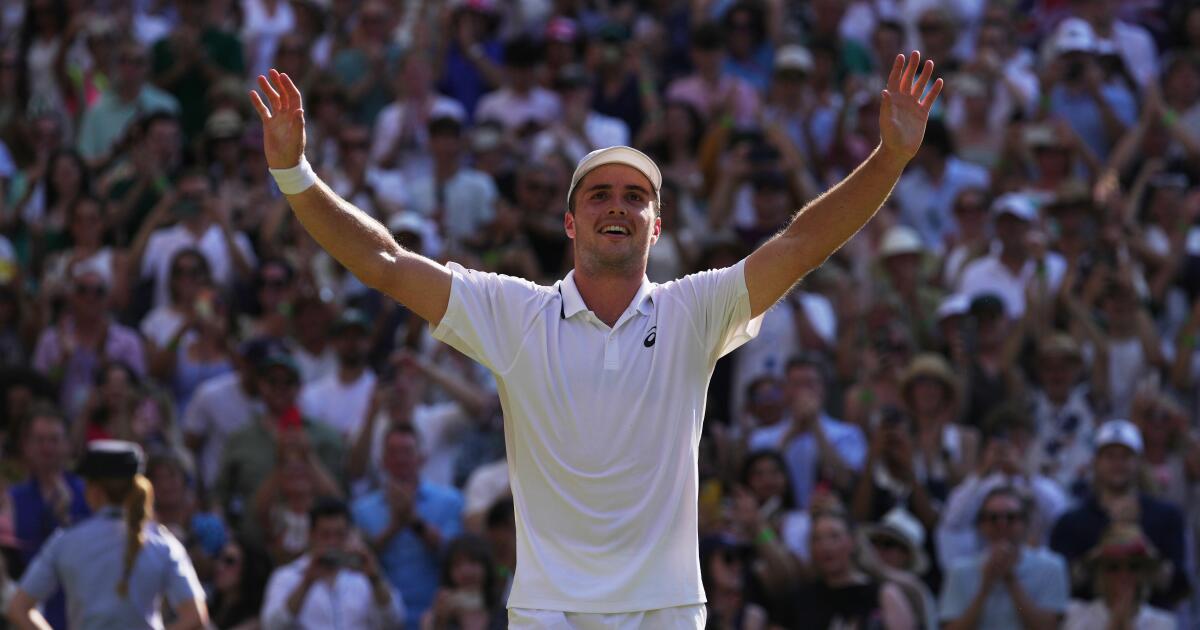
LONDON — A local boy sleeps in his own bed, plays in front of a king and queen and makes a Cinderella run to the Wimbledon semifinals. Sounds like a Hollywood script that might never see the silver screen.
But it’s no fairy tale — it’s Arthur Fery’s out-of-nowhere performance over the last 10 days.
Fery, a virtually unknown British wild card with a triple-digit ranking, has become the emotional heartbeat of Wimbledon while legitimately diverting some national attention from England’s World Cup quest.
The royal treatment at his matches across the All England Club has come in more ways than one.
Fery, who grew up five minutes from Wimbledon and is staying at home during the tournament, first played before grass-court king Roger Federer, Wimbledon’s eight-time singles champion, during Monday’s fourth-round victory. Two days later, he beat No. 9 seed and French Open runner-up Flavio Cobolli of Italy in the quarterfinals 6-4, 7-6 (4), 6-0 in front of Queen Camilla.
Ranked 114th, Fery had never reached the semifinals of an ATP Tour event, let alone a major, before his brief chat with the queen following the match.
“She just said, ‘Congratulations, keep going,’” 23-year-old Fery told reporters later. “I told her it was my birthday on Sunday, so it would be great to play the Wimbledon final on my birthday.”
That’s still a match away. To get there, Fery will have to get past one of the hottest players on tour: No. 2 seed Alexander Zverev, who is fresh off his first Grand Slam title at the French Open. Looming on the other side of the draw is a highly anticipated showdown between defending champion Jannik Sinner against 24-time major winner Novak Djokovic.
If Fery can continue his magical run to the end, he would become the first British wild card to win a Wimbledon title.
Arthur Fery reacts after defeating Flavio Cobolli in the Wimbledon quarterfinals on Wednesday.
(Maja Smiejkowska / Associated Press)
Born in France, Fery’s family moved to Wimbledon when he was an infant. His mother played professional tennis. He was a top British junior but chose to sharpen his game for three years in the U.S. collegiate system at Stanford, as many of his compatriots have done.
“I came out with a lot of hunger coming out of that, and I was ready to attack the pro circuit,” Fery said.
After struggling with bone bruising in his arm that limited him to playing mostly on the lower-tier Challenger circuit in recent years, Fery is finally healthy and playing consistently.
His path to the last four in London has been a masterclass in clutch come-from-behind performances. The Brit has stared down near-certain elimination in multiple matches, repeatedly breaking his opponents’ momentum with Houdini-like on-court acts.
At 5-foot-9, Fery possesses a skill set perfectly suited for low-bounding grass.
His compact strokes, low center of gravity, and elite movement allow him to hug the baseline, take time away from opponents, and confidently execute delicate volleys at the net, according to ESPN analyst Chris Eubanks.
“He defends well,” said Eubanks, a 2023 Wimbledon quarterfinalist. “He can scrap. He can claw. He can dig his way back into points. And when he ventures forward, he’s very, very comfortable at the net. This is a picture-perfect example of someone whose game is built for the surface.”
Still, it’s hard to fathom the multitude of milestones for Fery, who briefly reached the No. 1 ranking in college and earned 2023 Pac-12 Singles Player of the Year honors before leaving early to pursue a pro career.
He arrived at Wimbledon with just one main-draw victory at a major, a losing record as a professional, and only one previous ATP quarterfinal, at Queen’s Club last month. He’s now 11-8, won his first two five-set matches, and is the first British wild card to reach the Wimbledon men’s semifinals in the Open Era. The only other men’s wild-card semifinalist was Goran Ivanisevic, who won the title as a wild card in 2001.
Fery, who started the season ranked No. 185 and will climb to at least No. 36 after the tournament, said there were a “lot of first times” as he reflected on his unprecedented run. “First five-setter, longest match that I’ve ever played, first time breaking into the top 100, first second week in a slam, all at home, five minutes from where I grew up. It’s a great story for me,” he said.
The gap with his fellow semifinalists is understandably massive.
Entering Wimbledon, Djokovic, Sinner and Zverev’s combined records include 29 Grand Slam titles, 2,088 match wins and 155 tour-level titles. Fery was 6-8 in tour-level matches with zero titles.
But he has singlehandedly lifted the tournament for locals. With top hopes Jack Draper and Emma Raducanu withdrawing before the tournament and the rest of Britain’s singles prospects falling one by one — 18 men and women were eliminated by the third round — Fery became the nation’s last knight standing.
If his first name inevitably evokes Arthurian legend, Fery’s march through the draw gave Britain reason to believe again. No sword, no Round Table, just world-class shot-making, a lion’s heart and a Centre Court crowd thrilled to rally behind him.
“This is really quite something to see on home soil,” said Russell Fuller, the BBC’s tennis correspondent, who compared it with Raducanu’s stunning U.S. Open win in 2021 as a qualifier.
Fery earned every bit of it.
In the first round against Damir Dzumhur, Fery dropped the opening set and trailed by a break in the second before surging back. Against Zizou Bergs in the third round, he faced a 4-1 deficit with a double break in the fourth set, and again fell behind 4-1 in the fifth, before somehow surviving.
Then, stepping onto Centre Court for the first time against former top-10 stalwart Grigor Dimitrov of Bulgaria in the fourth round, Fery clawed out of a 2-sets-to-1 hole and a break down in the fourth set to clinch the victory in a fifth-set tiebreak.
“He carries himself with humility, but he’s a fierce competitor, and he’s got a ton of belief in himself,” said Stanford men’s coach and former top-60 player Paul Goldstein, who flew to England Tuesday to see his former charge compete against Cobolli.
While Fery attempts to outmaneuver Zverev on Friday, the other semifinal features a 2025 Wimbledon semifinal rematch between seven-time Wimbledon winner Djokovic and top-ranked Sinner, who defeated the Serb in straight sets on his way to the title. It’s also their second Grand Slam semifinal meeting in 2026. At January’s Australian Open on hard courts, Djokovic bested 24-year-old Sinner in five sets before falling to now-injured Carlos Alcaraz in the Melbourne final.

Arthur Fery hits a return during his Wimbledon quarterfinal win over Flavio Cobolli on Wednesday.
(Clive Brunskill / Getty Images)
Djokovic, 39, enters the match after surviving a grueling five-set, 5-hour-plus quarterfinal slugfest against No. 3 Félix Auger-Aliassime that concluded just minutes before Wimbledon’s 11 p.m. curfew. But the seventh-seeded Serb has a way of defying Father Time and he has had two days to recover on a surface where points are shorter and generally less taxing on the body.
Italy’s Sinner, who defeated Alcaraz in last year’s Wimbledon final, has been efficient if not at the level that saw him capture five consecutive titles before crashing out in the second round at the French Open. After a first-round scare here, the four-time Grand Slam champion has dominated opponents behind his improving serve, winning 80% of his first-serve points. He hasn’t dropped a set since the opening round. Sinner leads the head-to-head with Djokovic 6-5.
According to Eubanks, Djokovic must disrupt Sinner’s movement to break his rhythm, and take his chances.
“He’s got to play similar to how he played in Australia, where it was just all-out aggression,” Eubanks said.
For Sinner, he added: “His serve can be a neutralizing force for what Novak is going to try to do.”
On the other side of the ledger, Fery’s poise under pressure and deft use of the home crowd will be paramount to continue his surprise run against Germany’s Zverev, whom he called a “step up again” from his last five matches. Zverev, 29, is seeking his fifth major final and first at Wimbledon.
“I’m ready for it,” Fery said. “I have nothing to lose. I’m just going to go out there and … put my game on the court, do what I’ve done, believe in myself. We’ll see where that takes me.”
Home has never been closer to Centre Court. Nor has Arthur Fery ever been closer to tennis history.
Sports
Pirates star pitcher makes unfortunate history after being taken out in middle of perfect game bid

NEWYou can now listen to Fox News articles!
Jared Jones was flirting with Major League Baseball history on Wednesday night — he got it, but it was not what he originally envisioned.
The Pittsburgh Pirates pitcher retired the first 18 batters he faced, but he was taken out in the middle of his perfect game bid after six innings.
Now, the Pirates certainly have their reasons — the 24-year-old Jones hasn’t thrown more than 81 pitches in eight starts since returning May 20 after missing all of last season while undergoing ulnar collateral ligament internal brace surgery on May 21, 2025. He was yanked with 77 pitches and likely would have needed more than 100 pitches to record the 25th perfect game in MLB history.
Jared Jones of the Pittsburgh Pirates pitches during the first inning against the Atlanta Braves at PNC Park on July 8, 2026, in Pittsburgh, Pennsylvania. (Photo by Joe Sargent/Getty Images)
However, Jones left the game after getting zero run support, so when the Atlanta Braves tacked on three runs late for a 3-0 victory, Jones instead found himself in the wrong chapter of the history books.
According to Opta Stats, Jones became the first pitcher in the modern era (since 1920) to pitch at least six perfect innings and not record a win.
“It does suck. Something’s cool coming on, but I’m on what? My eighth start off of surgery? I completely understand it, and it is what it is,” Jones told reporters after the game.
Pittsburgh Pirates starting pitcher Jared Jones (17) makes his way to the field to warm up before pitching against the Atlanta Braves at PNC Park. (Charles LeClaire/Imagn Images)
JUSTIN VERLANDER ANNOUNCES HE WILL RETIRE AFTER THIS SEASON: ‘I’VE REALIZED THAT TIME HAS COME’
Jones said he didn’t entertain attempting to complete the perfect game.
“Not with the pitch count,” he said. “Not really ever expecting to go nine right now, so that was never in my head.”
Joey Bart, traded to the Braves from the Pirates on June 18, followed a double by Mike Yastrzemski with a 422-foot, two-run homer to left-center field off a slider from Dennis Santana. Drake Baldwin added an RBI single to center in the ninth for good measure.
It was the second time in less than a week that a pitcher was taken out of the game with a perfect bid through six innings — the Miami Marlins took Eury Perez out after seven innings in which he had 92 pitches. Perez, too, is in the midst of returning from injury and has surprisingly found himself right in the postseason mix.
He was pulled for Lake Bachar to start the eighth, and the Marlins allowed eight runs to the Athletics in the final two innings, but held on to win 9-8.
Jared Jones (17) of the Pittsburgh Pirates delivers a pitch during a MLB game against the Cincinnati Reds on June 27, 2026, at PNC Park in Pittsburgh, Pennsylvania. (Joe Robbins/Icon Sportswire via Getty Images)
CLICK HERE TO DOWNLOAD THE FOX NEWS APP
The Pirates are 4.0 games out of the final wild card spot, which is held by the Marlins.
The Associated Press contributed to this report.
Follow Fox News Digital’s sports coverage on X, and subscribe to the Fox News Sports Huddle newsletter.
-

 Oklahoma2 minutes ago
Every Oklahoma State Cowboys’ College Football 27 Preseason Player Rating
-

 Oregon7 minutes ago
Illicit massage businesses shut down in Washington County
-
Pennsylvania14 minutes ago
Man arrested over alleged antisemitic threats to Gov. Josh Shapiro | The Jerusalem Post
-

 Rhode Island17 minutes ago
Aquatic Weed Treatments Planned for 2 RI Ponds, 1 Lake
-

 South-Carolina22 minutes ago
South Carolina Lottery Pick 3, Pick 4 results for July 9, 2026
-

 South Dakota29 minutes ago
Iverson Ford Welcomes the 2027 Ford Expedition to Drivers Across Eastern South Dakota
-

 Tennessee32 minutes ago
Tennessee Highway Patrol holds open house at Jackson district office
-

 Texas44 minutes ago
Longhorns Daily News: Texas coach Steve Sarkisian named among Dodd Trophy watch list


