Sports
How cricket became the next big thing for sport's wealthiest investors


Chuck Ramkissoon, the most interesting character in Joseph O’Neill’s award-winning novel Netherland, is a Trinidadian wheeler-dealer who has come to New York to make his fortune.
So far, so normal, but it is how he intends to make his mark that sets him apart from the thousands of other characters in stories about the American Dream because Ramkissoon’s route to riches is cricket.
In a memorable section of a remarkable book, Ramkissoon tells his friend, the story’s narrator, that he wants to build a cricket “arena” in Brooklyn.
Sensing his friend’s incredulity, our hero launches into a sales pitch that starts with the huge South Asian population in New York, moves into a business plan that involves 8,000 fans paying $50 (£39) each to watch 12 exhibition matches every summer, and ends with the kicker, “global TV rights… a game between India and Pakistan… a TV and internet viewership of 70 million in India alone… we’d breakeven in three, at most four years”.
This vision is meant to sound unrealistic, bordering on absurd. Cricket in New York? Attracting paying customers? With tens of millions watching on the other side of the world?
The book was written in 2008 but is set a few years earlier, more than two decades before 34,000 people watched India play Pakistan in the T20 World Cup in New York last month, a game that proved the old adage about truth being stranger than fiction.
The top hospitality tickets at the Nassau County Stadium had a face value of $10,000 (£7,800) and ordinary tickets were changing hands for more than $1,000 on the secondary market. The game garnered 256 million hours of viewing in India, an incredible figure for a contest that finished in the small hours of the morning there.
India fans in New York watch their team’s victory in the T20 World Cup final in June (Derek French/SOPA Images/LightRocket via Getty Images)
I was reminded of Ramkissoon last week when the England and Wales Cricket Board (ECB) revealed it has sent presentations to several owners of National Football League (NFL) teams to alert them to the opportunity of buying stakes in the eight teams that play in The Hundred, one of 17 different “franchise leagues” that have popped up in recent years.
Those pitch decks, which include a video explaining The Hundred’s rules, have also been sent to the owners of teams in the Indian Premier League (IPL), the daddy of those franchise leagues, and pretty much every serious multi-sport investor on the planet.
All have been invited to games in the month-long competition, which started on Tuesday, and various media outlets have reported that high-profile owners of British football teams, such as Wrexham’s Hollywood duo Rob McElhenney and Ryan Reynolds, are interested.
“Many of them know cricket very well, know The Hundred very well and may not feel the need to come,” explained the ECB’s director of business operations Vikram Banerjee during a conference call with reporters.
“Others, some of our American friends, for example, may like the idea of what we’ve got but don’t really know cricket at all, so they’ll come along and see what English cricket’s about.”
It is a lovely idea, expressed in quintessentially English fashion, but what the ECB is really selling is something far bigger than English cricket’s latest wheeze for remaining relevant — and solvent — in a fast-changing landscape. It is selling what Ramkissoon was selling: potential.
“Cricket is perhaps the only sport that has a combination of being the most popular game in a market as big as India but is also growing fast in so many new markets, such as the United States,” says Mike Fordham, a former ECB strategist who went on to become chief executive of the IPL’s Rajasthan Royals and now advises governing bodies from the Gulf to the Caribbean on running cricket leagues.
“And if you add the fact it has been added to the Olympic programme for 2028 in Los Angeles, and there is a good chance the 2036 Games will be in India, and look at how fast the women’s game is growing, the sport’s potential is obvious.”
So, after that long preamble, let us explore how cricket became just the ticket for every serious multi-sport investor, how American cricket fits in, and where the sport is heading.
But first, how big is the Indian cricket market?
According to the United Nations, India’s population, now north of 1.4 billion, overtook China’s about a year ago. This means one in six people alive are in India.
There are also millions of Indians living in other countries, including more than four-and-a-half million in the U.S. and more than a million in the UK.
India’s gross domestic product has been rising fast for the past 20 years and its economy is now either the third, fourth or fifth largest on the planet, depending on which metric you prefer. India still has hundreds of millions of very poor people, but the proportion in poverty is falling as its well-educated, urban middle class grows.
Cricket is India’s most popular sport and it is not even close.
It is the same story elsewhere in South Asia. Add the populations of Afghanistan, Bangladesh, Nepal, Pakistan and Sri Lanka to India’s and you clear the two-billion mark, which means one in four people live in countries where cricket is the number one sport, which does not include the sport’s fans in Australia, England, Jamaica, South Africa and everywhere else the game is loved.

Indian Premier League games are regularly played in front of packed stadiums (R Satish Babu/AFP via Getty Images)
“Obviously any conversation about cricket’s appeal has to start with India, and as India has got bigger and richer, so has cricket,” explains Gareth Balch, chief executive of global sports agency Two Circles.
“There are so many different numbers you can pluck out, from the rising value of IPL franchises to how many people consumed the broadcast of the India-Pakistan game in New York this summer.
“But a really good one is if you look at the total value of cricket’s media rights — it has risen fivefold over the past five years. That is remarkable growth and most of that is being driven by India and the rest of South Asia.”
As Balch notes, there are dozens of metrics you can choose to demonstrate the might of the Indian market, but let us pick out a few more to hammer this point home.
According to Oakwell Sports Advisory, a London-based firm, “India constitutes 90 per cent of the one billion cricket fans aged 16 to 69 globally” and “the Indian market is more than twice as large as the other 11 ICC (International Cricket Council) full member countries (the game’s most established nations) combined”.
When India played Pakistan at the 2019 Cricket World Cup in England, 800,000 fans applied for tickets and the game was watched by 229 million viewers on Star Sports, Disney’s Indian pay-TV network. India’s semi-final against New Zealand in that tournament drew an online audience of more than 25 million, a world record for concurrent live streams. That record has since been stretched to 35 million for another World Cup game between India and Pakistan last year.
When the IPL’s first eight franchises were sold in 2008, they went for more than $700m, almost double the reserve price. But when two expansion franchises were sold in 2021, they went for more than $1.2billion. Oakwell estimates the IPL’s total enterprise value to be over $15bn. Not bad for 10 teams that only play for two months a year.
These franchises are owned by the richest families and biggest conglomerates in India — the Ambani family, who recently threw a $600m wedding, co-own five-time IPL champions the Mumbai Indians — and the league officially became a “decacorn”, a start-up business that grows to a valuation beyond $10bn, in 2022.
Last year, the IPL sold its domestic media rights to Star Sports and Viacom18 in a five-year deal worth $6.2bn, three times the amount achieved in 2017. The deal means IPL games are second only to the NFL in terms of revenue per match, knocking Premier League fixtures into third place.
You get the picture.
OK, tell me more about The Hundred
Launched in 2021, it is a competition — with men’s and women’s versions — played between eight city-based franchises in England and Wales.
Its unique selling point is that it is even quicker than the Twenty20 (T20) format that has become the most popular version of the sport almost everywhere. The most notable exception to this is England, where Test cricket, which is played between international teams over five days, subsidises everything else, including the grassroots game.
Unfortunately, only cricket fans in Australia and India appear to like Test cricket as much — or in sufficient numbers — as English fans, which is why cricket chiefs have been looking for shorter versions of the game for more than 70 years.
The first was a format that could be played in a day. It is still catchily known as one-day cricket and involves each team getting 50 six-ball “overs” to score as many runs as possible. Every subsequent new format has just reduced the number of overs available, cutting the amount of time each game takes and encouraging players to score quickly.
Ironically, it was the ECB, in 2003, that came up with T20, which, you guessed it, is a 20-over-per-team game. For a time, its mix of big hits, quick wickets (or outs, in baseball parlance) and the excuse it provided for outdoor drinking on summer evenings reversed the gradual decline of the domestic game. But, like so many other English inventions, it was perfected elsewhere, particularly in India.
So, the ECB, knowing it has to diversify from Test cricket and ever conscious of the shadow thrown by football, had another go and came up with The Hundred, a format that is literally 100 balls per team, which knocks 40 balls and about half an hour off the duration of a typical T20 match.

The Hundred has proved popular with fans in the UK (Stu Forster/Getty Images)
This, it believed, would attract more families to the games and persuade free-to-air broadcasters, like the BBC, to find some space in their prime-time schedules. It also decided to give the women’s competition equal billing and prize money from the off, with most games staged as double-headers.
Guess what? It worked. Now in its fourth season, The Hundred has been a domestic hit. Thanks to relatively low ticket prices and a big marketing push, attendances have been younger and more diverse than typical cricket crowds. The audiences on the BBC and Sky, the competition’s main broadcast partner and biggest benefactor, have been solid and the highlight reel-friendly action has done well on social media.
Contrary to some of the gloomier predictions that surrounded its birth, The Hundred has not killed off the older T20 league still played by the 18 counties that constitute English cricket’s traditional professional pyramid or ruined the competitive balance of the wider domestic game, in all its formats, by giving the counties that host Hundred franchises a massive leg-up. Not yet, anyway.
You can probably sense there is a “but” coming, can’t you?
Yes, what is it?
In short, The Hundred has not resonated beyond England’s shores.
This would not be such an existential threat if it were not for the fact that T20, powered by Indian money, has continued to spread its tentacles, grabbing chunks of the calendar — by far the most valuable real estate in any global sport — and increasing the cost of talent.
For the demographic reasons discussed above, the ECB never wanted to compete pound for rupee with the IPL when it came to attracting the best players, but it did think it could still beat nascent competitions in new territories such as Canada, the United Arab Emirates and U.S. for talent.
Seeing the top Australian players go from their Big Bash League, during the Northern Hemisphere’s winter, to million-dollar spells in the IPL and then lucrative stints in America’s Major Cricket League — which has attracted significant Indian investment — was one thing, but when players start pulling out of agreements to play in The Hundred because they can earn the same money in less time in Canada, the need for action is clear.
There is also pressure building within the English game, too, as those 18 counties, most of whom are member-owned, are groaning under almost £200m of debt. The Hundred was initially sold to them as a means to reset the clock.
The ECB rejected an offer of £300m for 75 per cent of the entire competition from British private equity firm Bridgepoint Group two years ago. Given the rising prices of IPL franchises and the sums being spent on teams elsewhere, that was probably a good call.
But there is a right time to cash in on every asset and now looks like that time for The Hundred.
The ECB, however, is not seeing it quite that simply. For the governing body, this sales process, which is for 49 per cent stakes in each franchise, is as much about making sure The Hundred is one of the franchise leagues still standing when the inevitable consolidation comes, as it is about finding a quick fix for the counties’ overdrafts.
So, unlike the auctions that have driven franchise values up in India, the ECB has asked both financial services giant Deloitte and Raine, the American boutique bank which has become sport’s go-to auctioneer, to run what Banerjee described as a “very strange speed-dating” process that will hopefully see The Hundred’s host venues partner up, “in a weird kind of school disco moment”, with an international investor.
On the same conference call, the ECB’s CEO Richard Gould stressed that this is as much about “skill sets” in areas such as digital engagement, event management and women’s sport as it is about massive cheques, although massive cheques would be nice, too.
If this sounds to you a bit like former British prime minister Boris Johnson’s policy on cake — “pro having it and pro eating it” — you are not the only one.
Banerjee and Gould were speaking only a few days after British newspaper The Telegraph reported unnamed IPL sources saying the ECB had no chance of raising the £200m or so it is aiming for from these sales of large minority stakes. They were actually a bit ruder than that, suggesting the process was a “car crash” and the suggested valuations “delusional”.
When asked about this, Gould drily noted the ECB has spoken to every single owner of an IPL and WPL (Women’s Premier League) team and they all seemed pretty interested in The Hundred then, which might be why they are now trying “to negotiate through the media”.
This is a fair comment, but The Athletic has spoken to several sources — who asked to remain anonymous to protect relationships — who believe the financial return from all of the ECB’s matchmaking will be “underwhelming” unless some of the host venues sell some or all of the 51 per cent stakes they have been gifted.
In other words, 49 per cent stakes will not bring in those massive cheques, particularly from IPL owners who have snapped up franchises in South Africa, the U.S. and elsewhere, but 70 per cent or even 100 per cent stakes might.
“No investor will want a minority stake and just see their funds go into infrastructure and other assets related to the county game that they have zero control over,” explains Oakwell’s Andrew Umbers.
“Therefore, the valuations are all over the place. Currently, nobody is selling a majority, but that might change.”
Fordham agrees.
“The real appeal for IPL investors would be in creating a bigger platform for sponsors, multi-league annual contracts for players and coaches, and more control of the calendar,” he says.
“I actually think most of The Hundred franchises will end up with IPL investors and at least a couple of them will be wholly owned by IPL groups.”
Laurie Pinto is a British financier who has been helping wealthy people buy and sell sports teams for years. He sees it like this.
“The ECB knows it has to do something and in cricket, that usually means cosying up to India and there will definitely be some of that,” he explains.
“But they are also worried about the ‘India-fication’ of cricket, for want of a better term. They are worried about India’s economic dominance of the game. That is why they brought in Raine. They want to globalise their ownership structure.
“The dream would be to link Wrexham with (Cardiff-based Hundred franchise) the Welsh Fire, or (NFL legend) Tom Brady’s crowd at Birmingham City with the Birmingham Phoenix. They’ll be talking to everyone: Fenway Sports Group, the Kroenkes, the Glazers, Jim Ratcliffe, all of them.”
It is not an unrealistic dream, either. Avram Glazer, admittedly not the most popular sports team owner in the UK throughout his time at Manchester United, was outbid for those two IPL expansion franchises three years ago but paid $30m for the Desert Vipers in the UAE-based International League T20 competition.
It has also been reported that Austrian drinks giant and multi-sports team owner Red Bull might want a slice of The Hundred. Red Bull already sponsors several Indian cricketers and has just hooked up with Leeds United. Yes, Leeds United, the Championship football team co-owned by Paraag Marathe, the former chairman of USA Cricket.
And just to really confuse you, RedBird Capital, the New York-based investment firm that owns AC Milan and Toulouse, as well as having a stake in the Fenway Sports Group empire, bought 15 per cent of the IPL’s Rajasthan Royals in 2021.
So America’s main contribution here is money?
Yes and no. English cricket would love American money. Please send some as soon as possible.
But cricket more generally wants American attention, love, respect… and money. Some of that has already started to flow.
As already mentioned, the 2024 T20 World Cup was co-hosted by Cricket West Indies, the governing body for the game in the Caribbean, and USA Cricket, with 16 of the 55 games taking place in the U.S.
Those games were shared between venues in Florida, New York and Texas, and, while there was some grumbling about the quality of the playing surfaces (another link with O’Neill’s Netherland), the tournament could not have gone much better for American cricket, with the U.S. claiming the upset of the tournament, a win over Pakistan, and reaching the second round.
That victory over Pakistan, and the earlier one against Canada, happened at Grand Prairie Stadium, near Dallas, which is the closest thing the U.S. has to Ramkissoon’s “Bald Eagle Field” and one of the two venues used by Major League Cricket (MLC), the six-team franchise league that is just about to complete its second season.
Launched in 2023, it is owned by American Cricket Enterprises, a consortium of private investors, including some of the franchise owners, which is comprised of IPL team owners and successful Indian-Americans, such as Microsoft chief executive Satya Nadella.
Their combined financial firepower has enabled the MLC teams to attract the current and former Australia captains, Pat Cummins and Steve Smith, as well as their Australian team-mates Travis Head and Glenn Maxwell, former South Africa skippers Quinton de Kock and Faf du Plessis, and ex-West Indies captain Kieron Pollard, as well as several other leading internationals. In terms of global stars, the MLC has trumped The Hundred by paying them more than the £125,000 maximum on offer in England this month.
English cricket bosses will be relatively relaxed about missing out on a few big names, particularly if it serves the greater purpose of growing cricket, especially in a new market that might, one day, provide some balance to India’s outsized influence over the game.
The T20 World Cup was one step on that journey, the MLC is another, and the first Olympic T20 competition at the Los Angeles Olympics in four years will be another.
“Cricket is full of opportunity — it’ll be one of the fastest-growing sports economically in the next decades,” says Balch.
“With this opportunity come choices: one choice would be for the cricket economy to resemble basketball’s, with the IPL potentially being the NBA. Basketball is a truly global sport with a dominant league. The U.S. ‘Dream Team’ might not win every game it plays, but every other basketball league on the planet is a few steps below the NBA.
“Cricket has to choose whether that’s the best economy for the game, especially considering the multiple formats of the game.”
Deciding whether your sport should have a league as dominant and successful as the NBA or not is a nice choice to have, though.
Ramkissoon would have loved such options. When he emailed potential backers with his great pitch for bringing back America’s “oldest team sport”, he received responses such as “Whoever, could you please stop sending me crazy junk mail?!”.
I should probably mention that the novel starts with the narrator being told that Ramkissoon’s “remains” have been found in a canal, in handcuffs, “evidently the victim of murder”.
He was a complicated man, though. Far more complicated than cricket, which is actually quite a simple bat-and-ball game. Far better than baseball. As hundreds of millions of Indians, Bangladeshis, Pakistanis, Afghans, Australians, New Zealanders, English, South Africans, Bajans, Jamaicans, Dutch, Irish… the list goes on, will tell you.
(Top photo: iStock; design: Eamonn Dalton)



Sports
London descends into disorder as Morocco fans flood streets after World Cup elimination by France

NEWYou can now listen to Fox News articles!
Public unrest began in parts of London late Thursday night, and it appears Morocco’s exit from the 2026 FIFA World Cup at the hands of France is the reason.
France took down Morocco 2-0, eliminating the African country for the second consecutive tournament, this time in a quarterfinal match.
As a result, many feared Paris would erupt into riots, especially after the chaos that followed Paris Saint-Germain’s UEFA Champions League victory over Arsenal in May.
Instead, images and videos from Edgware Road in northwest London showed police clashing with large crowds as smoke billowed through the streets and debris littered the roadway.
A police vehicle is parked in a road as people from pro-Palestinian activist groups gather near the Edgware United Synagogue during a demonstration against the “Great Israeli Real Estate Event” organized by real-estate agency My Home in Israel, which markets property in Israeli settlements in the occupied West Bank, in London, Britain, June 14, 2026. (Toby Shepheard)
Riot police, equipped with shields and body armor, tried to contain the crowds as they clashed with people launching fireworks and throwing debris. One video also appeared to show an officer down.
KYLIAN MBAPPÉ, OUSMANE DEMBÉLÉ FIRE FRANCE INTO WORLD CUP SEMIFINALS WITH WIN OVER MOROCCO
It’s unknown what happened to the officer who was down on the asphalt or how he was injured.
Fans waved Moroccan flags in the middle of the streets, which held up traffic. Some even jumped on top of vehicles trying to get through the area.
Moroccan fans in the stands before a FIFA World Cup 2026 quarterfinal match between France and Morocco at Boston Stadium July 9, 2026, in Foxborough, Mass. (Richard Sellers/SportsphotoAllstar)
Similar scenes unfolded after Egypt’s World Cup exit, when Argentina rallied for a controversial 3-2 victory that featured several disputed officiating decisions.
Paris, on the other hand, looked more like a city celebrating than one on the brink of a riot. Supporters of both France and Morocco flooded the streets, slowing traffic in several parts of the city.
One video showed horns blasting from cars with French and Moroccan flags out the windows on the L’avenue des Champs-Élysées in Paris. Supporters on the side of the road, waving their own flags, joined in on the celebration.
France’s Kylian Mbappé scored his eighth goal of this World Cup, which ties him for the most with Argentina’s Lionel Messi. Ousmane Dembélé also scored in the second half for France in the 2-0 win over Morocco.
It’s the third straight semifinal appearance for France, while Morocco still made World Cup history despite the loss. After becoming the first African country to reach the quarterfinals and semifinals in World Cup history in 2022, Morocco added to that by becoming the first-ever African nation to reach more than one quarterfinal.
Moroccan fans react while attending a watch party for the World Cup round of 8 match between France and Morocco in Boston, Massachusetts, on July 9, 2026. (Joseph Prezioso/AFP)
CLICK HERE TO DOWNLOAD THE FOX NEWS APP
Morocco’s exit means there are no more African nations alive in the World Cup. France will be taking on the winner of Spain and Belgium, while England and Norway and Argentina and Switzerland face off in the quarterfinals.
Follow Fox News Digital’s sports coverage on X and subscribe to the Fox News Sports Huddle newsletter.
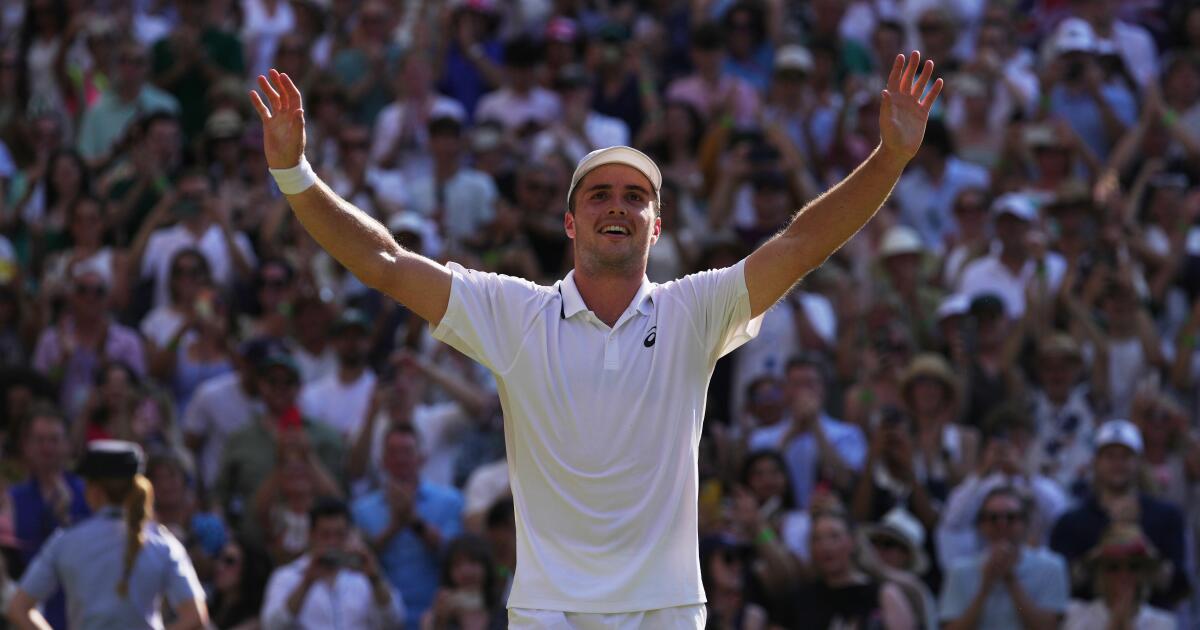
LONDON — A local boy sleeps in his own bed, plays in front of a king and queen and makes a Cinderella run to the Wimbledon semifinals. Sounds like a Hollywood script that might never see the silver screen.
But it’s no fairy tale — it’s Arthur Fery’s out-of-nowhere performance over the last 10 days.
Fery, a virtually unknown British wild card with a triple-digit ranking, has become the emotional heartbeat of Wimbledon while legitimately diverting some national attention from England’s World Cup quest.
The royal treatment at his matches across the All England Club has come in more ways than one.
Fery, who grew up five minutes from Wimbledon and is staying at home during the tournament, first played before grass-court king Roger Federer, Wimbledon’s eight-time singles champion, during Monday’s fourth-round victory. Two days later, he beat No. 9 seed and French Open runner-up Flavio Cobolli of Italy in the quarterfinals 6-4, 7-6 (4), 6-0 in front of Queen Camilla.
Ranked 114th, Fery had never reached the semifinals of an ATP Tour event, let alone a major, before his brief chat with the queen following the match.
“She just said, ‘Congratulations, keep going,’” 23-year-old Fery told reporters later. “I told her it was my birthday on Sunday, so it would be great to play the Wimbledon final on my birthday.”
That’s still a match away. To get there, Fery will have to get past one of the hottest players on tour: No. 2 seed Alexander Zverev, who is fresh off his first Grand Slam title at the French Open. Looming on the other side of the draw is a highly anticipated showdown between defending champion Jannik Sinner against 24-time major winner Novak Djokovic.
If Fery can continue his magical run to the end, he would become the first British wild card to win a Wimbledon title.
Arthur Fery reacts after defeating Flavio Cobolli in the Wimbledon quarterfinals on Wednesday.
(Maja Smiejkowska / Associated Press)
Born in France, Fery’s family moved to Wimbledon when he was an infant. His mother played professional tennis. He was a top British junior but chose to sharpen his game for three years in the U.S. collegiate system at Stanford, as many of his compatriots have done.
“I came out with a lot of hunger coming out of that, and I was ready to attack the pro circuit,” Fery said.
After struggling with bone bruising in his arm that limited him to playing mostly on the lower-tier Challenger circuit in recent years, Fery is finally healthy and playing consistently.
His path to the last four in London has been a masterclass in clutch come-from-behind performances. The Brit has stared down near-certain elimination in multiple matches, repeatedly breaking his opponents’ momentum with Houdini-like on-court acts.
At 5-foot-9, Fery possesses a skill set perfectly suited for low-bounding grass.
His compact strokes, low center of gravity, and elite movement allow him to hug the baseline, take time away from opponents, and confidently execute delicate volleys at the net, according to ESPN analyst Chris Eubanks.
“He defends well,” said Eubanks, a 2023 Wimbledon quarterfinalist. “He can scrap. He can claw. He can dig his way back into points. And when he ventures forward, he’s very, very comfortable at the net. This is a picture-perfect example of someone whose game is built for the surface.”
Still, it’s hard to fathom the multitude of milestones for Fery, who briefly reached the No. 1 ranking in college and earned 2023 Pac-12 Singles Player of the Year honors before leaving early to pursue a pro career.
He arrived at Wimbledon with just one main-draw victory at a major, a losing record as a professional, and only one previous ATP quarterfinal, at Queen’s Club last month. He’s now 11-8, won his first two five-set matches, and is the first British wild card to reach the Wimbledon men’s semifinals in the Open Era. The only other men’s wild-card semifinalist was Goran Ivanisevic, who won the title as a wild card in 2001.
Fery, who started the season ranked No. 185 and will climb to at least No. 36 after the tournament, said there were a “lot of first times” as he reflected on his unprecedented run. “First five-setter, longest match that I’ve ever played, first time breaking into the top 100, first second week in a slam, all at home, five minutes from where I grew up. It’s a great story for me,” he said.
The gap with his fellow semifinalists is understandably massive.

Entering Wimbledon, Djokovic, Sinner and Zverev’s combined records include 29 Grand Slam titles, 2,088 match wins and 155 tour-level titles. Fery was 6-8 in tour-level matches with zero titles.
But he has singlehandedly lifted the tournament for locals. With top hopes Jack Draper and Emma Raducanu withdrawing before the tournament and the rest of Britain’s singles prospects falling one by one — 18 men and women were eliminated by the third round — Fery became the nation’s last knight standing.
If his first name inevitably evokes Arthurian legend, Fery’s march through the draw gave Britain reason to believe again. No sword, no Round Table, just world-class shot-making, a lion’s heart and a Centre Court crowd thrilled to rally behind him.
“This is really quite something to see on home soil,” said Russell Fuller, the BBC’s tennis correspondent, who compared it with Raducanu’s stunning U.S. Open win in 2021 as a qualifier.
Fery earned every bit of it.
In the first round against Damir Dzumhur, Fery dropped the opening set and trailed by a break in the second before surging back. Against Zizou Bergs in the third round, he faced a 4-1 deficit with a double break in the fourth set, and again fell behind 4-1 in the fifth, before somehow surviving.
Then, stepping onto Centre Court for the first time against former top-10 stalwart Grigor Dimitrov of Bulgaria in the fourth round, Fery clawed out of a 2-sets-to-1 hole and a break down in the fourth set to clinch the victory in a fifth-set tiebreak.
“He carries himself with humility, but he’s a fierce competitor, and he’s got a ton of belief in himself,” said Stanford men’s coach and former top-60 player Paul Goldstein, who flew to England Tuesday to see his former charge compete against Cobolli.
While Fery attempts to outmaneuver Zverev on Friday, the other semifinal features a 2025 Wimbledon semifinal rematch between seven-time Wimbledon winner Djokovic and top-ranked Sinner, who defeated the Serb in straight sets on his way to the title. It’s also their second Grand Slam semifinal meeting in 2026. At January’s Australian Open on hard courts, Djokovic bested 24-year-old Sinner in five sets before falling to now-injured Carlos Alcaraz in the Melbourne final.

Arthur Fery hits a return during his Wimbledon quarterfinal win over Flavio Cobolli on Wednesday.
(Clive Brunskill / Getty Images)
Djokovic, 39, enters the match after surviving a grueling five-set, 5-hour-plus quarterfinal slugfest against No. 3 Félix Auger-Aliassime that concluded just minutes before Wimbledon’s 11 p.m. curfew. But the seventh-seeded Serb has a way of defying Father Time and he has had two days to recover on a surface where points are shorter and generally less taxing on the body.
Italy’s Sinner, who defeated Alcaraz in last year’s Wimbledon final, has been efficient if not at the level that saw him capture five consecutive titles before crashing out in the second round at the French Open. After a first-round scare here, the four-time Grand Slam champion has dominated opponents behind his improving serve, winning 80% of his first-serve points. He hasn’t dropped a set since the opening round. Sinner leads the head-to-head with Djokovic 6-5.
According to Eubanks, Djokovic must disrupt Sinner’s movement to break his rhythm, and take his chances.
“He’s got to play similar to how he played in Australia, where it was just all-out aggression,” Eubanks said.
For Sinner, he added: “His serve can be a neutralizing force for what Novak is going to try to do.”
On the other side of the ledger, Fery’s poise under pressure and deft use of the home crowd will be paramount to continue his surprise run against Germany’s Zverev, whom he called a “step up again” from his last five matches. Zverev, 29, is seeking his fifth major final and first at Wimbledon.
“I’m ready for it,” Fery said. “I have nothing to lose. I’m just going to go out there and … put my game on the court, do what I’ve done, believe in myself. We’ll see where that takes me.”
Home has never been closer to Centre Court. Nor has Arthur Fery ever been closer to tennis history.
Sports
Pirates star pitcher makes unfortunate history after being taken out in middle of perfect game bid

NEWYou can now listen to Fox News articles!
Jared Jones was flirting with Major League Baseball history on Wednesday night — he got it, but it was not what he originally envisioned.
The Pittsburgh Pirates pitcher retired the first 18 batters he faced, but he was taken out in the middle of his perfect game bid after six innings.
Now, the Pirates certainly have their reasons — the 24-year-old Jones hasn’t thrown more than 81 pitches in eight starts since returning May 20 after missing all of last season while undergoing ulnar collateral ligament internal brace surgery on May 21, 2025. He was yanked with 77 pitches and likely would have needed more than 100 pitches to record the 25th perfect game in MLB history.
Jared Jones of the Pittsburgh Pirates pitches during the first inning against the Atlanta Braves at PNC Park on July 8, 2026, in Pittsburgh, Pennsylvania. (Photo by Joe Sargent/Getty Images)
However, Jones left the game after getting zero run support, so when the Atlanta Braves tacked on three runs late for a 3-0 victory, Jones instead found himself in the wrong chapter of the history books.
According to Opta Stats, Jones became the first pitcher in the modern era (since 1920) to pitch at least six perfect innings and not record a win.
“It does suck. Something’s cool coming on, but I’m on what? My eighth start off of surgery? I completely understand it, and it is what it is,” Jones told reporters after the game.
Pittsburgh Pirates starting pitcher Jared Jones (17) makes his way to the field to warm up before pitching against the Atlanta Braves at PNC Park. (Charles LeClaire/Imagn Images)
JUSTIN VERLANDER ANNOUNCES HE WILL RETIRE AFTER THIS SEASON: ‘I’VE REALIZED THAT TIME HAS COME’
Jones said he didn’t entertain attempting to complete the perfect game.
“Not with the pitch count,” he said. “Not really ever expecting to go nine right now, so that was never in my head.”
Joey Bart, traded to the Braves from the Pirates on June 18, followed a double by Mike Yastrzemski with a 422-foot, two-run homer to left-center field off a slider from Dennis Santana. Drake Baldwin added an RBI single to center in the ninth for good measure.
It was the second time in less than a week that a pitcher was taken out of the game with a perfect bid through six innings — the Miami Marlins took Eury Perez out after seven innings in which he had 92 pitches. Perez, too, is in the midst of returning from injury and has surprisingly found himself right in the postseason mix.
He was pulled for Lake Bachar to start the eighth, and the Marlins allowed eight runs to the Athletics in the final two innings, but held on to win 9-8.
Jared Jones (17) of the Pittsburgh Pirates delivers a pitch during a MLB game against the Cincinnati Reds on June 27, 2026, at PNC Park in Pittsburgh, Pennsylvania. (Joe Robbins/Icon Sportswire via Getty Images)
CLICK HERE TO DOWNLOAD THE FOX NEWS APP
The Pirates are 4.0 games out of the final wild card spot, which is held by the Marlins.
The Associated Press contributed to this report.
Follow Fox News Digital’s sports coverage on X, and subscribe to the Fox News Sports Huddle newsletter.
-

 Indianapolis, IN2 minutes ago
Unsettled Friday and Saturday, then summer heat returns early next week | July 10, 2026
-

 Pittsburg, PA5 minutes ago
Buying Here: Modern home with backyard pool in Lawrenceville priced at $949,900
-

 Augusta, GA10 minutes ago
South Augusta community raises concern over Family Y on Tobacco Road
-

 Washington, D.C17 minutes ago
About 120 Iowa National Guard soldiers leave today for D.C. deployment – Radio Iowa
-

 Cleveland, OH20 minutes ago
Wanted: Sex offender on the run after crimes against a child
-

 Austin, TX25 minutes ago
Austin: Community Vigil for Lorenzo Salgado Araujo
-

 Alabama32 minutes ago
University of Alabama police officer's family leans on law enforcement community after his death
-

 Alaska35 minutes ago
Black bear breaks into Alaskan mall, eats a peach and relieves itself on floor before leaving: video

