Sports
How a Stanford professor helped lay the foundation for this 49ers era


For his first few frenetic months as the San Francisco 49ers’ general manager in 2017, John Lynch left his family behind in San Diego. His temporary home at the Santa Clara Marriott became a brainstorming center for reversing the fortunes of a moribund franchise.
The 49ers, coming off a 2-14 season, had perhaps the NFL’s worst roster. Lynch had no NFL front office experience. He’d have to learn on the fly with coach Kyle Shanahan, his new partner at the top of the 49ers’ power structure.
Tony Dungy, a coach under whom Lynch starred as a Hall of Fame safety with the Tampa Bay Buccaneers, recommended that he and Shanahan build an organic bond by watching as much film together as possible. So the duo immediately began watching hours of game tape. As the film rolled, they talked. They philosophized. They connected.
As the 49ers begin another playoff run, one can trace their current success — they’ve played in three of the past four NFC Championship Games — to the stream of football consciousness that flowed from Lynch and Shanahan during those marathon film sessions.
“I’m over here at the Marriott and I’m like, ‘God, we’ve got to capture these beliefs,’” Lynch said recently in his office.
The GM would remain restless until the 49ers could harness his and Shanahan’s confluence of knowledge in an efficient, usable way.
Then, the light came on. Lynch remembered Burke Robinson, a lecturer at nearby Stanford who’d been his instructor in a spring 2014 course called “The Art and Science of Decision Making.”
“I’m trying to think of how, and boom, I remember in Burke’s class on decision analysis, we did this deal on vision statements,” Lynch said. “I knew this is what we’ve got to do. Because that’s how you capture it all.
“Who better to go to than Burke?”
Over two-plus decades at Stanford, Robinson has taught his graduate-level course and advised students on significant life decisions. Lynch, who starred in football and baseball at Stanford from 1989 to 1992, returned to campus to resume his studies in 2014. He enrolled in Robinson’s class and worked on writing a vision statement for his immediate family.
“I think it’s the most valuable class that I took at Stanford or anywhere else,” Lynch said. “Burke’s a brilliant man, he really is. The basic fundamentals of just putting a framework to decisions is really invaluable because you can do it with anything in life.”
Robinson took the same principles he’s used to guide Silicon Valley businesses to his meeting with the 49ers. He joined Lynch and Shanahan in April 2017 at the team facility in the John McVay Draft Room, named after the GM who had worked with coach Bill Walsh to build the dynasty teams of the 1980s and 1990s.
The new regime’s first NFL Draft was coming up. It was time to solidify their sense of direction.
“I’ve advised some of these startups and they don’t have a vision of what they want to do,” Robinson said over lunch in Palo Alto near Stanford’s campus last month. “It’s like, ‘Hold on, you’re not just tech geeks designing features on some tech product. These have to add benefit to a customer somewhere. Where is the unmet market need that you’re going to satisfy? Where’s your vision for developing a product that meets the minimum set of needs and then advances from there?’
“It’s the same in companies and a football team. If you’re on a sailboat, you have to know which port you’re heading for.”
Robinson began by individually interviewing Lynch, Shanahan, 49ers CEO Jed York and executive vice president of football operations Paraag Marathe. He gauged the temperature of a franchise that was on its fourth head coach in four seasons and starved for organizational unity, which many within the franchise felt had been lacking under former general manager Trent Baalke.
When Jed York, far right, hired John Lynch and Kyle Shanahan in 2017, the 49ers were on their fourth coach in four years. (Michael Zagaris / San Francisco 49ers / Getty Images)
Lynch and Shanahan were then joined by 49ers vice president of player personnel Adam Peters and senior personnel executive Martin Mayhew, all meeting with Robinson in the draft room. (Peters was hired last week as the Washington Commanders general manager; Mayhew was hired by the Commanders as their GM in 2021.)
This was the main event, where the 49ers would craft the vision statement that would set a tone of cohesion in the front office for years to come.
Robinson began by asking all four men to write down and share their top three proposed inclusions. Desired traits in players soon cluttered the whiteboard. Some ideas, like “speed,” pertained to the physical nuts and bolts of playing football. These naturally formed a grouping titled “49er Talent” on the left side. Others like “football passion — loves the game” and “contagious enthusiasm” were functions of player demeanor, so a grouping titled “49er Spirit” popped up on the right.
Shanahan, according to Robinson, was initially ambivalent about the whole exercise. He just wanted to continue watching film with Lynch.
“I get it,” Lynch remembers telling Shanahan, “but we have a bunch of scouts that we’ll be working with for the first time, so everybody in this building has got to know (what exactly we want in players). We’ve got to be able to articulate that. It’s got to be crystal clear.”
For about three hours, the four men brainstormed, discussed verbiage and voted on orders of importance for their inclusions. An early draft of their work looked like this.

Courtesy Burke Robinson.
After a recess, Robinson narrowed the exercise to just Lynch and Shanahan, who have made it a point to meet immediately after every 49ers game since their hirings.
“The conversations we had after Adam and Martin left were about how they’re going to work together,” Robinson said. “It’s easy to work together when you agree. But you’re going to have times when you don’t agree. You’re going to have to have a consistent message going up to the draft room, to the media, to the players. You can’t be telling the players one thing and the media another.”
Said Lynch: “Kyle came alive, which was cool. And then it got real, then it got good. We hit our stride. Burke started challenging us. And Kyle likes to be challenged. The last two hours were money, and this is what we walked out with.”
That more refined version of the vision statement listed “contagious competitiveness” as one of its primary player traits on the right side, and it’s probably the most distinct example of a marriage between separate thoughts from Shanahan and Lynch.
Shanahan wanted “competitiveness” to be a key trait, but he envisioned it falling in the talent column. Lynch was also insistent on including that trait, but — in keeping with his emphasis on culture — he wanted a juicier term that would fit in the spirit column.
“We want guys who compete every day, but everybody has that,” Lynch said. “We want it to permeate the whole team.
“Burke was great at leading us. He’s probably like, ‘These simpletons.’ But he wouldn’t say it for us. He’d say, ‘Come on, how do we capture it?’ And I’m like — ‘Oh, contagiously competitive.’”
Robinson noted that the entire foursome — plus York and Marathe in their interviews — emphasized the importance of the 49ers returning to their winning processes of the 1980s and 1990s. This tie to the franchise’s illustrious history became the North Star of the vision statement.
“Our nucleus of dedicated players will reestablish The 49er Way and lead our organization back to the top of the NFL,” the top reads. “These players will represent our core values and beliefs in both their talent and spirit.”
Then there’s the closing sentence, which is underlined by silhouettes of the 49ers’ five Lombardi Trophies: “We firmly believe that players who embody these core values will change the culture and reestablish the 49er Way — a Brotherhood that will lead us back to competing for championships year after year.”
The 49ers emblazoned the final version on a large wall chart, which they hung up in the McVay Room for the 2017 draft.
“We sat down looking to make something just for that first draft,” Lynch said. “Then we liked it so much, we said ‘Let’s make it the guiding light for our organization.’”
Said Robinson: “They wanted to be the role model for the NFL. They said, ‘We’re rebuilding what we used to have.’”
“Things like this aren’t just a piece of paper,” Lynch said, waving a laminated copy of an updated 49ers’ vision statement. “You start to see it come to life. And that’s when it’s really cool.”
The 49ers have made much of their vision statement a reality. They haven’t yet won a Super Bowl, but the barren roster Lynch and Shanahan inherited in 2017 is now one of the most talented outfits in the league. This season, the 49ers have nine Pro Bowlers and five first-team All-Pro selections, the most of any team in the NFL. The “49er Talent” column is thriving.
There’s also plentiful evidence of realized success on the “49er Spirit” side. Stories of the locker room’s cohesiveness have helped position the team for their best odds yet to win a Super Bowl under the current leadership.

GO DEEPER
Postgame locker room summits with Trent Williams and Nick Bosa: A 49ers fixture
It started with unity upstairs. A collaborative process between the coaching staff and scouting department has enabled the 49ers to target and land enough of the right players to make their system work, even as they’ve walked a tightrope around the salary cap with a formula that’s put pressure on hitting mid-to-late-round draft picks. The team has been exceptionally productive in the fifth round (tight end George Kittle and safety Talanoa Hufanga are two All-Pros selected there) and the seventh round (quarterback Brock Purdy was famously the last pick of the 2022 draft).
“Our scouts know they’ve been heard out — they know they’ve been listened to,” Lynch said. “That’s culture to me. And Kyle said it well when we first started the interview process: ‘Culture is the people you surround yourself with. We’ve got to bring quality people to have a great culture, and it will happen naturally once we start to do that.’”
When Lynch began his tenure as the 49ers’ GM, he didn’t have any executive experience. But he did have a wealth of observational knowledge collected from his time as a Fox broadcaster.
“People in football have this very focused, insular view,” Lynch said. “When I was a player, I knew how they did things in Tampa and Denver — but you don’t really get a global outlook on the league the way you think you would. As a broadcaster, I started being a curious person about football. I asked, ‘What are the common threads?’
“I could be in John Schneider and Pete Carroll’s office (with the Seattle Seahawks) and they were saying the same thing, and then I’d go to bad organizations and the GM would say: ‘Man we’ve got all the talent, John, but the coach can’t get it out of them’ — and the coach would say, ‘We don’t have the talent, look how bad it is.’ … They weren’t connected. But there were things about the organizations that were perennially successful. It was like, ‘Gosh, it’s not that hard.’ You just have to have a good relationship.”
Though the 49ers have been unified under Lynch and Shanahan, they certainly haven’t been perfect.
A handful of early picks never came close to meeting expectations for them, including the two first-rounders — defensive lineman Solomon Thomas (a Stanford product who was a classmate of Lynch in Robinson’s decision analysis class in 2014) and linebacker Reuben Foster — the team selected in that 2017 draft. The blockbuster trade-up to select quarterback Trey Lance in 2021 wasn’t fruitful, either. And despite substantial on-field success, frustrating injuries and gut-wrenching losses have, at least so far, prevented the 49ers from reaching their ultimate goal.
GO DEEPER
One lesson from 49ers’ Trey Lance saga: 2021 was a bad year to gamble on a QB
But many of these setbacks have helped highlight another 49ers’ strong suit: adaptability.
“We haven’t been afraid to tweak the vision statement a little bit when things have changed,” Lynch said. “We’re all a product of our experiences.”
The first changes came after 2017 and 2018, when they began emphasizing a desire for “finishers” after blowing several late leads. After a 2020 season that saw the team put a record amount of salary on injured reserve, “availability” became a stated priority.
The evolution of the vision statement has tangibly affected the on-field product. Lynch said their 2019 draft selection of bruising receiver Deebo Samuel was a direct response to a league-wide resurgence of physicality at the line of scrimmage from defensive backs. To improve perimeter run defense, the prototype for the team’s speed-rushing “Leo” defensive end position has morphed from a lighter edge rusher to a much larger and more physical run stopper.

The 49ers’ defined vision statement has helped lead them to players like George Kittle, Deebo Samuel and Fred Warner. (Ryan Kang / Getty Images)
At this point, the 49ers’ success in talent acquisition speaks for itself. So does the annual league-wide popularity of the organization’s coaches and executives. Teams have hired away three Shanahan assistants to be their head coaches (Robert Saleh, Mike McDaniel and DeMeco Ryans) and two of the four participants in that original vision statement meeting — Mayhew and Peters — have landed GM jobs elsewhere. It’s clear the rest of the NFL is interested in adapting key parts of the 49ers’ formula.
Lynch hopes that it continues to be self-sustaining. He believes a precise sense of direction creates an ideal environment for internal development, which can organically replenish the 49ers’ brain trust even when key figures leave for promotions elsewhere.
“That’s the lifeblood,” Lynch said. “You want to grow from within so you have people indoctrinated in what we do.”
It all circles back to the foundational pillars the 49ers established before that 2017 draft.
“We didn’t want it to be just a cheesy slogan that we talk about every now and then,” Lynch said. “We wanted it to be about who we really are. It’s our beacon that reminds us who we are and what we’re trying to be.”
(Top illustration: Sean Reilly / The Athletic; photos: Stacy Revere / Getty Images and Michael Zagaris / San Francisco 49ers / Getty Images)



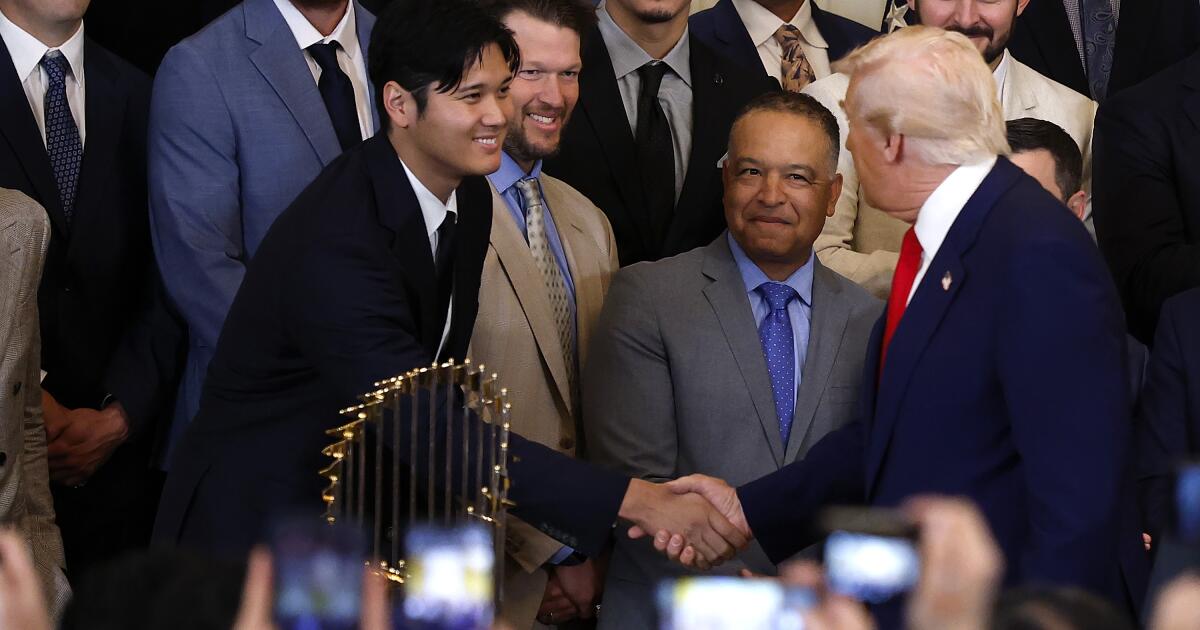
WASHINGTON — The Dodgers are scheduled to visit the White House on July 23 to celebrate their latest World Series title.
“President Trump is excited to welcome the Los Angeles Dodgers BACK to the White House to celebrate their World Series championship!,” White House spokesperson Taylor Rogers said in a statement to The Times.
The date falls on a scheduled off day in the middle of a nine-game East Coast road trip for the Dodgers. The team will play three games in Philadelphia against the Phillies July 20-22 before ending the trip with a three-game series against the New York Mets July 24 to 26.
The visit continues a tradition from the Dodgers’ two previous World Series championships. They were hosted by President Biden in 2021 and President Trump in April 2025.
After the Dodgers claimed their second consecutive World Series title with a dramatic Game 7 victory over the Toronto Blue Jays, a visit to the White House was planned, but it wasn’t until Thursday that a date was officially booked and confirmed.
Questions swirled around whether players would decline the visit this year after it did not happen during a scheduled visit to Washington in April.
Kiké Hernández said in 2018 he was unsure he would have gone had the Dodgers won the World Series the previous year. Mookie Betts said he was undecided and needed to talk it over with his family when last year’s visit was announced. After winning his first World Series with the Boston Red Sox in 2018, Betts skipped their trip to the White House the following year during Trump’s first term.
Both players, along with every returning member of the 2024 team who was with the team during its road trip, participated in the visit. The only notable absence was first baseman Freddie Freeman, who remained in Los Angeles to nurse an ankle injury.
Manager Dave Roberts, who indicated in comments to The Times in 2019 he might not go to the White House if Trump was president, also participated in last year’s ceremony.
Asked at the Dodgers’ fan festival in January about the possibility of returning to the White House, Roberts told The Times’ Bill Shaikin: “For me, I stand by: I’m a baseball manager. That’s my job.”
“I was raised — by a man who served our country for 30 years — to respect the highest office in our country,” Roberts said. “For me, it doesn’t matter who is in the office, I’m going to go to the White House. I’ve never tried to be political. … For me, I am going to continue to try to do what tradition says and not try to make political statements, because I am not a politician.”
Clayton Kershaw, who retired after last season but was on Team USA for this year’s World Baseball Classic, told The Times in the spring that he was aware Dodgers fans are split over whether the team should visit the White House again this year, but he said he is looking forward to it.
“I went when President Biden was in office. I’m going to go when President Trump is in office,” Kershaw said. “To me, it’s just about getting to go to the White House. You don’t get that opportunity every day, so I’m excited to go.”
Times deputy sports editor Ed Guzman contributed to this report.

NEWYou can now listen to Fox News articles!
All eyes were on Caitlin Clark on Wednesday night as she made her anticipated return from injury in a road matchup in Los Angeles.
But instead of a triumphant comeback, the Fever spent the entire night chasing the Sparks as Clark’s rough return fueled a 106-92 rout.
The superstar never found a groove, looking completely out of sync in her return from a back injury.
STEPHANIE WHITE GIVES CAITLIN CLARK STATUS UPDATE AHEAD OF FEVER-SPARKS, BUT HER NEXT MOVE RAISES QUESTIONS
Caitlin Clark huddles with teammates as the Indiana Fever battle the Sparks. (Photo by Katelyn Mulcahy/Getty Images) ((Photo by Katelyn Mulcahy/Getty Images))
Much of that disjointed performance falls squarely on head coach Stephanie White, who kept Clark on a ridiculously tight leash by limiting her to just 16 minutes. The stop-and-go approach could have sabotaged any chance for the phenom to establish a rhythm.
Clark finished with just 9 points, 4 rebounds and 3 assists. Her minus-16 plus-minus told the story.
The Los Angeles Sparks were severely shorthanded, taking the floor without stars Kelsey Plum and Cameron Brink.
MERCURY’S NOW-DELETED SOCIAL MEDIA POST MOCKING CAITLIN CLARK DRAWS SCRUTINY AFTER STAR’S INJURY
Yet while a depleted Sparks roster played to win, Indiana spent the night over-managing its biggest asset.
With Clark on a minutes restriction and Aliyah Boston out of the lineup, Kelsey Mitchell was forced to shoulder the entire offensive burden.
Mitchell did her part, pouring in 29 points while shooting 5-of-9 from beyond the arc.
Caitlin Clark orchestrates the Fever offense as Indiana battles the Los Angeles Sparks in primetime action. (Photo by Katelyn Mulcahy/Getty Images) ((Photo by Katelyn Mulcahy/Getty Images))
But one hot hand couldn’t stop an efficient LA squad.
The Sparks shot 45% from three-point range, going 9-of-20 from deep to cruise to the 106-92 victory.
White’s next move is to sit Clark against the Mercury on Thursday while Boston returns.
CLICK HERE TO DOWNLOAD THE FOX NEWS APP
After Wednesday’s loss to a shorthanded Sparks team, it’s fair to question whether Indiana’s cautious approach is working. The Fever dropped to 12-9.
Caitlin Clark and Dearica Hamby face off as Fever and Sparks battle at Crypto.com Arena in Los Angeles. (Photo by Tyler Ross/NBAE via Getty Images) ((Photo by Tyler Ross/NBAE via Getty Images))
Send us your thoughts: alejandro.avila@outkick.com / Follow along on X: @alejandroaveela
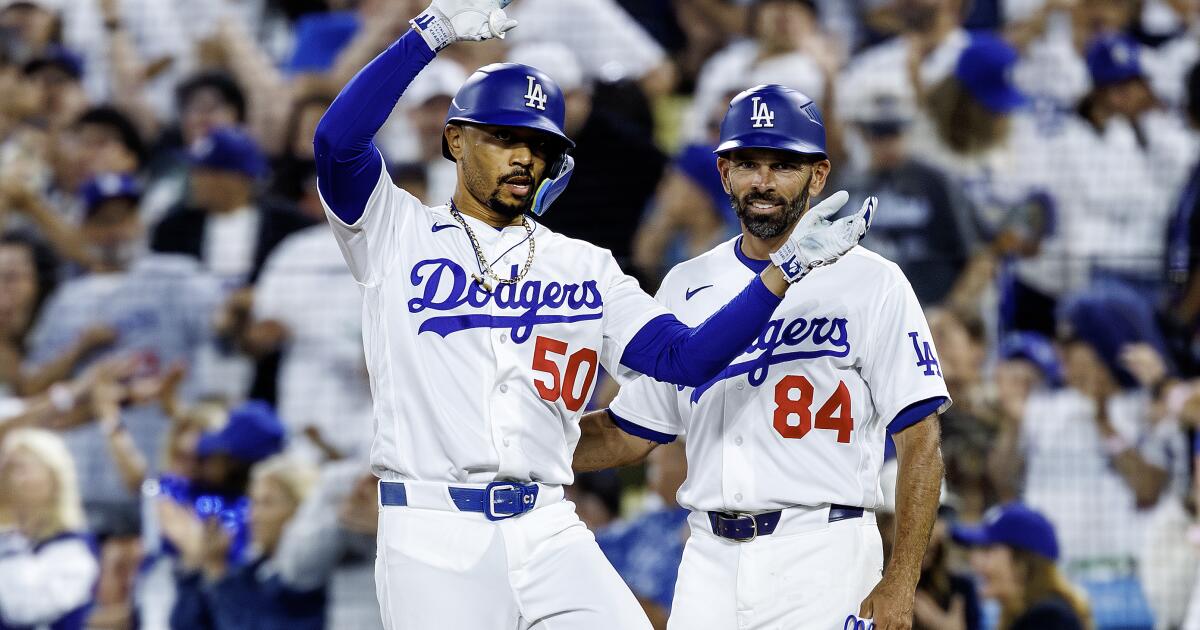
Mookie Betts’ first hit this series against the Rockies couldn’t have come at a more opportune time. With the crack of the ball against his bat, Tommy Edman scored from third, giving the Dodgers the lead.
And as Betts reached first, he pointed to Freddie Freeman, whose single put Edman in scoring position. It had taken a team effort to overcome another middling start from Roki Sasaki, and Betts, who had little to show before his game-winning hit, took the chance to highlight the joint contribution in the Dodgers’ 4-3 rubber-match win over Colorado (38-56).
“It feels great,” Betts said of his nine-pitch battle. “Helping the boys win, that’s really all it is. We play the game to win, and coming through in a big moment is kind of what, when you’re a kid, playing in the backyard, getting that hit is what you always strive to do, and fortunately, I was able to do it.”
Given a three-run lead in the first inning, brought to the Dodgers by a wild pitch and Kyle Tucker’s two-run, line-drive single to left field, Sasaki seemed set up for success.
Still, he gave away the lead as quickly as it came. In the second inning, he left a fastball too far over the plate, and third baseman Kyle Karros drove the ball over the left-center wall. The slider he dealt two batters later to second baseman Edouard Julien also crossed the zone too far over the plate, and Julien rounded the bases with another homer. In the third, a sacrifice fly by Mickey Moniak evened the scored, 3-3.
Sasaki’s troubles this season have been hard to pin down since his last win on May 23, as Sasaki tries to claw back the triple-digit velocity that’s escaped him as of late.
Against the Rockies, his fastball topped out at 99.1 miles per hour before steadily dropping to 98. He had managed five strikeouts in his six innings when manager Dave Roberts replaced him with Jack Dreyer, though the three earned runs couldn’t be ignored.
But Roberts also acknowledged the possibility that the pitcher had been tipping his pitches, possibly since he was playing in Japan, and Sasaki has tried to address it after a three-inning, six-run start last week. Even if he had fully self-corrected, his control issues remain. In the third inning, he walked the tying runner, Brett Sullivan.
“I’ve been working on a lot of things like the tipping stuff,” Sasaki said through interpreter Kensuke Okubo. “Also, I need to make quality pitches.”
Sasaki regained some of his confidence in the fourth when he worked out of a two-base jam with two strikeouts and a flyball to right, something that didn’t go unnoticed by Roberts.
“You can see the demeanor walking off the mound, the confidence,” Roberts said. “For me, it was more of let him end on a high note, feeling good about his outing, and then go from there.”
The Dodgers’ problems were compounded by Alex Call wasting the team’s two challenges in his at-bat in the first inning when the team had already taken the lead. And maybe it would’ve been excusable if Call had driven in the runners on first and second, but instead he ended the inning on a strikeout, stranding both. Roberts called the situation an “outlier” and didn’t feel as though he needed to have a conversation with Call regarding the situation.
After the three-run first, the Dodgers (61-33) remained hitless until Max Muncy laced a double down the right-field line in the sixth, though to little avail. As the innings ticked forward, Colorado’s chances seemed to increase. The Rockies hold the best league batting average (.297) in the eighth and ninth innings (the Dodgers are fourth with .268). And the Dodgers relievers, within the same constraints, have a 3.83 ERA — not bad, but not in the top 10 either.
Third baseman Max Muncy can’t get his glove on a line-drive double by Kyle Karros in the fourth inning.
(Gina Ferazzi/Los Angeles Times)
So when Alex Vesia struggled against the Rockies in the eighth inning and Muncy suffered a throwing error, Colorado seemed in position to score with the bases loaded and one out. Vesia struck out TJ Rumfield and Edgardo Henriquez (4-0), his replacement, retired Karros on a fly ball to right.
After Betts’ single allowed the Dodgers to take the lead, Tanner Scott (13) shut down the Rockies with back-to-back strikeouts, avoiding the team’s eighth series loss of the season.
“Didn’t feel great,” Roberts said. “Fortunately, we won a series, but that’s not the kind of way you want to do it.”
-
 Business7 minutes ago
California soccer fans sue StubHub after it fails to deliver expensive World Cup tickets
-
 Entertainment10 minutes ago
Lucas Museum to give free annual passes to South L.A. neighbors, host community preview day
-
 Lifestyle15 minutes ago
Meow Wolf taps famed L.A. animation house for its new Los Angeles venue
-
Politics22 minutes ago
Column: Trump decries ‘communism’ while his government takes ownership of companies
-
 Science25 minutes ago
‘I’d rather my house burn down than get cancer’: Herbicide use upends California’s fight to save forests
-
Sports30 minutes ago
Dodgers scheduled to visit White House in late July to celebrate 2025 World Series win
-

 World40 minutes ago
Former US Olympian pleads not guilty in DC reflecting pool vandalism case
-
 News1 hour ago
Former Olympian pleads not guilty in reflecting pool vandalism charges


