Sports
Hayes is closest English football has come to another Sir Alex Ferguson


Midway through a chat with her men’s counterpart at Chelsea, Emma Hayes awkwardly had to explain to Mauricio Pochettino that someone more important was ringing her.
It was Sir Alex Ferguson, who had heard about her decision to leave Chelsea and become the new U.S. women’s national team manager. Pochettino understood his place in the hierarchy, and Hayes picked up.
“He calls me from time to time, so I wasn’t surprised,” explained Hayes, whose first games in charge of USWNT will come in friendlies against South Korea on June 1 and June 4. “Anything he says to me I always take with such pride. He is a legend of the game and someone whose opinion I value and he has a love of America. We talked a little bit about that, a little bit about legacy, a little bit about leaving at the top. So there were wise words from him. I’m sure it won’t be the last phone call I get from him this season.”
Hayes’ managerial influences are widespread. Given the lack of investment in sports science focused on women’s football, she’s often had to look to other sports for inspiration to understand how to evolve and improve the women’s game. But perhaps her chief influence is Ferguson. This, in itself, shouldn’t come as a great surprise, considering Ferguson is the most successful manager in the history of English football and dominated from the period when Hayes’ teenage hopes of a playing career were ruined by injury, in the early 1990s, to the point where she became Chelsea manager in 2012.
But the curious thing is that, as a Ferguson disciple — and, more to the point, a very successful one — Hayes is pretty much unique. Ferguson’s former players who have gone into management have been only mildly successful. The next generation of young British managers tend to cite foreign coaches as their role models. It’s difficult to look at men’s English football and see many direct Ferguson influences.
In the women’s game, though, Hayes has continued his legacy, and when she became the first woman to receive the Football Writers’ Association tribute award earlier this year, Ferguson gladly appeared on screen to offer a glowing tribute.
The last half-decade in the English women’s can easily be likened to mid-1990s Premier League football: a European Championship on home soil, big improvements in television coverage, the move to modern stadiums and that golden period when suddenly the best players from across the world arrive. Amid those developments, Hayes has effectively been the Ferguson figure — adjusting better than others, staying one step ahead, and enjoying unparalleled success.

Football management essentially has two very different components. There is, to put it bluntly, the football and the management. There are those who understand the game on a deep level, but struggle to assert their authority and build a winning culture. On the other hand, there are also popular figures who get players onside but struggle with the technical side of the game.
To enjoy careers as successful as Ferguson and Hayes, you must tick both boxes, but they’re probably similar in that they’re naturally outstanding managers of individuals, knowing when to use the carrot and when to use the stick, but have often been questioned in terms of the footballing side of things.
Ferguson, for example, was often considered naive tactically when United initially struggled to make progress in Europe, and his habit of making strange selection decisions led to some supporters calling him ‘Tinkerbell’ for his constant tinkering, which was considered to do more harm than good. But gradually Ferguson became more comfortable tactically; in big games, he increasingly set up to stop opponents rather than to play an open game, with great success.
Similarly, Hayes generally gets glowing reports for her ability to lead individuals and cultivate a winning mentality, but was sometimes considered a bit of a back-to-basics, old-school manager, and was criticised for her tendency to leave out key players with little explanation. But that has always been a little unfair, and at times her tactical approach has worked excellently.
Take the way her sides have shuffled between a back three and a back four smoothly at times — specifically the 2021 FA Cup final, when it felt like her defenders were all playing in ‘false’ positions, prompting her opposition number Jonas Eidevall to hold up red and blue cards to his players at certain times, which referred to Chelsea’s shape. (Incidentally, it’s arguable that her stock has raised as much because of her spells as an ITV co-commentator as her managerial success. In an era when co-commentators are so rarely ex-managers, as was once the default, her ability to explain tactical concepts and coaching decisions has been a refreshing change.)
A more accurate observation is that neither Ferguson nor Hayes have been particularly concerned with a footballing philosophy, or on playing entertaining football for the sake of it. They are simply focused on winning, on doing what it takes from game to game.
There has been an extraordinary rewriting of Ferguson’s legacy; his United were rarely famed for their attractive football compared to their title rivals, and the entertainment came from the dramatic manner of their victories, which were often barely believable, rather than the finesse of their play. Part of United’s problem in replacing him has been the idea there was a grand stylistic tradition to replicate. But Ferguson changed his approach so often that he must have contradicted his own philosophy, if one ever existed, very regularly.
Similarly, while a specific style of play is easy to identify at other WSL clubs — Arsenal have always been more technical, Manchester City unashamedly want to play like their men’s side, Tottenham are focused on playing out from the back — Chelsea are more flexible. Often they’re more dangerous on the break than with patient possession play; City and Arsenal have the best pass-completion rates in the league, whereas Chelsea play the most long passes.
Hayes’ approach is less of a philosophy, and more based around getting the best from her side’s in-form attacker and using functional players to stop opponents. In the last five seasons, at various times it’s felt like her Chelsea style has been based around the driving runs of Fran Kirby, then the goals of Bethany England, briefly the guile of Pernille Harder, then the runs in behind of Sam Kerr, then the wing play of Guro Reiten, and more recently it’s often been the flair of Lauren James.
It’s more difficult to nail down what Hayes’ classic XI would be or a default style of play.

Hayes’ set-up has often focused on getting the best from her forwards, such as Kirby (Charlotte Wilson/Offside/Offside via Getty Images)
Equally, in big matches, Hayes has been able to count upon reliable, versatile, hard-working players with several years of experience at the club. In major title showdowns involving Ferguson’s Manchester United, it was striking how often his key player would be Darren Fletcher, or John O’Shea, or Phil Neville. Not the most glamorous players, but always effective.
Similarly, at times it would have been difficult to say (until recently, perhaps) that any of Jess Carter, Niamh Charles, or Erin Cuthbert were undroppable, or had a clearly defined role in the side. They were ‘do-a-job’ players. But Hayes has improved them as individuals, year on year, and knows how to use them, game to game.
Both Ferguson and Hayes understood the need for clubs to dramatically expand their backroom staff, and not be solely based around the manager. Ferguson relied heavily on his assistants and did little coaching himself, while Hayes is regularly seen consulting with her coaching staff. Her emphasis upon ‘the team behind the team’ is clear, to the extent that her audiobook, Kill The Unicorn, is based on the need to move away from the concept of one person having all the answers.
The slight contradiction, though, is that because Ferguson and Hayes were the ones to build these wider teams from positions as old-school manager rather than first-team coach, replacing them becomes difficult.
In terms of legacy, both have encountered one frustrating final boss: Barcelona. Ferguson won two European Cups and desperately wanted to add a third, but was foiled in both the 2009 and 2011 finals by Pep Guardiola’s side. Hayes has never won the European Cup, reaching the final in 2021, when her side were thrashed by Barca, who also eliminated her side in the past two seasons. Barca are the ultimate example of a club with an obvious philosophy, which has been transferred from the men’s to the women’s side.
Hayes was left fuming after the second leg of Chelsea’s semi-final defeat this season, calling the sending-off of Kadeisha Buchanan the “worst decision in Women’s Champions League history”, which was probably unwise. This week, it was announced UEFA would not charge her for those comments. It rather brought to mind Ferguson’s final Champions League game as manager, when United lost at home to Real Madrid after Nani had been controversially dismissed. Ferguson didn’t fulfil his post-match media commitments, with his assistant Mike Phelan explaining that he was “too distraught”. UEFA fined him £8,500. In that sense, Hayes probably took the right decision to attend the press conference.
Snatching victories from the jaws of defeat was the main theme of Ferguson’s time at Manchester United. But it’s arguable his side never won a title in circumstances as unusual as Hayes’ Chelsea might this weekend.
After a 4-3 defeat at Liverpool earlier this month, Hayes had essentially given up on the title — or at least, that’s what she told the media. But the following weekend, Stina Blackstenius’ two late goals for Arsenal defeated Manchester City and let Chelsea back in, and led to the remarkable spectacle of Chelsea demolishing Bristol City 8-0 to give themselves a goal-difference advantage over City, having started the day with a seven-goal deficit. Hayes sent a paper message onto the pitch, reminding her players of the task.
So this weekend is a goal-difference shootout. City travel to Aston Villa, knowing they probably not only need to win but make up a two-goal disadvantage on Chelsea, who travel to FA Cup winners Manchester United.
If Hayes clinches yet another league title, it will be a fitting place to bow out, for the closest thing English football has seen to another Ferguson.
(Top photos: Ian Kington/AFP via Getty Images; Ryan Pierse/Getty Images)



NEWYou can now listen to Fox News articles!
All eyes were on Caitlin Clark on Wednesday night as she made her anticipated return from injury in a road matchup in Los Angeles.
But instead of a triumphant comeback, the Fever spent the entire night chasing the Sparks as Clark’s rough return fueled a 106-92 rout.
The superstar never found a groove, looking completely out of sync in her return from a back injury.
STEPHANIE WHITE GIVES CAITLIN CLARK STATUS UPDATE AHEAD OF FEVER-SPARKS, BUT HER NEXT MOVE RAISES QUESTIONS
Caitlin Clark huddles with teammates as the Indiana Fever battle the Sparks. (Photo by Katelyn Mulcahy/Getty Images) ((Photo by Katelyn Mulcahy/Getty Images))
Much of that disjointed performance falls squarely on head coach Stephanie White, who kept Clark on a ridiculously tight leash by limiting her to just 16 minutes. The stop-and-go approach could have sabotaged any chance for the phenom to establish a rhythm.
Clark finished with just 9 points, 4 rebounds and 3 assists. Her minus-16 plus-minus told the story.
The Los Angeles Sparks were severely shorthanded, taking the floor without stars Kelsey Plum and Cameron Brink.
MERCURY’S NOW-DELETED SOCIAL MEDIA POST MOCKING CAITLIN CLARK DRAWS SCRUTINY AFTER STAR’S INJURY
Yet while a depleted Sparks roster played to win, Indiana spent the night over-managing its biggest asset.
With Clark on a minutes restriction and Aliyah Boston out of the lineup, Kelsey Mitchell was forced to shoulder the entire offensive burden.
Mitchell did her part, pouring in 29 points while shooting 5-of-9 from beyond the arc.
Caitlin Clark orchestrates the Fever offense as Indiana battles the Los Angeles Sparks in primetime action. (Photo by Katelyn Mulcahy/Getty Images) ((Photo by Katelyn Mulcahy/Getty Images))
But one hot hand couldn’t stop an efficient LA squad.
The Sparks shot 45% from three-point range, going 9-of-20 from deep to cruise to the 106-92 victory.
White’s next move is to sit Clark against the Mercury on Thursday while Boston returns.
CLICK HERE TO DOWNLOAD THE FOX NEWS APP
After Wednesday’s loss to a shorthanded Sparks team, it’s fair to question whether Indiana’s cautious approach is working. The Fever dropped to 12-9.
Caitlin Clark and Dearica Hamby face off as Fever and Sparks battle at Crypto.com Arena in Los Angeles. (Photo by Tyler Ross/NBAE via Getty Images) ((Photo by Tyler Ross/NBAE via Getty Images))
Send us your thoughts: alejandro.avila@outkick.com / Follow along on X: @alejandroaveela
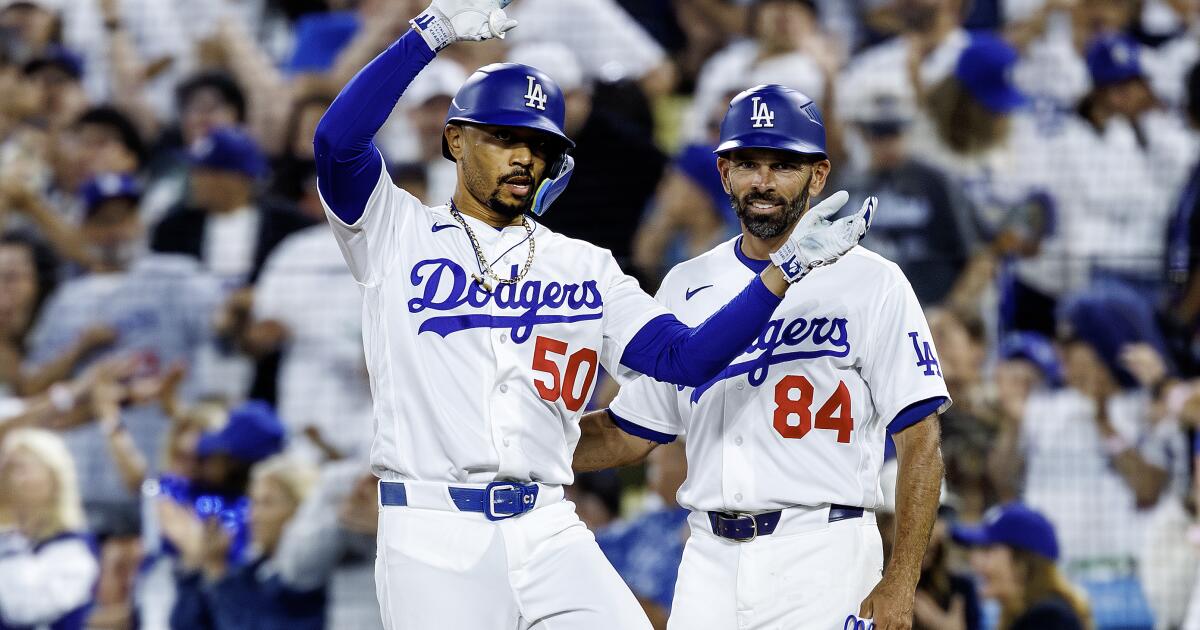
Mookie Betts’ first hit this series against the Rockies couldn’t have come at a more opportune time. With the crack of the ball against his bat, Tommy Edman scored from third, giving the Dodgers the lead.
And as Betts reached first, he pointed to Freddie Freeman, whose single put Edman in scoring position. It had taken a team effort to overcome another middling start from Roki Sasaki, and Betts, who had little to show before his game-winning hit, took the chance to highlight the joint contribution in the Dodgers’ 4-3 rubber-match win over Colorado (38-56).
“It feels great,” Betts said of his nine-pitch battle. “Helping the boys win, that’s really all it is. We play the game to win, and coming through in a big moment is kind of what, when you’re a kid, playing in the backyard, getting that hit is what you always strive to do, and fortunately, I was able to do it.”
Given a three-run lead in the first inning, brought to the Dodgers by a wild pitch and Kyle Tucker’s two-run, line-drive single to left field, Sasaki seemed set up for success.
Still, he gave away the lead as quickly as it came. In the second inning, he left a fastball too far over the plate, and third baseman Kyle Karros drove the ball over the left-center wall. The slider he dealt two batters later to second baseman Edouard Julien also crossed the zone too far over the plate, and Julien rounded the bases with another homer. In the third, a sacrifice fly by Mickey Moniak evened the scored, 3-3.
Sasaki’s troubles this season have been hard to pin down since his last win on May 23, as Sasaki tries to claw back the triple-digit velocity that’s escaped him as of late.
Against the Rockies, his fastball topped out at 99.1 miles per hour before steadily dropping to 98. He had managed five strikeouts in his six innings when manager Dave Roberts replaced him with Jack Dreyer, though the three earned runs couldn’t be ignored.
But Roberts also acknowledged the possibility that the pitcher had been tipping his pitches, possibly since he was playing in Japan, and Sasaki has tried to address it after a three-inning, six-run start last week. Even if he had fully self-corrected, his control issues remain. In the third inning, he walked the tying runner, Brett Sullivan.
“I’ve been working on a lot of things like the tipping stuff,” Sasaki said through interpreter Kensuke Okubo. “Also, I need to make quality pitches.”
Sasaki regained some of his confidence in the fourth when he worked out of a two-base jam with two strikeouts and a flyball to right, something that didn’t go unnoticed by Roberts.
“You can see the demeanor walking off the mound, the confidence,” Roberts said. “For me, it was more of let him end on a high note, feeling good about his outing, and then go from there.”
The Dodgers’ problems were compounded by Alex Call wasting the team’s two challenges in his at-bat in the first inning when the team had already taken the lead. And maybe it would’ve been excusable if Call had driven in the runners on first and second, but instead he ended the inning on a strikeout, stranding both. Roberts called the situation an “outlier” and didn’t feel as though he needed to have a conversation with Call regarding the situation.
After the three-run first, the Dodgers (61-33) remained hitless until Max Muncy laced a double down the right-field line in the sixth, though to little avail. As the innings ticked forward, Colorado’s chances seemed to increase. The Rockies hold the best league batting average (.297) in the eighth and ninth innings (the Dodgers are fourth with .268). And the Dodgers relievers, within the same constraints, have a 3.83 ERA — not bad, but not in the top 10 either.
Third baseman Max Muncy can’t get his glove on a line-drive double by Kyle Karros in the fourth inning.
(Gina Ferazzi/Los Angeles Times)
So when Alex Vesia struggled against the Rockies in the eighth inning and Muncy suffered a throwing error, Colorado seemed in position to score with the bases loaded and one out. Vesia struck out TJ Rumfield and Edgardo Henriquez (4-0), his replacement, retired Karros on a fly ball to right.
After Betts’ single allowed the Dodgers to take the lead, Tanner Scott (13) shut down the Rockies with back-to-back strikeouts, avoiding the team’s eighth series loss of the season.
“Didn’t feel great,” Roberts said. “Fortunately, we won a series, but that’s not the kind of way you want to do it.”
Sports
Justin Verlander announces he will retire after this season: ‘I’ve realized that time has come’

NEWYou can now listen to Fox News articles!
One of the greatest pitchers in the history of baseball will be hanging up his cleats after this season.
Three-time Cy Young Award winner Justin Verlander announced on Wednesday that the 2026 season will be his last.
Amid an injury-riddled season with the Detroit Tigers, Verlander decided it’s time to go.
Detroit Tigers pitcher Justin Verlander watches from the dugout during a game against the Chicago White Sox at Comerica Park in Detroit June 21, 2026. (David Rodriguez-Munoz/USA Today Network via Imagn Images)
“This season has challenged me in ways I haven’t experienced before, both physically and mentally. I’ve always believed that as long as I could compete at the level I expect of myself, I’d keep playing. I never wanted to retire because of a milestone, a number, or a date on the calendar. I wanted the game to tell me when it was time. Over the last several months, I’ve realized that time has come,” Verlander said in a social media post.
“While I’m fully committed to giving my team everything I have for the rest of this season, I’ve decided this will be my last. It’s fitting that I get to finish where it all started – with the Detroit Tigers, the organization that drafted me and gave me my first opportunity.”
Verlander inked a one-year deal with the Tigers, with whom he spent his first 12½ seasons before being traded to the Houston Astros, in the offseason. In Houston, he returned to dominance, winning both of his World Series titles and two of his Cy Young Awards.
“Baseball has given me more than I could have imagined. It taught me discipline, resilience, and the value of continuing to adapt and evolve. I’ve been fortunate to play with and against incredible players, for outstanding organizations, and compete in-front of fans who deeply appreciate the game,” Verlander added in his announcement.
Justin Verlander of the Houston Astros celebrates after the Astros defeated the Philadelphia Phillies in Game 6 of the 2022 World Series at Minute Maid Park Nov. 5, 2022, in Houston, Texas. (Mary DeCicco/MLB Photos via Getty Images)
PHILLIES STAR SAYS ‘BS RULE’ IS KEEPING HIM FROM BEING NAMED ALL-STAR IN FRONT OF HOME CROWD
“To every teammate, coach, player, clubhouse attendant, and fan who has been part of this journey – thank you. It’s been a privilege to share the field with you. To my family, especially my wife Kate, thank you for standing beside me through every season, every rehab, and every high and low. I couldn’t have done this without you. It’s time for the next chapter. But first, I’m excited to finish this season the only way I know how – with everything I’ve got.”
Verlander is the active leader with 3,554 strikeouts, which is good for eighth all-time. He needs 21 to surpass Don Sutton and 87 to pass Tom Seaver.
The 43-year-old made his MLB debut in 2005 and won the American League Rookie of the Year Award the following season in what was just a small glimpse of what was to come.
Verlander was a Cy Young Award finalist on four other occasions, consistently near the top of the leaderboard in just about every pitching stat. MLB Commissioner Rob Manfred gave Verlander a legend’s exemption to this year’s Midsummer Classic, making him a 10-time All-Star.
One could argue that Verlander should have at least one more Cy Young Award on his mantle, but he is on the fast track to Cooperstown and very much in the conversation to join Mariano Rivera as the only player unanimously elected to the Hall of Fame.
Verlander’s best season came in 2022, when he pitched to a career-best 1.75 ERA along with a 0.829 WHIP. However, that came after he missed the entire 2021 season due to Tommy John surgery for an injury he suffered after pitching just one inning in the abbreviated 2020 season.
Houston Astros starting pitcher Justin Verlander throws against the Boston Red Sox during the first inning Aug. 22, 2023, in Houston. (AP Photo/Michael Wyke)
CLICK HERE TO DOWNLOAD THE FOX NEWS APP
He won his first Cy Young Award in 2011, when he was also awarded the MVP Award, and his second in 2019. Verlander’s 11 seasons between his first and final Cy Young Awards are the second-most behind Roger Clemens, who had 18 seasons between his first and seventh.
Verlander led the majors in innings and WHIP four times while recording the most strikeouts in three seasons.
Follow Fox News Digital’s sports coverage on X, and subscribe to the Fox News Sports Huddle newsletter.
-

 Milwaukee, WI57 seconds ago
Milwaukee shooting Wednesday; 1 wounded near 11th and Locust
-

 Atlanta, GA8 minutes ago
Mosquitoes in Atlanta neighborhood test positive for West Nile Virus
-

 Minneapolis, MN11 minutes ago
Minneapolis, Hamel women accused of stealing millions in federal funds due in court Thursday
-

 Indianapolis, IN16 minutes ago
Man dies after car crashes into pole on near NW side
-

 Pittsburg, PA23 minutes ago
John Valentine wants to start a Downtown Chamber of Commerce
-

 Augusta, GA26 minutes ago
Stabbing at Augusta McDonald’s leaves 1 hospitalized
-

 Washington, D.C31 minutes ago
Metro Red Line Summer Shutdown: Changes to shuttle bus service after concerns
-

 Cleveland, OH38 minutes ago
Guardians Lose Another Horrific Game

