Sports
Gary Sheffield, one of baseball’s great offensive forces, is still defending his reputation


However you perceive Gary Sheffield — icon or problem child, steroid user or public-opinion victim — one image almost certainly springs to mind. It’s that waggling bat, the pulsating motion that for 22 seasons radiated so much swagger.
Through eight teams, nine All-Star nods, steroid allegations and a list of other microcontroversies too long to count, Sheffield’s signature stance served as an active reminder of just who his opponents — and everyone else — were dealing with.
Talk with Sheffield now, in the days before Hall of Fame voting is revealed in his final year on the ballot, and there are moments when one can practically feel that bat waving through the phone.
“Trying to change your reputation, then you’re splitting hairs,” Sheffield says, responding to a question about why controversy seems to follow him. “So why bother? My thing became, why bother? I am who I say am, and I’m gonna say who I am.”
On the surface, he remains unapologetically himself in a way only Gary Sheffield can. Dig a little deeper, and dichotomies emerge. Fifteen years after his playing career ended, Sheffield’s takes on the Hall, and his exclusion from it thus far, whirl between defiant disregard and a yearning for acceptance.
“You don’t want me in the Hall of Fame, I’m not offended,” Sheffield says in one breath.
In another: “Of course it (bothers me),” he says. “No question about it. I put in the work. I’m a Hall of Famer. I was a Hall of Famer since the day I was born. OK?”
This is the crux Sheffield faces. He may say he does not care. But how could he not? The Hall of Fame is his life’s work boiled down to one yes-or-no verdict. If Sheffield seems bound by conflicting emotions on that subject, well, that’s familiar territory for a man who has always been defined by his contradictions.
This is Gary Sheffield’s 10th and final year on the Hall of Fame ballot. (Mark Cunningham / MLB Photos via Getty Images)
“Gary is actually a very shy, sensitive person,” Doc Gooden said of his nephew way back in 1996. “He might come across as a tough guy who doesn’t let anything bother him. But I know he cares what people think about him.”
Oh yeah, Sheffield cares what people think. He still catalogs every slight, real or perceived. Last year he received 55 percent of the vote from baseball writers. His total has inched upward but is still far from the 75 percent threshold needed for induction.
By the numbers, Sheffield appears to have a worthy Hall of Fame resume. There’s the 509 home runs, the 60.5 WAR, the JAWS score (a metric that measures Hall of Fame worthiness) that ranks above 13 right fielders already in Cooperstown as players. The detractions, though, have always loomed larger for the electorate — mostly, the ties to performance-enhancing drugs.
Zoom out, though, and Sheffield’s case is confounding. All these years later, one of a generation’s greatest offensive forces remains on the defensive.
You probably know the voice (loud), the personality (bold) and the play style (intimidating). But understanding Sheffield beyond the bat wag requires probing into a few of the stories not everyone knows. He chuckles through his nostrils as he tells one of these: When Sheffield was a child, he once asked his mother why he did not have siblings.
“She said I was difficult enough,” Sheffield says, “so she didn’t need no more.”
In the Belmont Heights neighborhood of Tampa, Gooden — the pitcher who would go on to stardom and then lose it all in the grip of drugs — famously served as a de facto older brother. He and Sheffield even shared a room for a while. But the truth is Sheffield’s earliest years did not involve the company of other children. Later, growing up on the edge of a tough area, his parents kept the rules tight. No staying the night at friend’s houses. No being out after dark.
“I was lonely at times,” Sheffield says.
Perhaps that is why now, 15 years into retirement, Sheffield still spends so much time alone. He cherishes his wife and children. He’s even a grandfather. But aside from family, his preferred state is solitude. Picture Sheffield, the man best known for his outspoken nature and authoritative play, burrowed in a man cave detached from his Tampa home. He watches football and basketball. Smokes his cigars.
“Being an only child,” he said, “you treasure being by yourself.”
For over two decades, he was a menace in the batter’s box. But in many ways, Sheffield is still a loner searching for a place.
And with his Hall of Fame candidacy in the hands of baseball writers for a final time, Sheffield has been making the media rounds lately. The interviews are as interesting as ever. They also lead Sheffield to a familiar paradox.
“I don’t go around just talking,” Sheffield says. “That’s the craziest thing I ever hear. ‘There go Gary again.’ Well, there go a writer calling and asking me a question. You see what I’m saying?”
Listen to him speak, and the dualities pop up everywhere. Much of his rhetoric toes a line between profound and opaque.
“You can ask me anything,” Sheffield says. “If you saw me pissing around the corner and you told the police, I would say, ‘Yeah, I was pissing around the corner.’ That’s who I am.
“So when you say, ‘Oh, well, he’s pissing around the corner, I’m gonna put it in the media and blast it everywhere,’ you think you’re embarrassing me because you said I was pissing around the corner?’ You’re not embarrassing me.
“I’ll say, ‘Yeah, I was pissing around the corner.’ You can’t embarrass me. And that’s the deal.”
Over the years, there was drama with managers. And executives. And Barry Bonds. Sheffield will gladly rehash any of it: the unfounded tale of him purposely making errors in Milwaukee, the reason he waived a no-trade clause and went from the Marlins to the Dodgers, the media kerfluffles in New York regarding playing alongside Alex Rodriguez and Derek Jeter. “One thing about my memory,” he says, “I got photographic memory, when it comes to me.”

When in New York, Gary Sheffield was part of a series of star-studded lineups. (Al Bello / Getty Images)
It has all led to a label that too often gets attached to athletes who say exactly what is on their mind: misunderstood.
In 1991, Sheffield hired Marvet Britto as his publicist. Britto’s job was essentially to help promote the positive aspects of Sheffield’s brand. But as Britto explains it, that meant becoming “the most critical person in his life.”
“I felt that many of the writers tried to make Gary Sheffield fit into a template rather than accept who Gary Sheffield was born to be,” Britto said. “It takes a certain amount of emancipating your voice to truly deliver the authenticity of who you were born to be. Very few people have the courage to do that.”
Britto, then, says she never wanted to silence Sheffield. Her agency worked instead to amplify his voice into one of authority.
Today, Britto says, she and Sheffield remain like family. Big Sis, Sheffield called her in the acknowledgments of his book.
“When you don’t put in the work to try to understand someone, then you misunderstand them,” Britto said. “No one came from where Gary Sheffield came from who wrote about the sport. That was also part of the problem. So, therefore, the storytelling was always not reflective or written with the cultural fluency that was necessary to interpret who this player was, and why this player may have been communicating in a way in which (he was) communicating. That takes a certain level of cultural fluency, and it takes a certain level of work.”
Listen closely as Sheffield unpacks his career and the Hall of Fame conundrum, and there are breadcrumbs there, left by someone who is not shy about voicing his desire to finally be understood.
“I’m helping educate you on me,” he says. “So you understand me. If you got a question about something that you come up with later, you can say, ‘I can put two and two together,’ because I can explain him.”
He talks proudly about how he thrives under duress. “When everybody is praising me and saying, ‘Good job,’ and all that, that’s when I screw up,” he says. Attempting to put that aforementioned two and two together, perhaps this meant he conditioned himself for chaos. If being alone is his preferred state, swirling in turmoil might be a close, subconscious second. “Sheffield is not hard to approach,” the Tampa Bay Times wrote in 1998. “He’s just hard to figure out.”
Sheffield frames it differently.
“My uncle allowed the New York Mets to tell him what to say, what to think and how to go about it,” Sheffield said. “I refused to do that, because I think that’s what drove him to drugs. Because he wasn’t being his authentic self.
“When you hold things in, it eats at you. You have to look yourself in the mirror, and you have to live with yourself.”
Sheffield has talked a lot lately about the time he used “the cream.” He was training with Barry Bonds, a venture that lasted only a few weeks before their personalities clashed. Sheffield was coming off knee surgery. He had cysts, and surgeons went in through the back of the knee to remove them. He returned to the gym quickly, at Bonds’ urging. One day the stitches busted. Sheffield started bleeding. All over the gym, he says. Someone from the gym, he says, handed him some cream to help stop the bleeding.
“It was really an ointment,” he says. “It was like a thick-based ointment to stop the bleeding.”
In a recent interview with USA Today, Sheffield said he used the cream only once. But Sheffield has urged Hall of Fame voters to “do their homework,” so there is a bit more to discuss here. Sheffield purchased vitamins from BALCO, he says, but never anything he knew was steroids. After the falling out, Sheffield says his wife wrote BALCO a check for $146 to cover the vitamins. The book “Game of Shadows” — considered a seminal text on the inner workings of the steroid era — says the check was for $430. The lone chapter centered on Sheffield concludes with this line: “The cost to his reputation would be much greater.”
Next thing Sheffield knew, he was testifying before a grand jury. He was granted immunity, there not as a suspect but rather to discuss Bonds. In a 2004 Sports Illustrated article, Sheffield detailed using “the cream” on his leg every night, a way of healing the scars. The scar cream, he says now, was “something totally different” from what he was given in the gym.
“It was like you could go to a store and find something like that,” he said then. “I put it on my legs and thought nothing of it. I kept it in my locker. The trainer saw my cream.”

Gary Sheffield’s connection with Barry Bonds landed him in the Mitchell Report, with repercussions to this day. (Eliot Schechter / Getty Images)
Sheffield, it should be noted, was among the first MLB players to speak out against steroids. It was 2000 when he went on HBO’s “Real Sports” and alleged “six or seven” members of every team were juicing. He still swears he never knowingly used any performance-enhancing substance. His willingness to explain his involvement alone differentiates him from many suspected users.
“Game of Shadows” also cites a January 2002 drug calendar from trainer Greg Anderson that reflected Sheffield’s use of human growth hormone and testosterone. Sheffield says it’s not true. “That’s all fabricated,” he says. He’s still angered about the fact he was included in the Mitchell Report, a 409-page investigation released in 2007. His mentions in the report link him to Anderson and cite passages from Sheffield’s book, “Inside Power,” in which he denied steroid use. The section of the report related to Sheffield otherwise did not include any explosive revelations. Sheffield still bristles over the fact no one interviewed him for that report. Page 169 of the Mitchell Report, however, states Sheffield initially declined an interview request, then was later unable to schedule an interview because of his attorney’s health issues.
Take all that for what it’s worth — that is the extent of what we know about Sheffield and steroids. And even as we get further removed from the stain of the Steroid Era, even as other names linked to PEDs, such as David Ortiz, have been enshrined in Cooperstown, these allegations have helped keep Sheffield out of the Hall of Fame.
“Nothing has ever been proven,” Britto said. “How do you continue to just make assumptions about someone and let that become a part of their narrative? That’s why he had to defend himself.”
Sheffield’s case otherwise is compelling. He was a nine-time All-Star, a five-time Silver Slugger. He won a batting title and, in an era where so many were juicing, finished in the top six of MVP voting in four different seasons.
His WAR and subsequent HOF metrics would be even higher if not for his greatest flaw as a player: poor outfield defense. Even now, Sheffield still laments his early-career moves from shortstop to third base, from third base to outfield. Sheffield’s career WAR of 60.5 is still higher than players such as Harmon Killebrew, Vladimir Guerrero, Willie Stargell and Ortiz.
Sheffield nonetheless received only 11.7 percent of the vote his first year on the ballot.
His potent personality has long been a lightning rod, but it is also part of the Sheffield allure. Britto said she recently attended a golf tournament with Sheffield, where children far too young to have ever watched him play would approach and mimic his waving bat.
“To me,” Britto said, “that is the connective tissue that baseball should want.”
Now he is finally gaining more support. As of Jan. 18, he has appeared on 74 percent of writer’s ballots so far made public. That score tends to drop once all ballots are revealed, however, and most ballot observers seem to think he faces long odds to clear the 75 percent threshold in his final year.
Former manager Jim Leyland, who will be inducted in Cooperstown next summer, is among Sheffield’s supporters.
“This is a pretty simple one,” Leyland said of what makes Sheffield a Hall of Fame player. “I think there was quite a long period of time that Gary Sheffield was the most feared right-handed hitter in baseball.”
“It’s funny,” Sheffield says. “I’ve been retired 13, 14 years. I just started reflecting on my career.”
He is finally reminiscing, he says, because things are finally slowing down. Sheffield knows he’s talking about “rich people problems” here. But until two years ago, he had never had one residence in his adult life. Early in his career, he submerged himself in the star lifestyle — the cars and the clothes, the money and the women. He would travel around the country, smacking baseballs everywhere he went. Then he’d go skiing in Aspen. Then he’d go to his residence in the Bahamas. Then home to Tampa. Every season and offseason followed a regimented plan.
“It’s more sane,” he said of his life now. “It’s simpler.”
Once, back in 1996, his mother told Sports Illustrated women were his biggest weakness. He married Deleon Richards, a gospel singer, in 1999. He talks often about how that relationship changed his life. They’ve been together 26 years. He’s proud of it.
“When you got a spouse, you make it work and you find the good qualities in that person,” Sheffield says. “And when it’s not so good, you can still love that person. I think it’s a beautiful thing. It helps you understand how to love other people even more.”
When they were setting up their permanent home, Sheffield did not want any of his baseball memorabilia on display. Deleon encouraged him to put it all in the man cave. He has a tug-and-pull relationship with baseball like that. “I don’t miss playing at all,” he says. “Zero.” In 2021, he talked about how he struggles to watch the modern game. But one of his sons, Gary Jr., works in sports media. Another, Jaden, plays baseball at Georgetown. Garrett Sheffield spent last year playing in an independent league. Noah, a class of 2024 prospect, is committed to Florida State. Christian, a class of 2026 player, is on a similar track.
“At points in my life I hated the fact my kids wanted to entertain playing major-league baseball because of what I went through,” Sheffield says. “I didn’t want them dealing with that.”
At last, though, he is really thinking back on the good and the bad of it all. He has studied those players who have gotten into the Hall of Fame. He will not name names, but he sees others who — though they were excellent players — don’t have quite his accomplishments. He knows what people say. Consumes it all.
“There’s guys that failed tests,” Sheffield said. “There’s guys that have been accused. There’s guys that have been a lot of things. All the things they said about me, they’re already in there.
“And then they’ll talk about numbers. 500 home-run markers, 3,000-hit markers. There’s guys in there without them. So that means my numbers are better than all of it. So what do I think of it? … If I say what I think of it, it becomes, ‘Oh, he said this.’ Well, why did I say this? Because my numbers are better.”
This has become personal, too, Sheffield says, because of the way his wife and children perceive the Hall of Fame conundrum. “They want this so bad for me,” Sheffield says. “That don’t mean I don’t want it. That means they want it from a different perspective.”
From his own perspective, he earned this, and that leaves him both speaking of his desire to be enshrined in Cooperstown, and at other times dismissing the impending ballot reveal. “At the end of the day,” he said, “I come to realize it’s a popularity contest, and who (the writers) want to be in gets in.”
Those around him have watched that push-and-pull playing out, seen the conflict in him.
“The duality of that answer is he’s human, and he has a heartbeat,” Britto said. “Him not being in the Hall of Fame … his numbers warrant it, his pedigree warrants it, everything about Gary Sheffield from a data and metric and visibility and skill perspective warrants it. However, him not being in it, to him, feels deliberate.”
If Sheffield is not inducted this time, he could lean into his reputation and proudly bask in his own exclusion. That would be a fitting ending.
It just would not be the whole truth.
“I only want what’s rightfully mine, and that’s it,” Sheffield said. “And that’s the Hall of Fame.”
(Top photo of Sheffield in 2022: Michael Reaves / Getty Images)



NEWYou can now listen to Fox News articles!
The World Cup group stage can get complicated quickly.
With 48 teams participating for the first time ever, FIFA instituted new tiebreaker rules to determine the top two in each group along with the eight highest third-place finishers.
Below, FOX Sports Research has broken down what each team needs to advance, what results would send them through, and which scenarios could leave their fate hanging in the balance.
Here’s where every group stands heading into the next round of matches, and the simple scenarios for them to advance.
Note: Below scenarios are through all games played on June 25. Additionally, three points is now the minimum required for teams to advance as one of the eight third-place teams.
GROUP A SCENARIOS
- Mexico won the group and will face a third-place team from either Group C or E in the Round of 32 in Mexico City on June 30.
- South Africa finished as runner-up in the group, and will play Canada on June 28 in Los Angeles.
- South Korea finished third, and currently ranks eighth among the third-place teams.
- Czechia cannot advance to the knockout stage.
Mexico celebrates after securing the top spot in Group in the win vs. South Korea.
This page may contain affiliate links to legal sports betting partners. If you sign up or place a wager, FOX Sports may be compensated. Read more about Sports Betting on FOX Sports.
GROUP B SCENARIOS
- Switzerland won the group and will play a third-place team from either Group G or J in the Round of 32 in Vancouver on July 2.
- Canada finished as runner-up in the group and will play South Africa on June 28 in Los Angeles.
- Bosnia and Herzegovina finished third, and will play USA in the Round of 32 on July 1 in Santa Clara.
- Qatar cannot advance to the knockout stage.
GROUP C SCENARIOS
- Brazil won the group and will play Japan on June 29 in Houston.
- Morocco finished as runner-up of the group and will play the Netherlands on June 29 in Monterrey.
- Scotland finished in third, and currently ranks tenth among third-place teams.
- Haiti cannot advance to the knockout stage.
GROUP D SCENARIOS
- USA won the group, and will play Bosnia and Herzegovina in the Round of 32 on July 1 in Santa Clara.
- Australia finished as runner-up of the group and will play Egypt on July 3 in Arlington.
- Paraguay finished in third, and will play Germany on June 29 in Foxborough.
- Türkiye cannot advance to the knockout stage.
Folarin Balogoun of the U.S.
GROUP E SCENARIOS
- Germany won the group and will play Paraguay on June 29 in Foxborough.
- Ivory Coast finished as runner-up of the group and will play Norway on June 30 in Arlington.
- Ecuador finished in third, and clinched a spot as a third-place team.
- Curaçao cannot advance to the knockout stage.
GROUP F SCENARIOS
- Netherlands won the group and will play Morocco on June 29 in Monterrey.
- Japan finished as runner-up of the group and will play Brazil on June 29 in Houson.
- Sweden finished third, and will play France on June 30 in East Rutherford.
- Tunisia cannot advance to the knockout stage.
GROUP G SCENARIOS
- Belgium won the group and will play a third-place team from Group A, I, or J on July 1 in Seattle.
- Egypt finished as runner-up of the group and will play Australia on July 3 in Arlington.
- Iran finished in third and currently ranks sixth among the third-place teams.
- New Zealand cannot advance to the knockout stage.
GROUP H SCENARIOS
- Spain won the group and will play the runner-up of Group J on July 2 in Los Angeles.
- Cape Verde finished as runner-up of the group and will play Argentina on July 3 in Miami.
- Uruguay cannot advance to the knockout stage.
- Saudi Arabia cannot advance to the knockout stage.
GROUP I SCENARIOS
- France won the group and will play Sweden on June 30 in East Rutherford.
- Norway finished as runner-up of the group and will play Ivory Coast on June 30 in Arlington.
- Senegal finished in third, and clinched a spot as a third-place team.
- Iraq cannot advance to the knockout stage.
GROUP J SCENARIOS
- Argentina won the group and will face Cape Verde on July 3 in Miami.
- Austria will advance with a win or draw; in a draw, the runner-up will be decided by tiebreakers.
- Algeria will advance with a win or draw; in a draw, the runner-up will be decided by tiebreakers.
- Jordan cannot advance to the knockout stage.
Lionel Messi of Argentina.
GROUP K SCENARIOS
- Colombia has advanced.
- Colombia will win the group with a win or draw.
- Portugal will advance with a win or draw, and will win the group with a win.
- Uzbekistan can advance with a win, but it is not guaranteed.
GROUP L SCENARIOS
- England will advance with a win/draw.
- England will win the group with a win AND a Ghana draw/loss.
- Ghana will advance with a win/draw.
- Ghana will win the group with a win AND an England draw/loss.
- Panama cannot advance to the knockout stage.
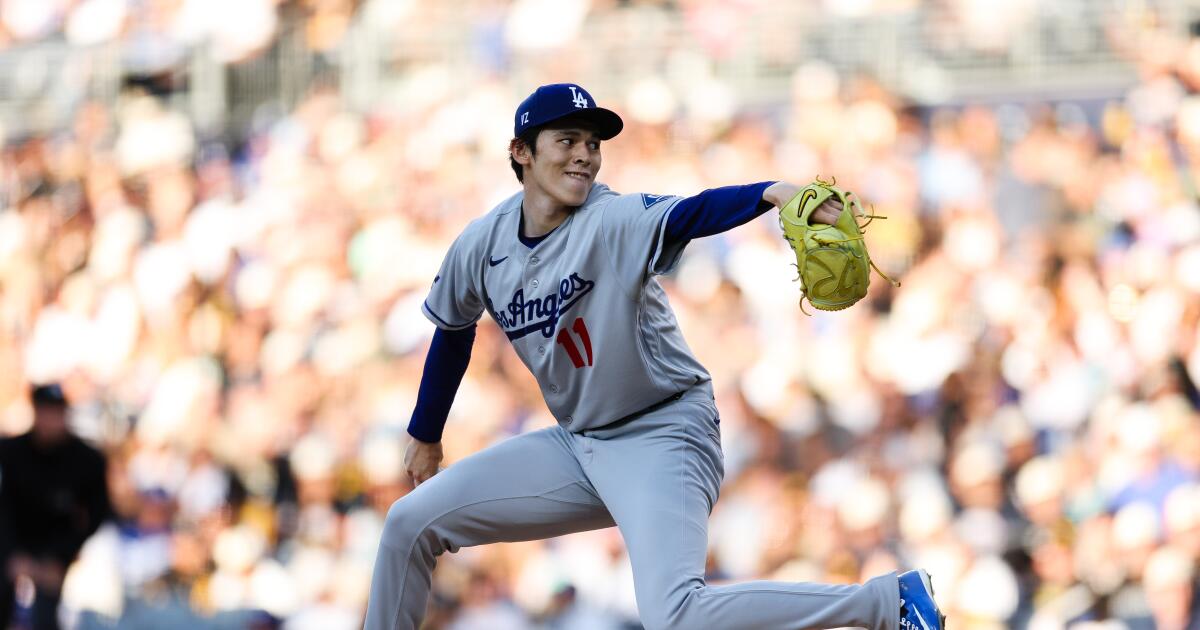
SAN DIEGO — The home run that Roki Sasaki gave up to San Diego’s Ty France was more dramatic than the two walks he issued to open the inning. But it was the free passes that really hurt him.
In the Dodgers’ 7-1 loss to the Padres on Friday, Sasaki was out of the game before he could record an out in the fifth inning. He gave up only three hits but issued five walks, tying his season high, and hit a batter.
“I actually felt different than I ever felt before, mechanically,” Sasaki said through interpreter Kensuke Okubo, noting that his lower body felt a little off. “So I need to go over it and see what was really happening.”
Sasaki successfully pitched around traffic for much of his outing, other than the three-run homer to France in the second inning. But the inefficiency sent his pitch count past 80 before he exited with runners on first and second in the fifth.
“I’m not going to have it every time out, so that’s something I have to improve,” Sasaki said. “And also the game plan. I was able to execute some of the pitches, but some of the pitches I couldn’t, so that’s something I have to go through before next start.”
Earlier this month, when Sasaki held the Angels scoreless through seven two-hit innings, it seemed as if he’d had a breakthrough. But in three starts since, including a seven-run dud against the Chicago White Sox two weeks ago, he has yet to pitch through the sixth inning.
“I am a little surprised, because there was such good momentum going on,” manager Dave Roberts said. “Hopefully we can get him back to throwing the way he did in May.”
The Padres’ Walker Buehler walks off after holding his old team to one run for 5-1/3 innings Friday at Petco Park.
(Derrick Tuskan / Ap Photo/derrick Tuskan)
Sasaki’s command issues Friday showed up almost immediately. After striking out Padres leadoff hitter Fernando Tatis Jr., Sasaki walked Samad Taylor on 10 pitches. But Sasaki bounced back by inducing a double play.
The next inning, there would be no such escape. Sasaki walked both Manny Machado, whom he also battled for 10 pitches, and Gavin Sheets to open the frame. Then Xander Bogaerts’ sharp line drive to center field found leather.
France’s long fly ball to left field, however, found the seats.
Sasaki’s only clean inning, the third, was made possible by catcher Dalton Rushing’s successful challenge of a called ball four against Tatís, flipping a walk into a strikeout.
“I know that there’s confidence in there,” Roberts said. “But when you feel good and you don’t feel good mechanically and can’t execute pitches, then the results are walks, and 1-2 [count] homers, and things like that. But I do think that we can kind of tackle the mechanical things that he’s probably looking for right now.”
The Padres piled on in the eighth inning against reliever Jonathan Hernandez, as the sold-out crowd chanted “Beat L.A.!”
Mookie Betts hit a home run off former teammate Walker Buehler for his second homer in as many games. Betts seems to have come out of his offensive funk, entering Friday with a 1.061 on-base-plus-slugging percentage over the previous 11 games.
Buehler earned the win, delivering five strikeouts in 5⅓ innings.
“[Buehler] is reinventing himself,” Roberts said. “He’s throwing the kitchen sink at you. Cutter, slider, changeup, two-seamers. He doesn’t just try to bully you, and he’s finding ways to just get guys out. So yeah, he’s gonna still go up there and compete.”
The Dodgers went 0 for 4 with runners in scoring position and squandered a bases-loaded opportunity with one out in the sixth inning after chasing Buehler. Max Muncy popped out and Kyle Tucker, back in the lineup after exiting Monday’s game because of back spasms, flied out.
The Dodgers have built such a big lead in the division that the loss barely made a dent. The Padres, in second place, trail by eight games.


Caitlin Clark hit in throat during WNBA loose-ball scramble, sparking backlash and game suspension
WNBA superstar Caitlin Clark was hit in the throat during a loose-ball scramble, sparking outrage and a one-game suspension for Alyssa Thomas. Fox News’ Garrett Tenney reports on the ‘absolutely unacceptable’ incident and the coach’s reaction. Political analyst Gianno Caldwell discusses Clark’s immense impact on WNBA viewership, including a $2.2 billion deal, and the role of gender and race in the controversy.
NEWYou can now listen to Fox News articles!
Phoenix Mercury All-Star Alyssa Thomas is the latest villain to Caitlin Clark fans after punching Clark in the throat during a game on Wednesday night.
The referees missed the punch in real time, but fans and the league office did not.
A viral clip of the punch in slow motion spread across social media, pouring gasoline on the ongoing culture war surrounding Clark’s physical treatment by opposing players, which has been a controversial issue dating back to Clark’s rookie season in 2024.
And Less than 24 hours after the incident, the WNBA slapped Thomas with a one-game suspension for what was deemed a “reckless” and “non-basketball act.”
Who is the woman behind the punch?
If Thomas wasn’t in the WNBA, she says she would go pro in combat sports
In a 2019 interview with Nike PLAYlist, Thomas answered what sport she would have gone pro in if she didn’t go pro in basketball.
“Either boxing or MMA,” Thomas said.
If Thomas never went pro in any sport, she said she would have gotten into dentistry.
“Since I was a kid, I loved going to the dentist. I just was fascinated with teeth and still am. I’m passionate about that whole process of cleaning,” according to a profile on WNBA.com.
The first time Thomas stepped on a basketball court, she threw a ‘hissy fit’
Thomas was signed up to try basketball for the first time at the age of five by her mother, Tina, per the WNBA.
Thomas said she “Threw myself all down the stairs, down the hallway,” while her mom said “She just threw an absolute hissy fit.”
WNBA SUSPENDS ALYSSA THOMAS FOR ‘RECKLESSLY’ HITTING CAITLIN CLARK IN THROAT DURING SCRAMBLE
Her parents didn’t let her win a popular board game
Thomas’ parents never took it easy on her when they played “Candyland” as she was growing up.
“We weren’t the parents that were just going to let you win,” Tina said, per the WNBA.
“In life, you have to fight, and how are you going to fight if you don’t teach your kids to fight? So if she fell over, ‘get up, you’re alright,’ and if she didn’t get up, you knew something was wrong.”
It was a parenting tactic also used by the father of New York Yankees legend Derek Jeter, who famously never let Jeter win in board games or card games when he was growing up, to instill harsh competitiveness at an early age.
Thomas added that her mom was especially hard on her and helped develop her toughness.
“By no means was it easy, and it’s still not easy,” Thomas said.
Thomas plays more physically because shoulder issues hinder her shooting ability
Phoenix Mercury forward Alyssa Thomas scrambles to get up over Indiana Fever guard Caitlin Clark during a game at Gainbridge Fieldhouse in Indianapolis on June 24, 2026. The Phoenix Mercury defeated the Indiana Fever 111-109. (USA TODAY Network via Reuters Connect)
Thomas currently plays basketball with torn labrums in both of her shoulders.
The injuries are so severe that she completely lacks the structural integrity to lift her arms and shoot a traditional, fluid jump shot. Instead, she is forced to use a rigid, one-handed pushing motion from her chest just to get the ball to the rim.
Because she cannot rely on outside shooting, Thomas adapted by leaning entirely into her physical frame. She drives directly into the teeth of opposing defenses, absorbing heavy contact in the paint to score closer to the basket.
Indiana Fever guard Caitlin Clark shown after falling in the lane while Phoenix Mercury forward Alyssa Thomas watches the ball at Gainbridge Fieldhouse Indianapolis, Indiana on June 24, 2026. (Grace Smith/IndyStar / USA TODAY NETWORK via Imagn Images)
That brutal, driving style requires her to initiate intense physical collisions on nearly every single possession.
Despite the mechanical limitations and constant pain, the tactical shift worked. She transformed herself into a six-time All-Star, three-time First-Team All-WNBA, an Olympic gold medalist and the undisputed triple-double queen of the WNBA.
Thomas has been the center of immense criticism this week
The throat punch on Clark ignited a fierce wave of backlash.
Indiana Fever Head Coach Stephanie White led the charge, completely unloading on Thomas and the league’s officials during her postgame press conference.
“We have a generational talent and a WNBA superstar who had two cheap shots right there that weren’t called,” White said, pointing directly at Thomas’s actions. “Absolutely unacceptable.”
White argued that Thomas regularly crosses the line from playing physical defense into inflicting dangerous, non-basketball contact.
“It’s absolutely egregious and utterly disrespectful,” White continued to fume to reporters. “The fist in the throat is crazy. It’s crazy. It’s dangerous.”
On Thursday, Fever President Kelly Krauskopf released a statement praising the decision to suspend Thomas.
“Player safety should be paramount in our league. We appreciate the WNBA’s review of last night’s incident and the action taken. Right now our focus is on Caitlin and our entire team as we prepare for Saturday,” Krauskopf wrote.
Former Minnesota Vikings captain and prominent conservative activist Jack Brewer said the punch would be considered a “hate crime” if the roles were reversed.
CLICK HERE TO DOWNLOAD THE FOX NEWS APP
“This would be considered a hate crime if it were the other way around,” Brewer told Fox News Digital.
Other critics have expressed their own outrage on social media.
-

 Indianapolis, IN18 seconds ago
Storm chance today, then turning hot and humid through midweek
-

 Pittsburg, PA5 minutes ago
Reunited! Penguins Get the Other Twin Ruck in Round 2
-

 Augusta, GA12 minutes ago
Richmond County elections board seeks dismissal of Myles election challenge
-
Washington, D.C15 minutes ago
Your access has been blocked – The Atlantic
-

 Cleveland, OH20 minutes ago
Cleveland boy, 13, dead following ATV crash in Erie County
-

 Austin, TX27 minutes ago
Cedar Park greenlights Texas Materials HQ move with $14M incentive deal
-

 Alabama30 minutes ago
The legend of Alabama’s black panthers: Why the sightings never stop
-

 Alaska35 minutes ago
Delmonico’s Love Letter To America: A Red, White, And Blue Baked Alaska

