Sports
Football and social media: What next for players and clubs in a changing landscape?


Erling Haaland has posted only once on X in the past two weeks.
The message was unremarkable and safe but notable nevertheless for a player of the Manchester City striker’s profile using a platform that has become a no-go zone for many footballers.
All together 🩵 pic.twitter.com/YozFL4EdKC
— Erling Haaland (@ErlingHaaland) January 29, 2025
Haaland’s posts are invariably bland. Jude Bellingham is rare among high-profile footballers in that his X posts occasionally contain a slightly more personal element.
Familia.🤍 https://t.co/uNf6mKvDha
— Jude Bellingham (@BellinghamJude) December 27, 2024
But the Real Madrid and England star last posted on December 27 and many of the entries on his timeline are reposts from Madrid, sponsors or fan accounts.
Kylian Mbappe has posted once, with one retweet, since October.
Mohamed Salah posts regularly but almost always purely in photographic form. Cristiano Ronaldo largely follows the Haaland/Bellingham/Mbappe blueprint. Lionel Messi does not even have an account.
For years, Twitter, now known as X, was the platform of choice for professional players. Not anymore.
“When we’re working with new players, X is never even a conversation anymore, really, whereas four or five years ago it used to be,” says Ehsen Shah, the founder and CEO of B-Engaged, a company that provides social media services to players including Hector Bellerin, Kai Havertz, Thiago, Alphonso Davies and Serge Gnabry.
“We used to say, ‘This is a platform where you can have a bit more of a raw opinion, you can say what you want to say in a word format rather than always having to rely on having an image and sitting on your Instagram grid’, which players want to look a certain way.
“Players can’t really do that anymore. They don’t see it as a platform that they can actually work with and for us as the professionals behind it, it’s because of the negativity on that platform, whether it’s politics, sport, whatever else it might be.
“So why are we going to throw a player into that? It’s almost like seeing a house burning and thinking, ‘Oh yeah, let me just go in there and see what’s going on’.”
Arsenal’s Kai Havertz in 2024 (Alex Pantling/Getty Images)
A decade or more ago, Twitter was the growth platform for players. They used it to converse directly with supporters and Wayne Rooney even appeared to use it to arrange transportation to training.
Hi rio do u want picking up in the morning pal
— Wayne Rooney (@WayneRooney) April 23, 2011
But things have moved on. “In the past five years, the way players want to be seen on social media has changed,” says a media officer from a Premier League club, speaking to The Athletic anonymously to protect relationships. “When X did suit players’ needs it was more because they wanted to engage with the fanbase.
“That has changed a lot. Now they are personal brands, so with branded content, with collaborations with Nike, Adidas, whoever your boot supplier is, everything is set up on Instagram far more to benefit players as brands.
“I’m not saying players don’t want to connect with fans, but they want to be seen as brands more.”
The changing face of social media appears to have led to a decline in player activity on X. While many retain accounts, relatively few engage actively with other users.
Many have been drawn to more visual platforms. For younger players, that sometimes means TikTok, but for the majority, Instagram is the network of choice.
“It was the first social media app that was created for smartphone users, and that’s what Instagram did very well, very quickly and it really resonated with Millennial/Gen Z, which most footballers currently are,” says Amar Singh, an ex-journalist, former head of content at West Ham United and now senior vice-president at sports marketing agency MKTG.
“It’s a very visual platform, and consequently people are more likely to engage with brands there and more likely to follow brands and personalities based on the visuals.
“It’s less of a word challenge than X, where it’s all about what you’re saying in however many characters it is, which immediately appealed to broadcasters and journalists — people who like words.
“With footballers, social media is an expression of their personality and their image, just like the influencers and content creators, and Instagram is a great platform for expressing some of those aesthetics.
“Footballers have got better at understanding the platform, and using it to drive partnerships to grow audiences.”
If the golden age of football Twitter is over, seemingly never to return, the picture for clubs is different. X is long-established as the go-to place online for breaking news, updates and links to official statements.
Its format works as a news feed and, despite the changes since it was bought and rebranded by the billionaire Elon Musk, its dominant position is unlikely to change.
“Clubs do have Instagram accounts, but they don’t really use them to disseminate information,” says Singh. “They will sometimes, but it’s just not a platform really set up for that. Link sharing is tricky on Instagram.
“You can post links on Twitter, for example, and say, ‘Come and read the full statement on our website’. You can move people around from Twitter in a way that you can’t from Instagram.”
In November last year, the German club St Pauli took a stand against X. The Hamburg-based side became the first from one of Europe’s major leagues to walk away from the platform in response to Musk’s takeover, the changes to fact-checking and Musk’s links with re-elected U.S. president Donald Trump.

Elon Musk had a prominent place at President Trump’s inauguration last month (Victor J. Blue/Bloomberg via Getty Images)
“Elon Musk has turned a debate room into a hate amplifier that can also influence the German parliamentary election campaign,” St Pauli spokesperson Patrick Gensing told The Athletic. “Insults and threats are barely sanctioned and sold as supposed freedom of speech.
“It can be assumed that X will also promote authoritarian, misanthropic and right-wing extremist content in the German parliamentary election campaign and thus manipulate public discourse. Musk tries to influence the discussions and the election in Germany and he supports the far-right AfD (Alternative for Germany).”
Musk addressed an AfD campaign event last month via video link and St Pauli’s allegations against him and X have been echoed by other commentators. The Athletic asked X for a response to all the allegations from both Musk and the company itself but did not receive a response.
The Athletic also contacted Tesla, Musk’s most famous company, to ask for a response from its owner, but again did not receive a comment.
Werder Bremen followed St Pauli’s lead a few days later but the idea that their stand might prompt a mass exodus of major clubs seems far-fetched.
“I’m sure a lot of clubs have had internal conversations, and I’m sure there’ll be members of staff at clubs who’d be quite happy for political reasons to leave X,” says the Premier League club’s media officer. “But there’s no real whisper among the people we talk to about clubs leaving X.
“The difficulty for a club comes from the fact there will be an element of your fanbase that actually likes the changes Musk has made to X and the way it is slanted politically.
“German football is a lot more politically driven anyway and St Pauli has a very clear identity, so if you’re a St Pauli fan, you’re also signing up to a certain way of living your life.
“I don’t think the majority of English professional clubs have that behind them, so there will always be an element of a fanbase which has absolutely no issue with what X is right now.
“If any club said they were coming off X they would almost be saying to a proportion of your fans — in some cases, it might be 10 per cent and in others, it might be 80 per cent — “we disagree with what this platform is and therefore, by extension, we disagree with you”, so I think that would be very difficult for a club to do.
“Even clubs like Liverpool or Everton that come from a very socialist, working-class city, there will still be people there who agree with the basic principles of the way X has shifted right, so either of those clubs coming off X would be like them saying to those fans, ‘You’re not for us’, basically.”
Any clubs who opted to leave X or scale back their activity on the platform would now have more options than ever.
Since Musk’s takeover, Meta, the owner of Facebook and Instagram, has launched Threads as a direct competitor. Bluesky, the mirror platform launched from within Twitter but later sold by the company, has enjoyed rapid growth.
Disgruntled X users have migrated to Bluesky in large numbers, but the idea of ‘football Twitter’ making the move en masse appears to be a non-starter.
“It’s important to remember where Bluesky and Threads came from,” says Lewis Wiltshire, formerly Twitter UK’s first head of sport and now senior vice-president and managing director of digital at IMG.
“Bluesky was created within Twitter as a research project. It no longer has corporate ties to Twitter but remains, in essence, a replica. Threads was created as a competitor to Twitter. Original Twitter, now X, is still alive and kicking.
“Despite a lot of headlines after the U.S. election proclaiming that people were deserting X, the vast majority of sports organisations are still using it pretty much as they did before. So it’s not as if Bluesky and Threads have an open goal.
“Digital marketing teams also have to consider a website, app, CRM (customer relationship management) activity, digital membership, e-comm, possibly a direct-to-consumer streaming service, and more.
“Within social media, they need to assess what are the best platforms to achieve various objectives, one of which is real-time updates. That’s the part Twitter/X has always excelled at.
“There are a hundred things to do or places to be, so if there’s no burning problem to solve, it’s going to be at the bottom of their pile.
“But let’s imagine for a moment that every organisation in football upped and left X. There is no evidence this is happening, or is about to happen, but even if it did, the audience we call ‘Football Twitter’ would not lift-and-shift to one specific alternative.
“The reality is, those people would disperse across multiple different platforms. The biggest winner might not be Bluesky or Threads. It could be Reddit, which was a big riser in our 2025 IMG Platform Power Rankings, as we see fans increasingly being drawn towards community-focused platforms.
“Also, Instagram, Facebook, TikTok, Discord, apps like The Athletic, and more.
“And even if all of Football Twitter lifted and shifted to one platform as one block of people, en masse — which absolutely will not happen — it would still be niche. Despite having been one of the most famous platforms in the world for almost 20 years, X is much smaller than Instagram and TikTok, which in turn are much smaller than behemoths like YouTube and Facebook.”

GO DEEPER
LinkedIn: The social media platform footballers are turning to for recruitment and self-expression
For now, X remains the most popular platform for clubs. It has been estimated that all 20 Premier League clubs joined Threads within 14 hours of its launch and some have become active on the platform, while most have set up Bluesky accounts but few post regularly.
Bluesky is still seen by many as a fall-back platform, according to the Premier League club media officer.
“At the moment there’s just an unknown about X,” he says. “And I think this is what has given birth to Threads and Bluesky — there’s almost a thought that you might wake up one morning and X just might not exist.
“So I wouldn’t say Bluesky and Threads are fall-backs, but if anything happens to X, they’re definitely clubs’ alternatives.”
For players, though, the appeal of new X alternatives appears to be minimal. Since moving away from active posting on X, most have found a comfortable home on Instagram.
“When Threads came out, there was a big push from Meta to onboard players but most players said, ‘I just don’t really want to deal with another platform’,” says Shah. “You can try to bring new platforms to players but they’re not that receptive to it.
“Even with TikTok, you’ve got a younger generation that consumes it, but they might not necessarily use it to post anything on there.
“TikTok is so huge but that platform works because it was providing something completely different. Bluesky and Threads are just providing something that already exists.”
So, for the time being, the picture appears to be set. X remains the primary news platform for clubs, Instagram is the preferred branding and image-boosting network for players and Facebook remains an important part of a multi-platform world due to its sheer number of users.
But clubs are increasingly looking to branch out on their own. Many clubs have launched WhatsApp channels, disseminating information directly to their own fans.
Most major sides have their own apps, providing bespoke content catering to the needs of a single fanbase, with the added bonus that clubs can collate the kind of data on their users that social media companies would demand payment for.
So, while the dominance of X, Instagram and Facebook is unlikely to end anytime soon, there are still lots of unknowns. “I do think everything’s in play,” says Singh. “It’s going to be very interesting to see how Bluesky and Threads develop. Both feel like much less toxic places than X, and I think a lot of football people are there because they dearly want Bluesky to work.
“It looks and feels like the golden days of Twitter, but it feels like it hasn’t yet got the clout with the stakeholders.
“Ultimately, people will go to where the fans are. It’s a numbers game. Clubs often have small, very hard-working social media teams, the ‘admins’ as people call them, and there are only so many platforms you can operate and activate effectively at the same time and ultimately they will go where the fans are.
“People forget that actually, even though it’s not as socially relevant anymore, you’ve got 3.1 billion users on Facebook and 400 users are added every minute. It still accounts for about 30 per cent of all social media ads spent.
“So Facebook is an absolute monster, and in other markets in the world, places such as Africa and Asia, it’s still absolutely huge as the first point of call for fandom.
GO DEEPER
Tracking down the people making thousands out of posting fake Man United news online
“I think clubs will want to have more direct relationships with fans, because they’re always looking for new ways to leverage their intellectual property and commercialise more effectively.
“It’s becoming about having your own dataset on fans. Football clubs realised very quickly that social media is great for reaching a critical mass of fans and talking to fans, but when it came to trying to get some rich data on those fans, the social media platforms said you had to pay for it or they were putting up barriers.
“Football clubs are starting to wake up to the importance of developing their own platforms. You’ve got Real Madrid who have got 126 million Facebook followers, but what does that actually mean in terms of fans?
“You can’t really call each account on there a Real Madrid fan so it’s a bit of a false economy and I think football clubs are really going to be focused more on growing their own audiences directly.
“It’s much more valuable to them to have someone download their own app and log into it a few times a week.
“They’re going to be able to get more out of that user in terms of understanding how to target them, how to speak to them, what they’re interested in, and how they can shape their strategy than they would ever get from a social platform.”
(Top illustration: Demetrius Robinson / The Athletic; istock)



Sports
Pirates star pitcher makes unfortunate history after being taken out in middle of perfect game bid

NEWYou can now listen to Fox News articles!
Jared Jones was flirting with Major League Baseball history on Wednesday night — he got it, but it was not what he originally envisioned.
The Pittsburgh Pirates pitcher retired the first 18 batters he faced, but he was taken out in the middle of his perfect game bid after six innings.
Now, the Pirates certainly have their reasons — the 24-year-old Jones hasn’t thrown more than 81 pitches in eight starts since returning May 20 after missing all of last season while undergoing ulnar collateral ligament internal brace surgery on May 21, 2025. He was yanked with 77 pitches and likely would have needed more than 100 pitches to record the 25th perfect game in MLB history.
Jared Jones of the Pittsburgh Pirates pitches during the first inning against the Atlanta Braves at PNC Park on July 8, 2026, in Pittsburgh, Pennsylvania. (Photo by Joe Sargent/Getty Images)
However, Jones left the game after getting zero run support, so when the Atlanta Braves tacked on three runs late for a 3-0 victory, Jones instead found himself in the wrong chapter of the history books.
According to Opta Stats, Jones became the first pitcher in the modern era (since 1920) to pitch at least six perfect innings and not record a win.
“It does suck. Something’s cool coming on, but I’m on what? My eighth start off of surgery? I completely understand it, and it is what it is,” Jones told reporters after the game.
Pittsburgh Pirates starting pitcher Jared Jones (17) makes his way to the field to warm up before pitching against the Atlanta Braves at PNC Park. (Charles LeClaire/Imagn Images)
JUSTIN VERLANDER ANNOUNCES HE WILL RETIRE AFTER THIS SEASON: ‘I’VE REALIZED THAT TIME HAS COME’
Jones said he didn’t entertain attempting to complete the perfect game.
“Not with the pitch count,” he said. “Not really ever expecting to go nine right now, so that was never in my head.”
Joey Bart, traded to the Braves from the Pirates on June 18, followed a double by Mike Yastrzemski with a 422-foot, two-run homer to left-center field off a slider from Dennis Santana. Drake Baldwin added an RBI single to center in the ninth for good measure.
It was the second time in less than a week that a pitcher was taken out of the game with a perfect bid through six innings — the Miami Marlins took Eury Perez out after seven innings in which he had 92 pitches. Perez, too, is in the midst of returning from injury and has surprisingly found himself right in the postseason mix.
He was pulled for Lake Bachar to start the eighth, and the Marlins allowed eight runs to the Athletics in the final two innings, but held on to win 9-8.
Jared Jones (17) of the Pittsburgh Pirates delivers a pitch during a MLB game against the Cincinnati Reds on June 27, 2026, at PNC Park in Pittsburgh, Pennsylvania. (Joe Robbins/Icon Sportswire via Getty Images)
CLICK HERE TO DOWNLOAD THE FOX NEWS APP
The Pirates are 4.0 games out of the final wild card spot, which is held by the Marlins.
The Associated Press contributed to this report.
Follow Fox News Digital’s sports coverage on X, and subscribe to the Fox News Sports Huddle newsletter.
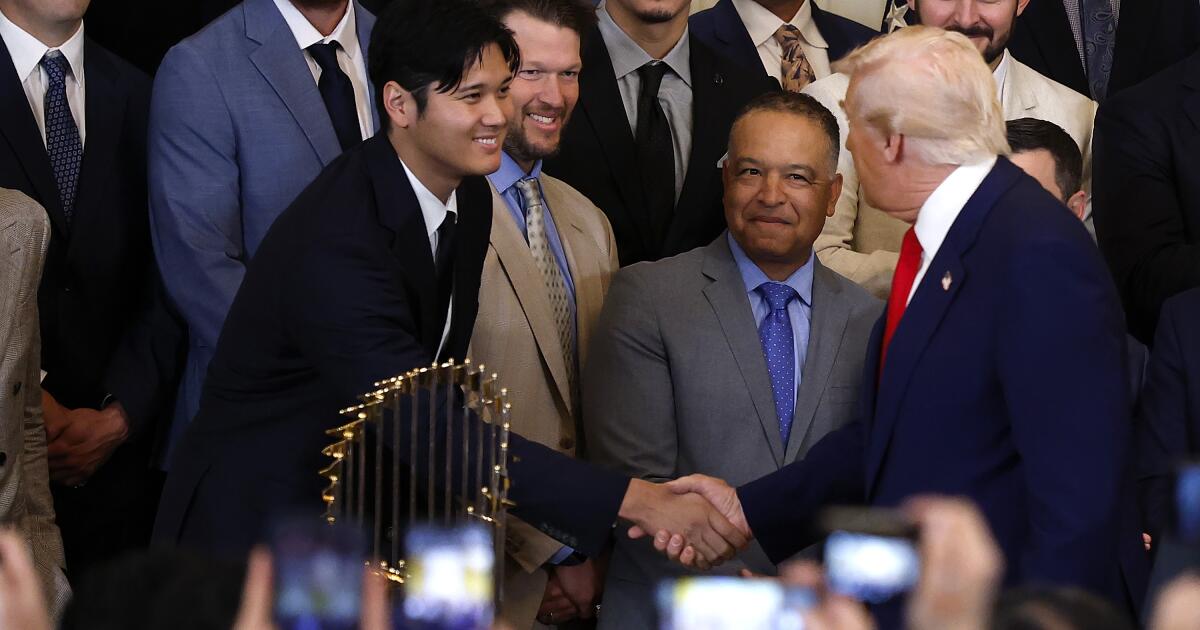
WASHINGTON — The Dodgers are scheduled to visit the White House on July 23 to celebrate their latest World Series title.
“President Trump is excited to welcome the Los Angeles Dodgers BACK to the White House to celebrate their World Series championship!,” White House spokesperson Taylor Rogers said in a statement to The Times.
The date falls on a scheduled off day in the middle of a nine-game East Coast road trip for the Dodgers. The team will play three games in Philadelphia against the Phillies July 20-22 before ending the trip with a three-game series against the New York Mets July 24 to 26.
The visit continues a tradition from the Dodgers’ two previous World Series championships. They were hosted by President Biden in 2021 and President Trump in April 2025.
After the Dodgers claimed their second consecutive World Series title with a dramatic Game 7 victory over the Toronto Blue Jays, a visit to the White House was planned, but it wasn’t until Thursday that a date was officially booked and confirmed.
Questions swirled around whether players would decline the visit this year after it did not happen during a scheduled visit to Washington in April.
Kiké Hernández said in 2018 he was unsure he would have gone had the Dodgers won the World Series the previous year. Mookie Betts said he was undecided and needed to talk it over with his family when last year’s visit was announced. After winning his first World Series with the Boston Red Sox in 2018, Betts skipped their trip to the White House the following year during Trump’s first term.
Both players, along with every returning member of the 2024 team who was with the team during its road trip, participated in the visit. The only notable absence was first baseman Freddie Freeman, who remained in Los Angeles to nurse an ankle injury.
Manager Dave Roberts, who indicated in comments to The Times in 2019 he might not go to the White House if Trump was president, also participated in last year’s ceremony.
Asked at the Dodgers’ fan festival in January about the possibility of returning to the White House, Roberts told The Times’ Bill Shaikin: “For me, I stand by: I’m a baseball manager. That’s my job.”
“I was raised — by a man who served our country for 30 years — to respect the highest office in our country,” Roberts said. “For me, it doesn’t matter who is in the office, I’m going to go to the White House. I’ve never tried to be political. … For me, I am going to continue to try to do what tradition says and not try to make political statements, because I am not a politician.”
Clayton Kershaw, who retired after last season but was on Team USA for this year’s World Baseball Classic, told The Times in the spring that he was aware Dodgers fans are split over whether the team should visit the White House again this year, but he said he is looking forward to it.
“I went when President Biden was in office. I’m going to go when President Trump is in office,” Kershaw said. “To me, it’s just about getting to go to the White House. You don’t get that opportunity every day, so I’m excited to go.”
Times deputy sports editor Ed Guzman contributed to this report.

NEWYou can now listen to Fox News articles!
All eyes were on Caitlin Clark on Wednesday night as she made her anticipated return from injury in a road matchup in Los Angeles.
But instead of a triumphant comeback, the Fever spent the entire night chasing the Sparks as Clark’s rough return fueled a 106-92 rout.
The superstar never found a groove, looking completely out of sync in her return from a back injury.
STEPHANIE WHITE GIVES CAITLIN CLARK STATUS UPDATE AHEAD OF FEVER-SPARKS, BUT HER NEXT MOVE RAISES QUESTIONS
Caitlin Clark huddles with teammates as the Indiana Fever battle the Sparks. (Photo by Katelyn Mulcahy/Getty Images) ((Photo by Katelyn Mulcahy/Getty Images))
Much of that disjointed performance falls squarely on head coach Stephanie White, who kept Clark on a ridiculously tight leash by limiting her to just 16 minutes. The stop-and-go approach could have sabotaged any chance for the phenom to establish a rhythm.
Clark finished with just 9 points, 4 rebounds and 3 assists. Her minus-16 plus-minus told the story.
The Los Angeles Sparks were severely shorthanded, taking the floor without stars Kelsey Plum and Cameron Brink.
MERCURY’S NOW-DELETED SOCIAL MEDIA POST MOCKING CAITLIN CLARK DRAWS SCRUTINY AFTER STAR’S INJURY
Yet while a depleted Sparks roster played to win, Indiana spent the night over-managing its biggest asset.
With Clark on a minutes restriction and Aliyah Boston out of the lineup, Kelsey Mitchell was forced to shoulder the entire offensive burden.
Mitchell did her part, pouring in 29 points while shooting 5-of-9 from beyond the arc.
Caitlin Clark orchestrates the Fever offense as Indiana battles the Los Angeles Sparks in primetime action. (Photo by Katelyn Mulcahy/Getty Images) ((Photo by Katelyn Mulcahy/Getty Images))
But one hot hand couldn’t stop an efficient LA squad.
The Sparks shot 45% from three-point range, going 9-of-20 from deep to cruise to the 106-92 victory.
White’s next move is to sit Clark against the Mercury on Thursday while Boston returns.
CLICK HERE TO DOWNLOAD THE FOX NEWS APP
After Wednesday’s loss to a shorthanded Sparks team, it’s fair to question whether Indiana’s cautious approach is working. The Fever dropped to 12-9.
Caitlin Clark and Dearica Hamby face off as Fever and Sparks battle at Crypto.com Arena in Los Angeles. (Photo by Tyler Ross/NBAE via Getty Images) ((Photo by Tyler Ross/NBAE via Getty Images))
Send us your thoughts: alejandro.avila@outkick.com / Follow along on X: @alejandroaveela
-

 Michigan4 minutes ago
Menominee, Michigan man arrested on sexual assault charges involving a minor
-

 Massachusetts11 minutes ago
Healey administration vows to appeal as Trump rejects Massachusetts blizzard aid request – The Boston Globe
-

 Minnesota14 minutes ago
Minnesota Looks to Add 1,100 Child Care Slots, With Melrose Among the 11 Funded Communities
-

 Mississippi19 minutes ago
Death of Mississippi teen Nolan Wells under investigation
-

 Missouri26 minutes ago
Missouri realtors hold statewide rally to vote no on Amendments 4 & 5
-

 Montana29 minutes ago
District court judge blocks new Montana GOP bylaws – WTOP News
-

 Nebraska34 minutes ago
Nebraska ag experts say early detection for livestock parasites, illnesses will be important during summer show season
-

 Nevada41 minutes ago
Local artists on Northern Nevada stages, now through Labor Day weekend

