Sports
Discussing Kevin De Bruyne and the most influential midfielders of the Premier League era


“Always I have to be careful for the respect for the players that have played incredible roles, but there’s no doubt he’s one of the greatest for sure,” said Pep Guardiola of Kevin De Bruyne’s impending exit from Manchester City.
De Bruyne’s impact at City since joining from Wolfsburg in 2015 has been huge, with the Belgian scoring 106 goals in 413 appearances, contributing to 187 Premier League goals (scoring or assisting), equalling the assist record for a single season and winning 19 trophies.
While Guardiola was careful about discussing where he stands in the greatest player debate, the City coach praised his “influence in our success in the last decade”.
Which had us asking, who are the most influential midfielders of the Premier League era?
Here is a selection of our writers’ answers and explanations of why they chose them. There probably isn’t a right answer but please let us know who we’ve overlooked (sorry, Paul Scholes) and register your vote in our poll (or submit your own entry).
We’ll publish the results on Sunday.
Yaya Toure
Premier League career: Manchester City 2010-18
Quite simply, Yaya Toure played in a style different to any midfielder the Premier League had seen before. He had the physicality of a centre-back, screening of a No 6, driving ability of a No 8, and shot power of a striker, patch-worked together in one sky blue-clad body.
There was Claude Makelele, who achieved Toure’s defensive coverage but was far more limited in attack, while even Arsenal’s Patrick Vieira lacked the Ivorian’s ability to take games by the scruff of their necks. Mousa Dembele, at his best, probably comes closest.
Here was the player that straddled City’s first post-takeover steps — his goal against Stoke City won the 2011 FA Cup, the club’s first trophy in 35 years — and Pep Guardiola’s dominant sides. David Silva, as wonderful as he was, relied on the industry and guile of his deeper-lying partner.
Toure playing for Manchester City in 2018 (Mike Hewitt via Getty Images)
He is probably the figure who has most influenced the mimetic ideal of a Premier League midfielder, his frame dominating in the most physical league in the world, but his technical ability still allowing him to evade pressure and crash the box. Ask any top-flight manager to draw up the frame and skill set of their ideal midfielder, all rules of creation in their hands, and Toure would be the closest facsimile.
Jacob Whitehead
Frank Lampard
West Ham United 1995-01, Chelsea 2001-14, Manchester City 2014-15
Goals. Lampard scored 177 of them, elevating him to seventh place on the Premier League’s all-time list. To put that into context, he’s surrounded by strikers. The next-highest midfielder — Steven Gerrard — is in 23rd place. Lampard’s assists? 102. Astonishing numbers that highlight Lampard’s incredible attacking output across 22 Premier League seasons, most spent with Chelsea, where he won three Premier League titles after signing from West Ham in 2001.
Lampard’s biggest talent, by his own admission, was his work ethic and dedication. Encouraged by his father, Frank Lampard Snr, he practised relentlessly, striving to be the best that he could be every day at training, and, ultimately, he got his reward.
An elegant passer of the ball, aided by his awareness and football intelligence, Lampard mastered the art of the late run into the penalty area, where he scored goals of every description to establish himself as one of the Premier League greats.
Stuart James
Roy Keane
Nottingham Forest 1990*-93, Manchester United 1993-2005
A force of nature, a supreme competitor. Sir Alex Ferguson once said, “If I was putting Roy Keane out there to represent Manchester United on a one-on-one, we would win the Derby, the Grand National, the Boat Race and anything else.”
Keane was not just part of a dominant team at United in the 1990s and early 2000s, he was the heart and soul.

Keane was United’s on-pitch leader (Michael Steele/EMPICS via Getty Images)
He didn’t play defence-splitting passes like Gerrard, De Bruyne or Paul Scholes. He didn’t have the silky skills of Cesc Fabregas, Luka Modric or Silva. He didn’t score goals like Lampard and he didn’t have the towering presence of Vieira. But he was, in an understated way, an extraordinary footballer — not just a fearsome tackler but a swashbuckling box-to-box midfielder and who evolved into an intelligent and inspirational (if at times impetuous) captain who elevated and at times dragged his team-mates to another level.
Oliver Kay
* 1992-93 was the first Premier League season
Xabi Alonso
Liverpool 2004-09
As if it wasn’t enough to be so good that Jose Mourinho compared you to a “metronomic” Guardiola. No, Alonso could also do the audacious to sit alongside the elegantly procedural midfield demands.
He scored in a Champions League final, won the FA Cup and shared the limelight with Gerrard in his prime. But the Basque midfielder will also be remembered for one of the Premier League’s most ridiculous goals, against Newcastle United at Anfield in September 2006.
Having won the ball himself just outside the centre circle, he saw opposition ‘keeper Steve Harper off his line and duly put the ball into the net from a staggering 60 yards. It was the second-longest goal in top-flight history but remarkably, he had already gone better.
That year, he had scored from more than 70 yards near the end of an FA Cup win at Luton Town after the goalkeeper had gone up for a set piece. The complete range of passing, a penchant to put his foot in when required and capable of jaw-dropping goals — Alonso had it all.
Greg O’Keeffe
Steven Gerrard
Liverpool 1998-2015
Football has become about specialisms, players whose job description is tightly defined around one super-strength. Very few have possessed the ability to claim they are one of the best across all categories.
Vieira, Toure and Rodri all have a case, but those players were usually part of either the best or second-best team in England. Gerrard did not have that luxury in many seasons, yet he is still the best all-rounder there has been. It is why his spectacularly outsized influence on Liverpool was so captivating.
He had power, guile, range, aggression. He was Roy of the Rovers incarnate, a sheer force of nature who could transform games on his own. It is why Jose Mourinho tried to sign him for three different clubs and why Ferguson thought he was the only player who replicated Keane’s ubiquity on the pitch.

Gerrard stayed loyal to Liverpool (AMA/Corbis via Getty Images)
That ferocious energy and desire to be everything was what Rafa Benitez refined. He added a subtlety to his game while playing just off Fernando Torres, producing sublime killer passes on tap. Late in his career, he was reinvented as a ‘quarterback’, pinging diagonals from deep with machine-like precision.
He could have been placed into any team or style and had he not stayed at his boyhood club and racked up titles elsewhere, the conversation would be a lot shorter.
Jordan Campbell
Cesc Fabregas
Arsenal 2003-11, Chelsea 2014-19
He was so good, he changed the way Arsenal played football.
Arsene Wenger’s early success in north London had been built on the pace and power of Vieira, Emmanuel Petit and Gilberto Silva, but when a scruffy 16-year-old with a dodgy mullet and a baggy shirt arrived from Barcelona, a new era began.
After Viera’s departure, Fabregas was given the keys to the Arsenal midfield and grabbed them with both hands. His passing was slick, his vision sublime, and he quickly became the poster boy for what would come to be known as ‘Wengerball’.
He was unlucky to never win the trophies his quality deserved with Arsenal, but he returned from a spell back at Barcelona to win two Premier League titles in three seasons with Chelsea.
Under Wenger, Mourinho and Antonio Conte, the styles were wildly different, but it’s a testament to how good a player he was that Fabregas’ quality always shone through.
Kaya Kaynak
Patrick Vieira
Arsenal 1996-2005, Man City 2010-11
In the Premier League, there was a time before Wenger and a time after he arrived.
And just as Thierry Henry used Wenger’s Arsenal team as a vehicle to redefine the role of a Premier League forward, so Vieira used it to transform the idea of a midfielder.
There had been outstanding box-to-box operators before him, most notably Bryan Robson at the league’s inception in the early 1990s, then Keane. But Vieira was the complete package.

Vieira was key to Wenger’s Arsenal (John Peters/Manchester United via Getty Images)
He could match any midfielder of his era for technique, skill and intelligence while having the edge on everyone else in athleticism, physical presence, stamina and mobility. He could bend games to his will through sheer force of personality and he did it all while gliding across the pitch with a grace that no supreme, 6ft 4in (193cm) athlete should be able to produce.
Steve Madeley
Kevin De Bruyne
Manchester City 2015-2025
It’s not just the relentlessness of De Bruyne’s output that City will miss, but the imagination and variety — the spark — that he consistently found, so often the man with the creative solution that other talented team-mates just couldn’t see.
There were moments of sheer genius — a deft reverse pass to find Leroy Sane in a 7-2 win against Stoke City; a free kick rolled under the wall against Cardiff City, a defence-splitting ball to drag Manchester City back into the game at Newcastle.
There were moments of repeated brilliance — those unstoppable crosses from the right, always struck with whip, venom, and deep into the areas that no opponent wanted to defend. And when all else failed, there was sheer power — searing strikes against Swansea City and Chelsea, a thumping half-volley off the bar at St James’ Park, and a surging, title-winning run into the box against Aston Villa all springing to mind.
On both feet, and with absolutely everything he had, De Bruyne brought a unique mix of brutal efficiency and eye-catching style, a hard-working midfielder with game-breaking talent to boot.
How City will adapt to life without him remains unclear; it’s the same question fans asked when Toure and Silva chose to move on, before a certain Belgian midfielder answered the call.
Leaving with six Premier League titles, five League Cups, two FA Cups and, most importantly, a Champions League to his name, the club have De Bruyne to thank for helping to deliver its finest hours.
Thom Harris
Claude Makelele
Chelsea 2003-08
There are not many football players whose role became so clearly defined that it is named after them.
Makelele arrived at Chelsea in the twilight of his career. Aged 30, Makelele had been converted from an attacking midfielder to a deep-lying, anchoring midfielder that would protect his back line and hoover up any defensive actions that came anywhere near his orbit.
However, it was not just his ability to cover ground and regain possession, but also how much his role transformed the way that Chelsea played on the ball — signalling to the Premier League that a 4-4-2 was becoming increasingly outdated.

Makelele even had a role named after him (Odd Andersen/AFP via Getty Images)
“If I have a triangle in midfield — Claude Makelele behind and two others just in front — I will always have an advantage against a pure 4-4-2 where the central midfielders are side by side,” said Mourinho as Chelsea manager. “That’s because I will always have an extra man. It starts with Makelele, who is between the lines.”
When ‘The Makelele Role’ becomes an established phrase within the game, you know you have made an impact in the Premier League.
Mark Carey
Paul Ince
Manchester United 1989*-1995, Liverpool 1997-99, Middlesbrough 1999-2002, Wolverhampton Wanderers 2003-04 (Ince played in the top flight for West Ham from 1986-89)
Ince was the start of it all. In the inaugural Premier League season (1992-93), Manchester United won their first title in 26 years. Ince played 41 of the 42 games. He made United win matches.
Next season, same again. United won the second ever Premier League season, with Ince playing 39 of 42 matches and scoring eight goals, most of them alongside new arrival Keane.
In the third Premier League season, United were beaten into second place by Blackburn Rovers and Ince’s relationship with Ferguson had soured, so he was sold to Inter Milan for £7.5million ($9.7m at current rates).
A lot was said about Ince, not least by Ferguson, who called Ince a “big-time Charlie” when the midfielder was playing for Liverpool, a comment Ferguson later regretted.
It’s true, Ince did rate himself, but justifiably so. If you supported the opposition, Ince felt unbeatable. He controlled the midfield and controlled the game, the way great Italian midfielders were able to.
He spent two seasons in Serie A before signing for Liverpool. He was past his best then, but before that, Ince was the Premier League’s stepping stone to get to Keane, Vieira and De Bruyne.
Andrew Hankinson
N’Golo Kante
Leicester City 2015-16, Chelsea 2016-23
Kante took the Makelele role and asked for large fries to go with it. He super-sized what it meant to be a ball-winning midfielder (despite his shorter height and slighter frame) and spearheaded consecutive Premier League titles with different clubs.
He arguably achieved a unique feat in being central to two successive title-winning teams. Eric Cantona did something similar with Leeds United and Manchester United in 1992 and 1993, but only joined the former from February onwards when they were already top of the table.

Kante was central to Leicester’s remarkable title (Getty Images)
It is impossible to envisage Leicester winning the title in 2016 without Kante, who did the jobs of two, even three players with his relentless interceptions and tackles. Then at Chelsea a season later, he repeated the feat, scooping up all the player-of-the-year awards along the way.
A World Cup and a Champions League would follow as Kante reimagined himself slightly further up the field. Sadly, injuries stunted his golden era, but at his best, no one in the world was better at what Kante did.
He is also the greatest bargain buy on this list, costing Leicester just £5.6m from French club Caen in 2015
Tim Spiers
David Silva
Manchester City 2010-20
There is an interesting debate to be had between Silva and De Bruyne, purely in terms of their different styles of play. Plenty of City fans will pick Silva as the best player to ever play for the club, and most Spaniards would probably side with Silva due to their different appreciation of what makes a footballer special.
De Bruyne’s game lends itself more to British sensibilities: he is all about powerful running and crash, bang, wallop goals.
Silva was the yin to De Bruyne’s yang. If De Bruyne was the icing on the cake, Silva was the cake.
He made City tick during his entire period at the club, whether it was Roberto Mancini, Manuel Pellegrini or Guardiola in charge. The latter’s game plans are all about controlling the game and Silva’s tempo-setting approach, always knowing how many touches were needed in a given moment, found an obvious home. To sound all hipster for a moment, Silva would be the thinking man’s choice.
Sam Lee
Have your say
(Top image: Getty Images)



NEWYou can now listen to Fox News articles!
All eyes were on Caitlin Clark on Wednesday night as she made her anticipated return from injury in a road matchup in Los Angeles.
But instead of a triumphant comeback, the Fever spent the entire night chasing the Sparks as Clark’s rough return fueled a 106-92 rout.
The superstar never found a groove, looking completely out of sync in her return from a back injury.
STEPHANIE WHITE GIVES CAITLIN CLARK STATUS UPDATE AHEAD OF FEVER-SPARKS, BUT HER NEXT MOVE RAISES QUESTIONS
Caitlin Clark huddles with teammates as the Indiana Fever battle the Sparks. (Photo by Katelyn Mulcahy/Getty Images) ((Photo by Katelyn Mulcahy/Getty Images))
Much of that disjointed performance falls squarely on head coach Stephanie White, who kept Clark on a ridiculously tight leash by limiting her to just 16 minutes. The stop-and-go approach could have sabotaged any chance for the phenom to establish a rhythm.
Clark finished with just 9 points, 4 rebounds and 3 assists. Her minus-16 plus-minus told the story.
The Los Angeles Sparks were severely shorthanded, taking the floor without stars Kelsey Plum and Cameron Brink.
MERCURY’S NOW-DELETED SOCIAL MEDIA POST MOCKING CAITLIN CLARK DRAWS SCRUTINY AFTER STAR’S INJURY
Yet while a depleted Sparks roster played to win, Indiana spent the night over-managing its biggest asset.
With Clark on a minutes restriction and Aliyah Boston out of the lineup, Kelsey Mitchell was forced to shoulder the entire offensive burden.
Mitchell did her part, pouring in 29 points while shooting 5-of-9 from beyond the arc.
Caitlin Clark orchestrates the Fever offense as Indiana battles the Los Angeles Sparks in primetime action. (Photo by Katelyn Mulcahy/Getty Images) ((Photo by Katelyn Mulcahy/Getty Images))
But one hot hand couldn’t stop an efficient LA squad.
The Sparks shot 45% from three-point range, going 9-of-20 from deep to cruise to the 106-92 victory.
White’s next move is to sit Clark against the Mercury on Thursday while Boston returns.
CLICK HERE TO DOWNLOAD THE FOX NEWS APP
After Wednesday’s loss to a shorthanded Sparks team, it’s fair to question whether Indiana’s cautious approach is working. The Fever dropped to 12-9.
Caitlin Clark and Dearica Hamby face off as Fever and Sparks battle at Crypto.com Arena in Los Angeles. (Photo by Tyler Ross/NBAE via Getty Images) ((Photo by Tyler Ross/NBAE via Getty Images))
Send us your thoughts: alejandro.avila@outkick.com / Follow along on X: @alejandroaveela
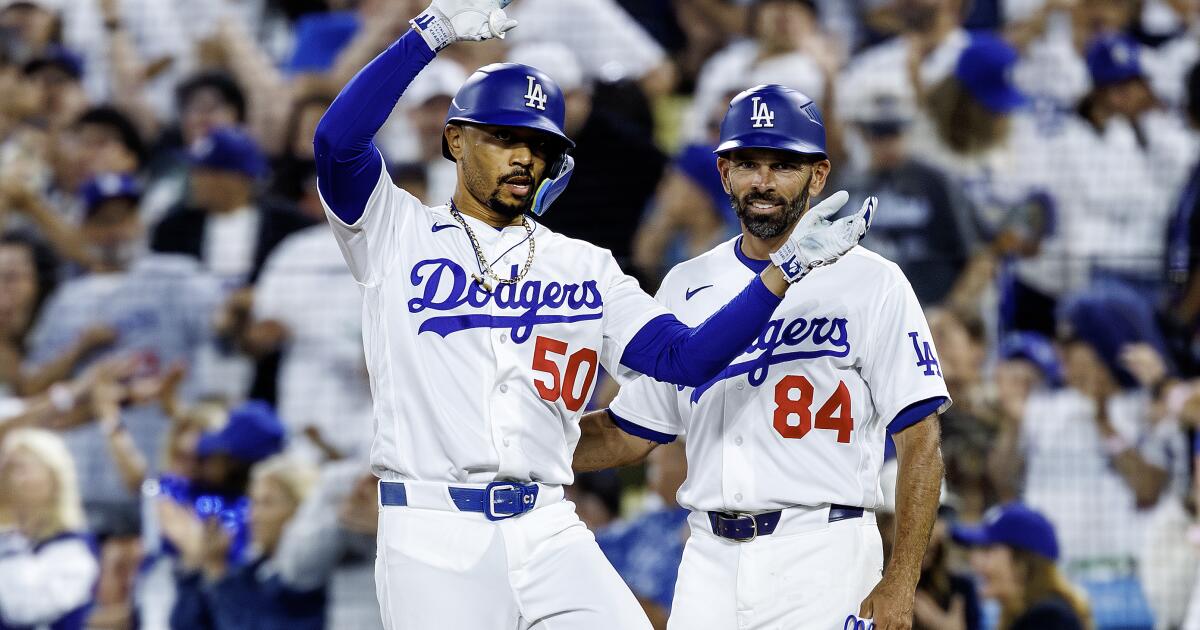
Mookie Betts’ first hit this series against the Rockies couldn’t have come at a more opportune time. With the crack of the ball against his bat, Tommy Edman scored from third, giving the Dodgers the lead.
And as Betts reached first, he pointed to Freddie Freeman, whose single put Edman in scoring position. It had taken a team effort to overcome another middling start from Roki Sasaki, and Betts, who had little to show before his game-winning hit, took the chance to highlight the joint contribution in the Dodgers’ 4-3 rubber-match win over Colorado (38-56).
“It feels great,” Betts said of his nine-pitch battle. “Helping the boys win, that’s really all it is. We play the game to win, and coming through in a big moment is kind of what, when you’re a kid, playing in the backyard, getting that hit is what you always strive to do, and fortunately, I was able to do it.”
Given a three-run lead in the first inning, brought to the Dodgers by a wild pitch and Kyle Tucker’s two-run, line-drive single to left field, Sasaki seemed set up for success.
Still, he gave away the lead as quickly as it came. In the second inning, he left a fastball too far over the plate, and third baseman Kyle Karros drove the ball over the left-center wall. The slider he dealt two batters later to second baseman Edouard Julien also crossed the zone too far over the plate, and Julien rounded the bases with another homer. In the third, a sacrifice fly by Mickey Moniak evened the scored, 3-3.
Sasaki’s troubles this season have been hard to pin down since his last win on May 23, as Sasaki tries to claw back the triple-digit velocity that’s escaped him as of late.
Against the Rockies, his fastball topped out at 99.1 miles per hour before steadily dropping to 98. He had managed five strikeouts in his six innings when manager Dave Roberts replaced him with Jack Dreyer, though the three earned runs couldn’t be ignored.
But Roberts also acknowledged the possibility that the pitcher had been tipping his pitches, possibly since he was playing in Japan, and Sasaki has tried to address it after a three-inning, six-run start last week. Even if he had fully self-corrected, his control issues remain. In the third inning, he walked the tying runner, Brett Sullivan.
“I’ve been working on a lot of things like the tipping stuff,” Sasaki said through interpreter Kensuke Okubo. “Also, I need to make quality pitches.”
Sasaki regained some of his confidence in the fourth when he worked out of a two-base jam with two strikeouts and a flyball to right, something that didn’t go unnoticed by Roberts.
“You can see the demeanor walking off the mound, the confidence,” Roberts said. “For me, it was more of let him end on a high note, feeling good about his outing, and then go from there.”
The Dodgers’ problems were compounded by Alex Call wasting the team’s two challenges in his at-bat in the first inning when the team had already taken the lead. And maybe it would’ve been excusable if Call had driven in the runners on first and second, but instead he ended the inning on a strikeout, stranding both. Roberts called the situation an “outlier” and didn’t feel as though he needed to have a conversation with Call regarding the situation.
After the three-run first, the Dodgers (61-33) remained hitless until Max Muncy laced a double down the right-field line in the sixth, though to little avail. As the innings ticked forward, Colorado’s chances seemed to increase. The Rockies hold the best league batting average (.297) in the eighth and ninth innings (the Dodgers are fourth with .268). And the Dodgers relievers, within the same constraints, have a 3.83 ERA — not bad, but not in the top 10 either.
Third baseman Max Muncy can’t get his glove on a line-drive double by Kyle Karros in the fourth inning.
(Gina Ferazzi/Los Angeles Times)
So when Alex Vesia struggled against the Rockies in the eighth inning and Muncy suffered a throwing error, Colorado seemed in position to score with the bases loaded and one out. Vesia struck out TJ Rumfield and Edgardo Henriquez (4-0), his replacement, retired Karros on a fly ball to right.
After Betts’ single allowed the Dodgers to take the lead, Tanner Scott (13) shut down the Rockies with back-to-back strikeouts, avoiding the team’s eighth series loss of the season.
“Didn’t feel great,” Roberts said. “Fortunately, we won a series, but that’s not the kind of way you want to do it.”
Sports
Justin Verlander announces he will retire after this season: ‘I’ve realized that time has come’

NEWYou can now listen to Fox News articles!
One of the greatest pitchers in the history of baseball will be hanging up his cleats after this season.
Three-time Cy Young Award winner Justin Verlander announced on Wednesday that the 2026 season will be his last.
Amid an injury-riddled season with the Detroit Tigers, Verlander decided it’s time to go.
Detroit Tigers pitcher Justin Verlander watches from the dugout during a game against the Chicago White Sox at Comerica Park in Detroit June 21, 2026. (David Rodriguez-Munoz/USA Today Network via Imagn Images)
“This season has challenged me in ways I haven’t experienced before, both physically and mentally. I’ve always believed that as long as I could compete at the level I expect of myself, I’d keep playing. I never wanted to retire because of a milestone, a number, or a date on the calendar. I wanted the game to tell me when it was time. Over the last several months, I’ve realized that time has come,” Verlander said in a social media post.
“While I’m fully committed to giving my team everything I have for the rest of this season, I’ve decided this will be my last. It’s fitting that I get to finish where it all started – with the Detroit Tigers, the organization that drafted me and gave me my first opportunity.”
Verlander inked a one-year deal with the Tigers, with whom he spent his first 12½ seasons before being traded to the Houston Astros, in the offseason. In Houston, he returned to dominance, winning both of his World Series titles and two of his Cy Young Awards.
“Baseball has given me more than I could have imagined. It taught me discipline, resilience, and the value of continuing to adapt and evolve. I’ve been fortunate to play with and against incredible players, for outstanding organizations, and compete in-front of fans who deeply appreciate the game,” Verlander added in his announcement.
Justin Verlander of the Houston Astros celebrates after the Astros defeated the Philadelphia Phillies in Game 6 of the 2022 World Series at Minute Maid Park Nov. 5, 2022, in Houston, Texas. (Mary DeCicco/MLB Photos via Getty Images)
PHILLIES STAR SAYS ‘BS RULE’ IS KEEPING HIM FROM BEING NAMED ALL-STAR IN FRONT OF HOME CROWD
“To every teammate, coach, player, clubhouse attendant, and fan who has been part of this journey – thank you. It’s been a privilege to share the field with you. To my family, especially my wife Kate, thank you for standing beside me through every season, every rehab, and every high and low. I couldn’t have done this without you. It’s time for the next chapter. But first, I’m excited to finish this season the only way I know how – with everything I’ve got.”
Verlander is the active leader with 3,554 strikeouts, which is good for eighth all-time. He needs 21 to surpass Don Sutton and 87 to pass Tom Seaver.
The 43-year-old made his MLB debut in 2005 and won the American League Rookie of the Year Award the following season in what was just a small glimpse of what was to come.
Verlander was a Cy Young Award finalist on four other occasions, consistently near the top of the leaderboard in just about every pitching stat. MLB Commissioner Rob Manfred gave Verlander a legend’s exemption to this year’s Midsummer Classic, making him a 10-time All-Star.
One could argue that Verlander should have at least one more Cy Young Award on his mantle, but he is on the fast track to Cooperstown and very much in the conversation to join Mariano Rivera as the only player unanimously elected to the Hall of Fame.
Verlander’s best season came in 2022, when he pitched to a career-best 1.75 ERA along with a 0.829 WHIP. However, that came after he missed the entire 2021 season due to Tommy John surgery for an injury he suffered after pitching just one inning in the abbreviated 2020 season.
Houston Astros starting pitcher Justin Verlander throws against the Boston Red Sox during the first inning Aug. 22, 2023, in Houston. (AP Photo/Michael Wyke)
CLICK HERE TO DOWNLOAD THE FOX NEWS APP
He won his first Cy Young Award in 2011, when he was also awarded the MVP Award, and his second in 2019. Verlander’s 11 seasons between his first and final Cy Young Awards are the second-most behind Roger Clemens, who had 18 seasons between his first and seventh.
Verlander led the majors in innings and WHIP four times while recording the most strikeouts in three seasons.
Follow Fox News Digital’s sports coverage on X, and subscribe to the Fox News Sports Huddle newsletter.
-
 News8 minutes ago
Former Olympian pleads not guilty in reflecting pool vandalism charges
-

 Los Angeles, Ca1 hour ago
Heat advisory, beach hazards in effect as Southern California sizzles
-

 Detroit, MI2 hours ago
Teen on moped hit by car after cruising through stop sign in Detroit
-

 San Francisco, CA2 hours ago
Flight of fancy: San Francisco moves to build private luxury airport terminal
-

 Dallas, TX2 hours ago
Dallas’ digital creator economy is booming. Burnout is too.
-
Miami, FL2 hours ago
I went to 2 famous Miami restaurants, a flashy steakhouse and a Cuban hot spot. Here’s how they compared.
-

 Boston, MA2 hours ago
Pedestrian struck and killed in Roxbury – Boston News, Weather, Sports | WHDH 7News
-

 Denver, CO2 hours ago
Santa Fe Drive in Denver closed this weekend for pedestrian bridge construction


