Sports
Commentary: Bad Bunny is American; Coldplay is not. The right is selectively freaking out over the Super Bowl

President Trump told the New York Post that music artist Bad Bunny was a “terrible choice” to headline the 2026 Super Bowl halftime show and that the NFL’s selection of the Puerto Rican singer and rapper sows “hatred.”
Department of Homeland Security adviser Corey Lewandowski suggested that Bad Bunny loathes the U.S. “It’s so shameful that they’ve decided to pick somebody who just seems to hate America so much to represent them at the halftime game,” he told conservative podcaster Benny Johnson.
Sen. Tommy Tuberville (R-Ala.) said on Monday that Bad Bunny disseminates “anti-American propaganda.”
The upshot: Bad Bunny (aka Benito Antonio Martínez Ocasio) is an enemy of the state. An outsider who doesn’t possess American values. A Super Bowl wrecker.
Bad Bunny took home multiple trophies from the 68th Grammy Awards last weekend in Los Angeles, including for album of the year. Very American, sir.
(Matt Winkelmeyer / Getty Images for the Recording Academy)
Heated debate around who is worthy to perform the halftime show is an American tradition (Prince, yes. The Red Hot Chili Peppers, no). But now, unsurprisingly, politics are part of that debate, so the mere fact that Bad Bunny is brown and Latino and sings in Spanish is seen by some as an affront to the right. Clearly the “Woke Bowl” is disrespecting the tough-on-immigration president, and in Español, no less.
But Bad Bunny is an American citizen, as are most people born in Puerto Rico after 1898, thanks to the Jones-Shafroth Act of 1917. Bad Bunny, born in 1994, made the deadline with 96 years to spare. If the fear is that foreigners are coming here to take our jobs and ruin beloved American traditions, there are plenty of nonnative artists to grouse about.
For decades, outsiders have foisted their foreign music upon us at the Super Bowl between commercials for Doritos and Budweiser.
The United Kingdom’s Phil Collins played the 2000 Super Bowl XXXIV Halftime Show, as did Enrique Iglesias, who is from Spain. The Irishmen of U2 stole jobs away from Americans when they played the 2002 Super Bowl. The following year it was sneaky Canadian Shania Twain and a sus character from England referred to only as Sting.
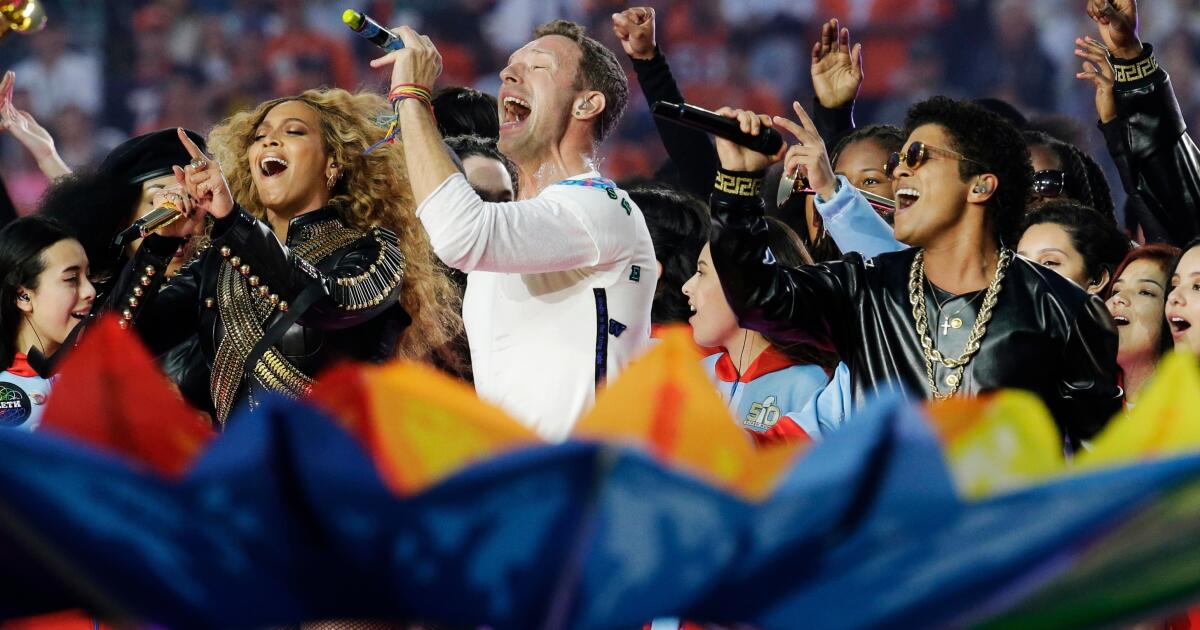
Then came bad hombre after bad hombre from the UK: Paul McCartney, the Rolling Stones, the Who, Coldplay. And don’t even get me started on Shakira, gyrating her Colombian self into 2020’s Super Bowl LIV Halftime Show, or the following year, the Weeknd using his sweet voice to distract from the fact he’s Canadian.
Remember all the anti-immigrant furor around those aforementioned performances? Of course not — because there was none. And this year, if the delicately reunited U.K. duo Oasis was to pull things together for 2026 and play the Super Bowl, it most certainly wouldn’t inspire the same kind of vitriol.
The right remembers that Bad Bunny criticized the Trump administration for its handling of Puerto Rico’s hurricane recovery, and that that he has spoken out against ICE’s inhumane treatment of immigrants. But calling Bad Bunny a dissenter is too direct, too Stalinist. It’s better to cast doubt upon the singer’s loyalty to America via thinly veiled racist rhetoric.
Turning Point USA, the right-wing group founded by Charlie Kirk and helmed by his wife, Erika Kirk, following his assassination, has organized its own counter-concert called the “All-American Halftime Show”. It will star rap-rocker Kid Rock and country artists Brantley Gilbert, Lee Brice and Gabby Barrett. The show is counter-programmed to compete with the Super Bowl halftime show, airing on X and conservative networks such as TBN and OAN around the same time as Bad Bunny’s set.
When the “alternative” show’s lineup was announced this week, Kid Rock took a jab at Bad Bunny in a statement: “He’s said he’s having a dance party, wearing a dress, and singing in Spanish? Cool. We plan to play great songs for folks who love America.”
Kid Rock isn’t known to wear dresses on stage, as Bad Bunny has done, but it’s unclear which songs of his he’ll play in the name of “loving America.”
Turning Point spokesman Andrew Kolvet said the show will reflect conservative values such as “faith, family, and freedom,” so Kid Rock likely won’t perform his 2001 track “Cool, Daddy Cool,” where he sings “Young ladies, young ladies, I like ‘em underage see / Some say that’s statutory, but I say it’s mandatory.” It’s also unlikely he’ll bust out his 2007 song “Lowlife (Living the Highlife)”: “I make Black music for the white man / Keep cocaine upon my nightstand.”
One thing is certain: He’ll continue to sing Trump’s praises, in English.


NEWYou can now listen to Fox News articles!
Pro wrestling is often known for its storyline-driven entertainment coupled with hard-hitting and high-flying action in the ring that leads to a crescendo that makes fans feel some kind of emotion. The major companies each try to drive to that moment.
Sometimes, a unique venue adds to the excitement of a show, especially for smaller independent pro wrestling companies who are trying to engage an audience for a few hours at a time. On July 14, Fight Factory Wrestling is going back to the beach for The War on the Shore 3.
COMPLETE PRO WRESTLING COVERAGE ON FOX NEWS DIGITAL
Fight Factory Wrestling hosted The War on the Shore 2 in Point Pleasant Beach, New Jersey, last year. (Provided to Fox News Digital)
The event will take place near Martell’s Tiki Bar in Point Pleasant Beach, New Jersey, bringing professional wrestling to the beach. Joey Janela, Ben Bishop, Jack Vaughn, Richard Holliday, Steve Maclin, Jay Lethal, Sent 2 Slauter, Lady Frost, Allie Katch, Steph De Lander and others are among those billed to be in matches for the event.
Dave Sturchio, one of the minds behind Fight Factory Wrestling with Chris Payne, talked to Fox News Digital about getting started in the sport. He said him and Payne initially got started wrestling in 2012 but as time went on, the two went their own way. The two came back together in 2024 to do the “Fight Factory Podcast.” He said Payne had aspirations to do a wrestling show on the beach – akin to World Championship Wrestling’s Bash at the Beach.
Sturchio said he called Payne to follow through on doing a beach show despite some apprehension about getting involved into the creative side of the sport. Sturchio said when he first approached the venue about the event, there was a little hesitation, but when he came back with a plan, the venue agreed.
“As the buzz started to develop and build over prepping for the show, I said to Payne, ‘I don’t know if this is a one off. I think that we have something here,’” Sturchio said. “And Payne and I, we’ve been in the industry since 2012, we’re life-long fans, I’m already an entrepreneur at heart, so how can I take my entrepreneurial stuff for the last three-four years of being my own boss, how do I spin this into becoming a pro wrestling promoter?”
Sturchio said that teaming with Payne allowed for the stars to align and to give each other a shot at building something great. He said the response from the first War on the Shore in 2024 was “overwhelming.”
Fight Factory Wrestling’s Dave Sturchio on the microphone at The War on the Shore 2. (Provided to Fox News Digital)
“We were like, this is actually kind of crazy. People are actually jones-ing for some wrestling in the summer. Typically, when you go to a VFW or your gymnasiums, independent wrestling kind of takes off and they don’t run as much in the summer because it’s hot. So, I said, if anything, nobody is going to run against us and unfortunately for us, we were put on a Tuesday night and we were like, ‘Jesus Christ, there’s no way anybody is going to show up on a Tuesday.’
“Turns out, nobody is really doing anything on a Tuesday. It was very easy to book the wrestlers in that regard because nobody else had anything going on. … First year was great. I think the best testament that we got was we booked Matt Cardona to be one of our featured guests on the first one and that’s when he tore his pec. So, he was out of action for a little while but he promised us that he would still show up.”
Sturchio said Cardona was blown away and thought he and Payne had been running shows for a while.
“If you’re going to blow away Matt Cardona, I think we got something. It was off to the races, man,” he added.
Now, Sturchio and Payne are set to put on their third War on the Shore in New Jersey and the card couldn’t be more interesting.
“This year, we really stacked the deck,” he told Fox News Digital. “Some professional wrestling shows you go to on the independents, there are those lulls. Matches where you’re like, ‘Oh, they’re giving this guy a chance over here and they’re gonna give this guy a chance over there.’
“This year, I told Payne, look, based off of everybody that we’ve booked so far, for me, and some independent wrestlers don’t want to hear this, we’re trying to build a roster, build a core roster. Meaning, if we used you before and you’ve done good work, we’re gonna use you again. Instead of saying, hey, random guy over here, who I don’t know who you are, but let’s give you a shot. So we’re trying to build stories and there are a lot of stories that are culminating.”
Sturchio pointed to a number of matches that fans should be eager to see. One specifically is the reformation of The Heavenly Bodies tag team with Justin and Mark Corino.
Pro wrestling fans back Point Pleasant, New Jersey, for The War on the Shore 2. (Provided to Fox News Digital)
“Those guys are reuniting for the first time in seven years,” he said. “They’re friends of mine, I came up with them. They were my first tag team opponents and I’ve known these guys forever and they’re near and dear to my heart.”
CLICK HERE TO DOWNLOAD THE FOX NEWS APP
Lady Frost will be in action against De Lander and Katch. Bishop defends the Fight Factory Premier Championship against Holliday and Vaughn. Janela will take on Jay Lethal for the first time ever and the event will feature a rumble and a tiki totem on a pole, which will act as Fight Factory Wrestling’s “Money in the Bank” type of gimmick.
“The card is stacked. I’m very excited about all of it. There’s not one lull,” Sturchio said. “We’re just going to roll right through and I think it’s going to be one of those nights that we remember for a very, very long time.”

Everyone knew going in that Lionel Messi would be the narrative centerpiece of the 2026 World Cup. Easily the most recognized name in the competition, Messi is considered by many to be the greatest soccer player of all time and, as the captain of 2022 winner Argentina, he is the reigning World Cup champ. At 18, he scored his first World Cup goal in 2006 and has competed in every World Cup since. He celebrated his 39th birthday before this year’s knockout rounds began, so it’s not unreasonable to assume that this will be his last.
No matter what Messi did, or failed to do, it would be News. Everyone with even a passing interest in the event knew this. Including me.
But I didn’t expect to completely fall for the guy. He’s a professional male athlete, for heaven’s sake, and I don’t emotionally invest in professional male athletes. Admire some of them, sure; watch with bated breath and then scream in astonishment when they pull off some amazing feat or another, absolutely. But the only athletes that have ever touched my heart have been women — Nadia Comăneci; Billie Jean King and the Title IX-sparking stars of women’s tennis; Dorothy Hamill; Brandi Chastain and 1999 Women’s World Cup winners; Venus and Serena Williams; Simone Biles; Caitlin Clark.
But here I am, at age 62, truly, madly, deeply in love with Lionel Messi.
I know, I know, me and half the world. Which normally would serve as an effective prophylactic. I am habitually wary of super-intense fandoms and the men who inspire them; stadiums filled with people chanting a single name inevitably set off internal alarm bells. As I have asked several times in columns throughout the years, how many “heroes” must we watch falter under pressure or be exposed for decidedly unheroic acts before we wise up and get out of the pedestal-placement business?
Yet here I am, stalking him on Instagram, up all hours flicking through interviews and career highlight clips. (I even watched the Apple TV docuseries “Messi Meets America”!) Here I am, literally praying to God, who clearly has more important things to do, for Argentina to advance and screaming Messi’s name every time he scores, assists or pretty much does anything at all.
In a matter of weeks, I have become addicted not just to watching the man play but seeing how he reacts when a shot is made or a game won.
Every World Cup player is happy when they or their team scores, but Messi is delighted. Like a kid seeing a puppy under the tree on Christmas morning. Like he cannot believe this wonderful thing that has just happened even if he was the one who sweat and ran and defied physics to make it happen.
His smile is infectious and even when he is running toward the stands, arms spread wide, after making some impossible shot or other, it never seems self-congratulatory. He is simply filled with joy and wants to spread it around. The field, the stadium, the world.
And his hugs. Long, deep, radiating emotion, utterly unself-conscious. Everyone needs to find someone who hugs them like Messi hugs people — teammates, coaches, opposing players, young fans. I could watch videos of him hugging his mentor and former teammate Ronaldinho or Argentina coach Lionel Scaloni all day long. (I’m not saying I have, nor am I saying I haven’t.)
Sometimes the hype gets a bit nauseating — former teammates who claim he never makes a mistake, commentators who refer to him as superhuman (despite the fact that he has missed as many penalty kicks as he has made in this World Cup). Whether Messi himself agrees that he is the GOAT is none of my business, but he doesn’t act like many sports stars who have received similar adulation. He doesn’t peacock, he doesn’t preen; he is visibly angry with himself when he doesn’t produce. He isn’t perfect — in various past games, he has gotten into heated disputes and shoving matches and famously (and many believe deservedly) taunted Netherlands coach Louis van Gaal during World Cup 2022. But for a man who has been such a star for so long, he presents himself as simply a player among players. The captain, certainly, but not the most important person on the field.
That is the most lovable, and superhuman, thing about him.
It feels pretty basic, not to mention embarrassing, to have a sudden summer crush on Messi, but I don’t care. He’s married to his childhood sweetheart, has three adorable sons and a picture of his mother tattooed on his back. He lets his teammates hoist him in the air and allows sports commentators to regularly (and lovingly) refer to him as “Little Messi.” He gets angry sometimes, but in this tournament he has yet to noticeably hector the refs or rumble with his opponents. He wants to win, obviously, but his joy comes from playing the game well rather than defeating another team.
That’s why, despite my newfound addiction to Messi delight, the moment I loved him best was when he didn’t celebrate at all. In the round of 32, Argentina (No. 2 in FIFA rankings) seemed guaranteed a win over Cape Verde (67). But even with Messi’s early goal, the game was a nail-biter, with Cape Verde scoring two brilliant goals while their goalie Vozinha made eight saves, including four shots (one of them a free kick) from Messi. After Argentina won in additional playing time, there was none of the usual jubilation. Instead, a subdued Messi walked to the midfield to shake hands with his opponents, a sign of exhaustion, no doubt, but also of respect. He hugged Vozinha and told him that his country should be proud of him.
The exuberance was back Tuesday, however, when, after trailing Egypt for most of the round of 16 game, Argentina managed to pull off the comeback of the tournament, going from a 0-2 deficit to a 3-2 win after the 79th minute, with Messi scoring the tying goal.
This time, the smiles, the hugs, the radiant joy filling Atlanta Stadium could have powered the entire state of Georgia. This time, Messi was so happy, he wept.
So did I. The World Cup is over in less than two weeks, and France and Spain are currently the 1-2 favorites to win the thing. My love for Messi is, after all, just a summer romance.
And as with any summer romance, I want it to last forever.
Sports
Donovan Mitchell signs massive $273M Cavaliers extension as LeBron James return speculation grows

NEWYou can now listen to Fox News articles!
Donovan Mitchell got quite a payday from the Cleveland Cavaliers Tuesday, agreeing to a four-year, $273 million maximum extension, which includes a full trade kicker and player option for the 2030-31 season.
While Mitchell could’ve waited one more year to get a potential five-year, $353 million deal, the 29-year-old wasted no time signing an extension on the first day he was eligible to do so this summer.
It’s hard for Cleveland not to want to build its team around Mitchell now and for the foreseeable future. He has been an All-Star seven straight seasons, which includes three with the Utah Jazz before he was traded to Cleveland during the 2022 offseason.
Donovan Mitchell (45) of the Cleveland Cavaliers looks to pass the ball during a game against the Memphis Grizzlies Feb. 2, 2023, at Rocket Mortgage FieldHouse in Cleveland. (David Liam Kyle/NBAE via Getty Images)
He has averaged 26.7 points in four seasons with the Cavaliers, including 27.9 last season, and has made an All-NBA team in three of his four years.
Mitchell also noted having “unfinished business” after the team got swept by the eventual NBA champion New York Knicks in the Eastern Conference finals.
Mitchell was heading into the 2026-27 season on the last guaranteed season of his previous contract before a 2027 player option kicked in.
CAVS NEED LEBRON JAMES ‘TO RETURN HOME TO SAVE THE DAY,’ ESPN STAR STEPHEN A SMITH SAYS
Now, the bigger question for the Cavaliers: Does Mitchell’s contract extension hurt or help their chances of yet another reunion with LeBron James?
The 41-year-old has made it clear he will be playing elsewhere for the 2026-27 NBA season, marking the end of his eight years with the Los Angeles Lakers.
James, the NBA’s all-time leading scorer, hasn’t indicated where he might be heading, but reports have indicated his agent, Rich Paul, is actively looking at specific teams.
LeBron James (6) of the Los Angeles Lakers reacts to a foul call during the second half of a game against Dallas Mavericks at Crypto.com Arena Jan. 12, 2023, in Los Angeles. (Kevork Djansezian/Getty Images)
Among them is the Cavaliers, as the man from Akron, Ohio, has played a significant role in the franchise’s history, including an NBA title in 2016. If this is James’ final NBA run, why not do it where it all began, where he returned after his successful stint with the Miami Heat and where he can close the book on a one-of-a-kind career?
However, other teams, including the Philadelphia 76ers, Miami Heat and Golden State Warriors have been rumored and debated about.
Of course, the salary cap and staying within its parameters is a big deal for NBA teams. While a Cavaliers fan could view Mitchell’s max extension as a bad thing for James to land back in Cleveland, it is not believed it will affect their chances at signing him.
As for James’ NBA title chances, the Cavaliers did reach the Eastern Conference finals, and the 41-year-old wouldn’t have to be the center of attention in terms of offensive playmaking. Mitchell and Evan Mobley can lead the way there, while Jarrett Allen protects the rim down low.
The Cavaliers and James Harden, whom they acquired before the trade deadline last season, are reportedly negotiating a team-friendly deal as well to keep their salary cap at bay.
Donovan Mitchell of the Cleveland Cavaliers reacts during the fourth quarter against the Detroit Pistons in Game 7 of the second round of the NBA Eastern Conference Playoffs at Little Caesars Arena on May 17, 2026 in Detroit. (Gregory Shamus/Getty Images)
CLICK HERE TO DOWNLOAD THE FOX NEWS APP
Whether the big fish will be landed, bringing “The Chosen One” back to his roots one last time remains to be seen.
Mitchell has left no doubt, though, where his future lies in the NBA, and he will look to get that unfinished business squared away in Cleveland.
Follow Fox News Digital’s sports coverage on X and subscribe to the Fox News Sports Huddle newsletter.
-
 Lifestyle13 minutes ago
Can you say no to a friend’s wedding? : It’s Been a Minute
-

 Technology21 minutes ago
The robotaxi law that could ban Tesla
-

 World28 minutes ago
US urges donors to abandon UNRWA funding as UN defends agency’s mission
-

 Politics31 minutes ago
EXCLUSIVE: FBI adds alleged COVID fraudster accused of taking $5M from kids’ meal program to Most Wanted list
-

 Health36 minutes ago
One walking habit could signal a healthier brain after 80, scientists say
-

 Sports43 minutes ago
New Jersey pro wrestling promotion bringing the fight to the beach
-

 Technology46 minutes ago
Are airline miles still worth it?
-
 Business51 minutes ago
Walmart’s EV chargers are coming to California with discounts for members

