Sports
Brailsford's story, part one: The rise of Mr Marginal Gains and the road to Manchester United


If you work in the sports industry but have not been invited to one of Jimmy Worrall’s events, it’s a message: you haven’t made it yet.
One of life’s great networkers, Worrall is the founder of Leaders In Sport, a conferencing and publishing business based in London but with a global outlook.
Sir Dave Brailsford, the man tasked with the job of making Manchester United a feared and revered team once more, has been invited to lots of Worrall’s events. Sometimes, he is the event.
About a decade ago, Worrall started an offshoot of his Leaders mega-gatherings. He called them P8, a play on the G8 summits in international politics, with the P standing for “performance”.
Brailsford talks at a Leaders conference (Charlie Crowhurst/Getty Images for Leaders)
The format is simple. Worrall books space in a hotel for a day or two and invites a group of big names to hammer out whatever job-related problem they want to discuss — no media, no sponsors. Invitees have included Carlo Ancelotti, baseball’s Billy Beane, Gareth Southgate, Arsene Wenger and Mercedes F1 boss Toto Wolff. Brailsford has been to every one.
“It’s like an MBA (Master’s degree) with bells on,” Worrall tells The Athletic. “And when Dave speaks, they all listen. His contributions are just better than the others.
“We did a tour of a few different U.S. teams in the autumn of 2022 and I remember taking him to the (NFL’s) Philadelphia Eagles. (Eagles general manager — a job roughly equivalent to sporting director/director of football) Howie Roseman suggested we pop down to say ‘Hi’ to the coaching staff. So, we went down to where (head coach) Nick Sirianni and his guys were.
“I wondered if Sirianni would have the first clue who Dave was, this Tour de France guy. But when Howie introduced Dave, Nick leapt up from behind his desk and shook Dave’s hand. Pointing to a load of motivational messages on the wall, he said, ‘You see all these mottos? They’re our marginal gains. I’ve been studying you for years’.
“I’ve witnessed things like that all over the world of sport. Dave is the best high-performance thinker in the world.”
That’s a big claim and some might suggest Worrall, now a “strategic advisor” to the European Club Association, Deloitte and INEOS, is a bit biased when it comes to his friend’s abilities. But he is not alone.
The Football Association asked Brailsford to join an advisory panel when it was trying to climb out of the crater left by England’s performances, and early exit, at the 2016 European Championship in France. And in 2022, the England and Wales Cricket Board wanted to pick his brains for its next five-year plan.

Brailsford (fourth right) celebrates Chris Froome’s 2016 Tour de France win (Jean Catuffe/Getty Images)
These were formal examples of sports tapping into Brailsford’s expertise but he has been doing this on a more informal basis for 20 years.
“I’ve known Sir Dave for years, working across different sports, and he is, without doubt, the best in the world at creating a high-performance culture and turning that into winning,” said Newcastle United director of football Dan Ashworth after he had invited Brailsford to speak to that club’s players and staff before the 2022-23 season.
With Brailsford now keen to bring Ashworth to Manchester United, that quote looks like a textbook case of foreshadowing but at the time, it was just another example of one sports expert paying homage to the “Tour de France guy”.
But what has he done that could give him any insight into what it takes to win in the NFL, international cricket or club football?
There is no answer to that question, but Brailsford will turn 60 this week, and while nobody could have predicted even 15 months ago that he would become this powerful at perhaps the biggest football team on the planet, it makes sense when you lay it all out.
That does not mean it will work, of course, but people used to say the same thing about British cyclists winning the top races…

Brailsford’s father, John, was an orphan from Sheffield who started off as an apprentice in the Yorkshire city’s steel industry and became a master blacksmith but followed his heart to work as a mountain guide in France, via stops as a teacher in Derbyshire, where Brailsford was born on February 29, 1964, and north Wales, where he grew up.
A good amateur cyclist, John was head of outdoor education at a school in the Welsh town of Bangor and spent his weekends climbing in the nearby Snowdonia mountains. Family holidays involved more cycling and climbing in the French Alps. He also invented climbing equipment, including an ice axe that is still used by mountaineers today, and wrote several guidebooks.
Adversity, self-reliance, technical skill, hard work, passion, leadership… hmmm, nobody likes amateur psychiatry but one wonders what lessons the future Sir Dave may have learned at home.
Brailsford left his Welsh-language school at 16 and became an apprentice draughtsman with the local highways agency. But three years later, to his mother’s horror but John’s quiet approval, he announced he was moving to France to become a professional cyclist.
Over the next four years, riding as a sponsored amateur for a team based in Saint-Etienne, he learned he was not quite good enough to make it as a pro but he became fluent in French and an avid reader of books about coaching, physiology and psychology.

Brailsford in his early British Cycling days in 2011 (Tom Jenkins/Getty Images)
Armed with this knowledge, he returned to the UK and did a sports science degree in Chester and then an MBA in Sheffield. His first real job was running a perfume business in Paris, before doing a similar job in Worcester, in the West Midlands.
Scents to cycling is not an obvious path but Brailsford had not stopped being interested in a career in the sport. So, when he set up his own independent consultancy, in his early thirties, it made sense that one of his clients was Planet X, a Yorkshire-based cycling retailer.
And while he was edging closer to the job that would make his name, that job was edging closer to him, too.
The 1996 Summer Olympics were a nadir in the history of British involvement at the Games. The team returned from Atlanta with only 15 medals and just one gold. That meant finishing 36th in the medal table, below Belgium, Kazakhstan and North Korea.
The remedy was adding the pursuit of medals to the list of good causes that the recently launched National Lottery should fund and a new quango, UK Sport, was set up to allocate the money and make sure it was well spent.
The era of big budgets, medal targets and performance directors had begun… it just needed people who could run it all.
Largely by default, Peter Keen was that person at British Cycling. A schoolboy champion, Keen had become the national track cycling coach by the age of 25 and was Chris Boardman’s coach when he won the individual pursuit title at the 1992 Games in Barcelona — Britain’s first cycling gold for 72 years.
A superb coach with an academic’s brain, Keen was also honest enough to know he needed help. So he hired Brailsford, first to get hold of the better equipment the British team could suddenly afford, and then to do whatever else was required now Keen had told everyone the target was Olympic domination.
Long story short? Keen was right.
By the time he took an overarching elite-performance role at UK Sport in 2003, Brailsford was Keen’s natural successor at British Cycling and the raw materials were in place to turn its home at the Manchester Velodrome into Team GB’s medal factory. Two Olympic golds in 2004 were followed by eight in both 2008 (France were next with two cycling golds) and 2012 (no other nation won more than one), with plenty of silvers and bronzes and World Championships titles, too.
Millions of words have been written and spoken about how Brailsford and company (because it was a team effort) did it but the short version is what NFL coach Sirianni referred to when he pointed to the writing on the walls at the Philadelphia Eagles’ training facility: marginal gains.
Based on the Japanese principle of ‘kaizen’, which loosely translates as constant improvement, Brailsford’s big idea was that if athletes and their teams upgrade all the little things they do by one per cent, the overall gain will be game-changing.

Bradley Wiggins and Brailsford hug after a medal win in 2008 (Tom Jenkins/Getty Images)
It has become a cliche now — and Brailsford himself got bored of talking about it years ago — but it is hard to exaggerate how persuasive and pervasive this idea was. Business leaders, educationalists, politicians and other sports leapt on the bandwagon and Brailsford was the guru de jour.
That was especially the case for a golden/yellow period between 2011 and 2016, when British cyclists seemed to win a different race every week across all of the sport’s different disciplines.
By this point, Brailsford had already decided to take what had worked so well in track cycling to the ultra-competitive world of road cycling by launching Team Sky in 2010. Never afraid of a target, he said he wanted to win the Tour de France, with a British rider, within five years.
He ticked that box within three years, when the now Sir Bradley Wiggins won cycling’s greatest race. That victory was the first of seven Tour wins in eight years, shared between four riders, three of them Brits.
That team, which was bought and renamed by Sir Jim Ratcliffe’s petrochemicals giant INEOS in 2019, has also won three editions of the Giro d’Italia and two Vueltas a Espana, the two other “grand tours” on the calendar, as well as dozens of week-long races, one-day classics, time trials and national and world championships.
I was lucky enough to have a roadside/trackside view of many of these triumphs as a cycling reporter for the BBC and, like every other reporter on that beat, I could fill notebooks with examples of what came to be lumped together as “marginal gains”.
Some of them became famous (and widely copied) pretty fast; some were not really new at all, Brailsford just rebranded them; some were clearly nonsense (although nonsense can be quite effective in sport if the right people believe it).
The link was that they were all answers to the fundamental question he would set himself. How do we win this race?
The easy answer is: You get to the finish line quickest. But how do you actually do that? Or, just as important, what stops you from doing it?
You need the best kit, right? So, Brailsford brought in designers from motorsport to create the most aerodynamic bikes, helmets and shoes, and he would hold the best stuff back until the big races so his competitors couldn’t copy it. Team GB got so good at this that some teams would be mentally defeated just by the sight of the Brits’ new kit at an Olympics, whether it was actually special or not.

Laura Trott thrived under Brailsford (Phil Walter/Getty Images)
You must prepare properly. So, he hired bright, hungry, workaholic coaches and support staff to make sure the riders were well coached, fed and looked after. If other teams did a winter training camp for a week somewhere hot, Team Sky would book an entire hotel on the Spanish island of Mallorca for December and January.
And he really valued coaching. Whereas other teams would spend all their budget on riders, he would save some for the team behind the team, because he believed a £900,000 rider with a £100,000 coach would beat a £1million rider.
Once a season started, other teams would not bother with training so much. The orthodox view was you raced to stay fit. Brailsford and his staff realised the racing could be easier than the training, so the riders would “detrain” as the season went on, or the races would not prepare them for the specific challenge ahead.
So, Team Sky broke up the calendar, inserting in-season training blocks. And if the secret to winning the Tour de France was how fast you climb above 2,000 metres, why not spend a big chunk of time only doing that? So, Team Sky went to Mount Teide, a volcano on the Spanish island of Tenerife with one of the highest roads in Europe and a spartan hotel at the top.
To get around France on a bike, you need to eat lots without stressing your stomach, so Brailsford hired great nutritionists who got the riders eating rice cakes on their bikes and drinking vitamin-rich blends of vegetables for breakfast. He bought a mobile kitchen and brought his own chefs to the Tour, so the team did not have to eat whatever the local hotel chef came up with. After all, it has to be tasty or they won’t eat it.
You have to stay healthy, so he got a surgeon to teach the team how to wash their hands properly and had the entire gang fist-bumping and using hand sanitiser gel long before anywhere had heard of Covid-19.
An article he read about the Royal Ballet’s tour taught him the importance of sleep, so he got the riders to bring their own pillows with them to races and had washing machines fitted on the team bus (they later had an entire van of washing machines, to avoid the risk of illness spreading throughout the team) so they had their own clean sheets every night.
In 2015, he turned up at the first race of the season in a motorhome, so he did not have to put up with the sometimes sketchy hotel rooms a race organiser would provide. He actually wanted his riders to stay in motorhomes, too, but that was a marginal gain too far for cycling’s bosses, who thought it would give the big-budget teams an advantage and not do much for the sport’s environmental footprint.
He made it clear that everyone was working for a common goal — to win — and everyone had a contribution to make. The mechanics had to be the best at the race, so Team Sky would have fewer mechanical problems than their rivals, or their bike changes would be slicker. If it was cold or wet, the support staff had to get the riders warm and dry while their rivals were still shivering. The press officers had to be the best at getting Wiggins, Chris Froome or whoever was winning through the post-race protocols and back at the hotel as quickly as possible.
Over a three-week bike race, with all other things being equal, the team who eat and sleep the best, have the fewest crashes and punctures, and don’t lose anyone to a cold or tummy bug, win. That is what marginal gains meant in practice. But what was also very clear, as I followed the team about France and elsewhere, was that it was about people.
Brailsford had simply put the best team together, and they were not all obvious hires. Some were, but his best recruit was Tim Kerrison, a sports scientist from Australia who had previously worked with rowers and swimmers and knew nothing about cycling. Kerrison used to remark that his naivety about the sport was a strength, as he asked lots of questions about why cyclists did things the way they did them and then showed them a better way.
Kerrison became head coach and he got them training harder, earlier in the season, and smarter.
Data played a big part but it was applied to fairly basic ideas about what a rider needed to do to win. The team have not won a Grand Tour since Kerrison left at the end of the 2021 season.
Of course, none of the above has much to do with football, right?
There is no disputing that, beyond pointing out that people wondered what it all had to do with winning the Tour de France until Brailsford did it.
So, what lessons can we draw from this that might explain what Brailsford will bring to Manchester United?
“Dave’s personality is perfectly matched to the qualities you need to thrive in elite sport, or any high-performance environment for that matter,” says Peter Keen, the man who hired him at British Cycling.

Team Sky celebrates with Froome (Chris Graythen/Getty Images)
“He is never ‘off’ — complete immersion. And when you are dealing with other obsessive, driven people, that’s powerful. You need them to feel secure. You need their trust. Dave earns that because he is as committed as they are.
“He is also fearless. Most people, if they see colleagues having an argument in the office, will pretend not to see it or just turn around because they don’t want to get involved. I’m not saying Dave likes a fight but he is not afraid of conflict. He will walk towards the argument and intervene, and 99 per cent of the time, he will make the situation better.
“I think he is intrigued by tension and there is a lot of that in elite sport — it’s relentless and it can be uncomfortable. He is OK with that.
“Dave is very good at picking the right people for the right role. He realised early on that his real skill was finding talented people who shared his hunger and work rate, but were perhaps best out of the limelight. Again, that is very powerful.
“But he is not at all sentimental. If you’re not performing anymore, you’ve got to go. That can seem quite clinical and uncaring but you cannot have passengers in elite sport. Dave has never had any problem with the difficult conversation.”
Brailsford calls this approach “compassionate ruthlessness” and he talked about it for the first time in Heroes, Villains and Velodromes, the 2008 book about Sir Chris Hoy’s rise to Olympic stardom by the late journalist Richard Moore. Like so many books about British cyclists of this era, Brailsford puts in a best-supporting actor performance.
“It means,” Brailsford explained to Moore, “telling people the truth all the time about where they’re at, and making very tough decisions about whether riders continue on the programme, about staff continuing or not…”
Does this make you think of a certain underperforming football giant, too?
Sir Michael Barber is an educationist who ran the public policy unit Britain’s then-Prime Minister Tony Blair set up to make sure his government was doing what it promised it would do. Barber described himself as a “deliverologist” and has advised governments in more than 60 countries on how to get things done. He is a good example of the kind of person who likes Brailsford, and vice versa.
“He brings a way of thinking about elite performance that is relevant to every sport,” Barber tells The Athletic.
“At first, it was a lot of stuff about technology and science, but he’s equally good at the more human side of things, the man-management stuff.
“Gareth Southgate was very interested in Dave’s advice on how you keep everyone in a World Cup squad motivated, including those who aren’t playing. Team Sky had almost 30 riders but only nine, and then it was eight, of them could ride the Tour.

Brasilford talks to Froome during a race in 2013 (Bryn Lennon/Getty Images)
“His real skill was making sure everyone in the team felt like they were contributing to the goal of winning the race. Gareth lapped it up and took detailed notes.
“A lot of very good sportsmen and women talk about doing their best, but with Brailsford, it is more than that. I remember talking to him after one of the Tour victories. It was in the lobby of the hotel the morning after and I congratulated him. He proceeded to tell me about the four things they got wrong that could have cost them the win.
“He is also very interested in learning from other sports and walks of life. When he ran the sub-two-hour marathon project, he didn’t know anything about running but he asked the same questions about the demands of the event that he asked before the Tour. And then he asked how best to prepare for that: Where do people lose speed? How many support runners do we need? What happens when there is an adverse camber on the road?”
This is a reference to one of the things Brailsford has done since he stepped back from his hands-on role with the cycling team and took on his current job as INEOS’s director of sport, which is basically a role he designed himself and then pitched to Sir Jim Ratcliffe in 2019.
Speaking to the T2 Hubcast podcast last year, Brailsford said he was in charge of something called “INEOS X… teams times teams”, which he described as an attempt to recreate the highly cooperative and multi-disciplinary world of Olympic sport in a professional teams environment.
What this means in practice is that he oversees all of Ratcliffe’s sports investments and tries to get them to share best practices, so they all win.
Practical examples of this would be moving the designers working on the America’s Cup sailing team Ratcliffe owns, the Sir Ben Ainslie-skippered INEOS Britannia, into the Brackley base of Mercedes-AMG Petronas, the Formula One outfit of which Ratcliffe owns a third, or turning French top-flight football club Nice’s training ground into a high-performance centre that the company’s cyclists and sailors can also use.
Another would be the INEOS 1:59 Challenge that Barber referred to, which saw Kenyan marathon great Eliud Kipchoge make history by breaking the two-hour mark for running 26.2 miles in 2019. Ratcliffe who loves a challenge, too, paid for the lot, and Brailsford, despite admitting that he knows “less about running than I know about football… and I don’t know much about football”, planned it for him.
Using the same “what are the demands of the event” checklist that he applied to winning Olympic medals and Grand Tours, Brailsford used his sailing team’s weather expertise to find the perfect location — a park in the Austrian city of Vienna, his cycling team’s aerodynamics experts to come up with a new formation for Kipchoge’s stellar cast of pace runners to use and Ratcliffe’s wallet to flatten out any bumps in the road; literally, in terms of a new roundabout in the park.
More recently, however, Brailsford has been on a football crash course. It is almost like he knew there was a big job on the horizon.
We have already written extensively about his work at Nice, so we will not dwell too long on it here, beyond noting that he threw himself at it with the customary gusto and it appears to have worked. They are third in Ligue 1, a point behind the team in second place, and into the quarter-finals of the Coupe de France.
“Dave wouldn’t pretend to be a football expert,” says Leaders In Sport’s Jimmy Worrall. “He knows he can’t match guys like Dan Ashworth or (Manchester City director of football) Txiki Begiristain for football knowledge, but he knows how to win.
“He was thrown in at the deep end at Nice. Of course, he was going to make mistakes but it was obvious to me that he would learn from those mistakes. He was working from seven in the morning until midnight, sleeping at the training ground in his motorhome.”
When Brailsford was asked about his football qualifications on that T2 podcast, he put it like this: “When I watch cycling, I’ll be watching in colour and you’ll be watching in black and white. But in football, I’m watching in black and white. I’ll get better, I’m working on it.”
Michael Barber agrees.
“Dave is passionate about football,” he says. “He loves it.”
While Keen chips in with an even better anecdote.
“We were close for a while and we had complementary skills,” explains Keen. “He was good at things I couldn’t do and vice-versa, and it worked really well. We didn’t socialise much but I vividly remember one occasion when Dave had managed to get some tickets for a Manchester United game. That would have been about 2003.
“Now, I’m not suggesting he has been playing the long game all this time but I do know that he has always loved football and Manchester United.”
I mentioned earlier that 2016 was the end of a period when it felt like Brailsford might actually achieve the new goal he set himself three years before when he said he wanted to make Team Sky “the most admired sports team in the world”, because that was when shadows started to be cast on his achievements and he ceased to be everyone’s favourite “man with a plan”.

Brailsford celebrates a Nice goal last year (Jean Catuffe/Getty Images)
In truth, the shadows had been there before, but allegations of doping within the British Olympic team and at Team Sky hit the mainstream in 2016 with the leak of Wiggins’ medical records. Suddenly, there appeared to be another explanation for all that winning.
I am not going to get into that here, 4,000 words into an article about what Brailsford can bring to Manchester United (or any other elite sports team), because that story deserves a few thousand words of its own in the coming days. What is important to note at this point is that he started a move away from the limelight in 2016 that he has only recently begun to reverse.
Some of that has to do with two serious health scares (cancer treatment in 2019, then heart surgery in 2021) and some of it is because Team INEOS, now known as INEOS Grenadiers after Ratcliffe’s London pub/off-road vehicle, stopped winning the Tour de France.
It happens. Sport is cyclical and some believe the team lost their edge because Brailsford backed away, bruised by the public reaction to the claims of cheating that he and his supporters have always fiercely denied. Without his presence at every race, standards slipped, details were missed, the intensity waned.
But Brailsford has not lost his edge. And he is now walking the walk at United. As Keen put it, that’s powerful.
Before the strains in their once-close relationship started to surface, Wiggins provided one of the best explanations of what Brailsford stands for, and what he won’t stand for, in his 2009 autobiography In Pursuit Of Glory.
Towards the end of the book, Wiggins describes a “strange poster in Dave B’s office in Manchester”. It is a huge picture of Chris Hoy getting his gold medal at the 2004 Olympics in Athens, taken from behind the podium — “not Chris’ best side by any means”, as Wiggins puts it.
Sir Clive Woodward, England’s 2003 Rugby Union World Cup-winning coach was visiting the velodrome, as they all did back then, and he asked Brailsford why he had chosen that picture, from that angle, to put on the wall.
“That is to remind people why we are here,” answered Brailsford. “We are all behind that bloke — and any rider in a GB kit who goes onto the track. We are here totally to serve and to make sure they have everything they want.
“Any of the backroom staff who can’t accept that are in the wrong place and the wrong job and need to remove themselves immediately. Or I will remove them.”
(Top photos: Getty Images; design: Eamonn Dalton)



NEWYou can now listen to Fox News articles!
All eyes were on Caitlin Clark on Wednesday night as she made her anticipated return from injury in a road matchup in Los Angeles.
But instead of a triumphant comeback, the Fever spent the entire night chasing the Sparks as Clark’s rough return fueled a 106-92 rout.
The superstar never found a groove, looking completely out of sync in her return from a back injury.
STEPHANIE WHITE GIVES CAITLIN CLARK STATUS UPDATE AHEAD OF FEVER-SPARKS, BUT HER NEXT MOVE RAISES QUESTIONS
Caitlin Clark huddles with teammates as the Indiana Fever battle the Sparks. (Photo by Katelyn Mulcahy/Getty Images) ((Photo by Katelyn Mulcahy/Getty Images))
Much of that disjointed performance falls squarely on head coach Stephanie White, who kept Clark on a ridiculously tight leash by limiting her to just 16 minutes. The stop-and-go approach could have sabotaged any chance for the phenom to establish a rhythm.
Clark finished with just 9 points, 4 rebounds and 3 assists. Her minus-16 plus-minus told the story.
The Los Angeles Sparks were severely shorthanded, taking the floor without stars Kelsey Plum and Cameron Brink.
MERCURY’S NOW-DELETED SOCIAL MEDIA POST MOCKING CAITLIN CLARK DRAWS SCRUTINY AFTER STAR’S INJURY
Yet while a depleted Sparks roster played to win, Indiana spent the night over-managing its biggest asset.
With Clark on a minutes restriction and Aliyah Boston out of the lineup, Kelsey Mitchell was forced to shoulder the entire offensive burden.
Mitchell did her part, pouring in 29 points while shooting 5-of-9 from beyond the arc.
Caitlin Clark orchestrates the Fever offense as Indiana battles the Los Angeles Sparks in primetime action. (Photo by Katelyn Mulcahy/Getty Images) ((Photo by Katelyn Mulcahy/Getty Images))
But one hot hand couldn’t stop an efficient LA squad.
The Sparks shot 45% from three-point range, going 9-of-20 from deep to cruise to the 106-92 victory.
White’s next move is to sit Clark against the Mercury on Thursday while Boston returns.
CLICK HERE TO DOWNLOAD THE FOX NEWS APP
After Wednesday’s loss to a shorthanded Sparks team, it’s fair to question whether Indiana’s cautious approach is working. The Fever dropped to 12-9.
Caitlin Clark and Dearica Hamby face off as Fever and Sparks battle at Crypto.com Arena in Los Angeles. (Photo by Tyler Ross/NBAE via Getty Images) ((Photo by Tyler Ross/NBAE via Getty Images))
Send us your thoughts: alejandro.avila@outkick.com / Follow along on X: @alejandroaveela
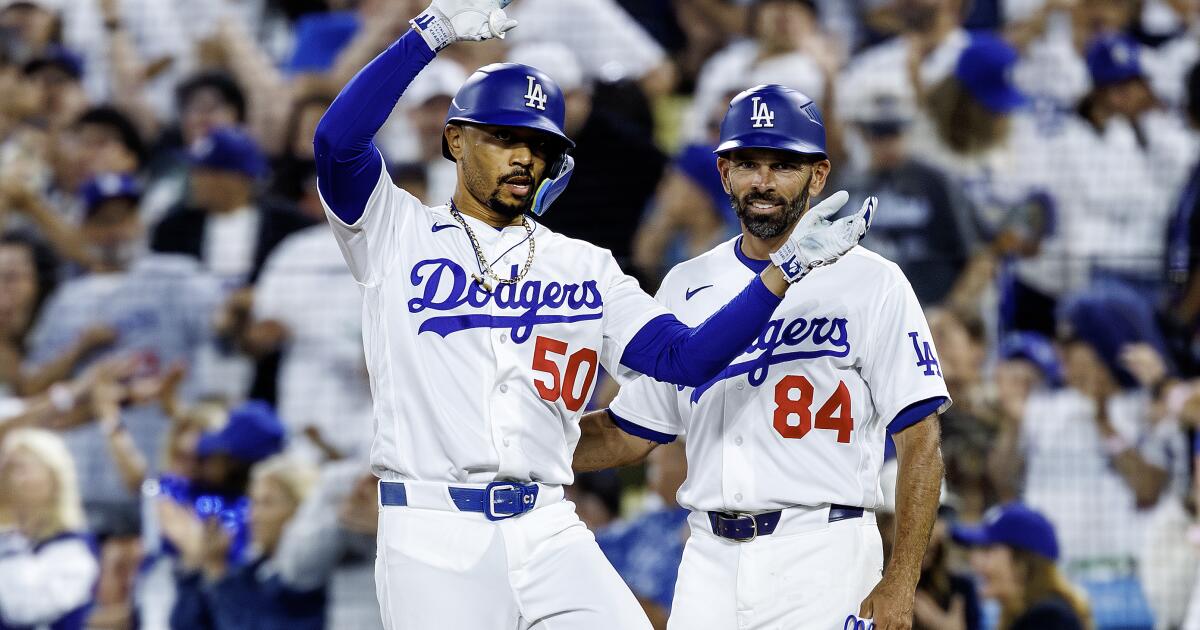
Mookie Betts’ first hit this series against the Rockies couldn’t have come at a more opportune time. With the crack of the ball against his bat, Tommy Edman scored from third, giving the Dodgers the lead.
And as Betts reached first, he pointed to Freddie Freeman, whose single put Edman in scoring position. It had taken a team effort to overcome another middling start from Roki Sasaki, and Betts, who had little to show before his game-winning hit, took the chance to highlight the joint contribution in the Dodgers’ 4-3 rubber-match win over Colorado (38-56).
“It feels great,” Betts said of his nine-pitch battle. “Helping the boys win, that’s really all it is. We play the game to win, and coming through in a big moment is kind of what, when you’re a kid, playing in the backyard, getting that hit is what you always strive to do, and fortunately, I was able to do it.”
Given a three-run lead in the first inning, brought to the Dodgers by a wild pitch and Kyle Tucker’s two-run, line-drive single to left field, Sasaki seemed set up for success.
Still, he gave away the lead as quickly as it came. In the second inning, he left a fastball too far over the plate, and third baseman Kyle Karros drove the ball over the left-center wall. The slider he dealt two batters later to second baseman Edouard Julien also crossed the zone too far over the plate, and Julien rounded the bases with another homer. In the third, a sacrifice fly by Mickey Moniak evened the scored, 3-3.
Sasaki’s troubles this season have been hard to pin down since his last win on May 23, as Sasaki tries to claw back the triple-digit velocity that’s escaped him as of late.
Against the Rockies, his fastball topped out at 99.1 miles per hour before steadily dropping to 98. He had managed five strikeouts in his six innings when manager Dave Roberts replaced him with Jack Dreyer, though the three earned runs couldn’t be ignored.
But Roberts also acknowledged the possibility that the pitcher had been tipping his pitches, possibly since he was playing in Japan, and Sasaki has tried to address it after a three-inning, six-run start last week. Even if he had fully self-corrected, his control issues remain. In the third inning, he walked the tying runner, Brett Sullivan.
“I’ve been working on a lot of things like the tipping stuff,” Sasaki said through interpreter Kensuke Okubo. “Also, I need to make quality pitches.”
Sasaki regained some of his confidence in the fourth when he worked out of a two-base jam with two strikeouts and a flyball to right, something that didn’t go unnoticed by Roberts.
“You can see the demeanor walking off the mound, the confidence,” Roberts said. “For me, it was more of let him end on a high note, feeling good about his outing, and then go from there.”
The Dodgers’ problems were compounded by Alex Call wasting the team’s two challenges in his at-bat in the first inning when the team had already taken the lead. And maybe it would’ve been excusable if Call had driven in the runners on first and second, but instead he ended the inning on a strikeout, stranding both. Roberts called the situation an “outlier” and didn’t feel as though he needed to have a conversation with Call regarding the situation.
After the three-run first, the Dodgers (61-33) remained hitless until Max Muncy laced a double down the right-field line in the sixth, though to little avail. As the innings ticked forward, Colorado’s chances seemed to increase. The Rockies hold the best league batting average (.297) in the eighth and ninth innings (the Dodgers are fourth with .268). And the Dodgers relievers, within the same constraints, have a 3.83 ERA — not bad, but not in the top 10 either.
Third baseman Max Muncy can’t get his glove on a line-drive double by Kyle Karros in the fourth inning.
(Gina Ferazzi/Los Angeles Times)
So when Alex Vesia struggled against the Rockies in the eighth inning and Muncy suffered a throwing error, Colorado seemed in position to score with the bases loaded and one out. Vesia struck out TJ Rumfield and Edgardo Henriquez (4-0), his replacement, retired Karros on a fly ball to right.
After Betts’ single allowed the Dodgers to take the lead, Tanner Scott (13) shut down the Rockies with back-to-back strikeouts, avoiding the team’s eighth series loss of the season.
“Didn’t feel great,” Roberts said. “Fortunately, we won a series, but that’s not the kind of way you want to do it.”
Sports
Justin Verlander announces he will retire after this season: ‘I’ve realized that time has come’

NEWYou can now listen to Fox News articles!
One of the greatest pitchers in the history of baseball will be hanging up his cleats after this season.
Three-time Cy Young Award winner Justin Verlander announced on Wednesday that the 2026 season will be his last.
Amid an injury-riddled season with the Detroit Tigers, Verlander decided it’s time to go.
Detroit Tigers pitcher Justin Verlander watches from the dugout during a game against the Chicago White Sox at Comerica Park in Detroit June 21, 2026. (David Rodriguez-Munoz/USA Today Network via Imagn Images)
“This season has challenged me in ways I haven’t experienced before, both physically and mentally. I’ve always believed that as long as I could compete at the level I expect of myself, I’d keep playing. I never wanted to retire because of a milestone, a number, or a date on the calendar. I wanted the game to tell me when it was time. Over the last several months, I’ve realized that time has come,” Verlander said in a social media post.
“While I’m fully committed to giving my team everything I have for the rest of this season, I’ve decided this will be my last. It’s fitting that I get to finish where it all started – with the Detroit Tigers, the organization that drafted me and gave me my first opportunity.”
Verlander inked a one-year deal with the Tigers, with whom he spent his first 12½ seasons before being traded to the Houston Astros, in the offseason. In Houston, he returned to dominance, winning both of his World Series titles and two of his Cy Young Awards.
“Baseball has given me more than I could have imagined. It taught me discipline, resilience, and the value of continuing to adapt and evolve. I’ve been fortunate to play with and against incredible players, for outstanding organizations, and compete in-front of fans who deeply appreciate the game,” Verlander added in his announcement.
Justin Verlander of the Houston Astros celebrates after the Astros defeated the Philadelphia Phillies in Game 6 of the 2022 World Series at Minute Maid Park Nov. 5, 2022, in Houston, Texas. (Mary DeCicco/MLB Photos via Getty Images)
PHILLIES STAR SAYS ‘BS RULE’ IS KEEPING HIM FROM BEING NAMED ALL-STAR IN FRONT OF HOME CROWD
“To every teammate, coach, player, clubhouse attendant, and fan who has been part of this journey – thank you. It’s been a privilege to share the field with you. To my family, especially my wife Kate, thank you for standing beside me through every season, every rehab, and every high and low. I couldn’t have done this without you. It’s time for the next chapter. But first, I’m excited to finish this season the only way I know how – with everything I’ve got.”
Verlander is the active leader with 3,554 strikeouts, which is good for eighth all-time. He needs 21 to surpass Don Sutton and 87 to pass Tom Seaver.
The 43-year-old made his MLB debut in 2005 and won the American League Rookie of the Year Award the following season in what was just a small glimpse of what was to come.
Verlander was a Cy Young Award finalist on four other occasions, consistently near the top of the leaderboard in just about every pitching stat. MLB Commissioner Rob Manfred gave Verlander a legend’s exemption to this year’s Midsummer Classic, making him a 10-time All-Star.
One could argue that Verlander should have at least one more Cy Young Award on his mantle, but he is on the fast track to Cooperstown and very much in the conversation to join Mariano Rivera as the only player unanimously elected to the Hall of Fame.
Verlander’s best season came in 2022, when he pitched to a career-best 1.75 ERA along with a 0.829 WHIP. However, that came after he missed the entire 2021 season due to Tommy John surgery for an injury he suffered after pitching just one inning in the abbreviated 2020 season.
Houston Astros starting pitcher Justin Verlander throws against the Boston Red Sox during the first inning Aug. 22, 2023, in Houston. (AP Photo/Michael Wyke)
CLICK HERE TO DOWNLOAD THE FOX NEWS APP
He won his first Cy Young Award in 2011, when he was also awarded the MVP Award, and his second in 2019. Verlander’s 11 seasons between his first and final Cy Young Awards are the second-most behind Roger Clemens, who had 18 seasons between his first and seventh.
Verlander led the majors in innings and WHIP four times while recording the most strikeouts in three seasons.
Follow Fox News Digital’s sports coverage on X, and subscribe to the Fox News Sports Huddle newsletter.
-
 News7 minutes ago
Former Olympian pleads not guilty in reflecting pool vandalism charges
-

 Los Angeles, Ca1 hour ago
Heat advisory, beach hazards in effect as Southern California sizzles
-

 Detroit, MI2 hours ago
Teen on moped hit by car after cruising through stop sign in Detroit
-

 San Francisco, CA2 hours ago
Flight of fancy: San Francisco moves to build private luxury airport terminal
-

 Dallas, TX2 hours ago
Dallas’ digital creator economy is booming. Burnout is too.
-
Miami, FL2 hours ago
I went to 2 famous Miami restaurants, a flashy steakhouse and a Cuban hot spot. Here’s how they compared.
-

 Boston, MA2 hours ago
Pedestrian struck and killed in Roxbury – Boston News, Weather, Sports | WHDH 7News
-

 Denver, CO2 hours ago
Santa Fe Drive in Denver closed this weekend for pedestrian bridge construction


