Sports
Beer, Euro 2024, and all those cups – what's going on?


The European Championship has been drenched in beer. In the fan zones and outside the stadiums. On the concourses and in the stands.
Everyone has been drenched. Fans, players and, much to the amusement of everyone not wearing a lanyard, journalists, who have been sheltering laptops and walking into press conferences dripping with booze.
Get the tiny violins. Possibly a towel.
We do need to talk about the plastic cups, which have been cascading down from the stands towards anyone taking a corner or goal kick.
The beer first, though.
The official sponsor of the tournament is Bitburger, the German brewer, and the concourse bars are exclusively stocked with their products. For matches at the Allianz Arena, for instance, Pils, Radler and an alcohol-free beer are €7 for 500ml. For games in Cologne, at the RheinEnergieStadion, they have been pouring Kolsch, the sweet beer usually served in small, cylindrical glasses. There are no limits on how much people can buy and fans are able to drink anywhere inside the stadium.
With exceptions.
For England’s group game against Serbia in Gelsenkirchen, only beer with two per cent alcohol was served, compared with the usual 4.8 per cent. The fixture was deemed high-risk. Other special measures were employed, too, including a ban on drinking in the stands. It is unclear at this stage whether England’s last-16 game against Slovakia on Sunday, back in Gelsenkirchen, will be subject to the same restrictions.
Yet even with that lower alcohol content, most travelling supporters are, where drinking is concerned, enjoying a different level of freedom to that experienced back home.
Reduced-alcohol beer on sale at Serbia v England (Matthias Hangst/Getty Images)
Since 1985 in England, supporters attending matches across the Football League have been prevented from drinking alcohol “in sight of the pitch”. In Scotland, the rules are even stricter: no drinking in stadiums at all.
In Spain, only non-alcoholic beer is allowed. In France, there are no in-stadium alcohol sales for Ligue 1 games. In Serbia, bars around stadiums are only allowed to serve until two hours before kick-off.
Then there is Germany.
UEFA’s approach when staging tournaments is to adapt their rules for food and drink around local legislation and in Germany, alcohol is very much a part of Bundesliga matchdays. There can, as has happened at Euro 2024, be restrictions during high-risk games, that is not unheard of, but there would be something fundamentally un-German about not being able to watch the football with a drink in hand.
Naturally, clubs make a lot of money from beer sales; almost all in the top two divisions have a brewery as a sponsor. Famously, Schalke’s Veltins Arena has a 5km pipeline that connects the stadium with a local brewery. So, on any given weekend, beer sprays out from German terraces. Watch Borussia Dortmund’s Yellow Wall when a goal is scored; in the right light and at the right angle, it can look like the whole stand is weeping with joy.
There was trepidation about this. For instance, before England fans travelled to Germany, the UK’s Foreign Office issued a warning about the strength of German lager. But concerns about over-consumption have not really materialised so far. There have been few arrests and while many supporters have enjoyed long days in sun-drenched beer gardens, there has been very little trouble.
The Athletic spoke to a steward at Allianz Arena on Tuesday night. He said he and his team had experienced few problems with behaviour so far during the tournament. They had been watchful. So far, so good, despite full-strength alcohol being served at the games hosted in Munich, none of which have been deemed high-risk.
The plastic cups are a nuisance, though, and they are everywhere — including in press conferences. On Tuesday night, Dragan Stojkovic was asked whether Serbian fans throwing them at Danish goalkeeper Kasper Schmeichel had created an unnecessary distraction, contributing to his side’s elimination after a goalless draw.
“Please, ask me about the football,” Stojkovic pleaded.

A cup of beer arrives as Schmeichel takes a goal kick against Serbia (Carl Recine/Getty Images)
Three nations have been fined for fans throwing objects onto the pitch so far — Croatia, Scotland, and Albania — and more are coming. When France played the Netherlands in the group stages, Antoine Griezmann had to evade a hail of beer cups when taking a corner. Against Switzerland, Germany’s Toni Kroos was similarly bombarded in the first half in Frankfurt, as was Italy’s Lorenzo Pellegrini against Croatia.

GO DEEPER
Why Toni Kroos ignored progress and stuck with his old Adidas boots
Before that game in Leipzig, a few fans and journalists in the lower tiers were struck by plastic cups from above. Later on, the ball actually struck one that had landed on the pitch. When Schmeichel was a target on Tuesday night, in the incident Stojkovic was asked about, substitute Yussuf Poulsen had to help clear the penalty box.
After England’s 0-0 draw with Slovenia, when Gareth Southgate approached the fans at full time, they responded with jeers and plastic; the English Football Association can expect a fine in the post.
Are UEFA planning action?
When asked about the beer cups by The Athletic on Tuesday, a spokesman said they would be awaiting full reports before making any decisions. Something is stirring, but we are not quite sure what yet.
Plastic cups are not usually such a nuisance in Germany. In March 2022, a game between Bochum and Borussia Monchengladbach was abandoned after an assistant referee was struck on the head by a beer cup. In 2023, a 3.Liga game between Zwickau and Rot-Weiss Essen was abandoned at half-time when a referee had a beer thrown in his face. But such incidents are rare, which might partly be because of legislative change.
In 2023, many German stadiums began a drive towards using reusable cups. At participating stadiums, fans pay a deposit for a cup outside the stadium and can claim it back by returning their cup after the game. Bayern Munich have had such a policy since 2018-19, but many other clubs have adopted it in the years since. The environmental impact is one consequence. Fans’ eagerness to keep hold of their cups and their deposit is another.
The atmosphere during Euro 2024 games so far has been excellent, with supporters — other than in a few cases — enjoying being together. They have filled the stadiums and town centres with noise and joviality and, while there have been flashes of antagonism, the prevailing mood has been benevolent and full of friendly rivalry.

A Belgium fan prefers a helmet to the tournament’s plastic cups (Stu Forster/Getty Images)
Given it has been many years since a football tournament took place in mainland Europe without Covid-19 restrictions, that makes tenuous sense. Many seem to be treating the tournament as they would a holiday, with a determination to make the best of the experience despite, certainly in the opening days, some wearying organisational issues.
Supporters tend only to make headlines when they behave badly. At this tournament, where there have been dramatic improvements but at which there are still queues and delays, they deserve to be recognised for what they have allowed Euro 2024 to become. Colourful, atmospheric, festival-like.
The freedom to enjoy themselves has been part of that, too.
GO DEEPER
When the Balkans came to Euro 2024: Chanting, flags and why Serbia threatened to quit
(Top photo: A plastic cup on the pitch at Slovenia vs Serbia; by Clive Mason via Getty Images)



Sports
Pirates star pitcher makes unfortunate history after being taken out in middle of perfect game bid

NEWYou can now listen to Fox News articles!
Jared Jones was flirting with Major League Baseball history on Wednesday night — he got it, but it was not what he originally envisioned.
The Pittsburgh Pirates pitcher retired the first 18 batters he faced, but he was taken out in the middle of his perfect game bid after six innings.
Now, the Pirates certainly have their reasons — the 24-year-old Jones hasn’t thrown more than 81 pitches in eight starts since returning May 20 after missing all of last season while undergoing ulnar collateral ligament internal brace surgery on May 21, 2025. He was yanked with 77 pitches and likely would have needed more than 100 pitches to record the 25th perfect game in MLB history.
Jared Jones of the Pittsburgh Pirates pitches during the first inning against the Atlanta Braves at PNC Park on July 8, 2026, in Pittsburgh, Pennsylvania. (Photo by Joe Sargent/Getty Images)
However, Jones left the game after getting zero run support, so when the Atlanta Braves tacked on three runs late for a 3-0 victory, Jones instead found himself in the wrong chapter of the history books.
According to Opta Stats, Jones became the first pitcher in the modern era (since 1920) to pitch at least six perfect innings and not record a win.
“It does suck. Something’s cool coming on, but I’m on what? My eighth start off of surgery? I completely understand it, and it is what it is,” Jones told reporters after the game.
Pittsburgh Pirates starting pitcher Jared Jones (17) makes his way to the field to warm up before pitching against the Atlanta Braves at PNC Park. (Charles LeClaire/Imagn Images)
JUSTIN VERLANDER ANNOUNCES HE WILL RETIRE AFTER THIS SEASON: ‘I’VE REALIZED THAT TIME HAS COME’
Jones said he didn’t entertain attempting to complete the perfect game.
“Not with the pitch count,” he said. “Not really ever expecting to go nine right now, so that was never in my head.”
Joey Bart, traded to the Braves from the Pirates on June 18, followed a double by Mike Yastrzemski with a 422-foot, two-run homer to left-center field off a slider from Dennis Santana. Drake Baldwin added an RBI single to center in the ninth for good measure.
It was the second time in less than a week that a pitcher was taken out of the game with a perfect bid through six innings — the Miami Marlins took Eury Perez out after seven innings in which he had 92 pitches. Perez, too, is in the midst of returning from injury and has surprisingly found himself right in the postseason mix.
He was pulled for Lake Bachar to start the eighth, and the Marlins allowed eight runs to the Athletics in the final two innings, but held on to win 9-8.
Jared Jones (17) of the Pittsburgh Pirates delivers a pitch during a MLB game against the Cincinnati Reds on June 27, 2026, at PNC Park in Pittsburgh, Pennsylvania. (Joe Robbins/Icon Sportswire via Getty Images)
CLICK HERE TO DOWNLOAD THE FOX NEWS APP
The Pirates are 4.0 games out of the final wild card spot, which is held by the Marlins.
The Associated Press contributed to this report.
Follow Fox News Digital’s sports coverage on X, and subscribe to the Fox News Sports Huddle newsletter.
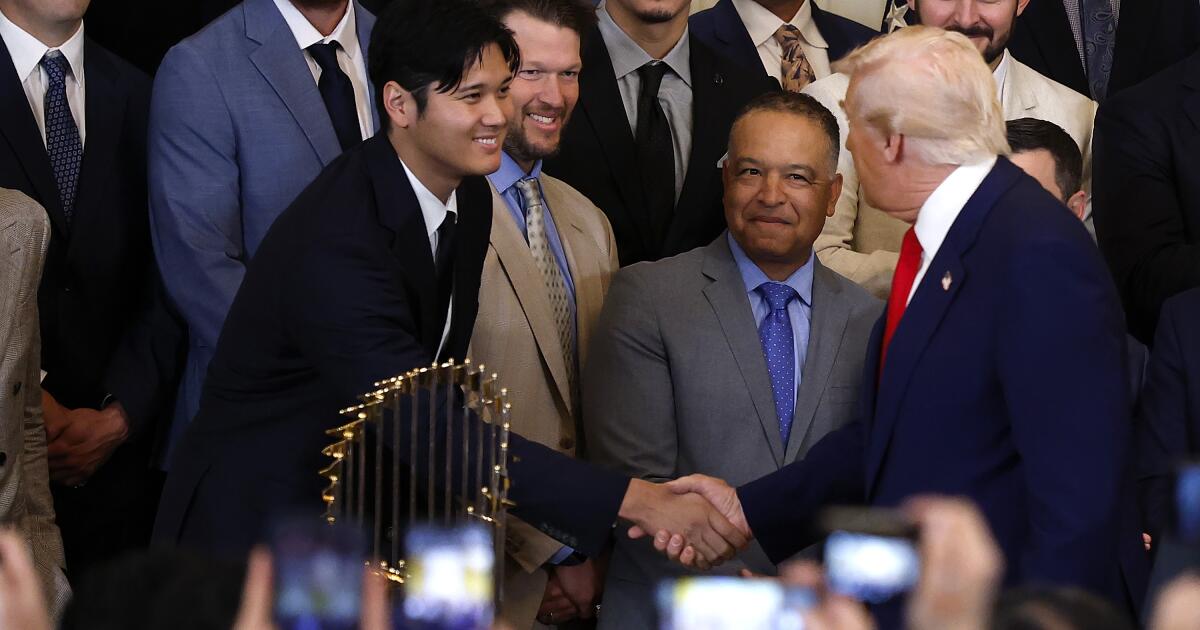
WASHINGTON — The Dodgers are scheduled to visit the White House on July 23 to celebrate their latest World Series title.
“President Trump is excited to welcome the Los Angeles Dodgers BACK to the White House to celebrate their World Series championship!,” White House spokesperson Taylor Rogers said in a statement to The Times.
The date falls on a scheduled off day in the middle of a nine-game East Coast road trip for the Dodgers. The team will play three games in Philadelphia against the Phillies July 20-22 before ending the trip with a three-game series against the New York Mets July 24 to 26.
The visit continues a tradition from the Dodgers’ two previous World Series championships. They were hosted by President Biden in 2021 and President Trump in April 2025.
After the Dodgers claimed their second consecutive World Series title with a dramatic Game 7 victory over the Toronto Blue Jays, a visit to the White House was planned, but it wasn’t until Thursday that a date was officially booked and confirmed.
Questions swirled around whether players would decline the visit this year after it did not happen during a scheduled visit to Washington in April.
Kiké Hernández said in 2018 he was unsure he would have gone had the Dodgers won the World Series the previous year. Mookie Betts said he was undecided and needed to talk it over with his family when last year’s visit was announced. After winning his first World Series with the Boston Red Sox in 2018, Betts skipped their trip to the White House the following year during Trump’s first term.
Both players, along with every returning member of the 2024 team who was with the team during its road trip, participated in the visit. The only notable absence was first baseman Freddie Freeman, who remained in Los Angeles to nurse an ankle injury.
Manager Dave Roberts, who indicated in comments to The Times in 2019 he might not go to the White House if Trump was president, also participated in last year’s ceremony.
Asked at the Dodgers’ fan festival in January about the possibility of returning to the White House, Roberts told The Times’ Bill Shaikin: “For me, I stand by: I’m a baseball manager. That’s my job.”
“I was raised — by a man who served our country for 30 years — to respect the highest office in our country,” Roberts said. “For me, it doesn’t matter who is in the office, I’m going to go to the White House. I’ve never tried to be political. … For me, I am going to continue to try to do what tradition says and not try to make political statements, because I am not a politician.”
Clayton Kershaw, who retired after last season but was on Team USA for this year’s World Baseball Classic, told The Times in the spring that he was aware Dodgers fans are split over whether the team should visit the White House again this year, but he said he is looking forward to it.
“I went when President Biden was in office. I’m going to go when President Trump is in office,” Kershaw said. “To me, it’s just about getting to go to the White House. You don’t get that opportunity every day, so I’m excited to go.”
Times deputy sports editor Ed Guzman contributed to this report.

NEWYou can now listen to Fox News articles!
All eyes were on Caitlin Clark on Wednesday night as she made her anticipated return from injury in a road matchup in Los Angeles.
But instead of a triumphant comeback, the Fever spent the entire night chasing the Sparks as Clark’s rough return fueled a 106-92 rout.
The superstar never found a groove, looking completely out of sync in her return from a back injury.
STEPHANIE WHITE GIVES CAITLIN CLARK STATUS UPDATE AHEAD OF FEVER-SPARKS, BUT HER NEXT MOVE RAISES QUESTIONS
Caitlin Clark huddles with teammates as the Indiana Fever battle the Sparks. (Photo by Katelyn Mulcahy/Getty Images) ((Photo by Katelyn Mulcahy/Getty Images))
Much of that disjointed performance falls squarely on head coach Stephanie White, who kept Clark on a ridiculously tight leash by limiting her to just 16 minutes. The stop-and-go approach could have sabotaged any chance for the phenom to establish a rhythm.
Clark finished with just 9 points, 4 rebounds and 3 assists. Her minus-16 plus-minus told the story.
The Los Angeles Sparks were severely shorthanded, taking the floor without stars Kelsey Plum and Cameron Brink.
MERCURY’S NOW-DELETED SOCIAL MEDIA POST MOCKING CAITLIN CLARK DRAWS SCRUTINY AFTER STAR’S INJURY
Yet while a depleted Sparks roster played to win, Indiana spent the night over-managing its biggest asset.
With Clark on a minutes restriction and Aliyah Boston out of the lineup, Kelsey Mitchell was forced to shoulder the entire offensive burden.
Mitchell did her part, pouring in 29 points while shooting 5-of-9 from beyond the arc.
Caitlin Clark orchestrates the Fever offense as Indiana battles the Los Angeles Sparks in primetime action. (Photo by Katelyn Mulcahy/Getty Images) ((Photo by Katelyn Mulcahy/Getty Images))
But one hot hand couldn’t stop an efficient LA squad.
The Sparks shot 45% from three-point range, going 9-of-20 from deep to cruise to the 106-92 victory.
White’s next move is to sit Clark against the Mercury on Thursday while Boston returns.
CLICK HERE TO DOWNLOAD THE FOX NEWS APP
After Wednesday’s loss to a shorthanded Sparks team, it’s fair to question whether Indiana’s cautious approach is working. The Fever dropped to 12-9.
Caitlin Clark and Dearica Hamby face off as Fever and Sparks battle at Crypto.com Arena in Los Angeles. (Photo by Tyler Ross/NBAE via Getty Images) ((Photo by Tyler Ross/NBAE via Getty Images))
Send us your thoughts: alejandro.avila@outkick.com / Follow along on X: @alejandroaveela
-

 New Hampshire55 seconds ago
Trans athletes drop lawsuit to gain access to girls’ sports in New Hampshire after SCOTUS ruling
-

 New Jersey6 minutes ago
Family describes frantic moments delivering baby on the NJ Turnpike
-

 New Mexico13 minutes ago
Hidden gem in Cloudcroft, New Mexico has best BBQ in US
-

 North Carolina16 minutes ago
North Carolina Airport Looks to Expand Commercial Service | AirlineGeeks.com
-

 North Dakota21 minutes ago
San Francisco plots risky socialist bank modeled after controversial experiment
-

 Ohio28 minutes ago
Feeling itchy? Ohio leads nation with 6 cities on Orkin’s 2026 bed bug list
-

 Oklahoma31 minutes ago
Oklahoma’s Brent Venables named to 2026 Dodd Trophy Preseason watch list
-

 Oregon36 minutes ago
Ryan Reynolds-backed Aviation Gin shutters Oregon distillery

