Sports
Artificial intelligence could transform football. So what might the future look like?


“It’s totally feasible that an artificial intelligence (AI) agent could simulate more football in 24 hours than has ever been played professionally in the real world in the entire 150-year history of the game,” says Lee Mooney, who was head of data insights at City Football Group for six years.
“Think about how many games Pep Guardiola can possibly have played in, managed and watched. If you go back every generation which led to him being where he is now, through Johan Cruyff and Rinus Michels, that compound experience could potentially be simulated in just a few hours.
“All that problem-solving knowledge would be built perfectly into a single synthetic brain. It would make for fascinating potential for new tactics, training methods, ways of measuring performance, recognising human coaching skill and talent judgement.”
It may sound futuristic but football is already heading in that direction, the most well-publicised example being Liverpool teaming up with Google DeepMind to improve their corner-kick strategy using AI.
Mooney built an industry-leading department at Manchester City before founding MUD Analytics, which works with clubs in the Premier League, English Championship, Scottish Premiership and MLS. He is as well-versed as anyone in how new technology can be embedded in sport and transform age-old methods.
AI allows computers to learn and perform tasks and solve problems that usually require human intelligence. It is trained on huge amounts of information and simulates billions of variables, identifying and predicting future patterns.
As early as 1997, supercomputers were able to evaluate 200 million chess positions per second and defeat human grandmasters. In Formula 1, teams can spend a few days simulating millions of laps ahead of an upcoming Grand Prix, adjusting for the optimal race strategy.
Although there are still some steps to be made, the advancement in player tracking data means Mooney believes football could reach the point where clubs have trained AI to simulate matches against their upcoming opponents, modelling individual players based on their technical qualities and mechanics and producing 3D animations of how the real-life games might play out.
“You could set up to play Manchester City, train the AI agent to understand how they play and what their individual strengths and weaknesses are, and then play the game millions of times to find the most efficient strategies to beat them with the players you have,” says Mooney.
“We train airline pilots in simulators before flying, because we need to know it is safe. This sort of AI could give coaches their own safe playground to take risks and explore a much broader universe of tactics and solutions, before then risking their jobs. Animation can then show the most effective build-up structures to beat their press, how quickly to press, and what structure to recover back into. You’re training technology to understand the game in a virtual space to then inform real-world decisions.
“My instinct is you’ll end up with a powerful set of general principles which shows the best solutions to counteract their biggest threats. There is also the potential for it to recognise if players are waning in-game or if their decision-making is becoming compromised and so recommend a substitution live.”
The pace of change in technology may have been rapid and opened up the potential for these ambitious ideas to become realistic goals, but there is the caveat of realism when it comes to implementing them. “To execute it within a club setting requires stability of leadership vision and funding — two rare commodities in football,” says Mooney.
It may have felt like a vague, far-off world not too long ago, but the impact of AI is increasingly being felt in the workplace, and football is no exception. Many are unsure how it will manifest itself, but its use in recruitment, coaching, fitness and medical areas is going to accelerate rapidly, as it has in other sports.
The Athletic has spoken to leading figures in football across those areas to understand what AI could mean for the future of the sport, including:
- 65 per cent of Premier League and Football League scouts surveyed by The Athletic believe AI is going to affect their role in the next five years
- Clubs have started using large language models to cut out the need for people to read hundreds of scouting reports
- The data analytics revolution was initially driven by a community outside football and there is a struggle to change the culture
- Barcelona’s Barca Innovation Hub has invested in a science company, Omniscope, which is aiming to use AI to prevent injuries and extend the peak condition of players.
In November, Premier League side Brighton & Hove Albion, who leverage their owner/chairman Tony Bloom’s data tools for recruitment, dispensed with the majority of their full-time senior scouts.
The proliferation of data analytics in football over the past 15 years means there is not a Premier League club among the 20 now who do not use data as the first filter in their scouting operation.
But the new frontier is AI.
A recruitment source at one major English team, speaking on condition of anonymity to protect relationships, says that one of the main proponents of AI at his club recently remarked that scouts could start to be replaced by AI within the next two years.
A scouting data scientist, whose company works with various clubs across Europe, believes the holy grail will be when clubs no longer have to imagine how a potential signing would fit into their team. Instead, they will be able to use AI to translate all the data and video they have on the player’s style and the buying team’s tactics and use that to visualise just how they would perform in certain situations. “It’s not going to be liked, because there might come a time where it puts jobs at risk,” says a senior figure in a Premier League recruitment team. “It’ll be a cost-saving function in the future.”
Clubs already have huge libraries of scouting reports and performance and physical data, but it comes down to humans to interpret it all. AI can expedite that process by cutting out the need for someone to sit and read 100 different reports, instead rapidly picking out the players who best match the criteria the club’s models are looking for. “You could profile players from matches over a period of time and ask AI for the nearest version of a certain player,” says the Premier League recruitment figure.
GO DEEPER
The state of scouting: Data culture clash, job cuts and an uncertain future
It may not be sexy, but it is time-saving, which has made some scouts anxious that it could see their profession drastically culled.
“This suggestion that AI will get rid of scouts, I don’t get it at all,” says Mooney. “There are things models can’t see or they have wide confidence bands (a range of uncertainty in the estimate). How a player behaves under pressure, small-space ball manipulation, the timing of scans, the softness of their touch, their vision to see a pass: traits that are easy to see on video but hard, or slow, with data.
“There is going to be a delicate dance as these things evolve. For everything a machine can’t see now, there will be a branch of research closing that gap. It’s going to create a healthy tension between human and machine but also a real co-dependency — quality human input is essential for developing stronger and stronger analytical assets.
“I’ve used every experience I’ve had, working with some top forward-thinking coaches and football people, to make our technologies better, but through doing that I value the human side more. One challenge for people in the AI space is that a lot of those who are leading it can be too detached from the human side. They don’t see themselves as being vulnerable to advancements in technology.”
Mooney is already using AI and machine learning — computer systems that are able to learn and adapt without following explicit instructions, by using algorithms and statistical models to analyse and draw inferences from patterns in data — at MUD Analytics when it comes to financial budgeting and recruitment. He and his team have just built a model which sequenced 25 million player appearances, stretching back to the early 2000s, identifying patterns and traits that can predict the trajectory of potential signings.
The nature of the sport has already been changed by the insights data has delivered. Fewer players take shots from outside the box due to the low probability of them resulting in a goal, while teams generally keep possession and dribble less than they used to, with some fans lamenting that structured systems have reduced the presence of mavericks in the game.
“I’m reminded of the Jurassic Park line about the scientists being so preoccupied with whether they could, they didn’t stop to think whether they should,” Mooney says.
“Is this what sport is meant to be? It is my professional job to help teams win and get as much value from their money as possible, so I’m going to have to do it because if I don’t someone else will, and then you’re in an arms race where you’re bringing a knife to a gunfight.”
Ted Knutson, who founded leading data analytics company StatsBomb in 2013 before selling it to Hudl earlier this year, experienced the resistance to new technologies in football.
The American was one of the early voices in the data analytics community and had groundbreaking success in his application of set-piece data while working for Midtjylland — controlled at the time by Premier League side Brentford’s owner Matthew Benham — as they scored 25 set-piece goals on their way to a first Danish league title in 2014-15.

Brentford owner Benham – left, with their head coach Thomas Frank – has been at the forefront of data innovation in football (Nick Potts/PA Images via Getty Images)
“I would go into clubs and show them how we improved other teams’ set-piece output but a coach would often say, ‘Yeah, that’s nice… so what?’,” says Knutson. “Football does not like change. We had to push really hard to change things on the event data (passing, shooting) side and using data in recruitment — it took 10 years for it to become really prevalent as the first filter in every Premier League club’s recruitment process.
“I see football teams where so much of what they need to do is just execute the basics, and they can’t do it. We’re asking: could we take really smart people and create sophisticated models like this? You could. Maybe in five years, you could do some of that but who is investing in that and pioneering it?”
StatsBomb’s work on pressing in football took the number of defensive events being measured from 30 per game to 300. Its work on expected goals, which took into account the positioning of all opposition players at the time of the shot, helped explain how Sean Dyche’s Burnley team had been seen as a statistical freak due to conceding a high volume of shots but few goals, when the reality was they smothered shots effectively.
Knutson, who brought Paris Saint-Germain on board in StatsBomb’s first year, believes the single biggest point in terms of winning over traditional football minds was in quantifying skill sets for each position. By using data and converting the information into radars, which summarised a player’s effectiveness across a range of skills, coaches could better visualise it than hard numbers.
StatsBomb made another leap in 2021 when it launched its 360 product, with Liverpool its first users. This added the location of every team-mate and opposition player to the 3,400 events collected per match. StatsBomb then built on that breakthrough in NFL, tracking every player’s location on the field 30 times per second.
“NFL is harder, because there is much more occlusion (blocking). In football, players are separate and then occasionally at set pieces they run into each other,” Knutson says. “In football, that should get there in the next couple of years.”
Knutson is doubtful clubs will be the true pioneers in the AI space, given the time and resources required to make advancements, but also because the nature of professional sport means those teams who find an edge do everything they can to protect that intellectual property. It is why, at Brighton and Brentford, most scouts do not have visibility of the models working in the background at their owners’ data companies.
The rise of data analytics was organic and not restricted to early adopters inside football such as Liveprool’s former director of research Ian Graham. Amateurs were able to use publicly-available StatsBomb data sets and build upon the work that had been achieved so far. Many of those people now work in recruitment positions within professional football.
“The more challenging space for AI is tactically in training,” says Knutson. “A lot of the analysts don’t have a lot of coach in them, so there is always a credibility gap there.
“If some quantitative people got coaching badges, I think you’d see that change. In American sports, we are seeing statistical analysts become assistant coaches. We’ll probably see it gradually happen over here too. The other problem is the difficulty people who aren’t players find in getting coaching badges. It’s gatekeeping, and certainly holds back some of the coaching elements.”
When Albert Mundet helped launch the Barca Innovation Hub in 2017, the focus was tactical analysis.
Early strides were made in using data models to predict the positioning of individual opposition players and where gaps would appear, but he believes data needs to become more affordable before AI’s full capabilities can be unleashed in that area.
“Our original AI focus was on the tactical side, but we are betting a lot of our investments on injury prevention,” says Mundet, who is now general manager and reports into Barcelona’s club president Joan Laporta.
“The past 10 years, GPS has been at the core of performance monitoring, but we believe this is not enough. It is one piece of the whole cake. We believe the next wave is biomedical data, combining genomics data and other markers in the body. It exists in other industries, but football has not touched it. Mixing it with GPS could help improve the prevention of injuries, which are increasing because of the number of games but also because of how much more intense the games have become.”
Zone7 is a company already working in that area, as previously reported by The Athletic. It uses AI to assess physical data and determine the risk of a muscle injury. Liverpool, Napoli, Rangers and LAFC are among its clients.
Mundet believes Barca’s investment in Made of Genes, a start-up from the surrounding Catalonia region, as part of a €5million (£4.2m, $5.2m) funding round, has given them that forecasting ability too.
“We are able to simulate the external load a player will experience at a specific moment in the future using a trained AI model based on historical data. Additionally, we can assess injury risk by combining this with genomic and metabolomic profiles through advanced AI models,” Mundet says. “We can help the coach make decisions on how to keep them healthy by reducing their exposure (in training and games). If we are going to be playing in quarter-finals, semi-finals and finals, we can help ensure the player arrives there with the optimal load and risk of injury”
Barca Innovation Hub’s latest investment could be the most profound yet in terms of its scale. It has invested in Omniscope, a techbio company founded by a disciplinary team in 2021, which is seeking to harness the advancements made in AI and immunology in the past few years to transform the diagnosis and treatment of illness. In sport, it believes it can translate into injury prevention and improved healing.
The human immune system can be difficult to understand given its complexity but Omniscope’s technology means that, via a blood sample, they are able to read millions of cells one-by-one — 100 times more than other technologies are capable of — to give the individual an inflammation score of between zero and 100. By using interpretative AI to identify gaps in the sequencing of the cells, it can diagnose early signs of disease, all while adhering to strict data privacy and ethical standards.
Essentially, it is building a foundational cell-by-cell model of the immune system with the aid of AI, which has never been done before. But the ability to heal quicker or, in the context of football, understand how to maintain healthy athletes, comes from generative AI.
Omniscope is driving the novel concept of piggy-banking healthy cells with the potential to reintroduce them to the body to fight diseases, or using AI to engineer therapeutic immune cells.
In football, Omniscope believes that if it can understand the immune system of a healthy athlete, it can use that knowledge to prevent injuries. It has already developed a specialised AI algorithm to comprehend the inflammation female players experience during their menstrual cycle and so can tailor care accordingly.
“We’ve sequenced hundreds of samples and found that it works,” says Omniscope CEO and co-founder Vijay Vaswani, speaking to The Athletic. “We believe this technology has the potential to significantly enhance sports medicine and improve athlete health management.
“We collect blood samples during periods of optimal health to establish a baseline and integrate this data with wearable technology to monitor the player’s overall immune health status. Deviations from the baseline are often early signs of inflammation, illnesses and injuries. After injury and during recovery, we track, cell by cell, whether the healing process is working by looking at the immune response. For recurring injuries, I can again leverage comprehensive cellular data to power AI models which predict, monitor treatment effectiveness, and guide personalised future care.
“We can see processes of muscle scarring to complement an MRI. It gives the doctor and physiotherapist a magic window to reassess their strategy in real time. It’s the first time in athletic medicine that you’re not guessing on the return-to-play timeline.”
Using your own immune cells for therapy is approved by the FDA — a U.S. agency that protects public health by regulating the safety of food, drugs, medical devices and other products — but Vaswani says it has not been popularised yet due to high costs, lengthy processing times and requiring years of clinical complexity.
AI has helped speed up the process and made it significantly more affordable.
There is a potential from this that Vaswani believes could be revolutionary, significantly enhancing athletes’ longevity by maintaining their peak for longer.
“Athletes represent significant investments for clubs, and maintaining their career longevity is essential for maximising this investment,” he says. “Imagine if your favourite athlete continued to play many more years beyond traditional expectations. To be able to reintroduce your own biology in a non-artificial manner is unique. I think it will happen in the next five years, because AI learns and catalyses medicine. What we thought was far off is now within our grasp.”
The goal for Barca Innovation Hub in the coming years is to get to the point where it can start to use this convergence of immunology and generative AI to treat Barcelona’s first-team players.
“By integrating regenerative therapies within Barca’s cutting-edge sports medicine practices, we’re not only looking to accelerate recovery and extend playing years, but also to redefine the concept of peak performance,” Mundet says.
If it develops as they hope, the club’s young stars such as Lamine Yamal, Pau Cubarsi, Pedri and Gavi could stand to benefit.
(Top photos: Getty Images; design: Dan Goldfarb)



Sports
Pirates star pitcher makes unfortunate history after being taken out in middle of perfect game bid

NEWYou can now listen to Fox News articles!
Jared Jones was flirting with Major League Baseball history on Wednesday night — he got it, but it was not what he originally envisioned.
The Pittsburgh Pirates pitcher retired the first 18 batters he faced, but he was taken out in the middle of his perfect game bid after six innings.
Now, the Pirates certainly have their reasons — the 24-year-old Jones hasn’t thrown more than 81 pitches in eight starts since returning May 20 after missing all of last season while undergoing ulnar collateral ligament internal brace surgery on May 21, 2025. He was yanked with 77 pitches and likely would have needed more than 100 pitches to record the 25th perfect game in MLB history.
Jared Jones of the Pittsburgh Pirates pitches during the first inning against the Atlanta Braves at PNC Park on July 8, 2026, in Pittsburgh, Pennsylvania. (Photo by Joe Sargent/Getty Images)
However, Jones left the game after getting zero run support, so when the Atlanta Braves tacked on three runs late for a 3-0 victory, Jones instead found himself in the wrong chapter of the history books.
According to Opta Stats, Jones became the first pitcher in the modern era (since 1920) to pitch at least six perfect innings and not record a win.
“It does suck. Something’s cool coming on, but I’m on what? My eighth start off of surgery? I completely understand it, and it is what it is,” Jones told reporters after the game.
Pittsburgh Pirates starting pitcher Jared Jones (17) makes his way to the field to warm up before pitching against the Atlanta Braves at PNC Park. (Charles LeClaire/Imagn Images)
JUSTIN VERLANDER ANNOUNCES HE WILL RETIRE AFTER THIS SEASON: ‘I’VE REALIZED THAT TIME HAS COME’
Jones said he didn’t entertain attempting to complete the perfect game.
“Not with the pitch count,” he said. “Not really ever expecting to go nine right now, so that was never in my head.”
Joey Bart, traded to the Braves from the Pirates on June 18, followed a double by Mike Yastrzemski with a 422-foot, two-run homer to left-center field off a slider from Dennis Santana. Drake Baldwin added an RBI single to center in the ninth for good measure.
It was the second time in less than a week that a pitcher was taken out of the game with a perfect bid through six innings — the Miami Marlins took Eury Perez out after seven innings in which he had 92 pitches. Perez, too, is in the midst of returning from injury and has surprisingly found himself right in the postseason mix.
He was pulled for Lake Bachar to start the eighth, and the Marlins allowed eight runs to the Athletics in the final two innings, but held on to win 9-8.
Jared Jones (17) of the Pittsburgh Pirates delivers a pitch during a MLB game against the Cincinnati Reds on June 27, 2026, at PNC Park in Pittsburgh, Pennsylvania. (Joe Robbins/Icon Sportswire via Getty Images)
CLICK HERE TO DOWNLOAD THE FOX NEWS APP
The Pirates are 4.0 games out of the final wild card spot, which is held by the Marlins.
The Associated Press contributed to this report.
Follow Fox News Digital’s sports coverage on X, and subscribe to the Fox News Sports Huddle newsletter.
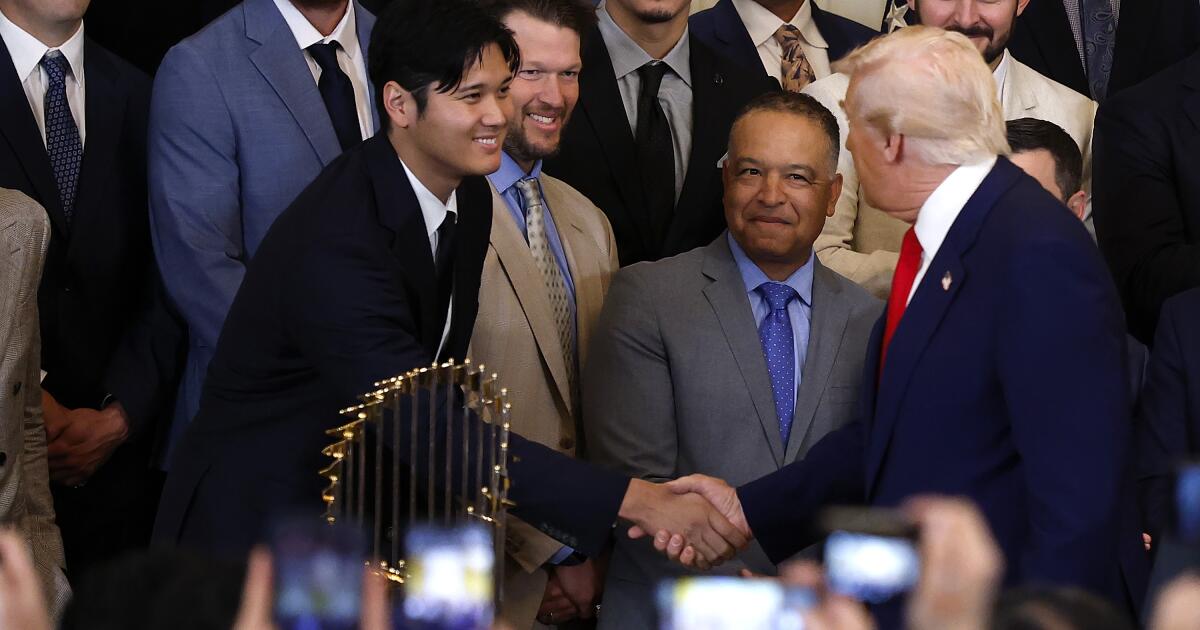
WASHINGTON — The Dodgers are scheduled to visit the White House on July 23 to celebrate their latest World Series title.
“President Trump is excited to welcome the Los Angeles Dodgers BACK to the White House to celebrate their World Series championship!,” White House spokesperson Taylor Rogers said in a statement to The Times.
The date falls on a scheduled off day in the middle of a nine-game East Coast road trip for the Dodgers. The team will play three games in Philadelphia against the Phillies July 20-22 before ending the trip with a three-game series against the New York Mets July 24 to 26.
The visit continues a tradition from the Dodgers’ two previous World Series championships. They were hosted by President Biden in 2021 and President Trump in April 2025.
After the Dodgers claimed their second consecutive World Series title with a dramatic Game 7 victory over the Toronto Blue Jays, a visit to the White House was planned, but it wasn’t until Thursday that a date was officially booked and confirmed.
Questions swirled around whether players would decline the visit this year after it did not happen during a scheduled visit to Washington in April.
Kiké Hernández said in 2018 he was unsure he would have gone had the Dodgers won the World Series the previous year. Mookie Betts said he was undecided and needed to talk it over with his family when last year’s visit was announced. After winning his first World Series with the Boston Red Sox in 2018, Betts skipped their trip to the White House the following year during Trump’s first term.
Both players, along with every returning member of the 2024 team who was with the team during its road trip, participated in the visit. The only notable absence was first baseman Freddie Freeman, who remained in Los Angeles to nurse an ankle injury.
Manager Dave Roberts, who indicated in comments to The Times in 2019 he might not go to the White House if Trump was president, also participated in last year’s ceremony.
Asked at the Dodgers’ fan festival in January about the possibility of returning to the White House, Roberts told The Times’ Bill Shaikin: “For me, I stand by: I’m a baseball manager. That’s my job.”
“I was raised — by a man who served our country for 30 years — to respect the highest office in our country,” Roberts said. “For me, it doesn’t matter who is in the office, I’m going to go to the White House. I’ve never tried to be political. … For me, I am going to continue to try to do what tradition says and not try to make political statements, because I am not a politician.”
Clayton Kershaw, who retired after last season but was on Team USA for this year’s World Baseball Classic, told The Times in the spring that he was aware Dodgers fans are split over whether the team should visit the White House again this year, but he said he is looking forward to it.
“I went when President Biden was in office. I’m going to go when President Trump is in office,” Kershaw said. “To me, it’s just about getting to go to the White House. You don’t get that opportunity every day, so I’m excited to go.”
Times deputy sports editor Ed Guzman contributed to this report.

NEWYou can now listen to Fox News articles!
All eyes were on Caitlin Clark on Wednesday night as she made her anticipated return from injury in a road matchup in Los Angeles.
But instead of a triumphant comeback, the Fever spent the entire night chasing the Sparks as Clark’s rough return fueled a 106-92 rout.
The superstar never found a groove, looking completely out of sync in her return from a back injury.
STEPHANIE WHITE GIVES CAITLIN CLARK STATUS UPDATE AHEAD OF FEVER-SPARKS, BUT HER NEXT MOVE RAISES QUESTIONS
Caitlin Clark huddles with teammates as the Indiana Fever battle the Sparks. (Photo by Katelyn Mulcahy/Getty Images) ((Photo by Katelyn Mulcahy/Getty Images))
Much of that disjointed performance falls squarely on head coach Stephanie White, who kept Clark on a ridiculously tight leash by limiting her to just 16 minutes. The stop-and-go approach could have sabotaged any chance for the phenom to establish a rhythm.
Clark finished with just 9 points, 4 rebounds and 3 assists. Her minus-16 plus-minus told the story.
The Los Angeles Sparks were severely shorthanded, taking the floor without stars Kelsey Plum and Cameron Brink.
MERCURY’S NOW-DELETED SOCIAL MEDIA POST MOCKING CAITLIN CLARK DRAWS SCRUTINY AFTER STAR’S INJURY
Yet while a depleted Sparks roster played to win, Indiana spent the night over-managing its biggest asset.
With Clark on a minutes restriction and Aliyah Boston out of the lineup, Kelsey Mitchell was forced to shoulder the entire offensive burden.
Mitchell did her part, pouring in 29 points while shooting 5-of-9 from beyond the arc.
Caitlin Clark orchestrates the Fever offense as Indiana battles the Los Angeles Sparks in primetime action. (Photo by Katelyn Mulcahy/Getty Images) ((Photo by Katelyn Mulcahy/Getty Images))
But one hot hand couldn’t stop an efficient LA squad.
The Sparks shot 45% from three-point range, going 9-of-20 from deep to cruise to the 106-92 victory.
White’s next move is to sit Clark against the Mercury on Thursday while Boston returns.
CLICK HERE TO DOWNLOAD THE FOX NEWS APP
After Wednesday’s loss to a shorthanded Sparks team, it’s fair to question whether Indiana’s cautious approach is working. The Fever dropped to 12-9.
Caitlin Clark and Dearica Hamby face off as Fever and Sparks battle at Crypto.com Arena in Los Angeles. (Photo by Tyler Ross/NBAE via Getty Images) ((Photo by Tyler Ross/NBAE via Getty Images))
Send us your thoughts: alejandro.avila@outkick.com / Follow along on X: @alejandroaveela
-

 Minneapolis, MN5 minutes ago
Minneapolis chief communications officer Adam Fetcher out amid possible criminal charges
-

 Indianapolis, IN12 minutes ago
Indiana Workforce Pell Grant options limited so far
-

 Pittsburg, PA15 minutes ago
Pennsylvania leaders take new approach to cracking down on robocalls
-

 Augusta, GA20 minutes ago
Augusta domestic violence shelter faces shortfall after Georgia funding veto
-

 Washington, D.C27 minutes ago
Why Gov. Kim Reynolds turned down previous request to send National Guard to D.C.
-

 Cleveland, OH30 minutes ago
LGBTQ+ Ohio Nonprofit Guide
-

 Austin, TX35 minutes ago
Think tank says state education reforms have set up future of the ‘Texas Miracle’
-

 Alabama42 minutes ago
New Alabama women’s basketball coach Pauline Love credits late mentor for coaching career

