Southwest
The cicada invasion has begun! Find out where the flying insects are emerging

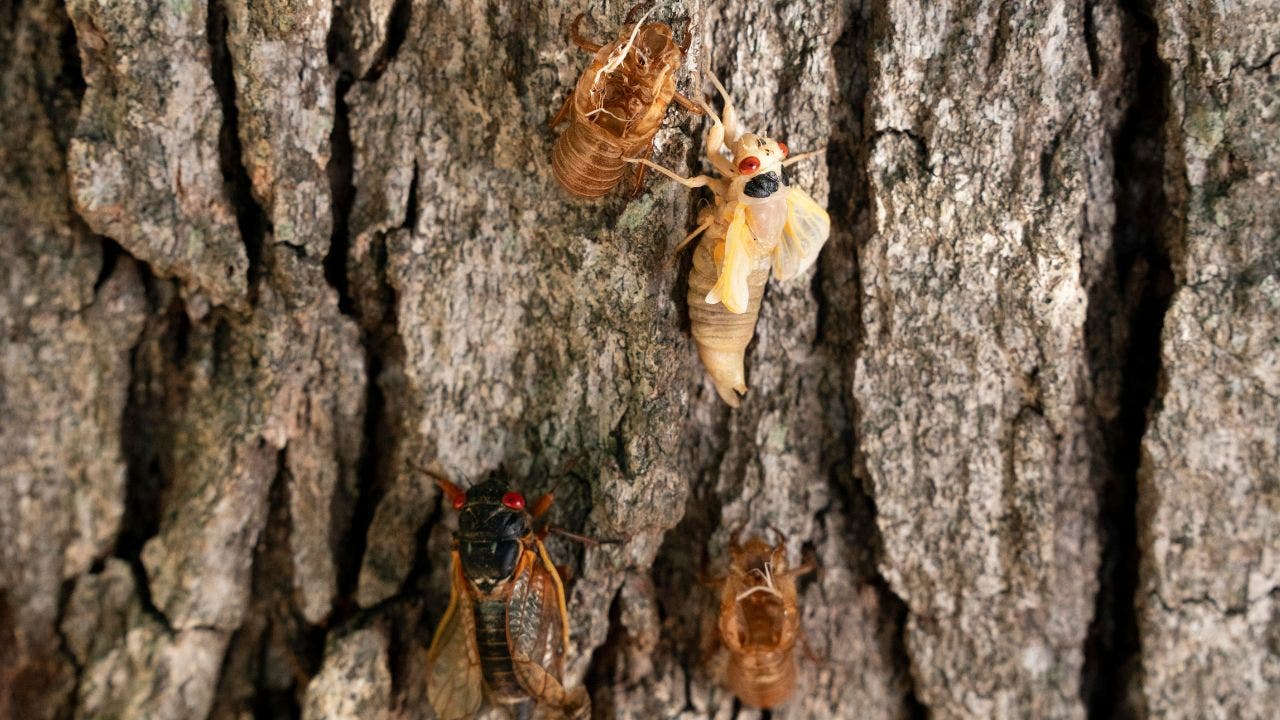
The historic cicada invasion is upon us!
Noisy flying insects known as cicadas have begun emerging from the ground and have been spotted buzzing around North Carolina and South Carolina before they will eventually appear across 15 other states.
The one to two-inch-long bugs are rising from the soil and growing wings before they then start a frantic mating frenzy lasting several weeks.
Billions, if not trillions, of two groups of cicadas will appear in 17 U.S. states over the coming months in a rare natural phenomenon not seen since 1803.
CICADA INVASION: AN ‘AMAZING’ AMERICAN PHENOMENON AND BONANZA FOR ANGLERS
A Brood XIX adult cicada emerges from its exoskeleton at the University of North Carolina on May 1, 2024 in Chapel Hill, North Carolina. Billions of the flying insects will appear in 17 states this year. (Sean Rayford/Getty Images)
It is the first time in 221 years that two types of cicadas — brood XIX and XIII — have risen from the ground at the same time, back when Thomas Jefferson was president, and it is not expected to happen again until 2244.
The bugs possess sturdy bodies, bulging compounded red eyes and membranous wings with a three-inch wingspan.
The two broods together will span parts of 17 states: Alabama, Arkansas, Georgia, Iowa, Indiana, Illinois, Kentucky, Louisiana, Maryland, Missouri, Mississippi, North Carolina, Oklahoma, South Carolina, Tennessee, Virginia and Wisconsin, according to the United States Forest Service.
Newly released video shows swarms of cicadas climbing up a tree, while in other footage the insects can be seen flying under the lights of a canopy, swarming a nearby wall and crawling on the ground.
“It is a pretty amazing phenomenon, I mean, it’s unique,” Eric Benson, a professor emeritus and extension entomologist at Clemson University in South Carolina, told Fox News Digital last month.
“They’re one of the longest-lived insects that we know and the fact that a bug can be underground for 13 years or 17 years, and then almost at the exact same time, they all come out of the ground synchronized,” Benson said. “It’s amazing to me. It’s one of nature’s cooler phenomena in the world.”
A USDA Forest Service map showing cicada brood emergence from April to May 2024 in the eastern United States. The areas in red show where Brood XIII, a 17-year brood, is expected to emerge. The areas in blue show where Brood XIX, a 13-year brood, is expected to emerge. The area in yellow shows where these brood emergences are expected to overlap in Illinois. (USDA Forest Service graphic)
RARE BROODS OF CICADAS TO ARRIVE SOON: WHEN TO EXPECT THEM AND WHAT IT MEANS FOR YOU
There are around 190 species of cicadas all over the world, but only in the eastern United States can you find the periodical cicadas, which emerge every 13 or 17 years.
Cicadas are not harmful to humans, pets, household gardens or crops, the EPA says. They are also a valuable food source for birds and mammals.
According to one social media video, turkeys have been feasting on cicadas. The video, posted on X, shows a dead turkey with its crop cut open, revealing at least a dozen cicadas that the bird had been gobbling up.
“Even back in history, Native Americans ate cicadas because all of a sudden you’re provided with all this amazing protein falling in your lap,” Benson said.
The busiest period of activity for cicadas is from now through early June, and they usually appear after a nice soaking of rain when the temperature of the ground hits 64 degrees, Benson explained.
“They’ll crawl up on a surface, usually the trunk of a tree, or it could be on the side of your house, a car, a fence or whatever. They’re insects, so they have to shed their skin to get to the next stage, and they will go through their final molt where they pull out of their immature skin, and they will be in their adult skin, which will have wings,” Benson said.
“They’ll molt, expand their wings, harden up and when they’re ready they’ll fly up into the trees.”
He said that eventually the cicadas will mate in a noisy fashion and then the females will deposit their eggs onto tree branches. They will hatch and fall into the ground where they will stay for the next 13 or 17 years before the process repeats.
So many cicadas will make noise at once in some places that sound levels might reach upward of 90 to 120 decibels, equivalent to a gas-powered lawnmower or motorcycle, the U.S. Forest Service says.
Meanwhile, the mating cicadas will die off and homeowners will be left hoping that the dead carcasses do not land in their gardens as they can smell badly if they die in large numbers together.
Several brood XIX cicadas crawl on the ground at the University of North Carolina on May 1, 2024. Billions of two groups of cicadas are set to appear in 17 U.S. states in a rare natural phenomenon not seen since 1803. (Sean Rayford/Getty Images)
Females laying their eggs on small tree branches can harm young trees and the EPA advises covering maturing saplings in mesh or netting to keep the insects out.
Experts also advise homeowners to cover pools, patio furniture or similar items from cicada or their droppings when they are active.
Brood XIII cicadas appear on a 17-year cycle, and are restricted mostly to northern Illinois, eastern Iowa, southern Wisconsin and a few counties in extreme northwestern Indiana, according to entomologist Floyd Shockley of the Smithsonian Institution’s National Museum of Natural History in Washington.
Brood XIX emerges on a slightly shorter 13-year cycle, and are widely distributed from Alabama, Arkansas, Georgia, Indiana, Illinois, Kentucky, Louisiana, Maryland, Missouri, Mississippi, North Carolina, Oklahoma, South Carolina, Tennessee and Virginia – a total of 15 states, according to Shockley. The two broods together span parts of 17 states.
These two broods overlap only in a small area in central Illinois and sometimes in Indiana. They are close enough potentially to have some interbreeding between broods.
A Brood XIX cicada crosses a brick path on campus at the University of North Carolina on May 1, 2024. (Sean Rayford/Getty Images)
Read the full article from Here


A former Riverside County man was found guilty of sex trafficking a female victim and forcing her to engage in commercial sex acts along L.A.’s notorious Figueroa Corridor.
Elias Abdul Shabazz, 34, formerly of Perris, was found guilty by a jury following a five-day trial, the U.S. Attorney’s Office said.
Prosecutors said Shabazz had led the victim to believe they were in a romantic relationship before he turned physically and sexually violent. He began demanding that the victim engage in commercial sex acts from May to October of 2021, court documents said.
He carried a handgun with him and, on occasion, was accused of using it to pistol-whip the victim. He also fired the gun at her feet while threatening to kill her, prosecutors said.
At trial, the victim said Shabazz demanded that she meet a daily quota of commercial sex proceeds and that she was terrified of the consequences of not meeting that quota.
She testified that Shabazz compelled her to work in the notorious Figueroa Corridor in South L.A., a dangerous area known for human trafficking and prostitution.
Shabazz had confiscated her identification card, Social Security card and birth certificate. He constantly monitored her cell phone to stop her from communicating with any friends or family.
“He also introduced her to addictive narcotics and controlled every aspect of her life, including when she ate, slept and showered,” prosecutors said.
In May 2025, Shabazz was arrested and has remained in federal custody. His last known address at the time was in Washington, D.C.
On June 26, 2026, Shabazz was found guilty of one count of coercing or enticing interstate transportation for purposes of prostitution.
A sentencing hearing is scheduled for Oct. 6, where he faces 15 years to life in prison.
“Sex trafficking matters rank among the most tragic cases our office prosecutes,” said First Assistant U.S. Attorney Bill Essayli. “This defendant will now face many years in a federal prison cell for his sick, disgusting, and disturbing behavior.”
“Elias Shabazz preyed on a vulnerable victim using physical and sexual violence and cruel psychological coercion to compel commercial sex acts for his own profit,” said Assistant Attorney General A. Tysen Duva of the Justice Department’s Criminal Division. “There is no place for this type of conduct in civilized society. We deeply respect the victim’s courage to face her trafficker in court. The Criminal Division will continue to bring these cases and try them.”
Anyone with information about human trafficking can report tips to the National Human Trafficking Hotline at 888-373-7888

The star-studded feel-good giveback event of the summer has returned. KTLA 5 is teaming up once again with Project Angel Food for the annual “Lead with Love: Going the Distance” telethon to raise critical funds for medically tailored meals delivered to people living with serious illnesses throughout Los Angeles County. The seventh annual telethon airs […]

A woman was hospitalized with serious injuries after she was violently attacked by a robber in downtown Long Beach. On June 18, Jennifer Silva, 34, was attending a World Cup watch party at a Hooters restaurant at 90 Aquarium Way. After the game ended, she left the restaurant just before 11 p.m. As she walked […]
-

 Los Angeles, Ca19 minutes ago
Man found guilty of sex trafficking victim along L.A.’s Figueroa Corridor
-

 Detroit, MI39 minutes ago
No. 23 overall pick in the 2026 NHL draft | Detroit Red Wings
-

 San Francisco, CA49 minutes ago
San Francisco Pride kicks off with rainbow lasers, ValQueeries celebrate at Valkyries Pride Night
-

 Dallas, TX54 minutes ago
How to buy Egypt vs. Australia World Cup soccer tickets
-

 Miami, FL1 hour ago
Helping Venezuela: Miami search-and-rescue team prepares to deploy
-

 Boston, MA1 hour ago
How to buy Paraguay vs. Germany 2026 World Cup tickets in Boston
-

 Denver, CO1 hour ago
Denver Broncos Roster Breakdown: Center—The Depth Question
-

 Seattle, WA1 hour ago
Iran-Egypt: Seattle World Cup Pride match updates

