Southwest
Oklahoma Native American community sees yearly return of popular wild onion dinners

As winter fades to spring and the bright purple blossoms of the redbud trees begin to bloom, Cherokee chef Bradley James Dry knows it’s time to forage for morels as well as a staple of Native American cuisine in Oklahoma: wild green onions.
Wild onions are among the first foods to grow at the tail end of winter in the South, and generations of Indigenous people there have placed the alliums at the center of an annual communal event. From February through May, there’s a wild onion dinner every Saturday somewhere in Oklahoma.
The bright green stalks of the onions reach a few inches above the dried leaves that crunch under Dry’s feet on a crisp morning in March as he hunts through parks and empty lots near downtown Tulsa. The land he forages straddles the Muscogee Nation and the Cherokee Nation, and he’s thinking of his elisi — grandmother in Cherokee — who taught him how to pick and cook wild onions.
THE GRITS BELT IS AN UNMARKED BUT UNDENIABLE DEMARCATION OF AMERICAN CULINARY CULTURES
“Being able to cook like this, cook the things that my grandmother would cook for strangers, that’s really cool,” Dry explains as he scans the forest floor. He’s careful not to overharvest, taking only what he needs.
“Traditionally, what I grew up with, you just boil them in a little bit of water and then fry them with scrambled eggs,” Dry said.
That’s the way wild onions are typically cooked for large gatherings, a side dish of greens with a familiar peppery bite, served alongside fried pork, beans, frybread, chicken dumplings, cornbread, and safke — a soup made with cracked corn and lye from wood ash that is common among tribal nations in the southeast, including the Muscogee, Chickasaw, Choctaw, Cherokee, and Seminole.
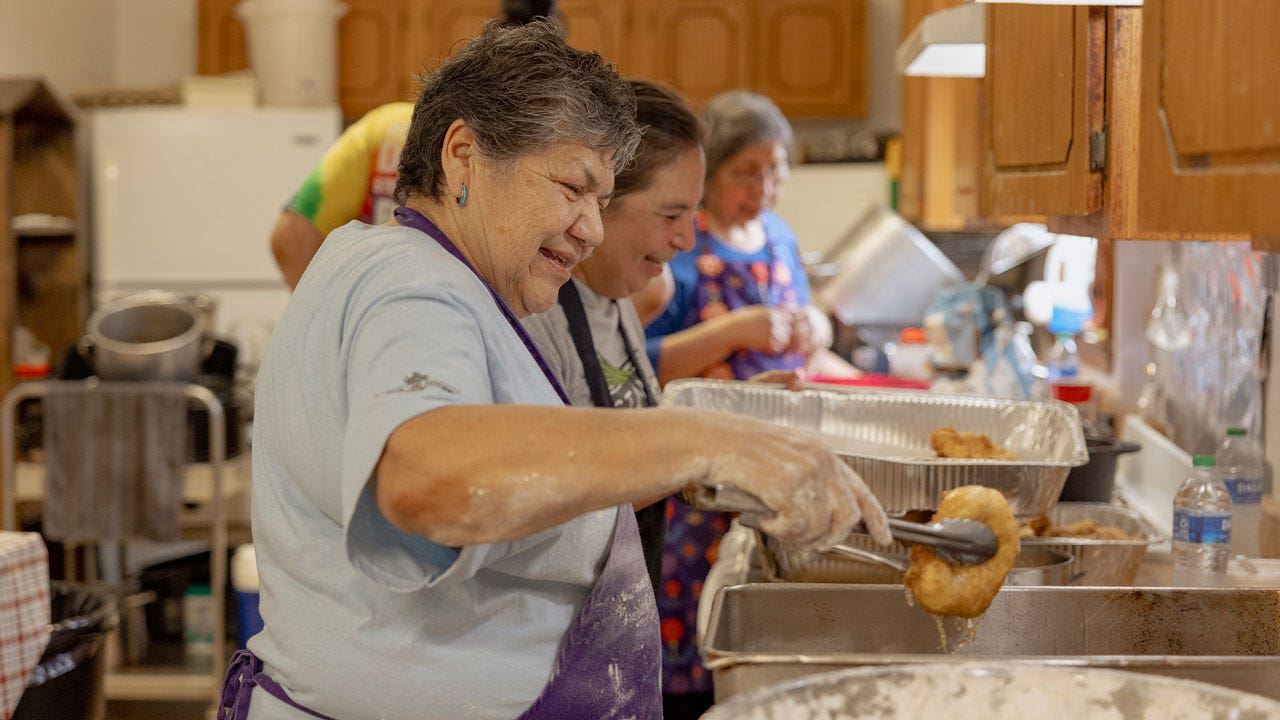
Carol Tiger, a member of Muscogee Nation and an elder at the Springfield United Methodist Church in Okemah, Oklahoma, lets the oil drip off a freshly-cooked piece of frybread at the church’s annual wild onion dinner on April 6, 2024. Wild onions are among the first foods to grow in the spring, and the dinners have been a tradition in Native American communities for generations. (AP Photo/Brittany Bendabout)
Dry likes to mix tradition with contemporary, such as using wild onions to make omelets and kimchi.
“I’ve even used them to create salsa or chimichurri for steaks,” he said.
The following Saturday morning, at least 100 people wait for the tribal community center to open in Okmulgee, the capital of the Muscogee Nation about 40 miles south of Tulsa. For the second consecutive year, the community is gathering for a wild onion dinner to raise travel funds for Claudia McHenry, a tribal citizen hoping to compete at this year’s Miss Indian World Pageant in Albuquerque, New Mexico.
Dozens of people cook and hand out food, there is a silent auction, and a local mekko — a Muscogee spiritual leader — gives the opening welcome.
Over the last several generations, churches in Oklahoma — particularly United Methodist Churches in Native American communities — have used wild onion dinners to raise funds for church bills and annual dues, said Chebon Kernell, a mekko for his community and a UMC clergy member.
“But as the years went by, it became an enormous community event,” he said.
McHenry said seeing the community rally behind her gives her the courage she needs.
“To just see people turn out for me physically,” she said. “It gives me really a lot of good emotions and pushes me and propels me to continue forward toward my goals.”
For the next three hours, hundreds show up and pay $15 for a plate of food to send her down that path. For many, helping McHenry or the local church is the only thing that could improve upon the undeniable allure of hogfry. And in no place is that truer than the Springfield UMC in Okemah, another 35 miles south, the following Saturday.
It isn’t uncommon for people to come from Arkansas, Kansas, or Texas for a piece of that community’s famed fried pork and a heap of wild onions. Some travel that far because they’re part of the Muscogee diaspora. Others simply follow the church’s signs down a dusty gravel road until the canopy of trees opens up to an endless field of waving grass, still copper from the winter’s rest.
For nearly two decades, hundreds have lined up on the porch of the church’s small gathering hall on the first Saturday in April for a plate of food. And every year you’ll find Carol Tiger there, elbow deep in a bowl of frybread mix.
Everyone calls Tiger the head cook.
“I just let them know what we have to do,” she said, sending a wave of laughter through the kitchen.
In past years, Tiger and other church elders would take their grandkids to pick onions, but this year they’re expecting 500 to 600 hungry people, so they purchased their onions cleaned and chopped for $40 a gallon. The families of the church also contribute a gallon each.
Elders tell stories from the rocking chairs on the porch, children play in the woods nearby, and vendors sell beadwork and clothing. The small field around the church has been cut and edged and is full of vehicles with tribal tags from across the state. Men fry pork in a giant pan over a fire outside, while women fill the dining hall with the warmth of home-cooked food.
After clearing their plates, attendees enjoy a piece of cake or a bowl of grape dumplings — a dessert traditionally made from wild grape juice that today is often made with frozen juice and canned biscuits. They stay well into the afternoon, talking and eating, certainly sad when it’s time to go.
But it’s mid-April, and wild onion dinner season isn’t over yet. There’s always next Saturday, a little further down the road.
Read the full article from Here


The star-studded feel-good giveback event of the summer has returned. KTLA 5 is teaming up once again with Project Angel Food for the annual “Lead with Love: Going the Distance” telethon to raise critical funds for medically tailored meals delivered to people living with serious illnesses throughout Los Angeles County. The seventh annual telethon airs […]

A woman was hospitalized with serious injuries after she was violently attacked by a robber in downtown Long Beach. On June 18, Jennifer Silva, 34, was attending a World Cup watch party at a Hooters restaurant at 90 Aquarium Way. After the game ended, she left the restaurant just before 11 p.m. As she walked […]

Jurors deliberating the fate of the man accused of starting the Palisades Fire, one of the most destructive wildfires in California’s history, failed to reach a verdict Thursday afternoon, telling the judge they were deadlocked.
A spokesperson from the United States Attorney’s Office told KTLA that jurors will continue to deliberate until they reach a verdict or give up.
Jonathan Rinderknecht, 30, a former Uber driver and one-time Pacific Palisades resident, is accused of starting the Lachman Fire on New Year’s Eve. The fire continued to smolder underground for about a week, even after Los Angeles firefighters believed it had been extinguished.
Flames reignited on Jan. 7, erupting into the deadly Palisades Fire that killed 12 people and destroyed thousands of homes in the upscale community, authorities said.
-

A courtroom sketch of Jonathan Rinderknecht, 29, during his initial court appearance on Oct. 23, 2025. (Bill Robles) -
The U.S. Dept. of Justice booking photo of Jonathan Rinderknecht over the Palisades Fire devastation in Malibu, California in January 2025 (AP).


Prosecutors argued that Rinderknecht deliberately set the fire, claiming he had grown increasingly resentful of wealthy residents and viewed Pacific Palisades as a symbol of that frustration.
“Their case, though circumstantial, is strong,” KTLA legal analyst Alison Triessl said. “The defense is relying on, can they (prosecutors) show beyond a reasonable doubt that Mr. Rinderknecht actually started this fire and it wasn’t the result of fireworks or some intervening cause.”
The defense argued there is no direct physical evidence tying Rinderknecht to the fire and said the prosecution’s case relies entirely on circumstantial evidence. Rinderknecht did not testify during the trial.
Defense attorney Steve Haney spoke outside the courthouse Wednesday about why he believes it will be difficult for prosecutors to prove how the fire started.
“The lack of scene preservation. The fact that they got there after a lot of the evidence was missing. Not a lot of direct evidence. This is a circumstantial case, which is always difficult as a prosecutor to prove,” Haney said.
Rinderknecht, who was arrested and indicted last October, faces up to 45 years in prison if found guilty of three arson counts, including destruction of property by means of fire, arson affecting property used in interstate commerce and timber set afire.
Tony Kurzweil contributed to this report
-

 Pennsylvania4 minutes ago
Federal government sues Pennsylvania, others over SNAP data
-

 Rhode Island7 minutes ago
Target 12: State of RI’s fire hoses
-

 South-Carolina12 minutes ago
Mississippi State baseball lands Will Craddock, South Carolina transfer infielder
-

 South Dakota19 minutes ago
South Dakota Republicans reject censuring John Thune over stalled SAVE America Act
-

 Tennessee22 minutes ago
Flood watch in effect for Middle Tennessee: 2-3″ of rain expected Saturday
-

 Texas27 minutes ago
Texas state school board approves mandated reading list including Bible passages
-

 Utah35 minutes ago
Utah, Salt Lake County awarded grants for community cleanup
-

 Vermont37 minutes ago
West Rutland man dies in hit-and-run, police seek vehicle

