Southwest
New Mexico's first step toward reuse of fracking water met with public concern

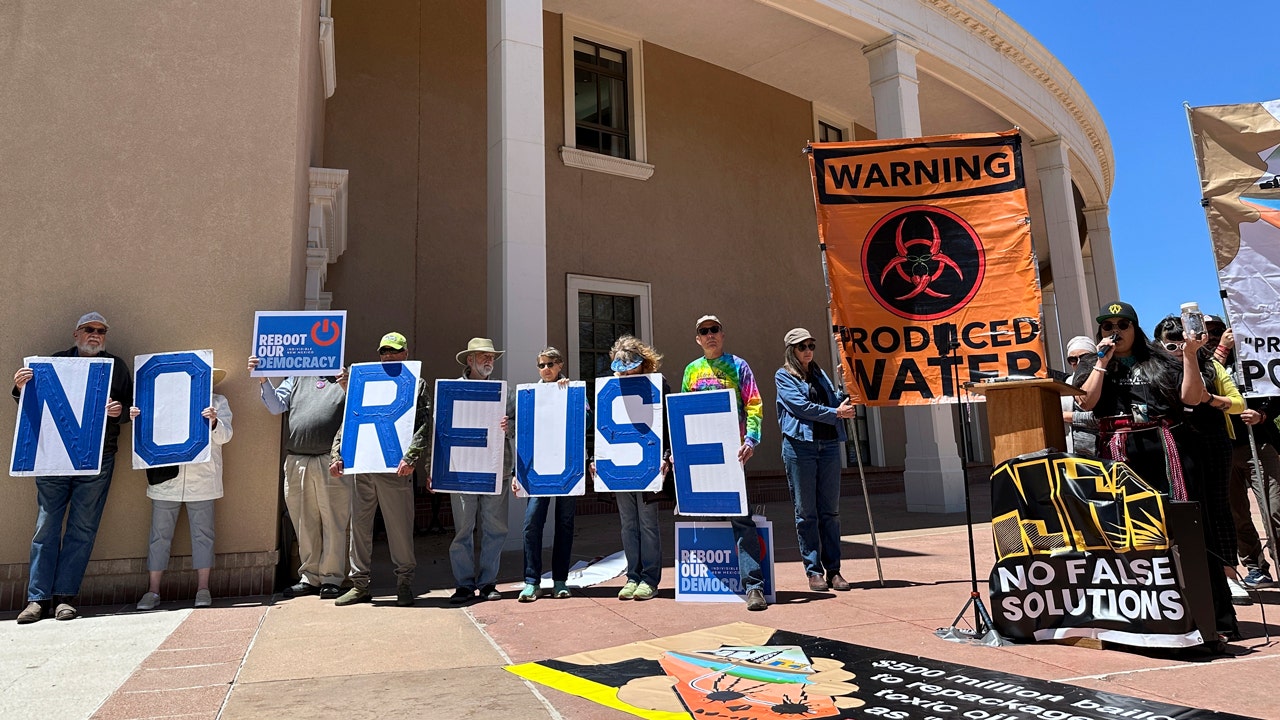
Environmental officials in New Mexico took initial steps Monday toward regulating the treatment and reuse of oil industry fracking water as the state grapples with scarce water supplies and fossil fuel producers confront shrinking opportunities for wastewater disposal.
A state water quality commission opened a weeklong series of hearings as the nation’s No. 2 state for petroleum production begins to build out a series of rules that initially prohibit the release after treatment of so-called produced water from oil and gas production while still opening the way for pilot projects.
“The rule is prohibitive when it comes to any type of release of any type of produced water, whether treated or untreated,” said Andrew Knight, assistant general counsel to the state Environment Department, in opening statements. “At this point, we couldn’t even tell you what testing would be needed to determine that a certain treatment technology or combination of technologies would be protective.”
BIDEN ADMIN ENACTS FIRST-EVER PFAS ‘FOREVER CHEMICAL’ LIMITS ON DRINKING WATER
He said the agency’s initial rule would be “as protective as possible while still allowing the science to advance through pilot and then demonstration projects.”
The proposal is generating public protests that give voice to fears of undisclosed contaminants used in the oil- and gas-drilling process. At the same time, oil producers and at least one water service provider say the regulations don’t provide specific water quality standards that might help effective treatment projects move forward.
The Environment Department “apparently wants a regulation to be able to deny a permit based on the source of the water, not its quality,” said Liz Newlin Taylor, an attorney for Select Water Solutions, a Houston-based water-management company for energy producers with operations in Carlsbad. “New Mexico certainly needs additional sources of water, and treated produced water could be part of this solution. These proposed regulations, however, failed.”
Protesters gather outside the New Mexico Statehouse to denounce a proposed rule for the treatment and recycling of oil-industry fracking water on May 6, 2024, in Santa Fe, New Mexico. (AP Photos/Morgan Lee)
Several environmental groups are urging the Environment Department to strike definitions that refer to the reuse of treated water in agriculture, recreational fields, rangeland and potable water.
“The public, understandably, is concerned that the rule allows land application of produced water, and that produced water will infiltrate and pollute groundwater,” said Tannis Fox, an attorney representing environmental groups Amigos Bravos and The Sierra Club. “This is not what the rule says, but it is what members of the public are concerned about.”
New Mexico Gov. Michelle Lujan Grisham has pitched plans for the state to underwrite a strategic new source of water by buying and selling treated water that originates from the used, salty byproducts of oil and natural gas drilling. Related legislation stalled at the Legislature in February without a House or Senate floor vote, but the governor has said she’ll persist.
Several dozen protesters gathered last week outside the state Capitol to condemn the oil wastewater rule. They included the lead plaintiff in a lawsuit alleging the state has failed to meet constitutional provisions for protecting against oil and gas pollution.
Another protester, Reyes DeVore, of Jemez Pueblo and the Native American environmental rights group Pueblo Action Alliance, said, “We collectively stand in opposition to the reuse of toxic oil and gas wastewater outside of the oil field.”
“The strategic water supply that the Gov. Grisham announced, it’s not a real solution,” she said.
Expert testimony submitted by the New Mexico Oil and Gas Association paints a dire portrait of competition in New Mexico for water resources among cities, farms, industry and wildlife — even as oil-industry water demands grow for fracking.
“Over the next 50 years, New Mexico will have approximately 25% less water available in rivers and aquifers,” said John D’Antonio, who previously served as New Mexico’s top water regulator — the state engineer. “It impacts everything from municipal planning to population growth to economic activity.”
Other expert testimony from the association notes that oil companies have more and more produced water to dispose of as they increase drilling activity — with decreasing capacity for disposal because of concerns including earthquakes linked to high-pressure injection wells. The industry generates four or five barrels of wastewater for every barrel of oil produced, said Robert Balch of the Petroleum Research Recovery Center at New Mexico Tech in Socorro.
Read the full article from Here


A former Riverside County man was found guilty of sex trafficking a female victim and forcing her to engage in commercial sex acts along L.A.’s notorious Figueroa Corridor.
Elias Abdul Shabazz, 34, formerly of Perris, was found guilty by a jury following a five-day trial, the U.S. Attorney’s Office said.
Prosecutors said Shabazz had led the victim to believe they were in a romantic relationship before he turned physically and sexually violent. He began demanding that the victim engage in commercial sex acts from May to October of 2021, court documents said.
He carried a handgun with him and, on occasion, was accused of using it to pistol-whip the victim. He also fired the gun at her feet while threatening to kill her, prosecutors said.
At trial, the victim said Shabazz demanded that she meet a daily quota of commercial sex proceeds and that she was terrified of the consequences of not meeting that quota.
She testified that Shabazz compelled her to work in the notorious Figueroa Corridor in South L.A., a dangerous area known for human trafficking and prostitution.
Shabazz had confiscated her identification card, Social Security card and birth certificate. He constantly monitored her cell phone to stop her from communicating with any friends or family.
“He also introduced her to addictive narcotics and controlled every aspect of her life, including when she ate, slept and showered,” prosecutors said.
In May 2025, Shabazz was arrested and has remained in federal custody. His last known address at the time was in Washington, D.C.
On June 26, 2026, Shabazz was found guilty of one count of coercing or enticing interstate transportation for purposes of prostitution.
A sentencing hearing is scheduled for Oct. 6, where he faces 15 years to life in prison.
“Sex trafficking matters rank among the most tragic cases our office prosecutes,” said First Assistant U.S. Attorney Bill Essayli. “This defendant will now face many years in a federal prison cell for his sick, disgusting, and disturbing behavior.”
“Elias Shabazz preyed on a vulnerable victim using physical and sexual violence and cruel psychological coercion to compel commercial sex acts for his own profit,” said Assistant Attorney General A. Tysen Duva of the Justice Department’s Criminal Division. “There is no place for this type of conduct in civilized society. We deeply respect the victim’s courage to face her trafficker in court. The Criminal Division will continue to bring these cases and try them.”
Anyone with information about human trafficking can report tips to the National Human Trafficking Hotline at 888-373-7888

The star-studded feel-good giveback event of the summer has returned. KTLA 5 is teaming up once again with Project Angel Food for the annual “Lead with Love: Going the Distance” telethon to raise critical funds for medically tailored meals delivered to people living with serious illnesses throughout Los Angeles County. The seventh annual telethon airs […]

A woman was hospitalized with serious injuries after she was violently attacked by a robber in downtown Long Beach. On June 18, Jennifer Silva, 34, was attending a World Cup watch party at a Hooters restaurant at 90 Aquarium Way. After the game ended, she left the restaurant just before 11 p.m. As she walked […]
-

 Los Angeles, Ca18 minutes ago
Man found guilty of sex trafficking victim along L.A.’s Figueroa Corridor
-

 Detroit, MI38 minutes ago
No. 23 overall pick in the 2026 NHL draft | Detroit Red Wings
-

 San Francisco, CA47 minutes ago
San Francisco Pride kicks off with rainbow lasers, ValQueeries celebrate at Valkyries Pride Night
-

 Dallas, TX53 minutes ago
How to buy Egypt vs. Australia World Cup soccer tickets
-

 Miami, FL60 minutes ago
Helping Venezuela: Miami search-and-rescue team prepares to deploy
-

 Boston, MA1 hour ago
How to buy Paraguay vs. Germany 2026 World Cup tickets in Boston
-

 Denver, CO1 hour ago
Denver Broncos Roster Breakdown: Center—The Depth Question
-

 Seattle, WA1 hour ago
Iran-Egypt: Seattle World Cup Pride match updates

