Southwest
Immigrant murder convictions 'tens of thousands' higher than ICE's bombshell figures: data expert

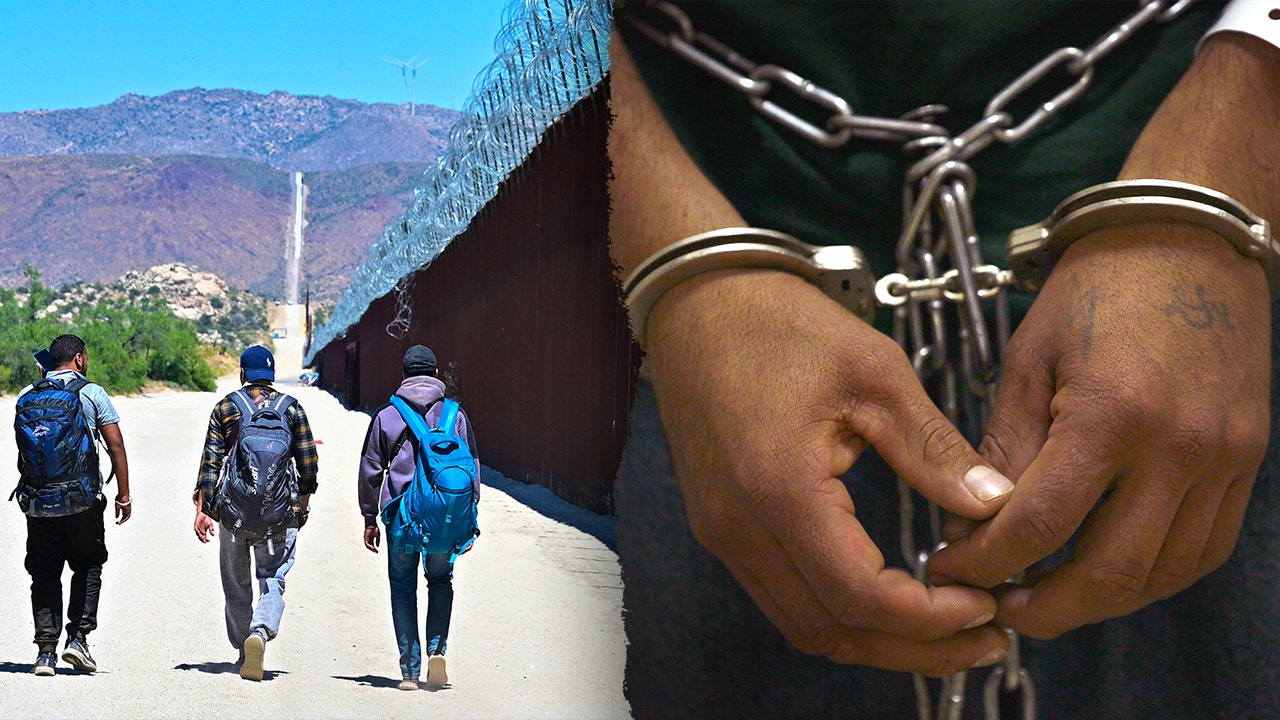
The total number of immigrant noncitizens in the U.S. who have murder convictions is likely “tens of thousands” more than the 13,400 listed on Immigration and Customs Enforcement’s (ICE) national docket, given the criminal records of border-hoppers in their native countries are not baked into the data, a data expert tells Fox News Digital.
The bombshell figures released last week via ICE’s national docket show that 277 noncitizens are currently being held by ICE, while 13,099 noncitizens are on the non-detained docket with homicide convictions. ICE’s non-detained docket includes noncitizens who have final orders of removal or are going through removal proceedings but are not detained in ICE custody.
Of the 13,099 convicted murderers not being detained by ICE, it is unclear how many are incarcerated by federal, state or local law enforcement, or roaming the streets. There are an additional 1,845 on the non-detained docket with pending homicide charges.
In total, 662,566 noncitizens with criminal histories are on ICE’s national docket, which stretches back decades.
US OFFICIALS NAB PERUVIAN GANG LEADER WANTED FOR NEARLY 2 DOZEN KILLINGS IN HOME COUNTRY: ‘SIGNIFICANT THREAT’
Texas National Guard troops watch over more than 1,000 immigrants who had crossed the Rio Grande overnight from Mexico on Dec. 18, 2023 in Eagle Pass, Texas. (John Moore/Getty Images)
The figures underline the serious threat illegal immigration and not vetting immigrants thoroughly poses to law-abiding people living in the U.S. The figures sparked an outcry from border security advocates.
Sean Kennedy, who specializes in law enforcement and crime data analysis, said the numbers of noncitizens in the U.S. who have murder convictions — as well as convictions for other crimes like assault and rape — is much higher than the 13,376 on ICE’s detained and non-detained dockets because those convictions only apply to crimes committed in the U.S. and not murders committed in migrants’ home countries.
“We don’t know how many people have come into the United States over the last decades, let alone in the last few years, who have criminal convictions or offenses overseas,” Kennedy said. “Very few of the migrants who crossed the border who have criminal records will ever be properly vetted because the criminal records in their home countries are insufficient, they’re not compatible with, or they’re just plain not shared with the United States. And we’ve seen this over and over again.”
Kennedy cited the case of a Peruvian gang leader, Gianfranco Torres-Navarro, who was wanted for nearly two dozen murders in his home country and entered the U.S. illegally at the Texas-Mexico border on May 16, as an example of how the vetting process is letting violent criminals into the U.S.
He was arrested by U.S. Border Patrol near Roma, Texas, before being released into the U.S. with a notice to appear for immigration proceedings, Fox News learned. It took almost two months before federal authorities learned Torres-Navarro was wanted in Peru for 23 killings, including the slaying of a retired police officer.
“He was a drug gang lord, and we didn’t know that because Peru didn’t tell us, or he wasn’t listed in a database that we had access to because our databases are very limited,” Kennedy said.
Gianfranco Torres-Navarro, the Peruvian gang leader wanted for 23 murders, was arrested by ICE after being caught and released at the border. (U.S. Immigration and Customs Enforcement)
Kennedy said that the federal database includes a list of people with mostly offenses that were committed in the U.S. and by people who are considered security threats, but there are lots of those who are security threats who are not identifiable, or their biometric data — such as fingerprints — is not being collected.
“So if you’re living in the mountains of Afghanistan and you go by a pseudonym, we have no idea [that] when you scan your fingerprints, you’re that guy,” Kennedy said, noting governments aren’t forthcoming with the data. “The Taliban government isn’t sharing that. The Venezuelans aren’t telling us who their gangsters or mobsters are. The Chinese aren’t telling us who their spies are, let alone the Russians or the Tajiks or anyone else.”
Kennedy said that added into the mix is the roughly 2 million so-called “gotaways” who crossed the border over the last three years but never encountered Border Patrol.
“We have no idea who they are,” he added.
Kennedy noted that when Border Patrol encounters migrants at the border, the agency asks for basic information such as their name, place of birth and also collects biometric information and registers it with the National Crime Information Center, a national database of all state and local crime information. It also processes the data through the National Vetting Center list, which co-ordinates with various federal agencies like TSA and co-ordinates with other countries.
“But that data is very limited, too, because that’s completely voluntary as to what countries submit … And worse than that, very few countries participate in agreements where they will share full and freely information about their criminal context,” Kennedy said.
“So we get very little information about foreigners crossing the border, and very little of it can be verified [and] many of the people who cross the border have no serious government documentation and sometimes none at all.”
Illegal immigrant Victor Martinez Hernandez is accused of savagely raping and murdering mother of five Rachel Morin in Maryland on Aug. 5, 2023. (Tulsa Police Department/ Facebook)
The ICE data from last week shows that among those on the non-detained docket, 62,231 were convicted of assault, 14,301 convicted of burglary, 56,533 had drug convictions and 13,099 convicted of homicide. An additional 2,521 have kidnapping convictions and 15,811 have sexual assault convictions.
It is not known how many of the noncitizens on the national docket entered the U.S. illegally or legally. For instance, a permanent resident Green Card holder who is convicted of a crime is subject to deportation once convicted and would therefore end up on the national docket.
Kennedy, who is the executive director of the Coalition for Law Order and Safety, a nonprofit research group which studies and advocates for effective public safety policies, said the lion’s share of the near 13,400 noncitizens convicted of homicide, carried out those killings while in the U.S., and that even if they have served their time they are not necessarily deported as their home countries can refuse to take them back.
ILLEGAL IMMIGRANTS WITH ‘TERRORISM TIES’ WILL CONTINUE TO EXPLOIT BORDER, HOMELAND SECURITY REPORT WARNS
That is because in 2001’s Zadvydas v. Davis, the Supreme Court ruled it unconstitutional to indefinitely detain people who would otherwise be deported if they cannot be deported.
Kennedy said there is no exact figure of the actual homicide crime convictions rate of noncitizens, but it can be gauged by extrapolating the numbers from a Texas investigation into noncitizen crimes and then applying them to the national rate.
That investigation, by the Texas Department of Public Safety (DPS), found that since June 2011, illegal immigrants have been charged with over 1,100 homicides, more than 3,500 sexual assaults and 3,700 other sex offenses.
It meant that the overall Texas homicide conviction rate in that period was 2.88 per 100,000 residents, while the illegal immigrant rate was 3.25 per 100,000 residents, or 13% higher. Legal immigrants, by contrast, were convicted of homicide at significantly lower rates than illegal immigrants and the overall Texas population.
“So if we extrapolate that across the United States, there would be tens of thousands of people in addition to these 13,000 who’ve committed a homicide here,” Kennedy explained.
Jocelyn Nungaray, 12, was found strangled to death in a Houston creek. Venezuelan migrants Franklin Pena, 26, and Johan Martinez-Rangel, 22, were indicted last month on capital murder charges in connection with Nungaray’s murder. (Fox Houston courtesy of the Nungaray family)
“There is a large number of people who are committing crimes in the United States who are here illegally that we know about. And there is a large number of people who are committing crimes in the United States who we don’t know about. They could be gotaways or somehow slipped through the cracks in another way and that population is a wild card for US law enforcement because we can’t deport them.”
“When you’re importing hundreds of thousands of young El Salvadorian men, or Venezuelan men, which for decades were homicide capitals of the world, it’s likely that many of them have committed murder or have been accomplices to murder because their homicide rates were 20 times the U.S. rate,” Kennedy added.
The Texas DPS investigation found that more than 20% of its incarcerated illegal immigrant killers were unknown to DHS, Kennedy said, adding this is likely replicated across other states as well – bringing the figures even higher again.
“These are all preventable crimes. If these people hadn’t come here, they wouldn’t have committed these crimes,” Kennedy explained. “So when we know someone has a criminal history, we have an obligation to protect our citizens first, not import the world whom some of them are criminals and offenders and violent and terrorists and other threats to U.S. public safety.”
Read the full article from Here


“Moana” has been called a box office flop, an unnecessary money grab by Walt Disney Studios, but what it hasn’t been called yet is a triumphant win for cultural representation on the big screen.
The live-action adaptation of the beloved 2016 animated movie “Moana” effectively bombed at the box office, making much less money than industry insiders anticipated.
While it failed to live up to the expectations of the box office and critics alike, the film did exceed the expectations of moviegoers of Pacific Island descent, and they’ve taken to social media to express just how much the movie means to them.
Moana is more than the main character’s name. It means ocean across several Pacific Islander languages.
One user explained how this kind of representation is more than entertainment.
“When I watched ‘Moana,’ I couldn’t hold back my tears. I heard the language of my parents, the language of my people. I saw our traditional Samoan clothing, our weaving, our siva, our culture, our values. I saw my people. I saw me.”
Another user said seeing Pacific Islanders on the silver screen influenced her own artistry.
“Representation matters. As a sometimes-Female-Polynesian-filmmaker (depending on the day and my imposter syndrome), seeing our stories on a screen this big makes me dream a little bigger too.”
Even the film’s star, Dwayne “The Rock” Johnson, spoke to the film’s representation in a recent Instagram post.
“I feel that our movie ‘Moana’ will always serve a bigger purpose than just a film – it’s representation. Our Polynesian culture showcased to the world, and embraced by the world – with love, humility, warrior spirit and MANA.”
That representation was taken as a serious responsibility by the actors and creative team behind the scenes of Disney’s latest live-action remake.
“We got chosen for a reason,” Rena Owen, who plays Gramma Tala in the film, explains.
“Every single one of us, whether that’s an actor, whether that’s a creative, whether that’s a crew person. We’re raised that way, we’re raised in villages and we’re raised… on our earth, with our sky father and our moana, that’s what we all have in common. So, we just had to be ourselves.”
Disney once again leaned on members of its Oceanic Cultural Trust, a group formed over a decade ago to ensure cultural accuracy for the first “Moana” movie.
The trust’s lead consultant, Dr. Grant Muāgututiʻa, spoke about the work that went into bringing Moana to life on screen.
“We have a big responsibility to our folks who are gonna be watching the film. We’re elated that the film crew and the filmmakers were really receptive to all of the input that we had and we’re really happy with the way it turned out.”
Dr. Muāgututiʻa is a linguist by trade, serving as Assistant Professor of Linguistics at California State University San Marcos. He told KTLA he was thrilled that people of Samoan descent can hear their language spoken in a major Disney film.
“The mountaintop scene where you can hear both Jon Tui, who plays Chief Tui, and Catherine Laga’aia, who plays Moana speaking Samoan. And then the Siva Tau scene, where Seiuli Dwayne Johnson also speaks Samoan. I think those are special moments that are new, especially for our people to see. They’re able to experience real islanders that are proud of their culture.”
“Moana” Choreographer and Cultural Trust member Tiana Nonosina Liufau agreed.
“Seeing an all-Pasifika cast, and hearing them, there’s a lot of Mana in that, hearing these words come out of their mouth, something audiences can trace back to their genealogy, that’s priceless. All worth it.”

Crews worked overnight on what is expected to be a long-term effort to clean up and repair a broken water main that caused extensive damage in West Hollywood on Thursday.
Yellow tape remained in place Friday morning, blocking streets around Sunset Boulevard and Holloway Drive as crews continued pumping water out of the century-old trunk line.
Asphalt and soil were also being removed so crews could get a better look at the damaged 36-inch trunk line, a major feeder pipe serving the area.
-

Aerial view of flooded streets in West Hollywood following a water main break on July 16, 2026. -
Two men fell into a sinkhole that opened on a sidewalk after a massive water main break in West Hollywood on July 16, 2026. (KTLA) -
Aerial view of flooded Metro buses in West Hollywood following a water main break on July 16, 2026. -
Aerial view of flooded streets in West Hollywood following a water main break on July 16, 2026. -
Aerial view of flooded streets in West Hollywood following a water main break on July 16, 2026. -
A broken water main sent water gushing out of an apartment building and turned streets into rivers in West Hollywood on July 16, 2026. (KTLA) -
A broken water main sent water gushing into a parking garage in West Hollywood on July 16, 2026. (KTLA) -
Floodwaters from a water main break push parked cars into one another in West Hollywood. July 2026. (KTLA) -
Floodwaters from a water main break push parked cars into one another in West Hollywood. July 2026. (KTLA) -
Residents stand at the entrance to an apartment parking garage as floodwaters from a water main break rush past in West Hollywood. July 2026. (KTLA) -
A parking garage is seen flooding following a water main break in West Hollywood on Thursday, July 16, 2026. (KTLA) -
Floodwaters from a water main break push parked cars into one another in West Hollywood. July 2026. (KTLA) -
Floodwaters from a water main break push parked cars into one another in West Hollywood. July 2026. (KTLA) -
Floodwaters from a water main break push parked cars into one another in West Hollywood. July 2026. (KTLA) -
A broken water main sent water gushing into the streets of West Hollywood on July 16, 2026. (KTLA)


“First and foremost is our crews’ safety,” a Los Angeles Department of Water and Power spokesperson said Thursday. “When we excavate, we are going to have to make sure the area is safe before we send crews in to proceed and start the actual repairs on the pipe.”
The water main ruptured around 3 a.m. Thursday, sending thousands of gallons of water rushing through West Hollywood streets, flooding dozens of garages and pushing parked cars into one another.
A Metro bus yard was also flooded, leaving several buses partially submerged.
The force of the water washed away dirt and gravel supporting the roadway, creating a massive sinkhole on Sunset Boulevard and a smaller one near Palm Avenue, where two people fell in.
“I’m astounded by the massive sinkhole that has just opened up before our eyes,” KTLA’s Annie Rose Ramos reported Thursday from Palm Avenue.
The two men appeared to be uninjured.
As for the larger trunk line that burst beneath Sunset Boulevard, KTLA’s Carlos Herrera reported it was scheduled for replacement in 2031.
LADWP officials now hope to establish a repair timeline after getting a closer look at the damage Friday. For now, the intersection is expected to remain closed for anywhere from several days to several weeks.
The cause of the rupture remains under investigation.
Los Angeles, Ca
Arrest made in deadly shooting at 4th of July gathering in Compton; search for 2nd suspect continues

Los Angeles County Sheriff Robert Luna gave an update Thursday on several shootings over the Fourth of July weekend that left three people dead and several others injured.
Police arrested Antoine Jones, a 50-year-old man from the Los Angeles area, who they believe is responsible for the murder of a 19-year-old woman and the attempted murder of two additional surviving female victims who were attending a large community block party in Compton.
On July 4 at approximately 11:40 p.m., deputies from the Compton station responded to an apartment complex on the 700 block of West Laurel Street following reports of multiple people being shot.
Meah Bordenave-Jenkins, a 19-year-old nursing student at the University of Nevada, Las Vegas, was killed when gunfire broke out at the party.
Deputies located Bordenave-Jenkins and the two other women suffering from gunshot wounds outside of the apartment complex.
“While today’s announcement represents an important step towards justice for Meah and her family, our work is very far from being over,” said LASD Sheriff Robert Luna.
The LASD is also seeking the public’s help in identifying those responsible for the murder of Eric Washington, 37, a beloved community activist and former government staffer, and the attempted murder of another surviving man injured that same night at the same party.
Washington was reportedly killed while trying to deescalate a conflict at the party, his family said. Deputies found victim Washington suffering from a gunshot wound inside the complex.
Investigators later learned that another man had also been shot at some point during the incident.
Bordenave-Jenkins and Washington both died from their injuries. The remaining victims, two women and a man, sustained non-life-threatening injuries and have been released from the hospital. They have not been identified by police.
Detectives determined the two shootings happened moments apart at the party but appear to be separate and unrelated.
-
A man and a women were killed and three others were injured, one critically, at a Fourth of July Party in Compton on July 4, 2026. (OnScene.TV) -
A shooting at a Compton Fourth of July block party in the 2100 block of Grandee Avenue in Compton left one man dead and another injured on July 5, 2026. (OnScene.tv) -
A shooting at a Compton Fourth of July block party in the 2100 block of Grandee Avenue in Compton left one man dead and another injured on July 5, 2026. (OnScene.tv) -
A shooting at a Compton Fourth of July block party in the 2100 block of Grandee Avenue in Compton left one man dead and another injured on July 5, 2026. (OnScene.tv) -
A shooting at a Compton Fourth of July block party in the 2100 block of Grandee Avenue in Compton left one man dead and another injured on July 5, 2026. (OnScene.tv) -
A shooting at a Compton Fourth of July block party in the 2100 block of Grandee Avenue in Compton left one man dead and another injured on July 5, 2026. (OnScene.tv) -
A shooting at a Compton Fourth of July block party in the 2100 block of Grandee Avenue in Compton left one man dead and another injured on July 5, 2026. (OnScene.tv) -
A shooting at a Compton Fourth of July block party in the 2100 block of Grandee Avenue in Compton left one man dead and another injured on July 5, 2026. (OnScene.tv) -
A shooting at a Compton Fourth of July block party in the 2100 block of Grandee Avenue in Compton left one man dead and another injured on July 5, 2026. (OnScene.tv) -
A man and a women were killed and three others were injured, one critically, at a Fourth of July Party in Compton on July 4, 2026. (Google) -
A man and a women were killed and three others were injured, one critically, at a Fourth of July Party in Compton on July 4, 2026. (OnScene.TV) -
A man and a women were killed and three others were injured, one critically, at a Fourth of July Party in Compton on July 4, 2026. (OnScene.TV) -
A man and a women were killed and three others were injured, one critically, at a Fourth of July Party in Compton on July 4, 2026. (OnScene.TV) -
A man and a women were killed and three others were injured, one critically, at a Fourth of July Party in Compton on July 4, 2026. (OnScene.TV) -
A man and a women were killed and three others were injured, one critically, at a Fourth of July Party in Compton on July 4, 2026. (OnScene.TV) -
A man and a women were killed and three others were injured, one critically, at a Fourth of July Party in Compton on July 4, 2026. (OnScene.TV)


Detectives identified Jones as the suspect responsible for Bordenave-Jenkins’ death and the attempted murder of the two surviving women. Authorities located Jones on July 14 in Los Angeles and took him into custody.
The LASD is still searching for the suspect or suspects responsible for the murder of Washington and the attempted murder of the surviving male victim.
“Although today’s arrest is significant, this investigation remains extremely active,” Luna said.
“There were hundreds of people at this gathering,” Luna said. “Somebody knows, somebody saw or somebody heard what happened.”
The LASD also announced they’re searching for a suspect in a separate shooting at a different Fourth of July gathering that occurred in the early morning of July 5.
At approximately 12:10 a.m., Compton deputies responded to the 2100 block of North Grandee Avenue, where they located a 30-year-old victim, Thaddeus Clark, and a second victim suffering from gunshot wounds at the gathering.
Clark, a father of three, did not survive his injuries, Luna said.
The LASD is urging anyone with information about Clark’s murder and the attempted murder of the surviving victim to contact the LASD Homicide Bureau.
Although these shooting incidents occurred at gatherings less than an hour apart, investigators found no evidence that the two were connected, Luna said.
Luna also announced three suspects have been arrested in connection with a shooting in East L.A. on July 5. It happened as crowds crossed the intersection near Whittier Boulevard and Leonard Avenue during a World Cup match.
Four people were hit by gunfire, including two men, one woman and a boy. None of the injuries were life-threatening.
The sheriff said the alleged shooter, a 15-year-old known gang member, was arrested. Two female suspects, ages 21 and 38, have been arrested in the Lancaster and Palmdale areas for their alleged roles in luring the primary victim to the location and assisting the shooting suspect in evading arrest.
They’re all facing four counts of attempted murder.
-

 Los Angeles, Ca1 hour ago
‘Moana’ is a triumph for Pacific Islander representation on the big screen
-

 Detroit, MI2 hours ago
Five shot during funeral at Detroit church
-

 San Francisco, CA2 hours ago
San Francisco Giants Announce Intriguing Roster Move Ahead of Mariners Series
-

 Dallas, TX2 hours ago
Dallas seafood wholesaler fined $250K for false salmon labeling
-

 Miami, FL2 hours ago
Absolutely Not: Florida woman’s “suggestive” license plate goes viral
-

 Boston, MA2 hours ago
Ariana Grande fan gets better tickets to TD Garden concert in Boston after resolving StubHub issue
-

 Denver, CO2 hours ago
Mitchell Fraboni will be the Bronco long snapper in 2026
-

 Seattle, WA2 hours ago
Seattle real estate owner sentenced to prison for $4.7 million tax evasion scheme – MyNorthwest.com

