Southwest
Americans exposed to nuclear radiation by government would be compensated under approved Senate bill

The Senate passed legislation Thursday that would compensate Americans exposed to radiation by the government by renewing a law initially passed more than three decades ago.
The bill by Sens. Josh Hawley, R-Mo., and Ben Ray Lujan, D-N.M., would expand the Radiation Exposure Compensation Act to include more people who believe that exposure caused their illnesses. While some Republicans have balked at the cost — an estimated $50 billion, according to Hawley’s office — the senators have argued that the government is at fault and should step up.
Hawley stood outside the Senate before the vote with advocates for the legislation, several of whom have been diagnosed with cancers or who have family members who have been diagnosed. He said it’s “hard to look them in the eye” and say they were poisoned by their government, “but we’re not going to be there for you.”
JAPAN AIMS TO EXTRACT SAMPLE FROM REMAINS OF COUNTRY’S WORST-EVER NUCLEAR DISASTER
The bill passed the Senate 69-30, with 20 Republicans and all but two Democrats voting in favor. But its prospects in the House are uncertain.
Uranium processing in the St. Louis area played a pivotal role in developing the nuclear weapons that helped bring an end to World War II and provided a key defense during the Cold War. But eight decades later, the region is still dealing with contamination at several sites.
In July, an investigation published by The Associated Press, The Missouri Independent and MuckRock showed that the federal government and companies responsible for nuclear bomb production and atomic waste storage sites in the St. Louis area were aware of health risks, spills, improperly stored contaminants and other problems but often ignored them.
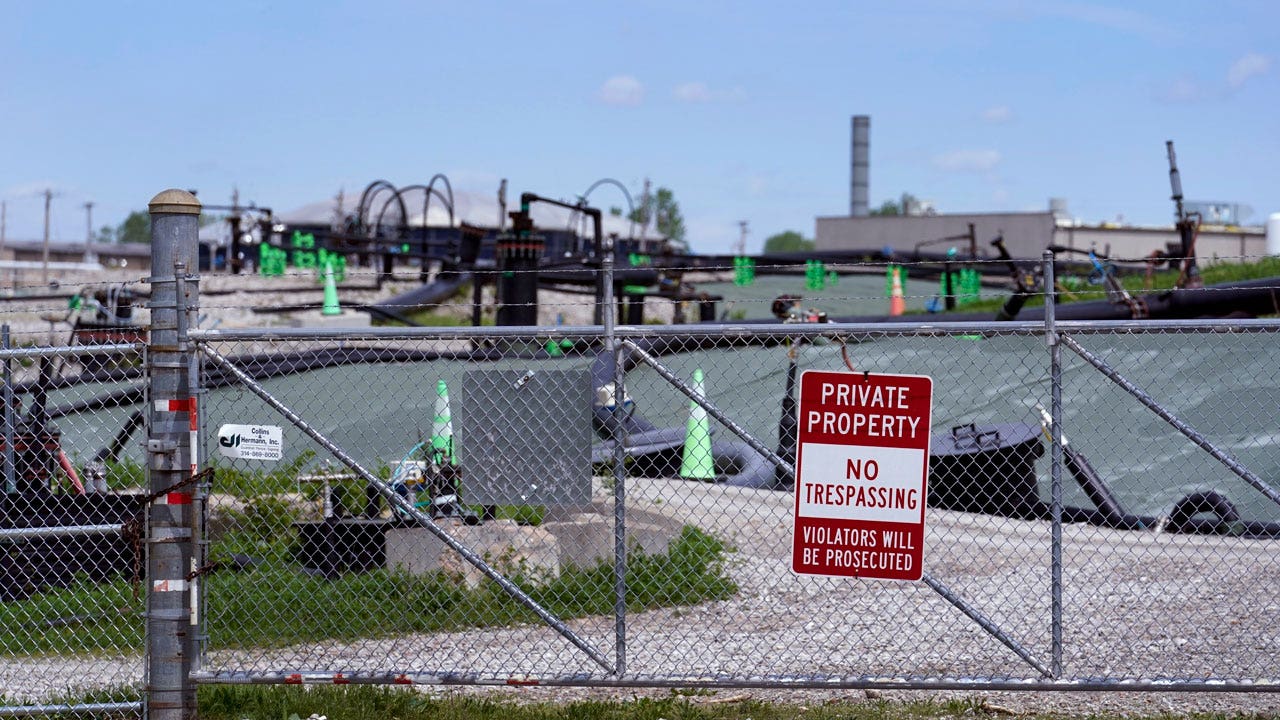
A “no trespassing” sign hangs on a fence outside the West Lake Landfill Superfund site on April 21, 2023, in Bridgeton, Mo. The Senate passed a bill that would expand compensation for Americans who were exposed to radiation by the government. (AP Photo/Jeff Roberson, File)
While it is difficult to prove definitively that the waste caused residents’ illnesses, the advocates argue that there is more than enough evidence that it has sickened people in the area.
“I am a two-time breast cancer survivor,” said Missouri state Rep. Chantelle Nickson-Clark, a Democrat who represents Florissant, an area that sits along the creek that was contaminated by nuclear waste in the 1960s. “I lost my mother to breast cancer, an aunt to breast cancer. Two cousins that are breast cancer survivors, a nephew that had a cancerous brain tumor and other genetic mutation deficiencies in my family. I’m here to represent a community that has been underserved, undervalued, underrepresented and unheard.”
President Joe Biden signed an executive order in 2022 extending RECA for two years, but it expires in June. Hawley’s bill would extend the law for five years and expand coverage to include people in Missouri as well as Idaho, Montana, Colorado, Tennessee, Kentucky, Alaska and Guam.
The White House indicated Wednesday that Biden would sign the legislation.
“The President believes we have a solemn obligation to address toxic exposure, especially among those who have been placed in harm’s way by the government’s actions,” the White House said in a statement.
Others worried about the cost. The taxpayer advocacy group Committee for a Responsible Federal Budget said that the legislation should include budget offsets to pay for it.
Advocates have been fighting for years to expand the program to include more sites in the U.S. In New Mexico, residents in the communities surrounding the area where the first atomic bomb was detonated in 1945 — the top-secret Manhattan Project — were not warned of the radiological dangers and didn’t realize that an atomic blast was the source of the ash that was raining down upon them. That included families who lived off the land — growing crops, raising livestock and getting their drinking water from cisterns.
Tina Cordova, a cancer survivor and founder of a group of New Mexico downwinders, talked about the wave of momentum for expanding the compensation program that has been building since “Oppenheimer,” a film about the development of the first atomic bomb, premiered last year.
“You know, we are ground zero,” she said. “We’re where it all started. The origins of the whole nuclear program are in New Mexico, and we were the first people exposed to radiation as a result of an atomic bomb and to be left out for 79 years is just truly unacceptable.”
Cordova has had many family members and friends die of cancer over the years. Thursday marked the 11th anniversary of her father’s death, and she said she was thankful to be in Washington to celebrate the vote.
“People have been waiting for justice for far too long, and it’s just simply time to do the right thing,” she said.
The vote was a rare up-or-down roll call on standalone legislation as Congress is busy trying to fund the government. Senate Majority Leader Chuck Schumer, D-N.Y., announced that he would put the bill on the Senate floor last week amid negotiations on the spending package.
Hawley would not say if he had threatened to hold up the spending bill over his legislation, which was included in a massive defense bill last year but stripped out at the last minute. But he said he had pledged to use “every tool at his disposal” to get the bill passed.
Persuading the GOP-led House to take up and pass the legislation could be more difficult. Rep. Cori Bush, D-Mo., is among those pushing for the measure.
In St. Louis, nuclear waste stored near Lambert Airport made its way into Coldwater Creek in the 1960s. Many people who live near the meandering creek believe the contamination is responsible for cancers and other illnesses, though experts say connecting radiation exposure to illness is complicated. Cancer concerns also have been raised by people in nearby St. Charles County, Missouri, where uranium was processed and a large quarry became contaminated, resulting in a Superfund cleanup.
In 2022, a St. Louis County grade school closed amid worries that contamination from Coldwater Creek got onto the playground and inside the building. The Army Corps of Engineers announced this week that it is testing a few homes near the creek after high radiation levels were found in their backyards.
After the report by AP and the other news agencies last year, Hawley introduced an amendment to the annual defense bill that would have extended the law. It also would have provided health care coverage and compensation to so-called “downwinders” exposed to radiation during weapons testing in several new regions, as well as to people in Missouri who were exposed to the nuclear waste. But it was removed during negotiations with the House.
Advocates for the bill who traveled to Washington for the vote said it represents hope for them and their families as they have been burdened with medical costs.
Christen Commuso, who works for the advocacy group Missouri Coalition for the Environment, said she has dealt with many health issues, including thyroid cancer, and has had to at times ration her care because it is so costly.
“It’s not about putting money in my pocket,” Commuso said. “It’s about providing me the ability to get the care that I deserve and need.”
Read the full article from Here


The star-studded feel-good giveback event of the summer has returned. KTLA 5 is teaming up once again with Project Angel Food for the annual “Lead with Love: Going the Distance” telethon to raise critical funds for medically tailored meals delivered to people living with serious illnesses throughout Los Angeles County. The seventh annual telethon airs […]

A woman was hospitalized with serious injuries after she was violently attacked by a robber in downtown Long Beach. On June 18, Jennifer Silva, 34, was attending a World Cup watch party at a Hooters restaurant at 90 Aquarium Way. After the game ended, she left the restaurant just before 11 p.m. As she walked […]

Jurors deliberating the fate of the man accused of starting the Palisades Fire, one of the most destructive wildfires in California’s history, failed to reach a verdict Thursday afternoon, telling the judge they were deadlocked.
A spokesperson from the United States Attorney’s Office told KTLA that jurors will continue to deliberate until they reach a verdict or give up.
Jonathan Rinderknecht, 30, a former Uber driver and one-time Pacific Palisades resident, is accused of starting the Lachman Fire on New Year’s Eve. The fire continued to smolder underground for about a week, even after Los Angeles firefighters believed it had been extinguished.
Flames reignited on Jan. 7, erupting into the deadly Palisades Fire that killed 12 people and destroyed thousands of homes in the upscale community, authorities said.
-

A courtroom sketch of Jonathan Rinderknecht, 29, during his initial court appearance on Oct. 23, 2025. (Bill Robles) -
The U.S. Dept. of Justice booking photo of Jonathan Rinderknecht over the Palisades Fire devastation in Malibu, California in January 2025 (AP).


Prosecutors argued that Rinderknecht deliberately set the fire, claiming he had grown increasingly resentful of wealthy residents and viewed Pacific Palisades as a symbol of that frustration.
“Their case, though circumstantial, is strong,” KTLA legal analyst Alison Triessl said. “The defense is relying on, can they (prosecutors) show beyond a reasonable doubt that Mr. Rinderknecht actually started this fire and it wasn’t the result of fireworks or some intervening cause.”
The defense argued there is no direct physical evidence tying Rinderknecht to the fire and said the prosecution’s case relies entirely on circumstantial evidence. Rinderknecht did not testify during the trial.
Defense attorney Steve Haney spoke outside the courthouse Wednesday about why he believes it will be difficult for prosecutors to prove how the fire started.
“The lack of scene preservation. The fact that they got there after a lot of the evidence was missing. Not a lot of direct evidence. This is a circumstantial case, which is always difficult as a prosecutor to prove,” Haney said.
Rinderknecht, who was arrested and indicted last October, faces up to 45 years in prison if found guilty of three arson counts, including destruction of property by means of fire, arson affecting property used in interstate commerce and timber set afire.
Tony Kurzweil contributed to this report
-

 Los Angeles, Ca44 minutes ago
Watch Project Angel Food's 'Lead with Love' telethon on KTLA
-

 Detroit, MI1 hour ago
Metro Detroit weather forecast, June 26, 2026 — 4 p.m. Update
-

 San Francisco, CA1 hour ago
Newlyweds celebrate Pride-themed weddings inside SF City Hall as parade preparations underway
-

 Dallas, TX1 hour ago
All Dallas restaurants firing up specials for July 4th and America’s 250th
-

 Miami, FL1 hour ago
Helping Venezuela: State Department deploys Miami-Dade search-and-rescue team
-

 Boston, MA1 hour ago
Photos: Norway takes on France in high-powered World Cup matchup in Foxborough – The Boston Globe
-

 Denver, CO2 hours ago
Denver Transplant Games sets Guinness World Record for mos living donors, recipients in one place at one time
-

 Seattle, WA2 hours ago
How to watch Egypt vs. Iran World Cup match in Seattle

