On Wednesday, February 28, West Virginia Governor Jim Justice assembled members of his cabinet and key state, local, and federal officials for a day-long meeting on infrastructure investment in West Virginia.
The Governor’s Infrastructure Funding Summit was led by Gehan Elsayed, Chief Engineer of Planning and Program Implementation at the West Virginia Department of Transportation and Governor’s Infrastructure Implementation Coordinator.
In kicking off the event, Ann Urling, Senior Advisor to the Governor, urged participants to “pull the rope together” to ensure the best outcomes for West Virginia on federal discretionary grant applications, interagency collaboration and coordination, and conveying a message of positive impact to local communities. Mitch Carmichael, Secretary for the West Virginia Department of Economic Development, gave a rousing presentation on Winning in West Virginia. Secretary Carmichael noted several key metrics contributing to the success of infrastructure and economic development investments in the state, most notably the dedicated and loyal workforce in the state and the $9.5 billion in private business investment over the last two years.
Governor Justice doubled down on the skill, tenacity, and dedication of West Virginia’s workforce, communities, and public servants assembled in the room. The Governor reflected on record investments in infrastructure that began well before the large federal packages being discussed, beginning with $1.4 billion in state investments in 2017, which ballooned to $5.1 billion in 2020 – before IIJA passed – to $13.4 billion at the beginning of 2024. With so many of his senior leadership focused on the success of these investments, the Governor was confident that “nothing is going to stop us unless we get in our own way” – a sure way to encourage everyone on the team to pull together.
Next, the discussion turned toward West Virginia’s efforts in Washington, D.C., where Melissa Decker, Director of the Governor’s Washington Office, shared tools and tactics for success in the nation’s capital. NGA’s Tom Curtin emphasized the importance of the “D.C. ground game,” crediting the Elsayed-Decker duo with a successful state-up, state-out approach to implementing key federal packages. Next, Brian Anderson, Executive Director of the Interagency Working Group on Coal and Power Plan Communities and Economic Revitalization spoke about federal resources and the opportunities to “bring the private sector to bear by taking advantage of tax credits in the Infrastructure Investment & Jobs Act (IIJA) and Inflation Reduction Act (IRA).” Kayleigh Kyle, Supervisory Community Liaison for the U.S. Department of Agriculture’s Rural Partners Network (RPN), then talked about the on-the-ground community work RPN is doing with local government and community leaders.
Advertisement
To round out the day, Senior Advisor Urling and Infrastructure Coordinator Elsayed led conversations on regional project development and how agencies are working together to prioritize IIJA investments. Ms. Urling spoke with economic and community development leaders on the importance of regional collaboration, an element of the “West Virginia style” the Governor highlighted earlier in the day. And Ms. Elsayed led discussions with leaders from the WV Department of Tourism, WV Energy Office, and Workforce Resiliency on how their work is contributing to West Virginia’s overall infrastructure investment efforts.
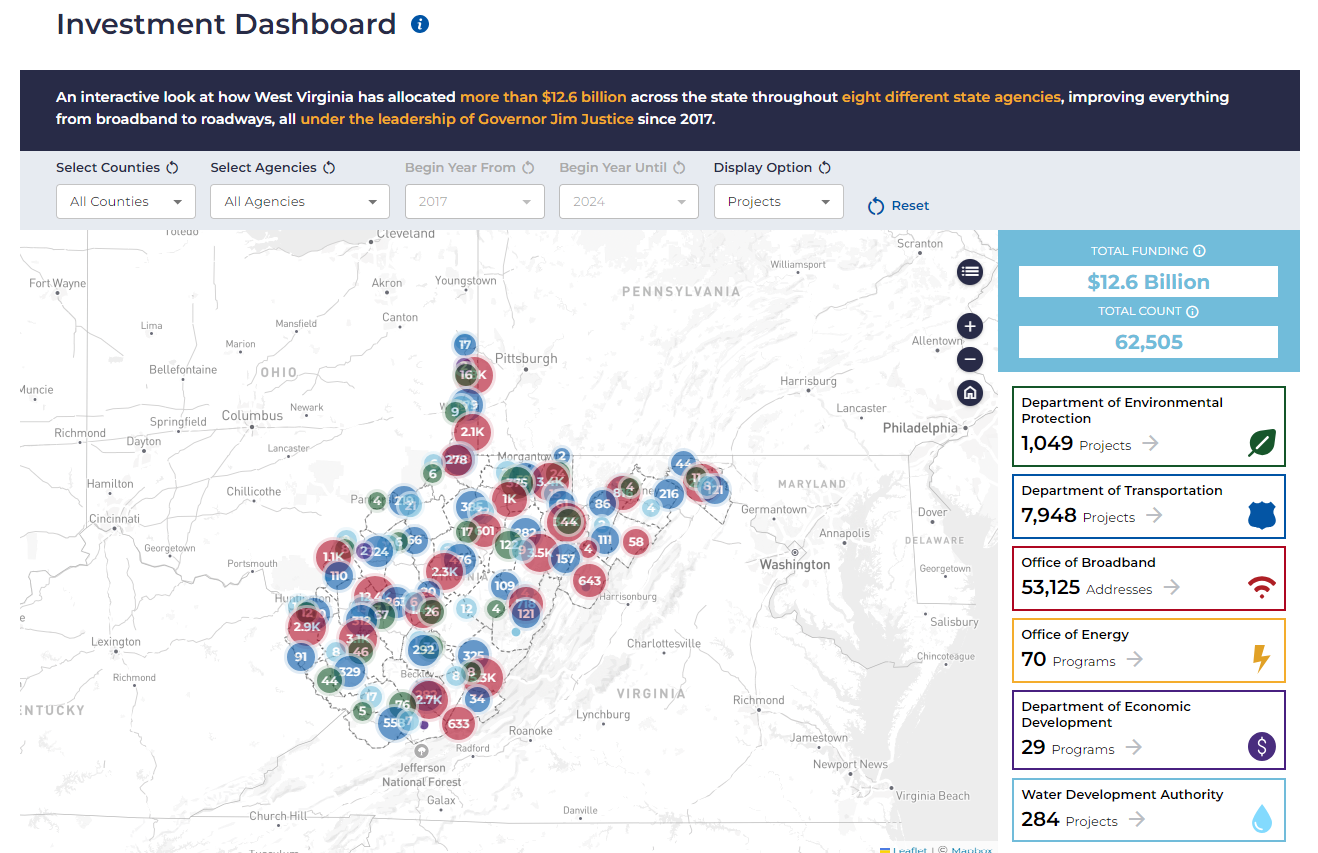
Infrastructure was clearly top of mind in West Virginia that day, as Governor Justice also announced, in a briefing, a significant upgrade to the West Virginia Infrastructure Hub website, with a newly-launched Investment Dashboard that allows users to explore infrastructure projects across the state that have already received funding. The West Virginia Infrastructure Hub is designed to efficiently distribute IIJA funds throughout the Mountain State. The website aims to ensure that the historic investment in infrastructure is distributed to where it is needed most.
NGA congratulates Governor Justice and his team on the launch of the Investment Dashboard and a successful infrastructure summit. To follow NGA’s ongoing activities and support for infrastructure implementation, please visit: https://www.nga.org/bestpractices/infrastructure/
PARKERSBURG, W.Va. (WCHS) — Records show containment issues predated a massive warehouse fire in Wood County, West Virginia.
The facility, formerly REO Processing West Virginia, is now Peoples Cartage. The company states it acquired the operation in September 2024, although the regulatory responsible-party name was not updated until May 2025.
County commissioners say they’ve learned to deal with disasters like this, including the Ames plant fire in 2017.
“They can shed light on what, to answer that to other people too,” said Jimmy Colombo, a county commissioner and former mayor in Parkersburg. “We are very interested in the health and well-being of our community just as you are and it’s a major concern for us that we do follow through what we’re supposed to be doing too.”
Advertisement
According to documents from the West Virginia Department of Environmental Protection, the company, the buildings and others under their umbrella have had several issues over the last half-decade plus.
In June of 2025, the state spill hotline got a call about a fire at the facility that involved the combustion of calcium hypochlorite hazardous waste, which is often called Cal Hypo for short.
That’s a powerful and unstable solid chlorine that’s commonly used to sanitize swimming pools and clear bacteria.
This underlying issue led to the West Virginia DEP inspecting the facility. They found an accumulation of Cal Hypo in floor sweepings.
The agency said the company failed to minimize the possibility of fire, explosion or any unplanned sudden or non-sudden release of hazardous waste or waste constituents to the environment.
Advertisement
BE THE FIRST TO COMMENT
Last September, Peoples Cartage submitted a plan of corrective action that outlined how and when they would become compliant with all the issues.
The WVU Medicine St. Joseph’s Rural Health Clinic is now accepting newborns at its Buckhannon office, with two providers — Rachel Burns, CPNP, and Sara Chipps, FNP-C — taking new pediatric patients. Read more →
This story brought to you paywall-free, courtesy of the My Buckhannon team and our community partners
CHARLESTON, WV — The West Virginia Governor’s Highway Safety Program (GHSP) and the U.S. Department of Transportation’s National Highway Traffic Safety Administration (NHTSA) are reminding drivers that speeding has legal consequences. As part of the Speeding Slows You Down high-visibility enforcement campaign, drivers will see more law enforcement on the roads. West Virginia’s mobilization runs from July 6 through July 31, 2026.
Advertisement
This campaign is designed to underscore the grave consequences of speeding and urge motorists to reduce their speed. This mobilization emphasizes the commitment of law enforcement to curb speeding behaviors and raise public awareness regarding the increased presence of officers on our nation’s roads during this mobilization period.
Speeding-related fatalities affect communities nationwide every year. In 2024, there were 11,288 speed-related traffic fatalities, accounting for 29% of all traffic fatalities. Young drivers have a higher chance of being involved in speeding-related crashes. In 2024, 39% of male drivers and 20% of female drivers in the 15- to 20-year-old age group involved in fatal traffic crashes were speeding.
In West Virginia, in 2024, speeding-related fatalities decreased 8% from the previous year, from 85 to 78. Our ultimate goal is zero fatalities, which points toward the importance of campaigns like this.
“Speeders don’t just put themselves in danger of serious injuries and death, they put other road users, including passengers, pedestrians, and bicyclists, at risk as well. We are asking drivers to please slow down; our goal is to save lives, and we’re putting all drivers on alert. The posted speed limit is the law. No excuses,” said Jack McNeely, GHSP Director.
The consequences of speeding can lead to a costly ticket, potential jail time, or worse, a crash resulting in injuries or death.
Advertisement
For more information on speeding, visit NHTSA.gov/Speeding.
For more information about the West Virginia Governor’s Highway Safety Program, visit highwaysafety.wv.gov or call 304-926-2509.