West Virginia
950 lose jobs as Cleveland-Cliffs closes mill in Weirton, West Virginia


Work at Weirton? We want to hear from you. Fill out the form below to tell us what you think about the closure and what should be done. All submissions will remain anonymous.
Cleveland-Cliffs is closing its tinplate works in Weirton, West Virginia, this month, putting 950 workers out of their jobs. This is the last mill still operating in what once was the vast Weirton Steel Works, located about 40 miles west of Pittsburgh.
The announcement is devastating news to the workers, their families and the surrounding community, which has already seen the long decline of steel production in the West Virginia panhandle and along both banks of the Ohio River.
In making the announcement, Cleveland-Cliffs placed blame on the US International Trade Commission (ITC) for failing to impose tariffs on tin products imported from Canada, Germany, China and South Korea.
In a press release Cleveland-Cliffs stated: “The need to idle the Weirton plant is a direct result of the unanimous decision issued by all four members of the International Trade Commission (ITC) negating the implementation of anti-dumping and countervailing duties on tin mill products calculated by the Department of Commerce.”
Both Cleveland-Cliffs and the United Steelworkers filed an anti-dumping complaint last year charging that tinplate products were illegally being dumped into the US market. In January, the Commerce Department announced import duties against Canada, China, Germany and South Korea.
In particular the complaint was targeted against China, which they claim is overproducing tin products and selling them below cost to drive competition out of the market.
The reality is that those responsible for the closure are not overseas but in the United States. The company is closing the facility in order to maximize profits. US corporations have cut hundreds of thousands of jobs over the past year and a half, intending to use mass unemployment as a weapon against rising opposition from the working class.
The ITC complaint amounted to a demand by the company that its own corporate-controlled government in Washington protect its bottom line from foreign competition. When this did not arrive, the company retaliated by throwing hundreds of workers out on the street.
In 2023, the global tin market was valued at $6.9 billion, and world output was 406.8 kilotons. The market is projected to grow to over $9.2 billion by 2031. Primarily, tin is used to coat steel for the production of cans and other products. It is also used in solder for piping and is a major component in optoelectronics, used for high-speed communications.
The ITC complaint filed by the United Steelworkers and Cleveland-Cliffs came amid a series of escalating trade war measures by the US against China. Last week, Secretary of the Treasury Janet Yellen demanded that China cut back its production of electric cars and solar panels, on the grounds that they are “undercutting” American producers. US capitalism is embroiled in a bitter conflict with what it sees as its main rival for dominance of global markets and supply chains.
This is not limited to official enemies but also countries which, for the moment, remain American allies against China. The purchase of US Steel by Japanese-based Nippon Steel for $14.9 billion has prompted a furious backlash, with politicians from parties demanding government action to torpedo the merger.
The bureaucracy of the United Steelworkers, as with the trade unions as a whole, is drawing together with the management of “native” companies on the false claim that trade war will save American jobs. It has instead backed Cleveland-Cliffs’ proposal to buy US Steel on entirely nationalist, “America First” grounds. This has two aims: first, to cover for its own role in enforcing job cuts and pro-company contracts over decades, and second, to try to dragoon workers into supporting new wars against China and others.
Lourenco Goncalves, Cleveland-Cliffs’ Brazilian chairman, president and chief executive officer, stated, “We worked very closely with our partners at the USW on this solution to save Weirton, and together fought tirelessly for its survival. … We have been upfront and open with union leadership throughout this process and our partnership with the USW remains unbreakable.”
Just last year, the union pushed through a massive concessions contract with Cleveland-Cliffs. At the time, the now-deceased USW President Tom Conway boasted that the contract would save the Weirton tin plant by allowing the company to make $100 million in capital improvements.
The year prior, the USW rammed through a national contract for oil refinery workers which it boasted “does not lead to inflationary pressures”—that is, keeps wages below price increases. That contract was the product of extensive collaboration between the White House and the USW.
In meeting with workers earlier this month, United Steelworkers International President Dave McCall offered no plan to mobilize workers to fight the shutdown, instead telling workers that the plant can only be saved through appealing the ITC decision.
But the International Trade Commission (ITC) rejected the company’s claim, declaring it did not find that there was significant damage to the American steel industry and that it was dropping its investigation.
Politicians both Democrat and Republican have lined up joining with Cleveland-Cliffs and the USW in denouncing the ITC decision.
West Virginia Senator Joe Manchin, a right-wing Democrat who frequently sides with Republicans against his own party, said: “Today’s announcement is a consequence of the International Trade Commission’s decision to turn a blind eye to nearly 1,000 hard-working employees right here in West Virginia in favor of illegally dumped and subsidized imports. Cleveland-Cliffs’ closure is an absolute injustice not only to American workers, but to the very principle of fair competition, and it will undoubtedly weaken our economic and national security.”
Both US senators from Ohio, Sherrod Brown (Democrat) and the ultra-right Trump supporter JD Vance (Republican) issued similar statements.
The Biden administration has not issued a statement, but protectionist policies are already becoming an issue in the upcoming presidential campaign. Biden has issued a statement opposing the Japanese-owned Nippon Steel plan to purchase Pittsburgh-headquartered US Steel, citing “national security” concerns. That is, the US needs access to domestic production in order to produce tanks, bombers and other equipment for US-backed wars in Gaza, Ukraine and around the world.
Decades of job cuts
The closure of the tinplate mill will mark the end of more than a century of steel production in Weirton, West Virginia.
Weirton Steel Corporation was formed in 1909 by Ernest Weir, as an integrated steel producer. In 1929, the company merged with two other steel companies, one in Detroit and the other in Cleveland, to form the National Steel Corporation. At its height, more than 13,000 people worked at the mills in Weirton, West Virginia.
However, by the 1970s, with the end of the postwar economic boom and the beginning of the decline of US economic dominance, American manufacturers carried out a massive program of reorganization to cut costs and boost production. Scores of steel mills were closed, and hundreds of thousands of workers were laid off.
During the 1980 and 1990s as the US steel industry was being reorganized and consolidated, the USW worked with the companies to cut hundreds of thousands of jobs, dismantling plant after plant, uprooting workers and their families and destroying communities.
Throughout this deindustrialization of Buffalo, Pittsburgh, Baltimore, Cleveland, Youngstown to Gary, Indiana, and Chicago, the USW worked tirelessly to prevent steelworkers from drawing the conclusions that it was necessary to unite with workers across national borders to fight the massive multinational corporations.
Instead, the union tried to turn steelworkers against their class brothers and sisters by placing the blame for the layoffs and unemployment onto the backs of their class brothers from Japan, South Korea and Brazil. This set up a global race to the bottom, enabling these companies to whipsaw workers from different countries as they moved production around the world.
In 1984, National Steel sold the Weirton mill to the employees in what became at the time one of the largest Employee Stock Ownership Programs (ESOP) in the country. Many organizations claiming to be socialists hailed employee ownership as the answer to mill closures. They saw this as an alternative to uniting workers internationally in the struggle against the capitalist system.
In reality, “employee ownership” was just another means through which the Wall Street bankers could force through further concessions, this time being done by the “employee managers.” The ESOP program meant that workers had to take a 20 percent pay cut, while saving National Steel $500 to $700 million in shutdown costs.
At that time, the mill employed over 7,000 workers. After the first initial few years, the company cut jobs, citing the need to make a profit. By 2004, the mill employed fewer than half that number.
In 2004, after several rounds of concessions and layoffs, Weirton was sold off in bankruptcy court and bought by the International Steel Group but sold two years later to Mittal Steel, which merged with Arcelor to become ArcelorMittal, the world’s largest steel producer in 2006.
In 2020, ArcelorMittal sold its US business, including the Weirton plant, to Cleveland-Cliffs for approximately $1.4 billion.
The nationalism and chauvinism being advanced by the United Steelworkers today has an even more sinister content than what was done in the 1980s and 1990s. The aim today is to prepare the working class for war.
The shutdown of Weirton can and must be stopped. This requires that workers unite with steelworkers and other workers around the world facing mass layoffs, not unite with management against “foreign” workers. To accomplish this, workers should form a rank-and-file committee at the Weirton works to fight against management, the USW’s collusion and the corporate-controlled political setup.
Autoworkers, educators, healthcare workers and others have already formed such committees and are working to coordinate their struggles across the country and internationally through a world movement, the International Workers Alliance of Rank-and-File Committees (IWA-RFC).

West Virginia
Secretary of State maintains West Virginia’s elections are “safe, secure” after Trump claims – WV MetroNews

CHARLESTON, W.Va. — West Virginia’s Secretary of State maintains that elections in the Mountain State are secure after voter information corruption claims by President Donald Trump.
Secretary of State Kris Warner joined MetroNews “Talkline” Friday to unpack claims by President Trump that voter information for over 200 million Americans had been compromised by China, starting in the 2020 election. Trump addressed the nation Thursday night and said 18 states had experienced corruption by the Chinese government in regard to voter data.
“Our elections are safe, secure, fair, and honest,” Warner said. “We have 55 county clerks and about 8,500 poll workers that did a phenomenal job in the Primary Election, and we’re ready, less than four months away to conduct a general midterm election. So, there’s confidence in our elections and we’re very proud of that.”
Warner said his office has not heard from federal officials.
“I know the President mentioned 18 states, but West Virginia’s not been contacted by the White House, by anyone in the intelligence community; nobody from FBI, CIA, DNI (Director of National Intelligence), or any other federal agency alerting us to any real or existing threat for our upcoming election,” he said.
If the White House or other officials reach out to the Secretary of State’s office with “actionable intelligence,” Warner said the election division will investigate it. Warner praised his office, saying that other states consider West Virginia as a gold standard for election safety,
“People from all over the country look to us,” Warner said. “So, obviously, anything that comes our way that we can act on, we want to increase our election security even further. But until then, we’re going to stay the course.”
West Virginia’s elections are quite secure, Warner emphasized, because the state uses ballot-marking devices. He said that not only are ballots marked electronically, but those votes are also noted on paper.
“Every vote in West Virginia cast is backed up by a paper ballot,” Warner said. “You get to see that paper ballot and make sure that it is exactly who you intended to vote for.”
Because of this commitment to security, Warner said, the election officers in West Virginia will catch anything out of the ordinary. He said his office tracks previous elections and understands the typical numbers of who votes in each precinct. Additionally, he said that 10 days after the election, an audit occurs to confirm results through hand counting.
West Virginia has also been one of the states targeted by the U.S. Department of Justice over disclosure of voter information. A federal judge tossed out a DOJ lawsuit against West Virginia earlier this week over voter data.
Warner said Trump’s claim doesn’t change West Virginia’s stance on refusing to hand over voter information to the DOJ.
“West Virginia law says I’m not to share personal information — that’s social security numbers, driver’s license numbers, tied to birth dates, in some cases, cell phone numbers, email addresses, your home address,” Warner said. “Again, there would need to be actionable intelligence that is going to strengthen our election security before we do anything further.”
While he said he agrees with the mission — keeping people outside of the law from voting — but this isn’t the way to do it. Warner said voter information is personal, and it doesn’t need to be “floating around to vendors” in the nation’s capital, Washington, D.C.

WEST VIRGINIA (WCHS) — On Wednesday, Gov. Patrick Morrisey announced a statewide plan to review every bridge in the state.
Bumpy roads and crumbling bridges are something drivers in West Virginia like Molly Darby are all too familiar with.
“We just bought a newer car and we actually got to take out additional insurance just for the tires, because you worry about that,” Darby said. “You worry about the popping and that can be a huge added expense to a lot of other people.”
About 19% of the state’s 7,300 bridges were deemed to be in poor condition in the 2025 infrastructure report card.
“We have DOT conducting a comprehensive review of all the bridges across West Virginia,” Morrisey said. “We have to be proactive. We have to stay ahead of maintenance and never let our state fall behind.”
Transportation Secretary Todd Rumbaugh said his team at the DOT is working to lower the number of problem bridges that effect every corner of the state.
“We are doing a comprehensive review of all of our bridges,” Rumbaugh said. “We’ve been going through making priorities and we currently have our statewide transportation improvement plan out there for public comment.”
One massive step being taken on the infrastructure front is the nearly $75 million bridge deck replacement on the Fort Hill Bridge in Charleston, one of the most traveled bridges in the state.
“This rehab project represents a once in a generational investment in our economic corridor,” Rumbaugh said. “It’s about much more than concrete, structural steel and orange barrels. It’s about safety reliability and planning for the next 50 years.”
West Virginia
Repair work on busiest bridge in West Virginia to happen in phases to “minimize disruptions”

CHARLESTON, W.Va. — Traffic in the Capital City will soon have to adjust as the busiest bridge in West Virginia draws closer to undergoing a rehabilitation project.
The West Virginia Division of Highways recently awarded a $74.5 million contract for the rehabilitation of the Eugene A. Carter Bridge to Triton Construction. The bridge, also known as the Fort Hill Bridge, is located in the Capital City and carries Interstate-64 over the Kanawha River.
Around 100,000 vehicles travel across the bridge each day.
Gov. Patrick Morrisey joined state and local officials Thursday at Magic Island to officially announce the contract awarding. DOH officials have told MetroNews that crews will build two median crossovers this August, with the majority of that construction taking place at night and on weekends to minimize its impact on traffic. Official repair work is expected to begin in early 2027, with an anticipated conclusion next December.
DOH officials said everything should be “back to normal” by Spring 2028 under the current timeline.
Del. J.B. Akers, R-Kanawha, was on hand for the news conference. He emphasized that motorists will have to be flexible with their routes.
“We’ll have a little bit of an inconvenience while that’s going on,” Akers said. “This is going to be a huge project that impacts traffic from all over the East Coast, really.”
Issues have popped up at the Carter Bridge in recent years. The state DOH made emergency repairs to fix potholes that had popped up last summer, causing traffic delays. Triton Construction also repaired concrete, installed a waterproof membrane, and added a 2-inch layer of asphalt last October.
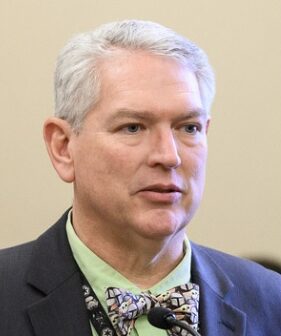
Minimizing the impact on motorists during this project has been a top priority, according to state Transportation Secretary Todd Rumbaugh.
“Our team at the Department of Transportation has worked tirelessly to phase this construction, so we minimize the disruptions on your daily commute and your businesses,” Rumbaugh said.
DOH officials said crews will work on one side of the bridge first, then crews will shift traffic and begin work on the other side. Motorists can stay up to date on the project by visiting the Division of Highways website to see the anticipated construction schedule.
Akers commended Morrisey and Rumbaugh for taking action now.
“For doing the hard thing, on a project like this, which is a maintenance and repair project,” Akers said. “They’re not kicking the can down the road for some other administration to deal with. They’re dealing with a major issue, right now, and this will be a generational project for this bridge. It’s going to prevent us from having to deal with this in the future.”
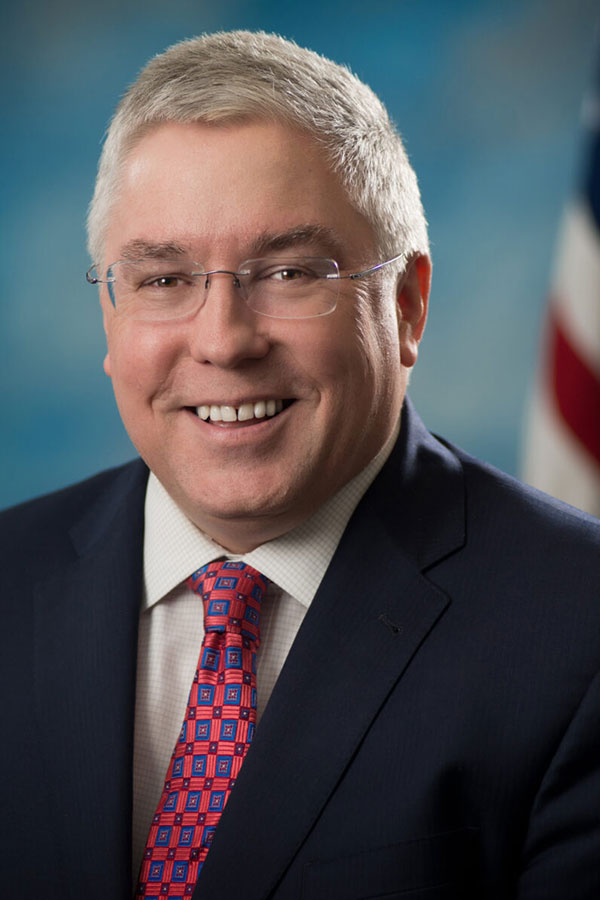
The governor mentioned the state had previously been given poor grades by national surveys on bridge safety. He said his administration is committed to improving bridges all across the state, starting with the heavily trafficked bridge in Charleston.
“This is a signal that we take bridge repair work very seriously,” Morrisey said. “When we inherit being an ‘F’ in bridges, I do not want that to be the case. We need safe bridges for our people, and I’m going to keep working every day to make sure that happens.”
Morrisey said in his year and a half as governor, the administration has been focused on “getting back to the fundamentals.”
“Site-selection and remediation, speed to build; cutting red tape faster, that’s what’s why I’m so excited about our one-stop shop permitting. (That’s) going to make things go even faster, and responsibly.”
Those efforts have been paying off, Morrisey said.
“When you have that kind of economic growth, that level of construction, it’s particularly important to make sure that your infrastructure is strong,” Morrisey said. “That’s really why we’re here today.”
Rumbaugh said the investment signals a commitment to the future of the Mountain State and its travelers.
“This rehab project represents a once-in-a-generation investment in our economic corridor,” Rumbaugh said. “It’s about much more than concrete, structural steels, and orange barrels. It’s about safety, reliability, and planning for the next 50 years.”
-

 Milwaukee, WI6 minutes ago
12-year-old injured in Milwaukee shooting, police seek information
-

 Atlanta, GA12 minutes ago
You can watch the Atlanta United vs Nashville MLS match live for free tonight – Here’s how
-

 Minneapolis, MN18 minutes ago
Minneapolis man charged for driving at 2 Washington County campground workers
-

 Indianapolis, IN24 minutes ago
Canada wildfire smoke leads to air quality alerts for Sunday, Monday
-

 Pittsburg, PA30 minutes ago
Abandoned mini golf course in Westmoreland County getting new life
-

 Augusta, GA36 minutes ago
Richmond County traffic stop attempt leads to chase, rollover crash
-

 Washington, D.C42 minutes ago
Wildfire smoke from Canada and Minnesota pushes farther into the US and engulfs DC in haze
-

 Cleveland, OH48 minutes ago
Identity sought after 19-year-old man killed outside Cleveland Heights convenience store

