Washington, D.C
A Worker-Led Alternative to Billionaire-Owned News in DC


CMR: It seems like the model of journalism funded by online ad revenue is somewhat defunct. We’ll get to the Post later, but what do you all make of the argument that good journalism takes a lot of money to make and just might not be profitable in and of itself?
AH: I think what Maddie just described is a really important answer to this. We’re hearing very often that journalism is not sustainable anymore, that now with the internet people aren’t willing to pay for journalism. What we all need to agree and commit it to is that journalism is a public good.
Journalism is a thing that we need. Particularly when it comes to local news, when we lose publications, corporate malfeasance increases, people are less likely to vote, to run for office, are less civically engaged. There is a litany of negative effects when we lose news, so there needs to be a commitment to make it happen. And good journalism is expensive. But when you compare it to all the other things that our government and we as a society spend our money on, it’s really not that expensive.
MP: Just check out those daily National Guard fees!
AH: Exactly. The ad model has collapsed, which means we need to replace that funding with something else.
CMR: What gap in coverage did you see the 51st filling when you launched, what were people looking for?
AH: DC is an interesting case. It’s not a news desert as compared to the very real news deserts, particularly in rural areas across the United States, where there are no publications left. But DC shows signs of approaching a news desert, and has experienced a steady and increasingly dramatic erosion of local news. It’s in a unique position because we have a lot of journalists in DC, but most of them are focused on Congress and what Trump said this week. That’s important work, but we also need journalists who are covering DC as a city where hundreds of thousands of people live and work.
Credit: Henry Kan
With the closure of DCist, where all of us used to work, followed by dramatic reductions at Washington City Paper, and buyouts at the Post that cut deeply into the Metro section, there were so many different gaps that were left in the city. Dedicated education coverage was dramatically lacking, as was dedicated housing coverage.
A thing we heard from a lot of DC residents was a lack of holistic coverage of crime, not in a dramatic or fear-mongering way, but as a societal issue. What services are young people in DC not getting, what ways are neighbors working to keep each other safe etc.
There was also a huge gap in accountability reporting too, the kind of reporting that holds elected officials feet to the fire. That’s something that our full-time reporter, Martin Austermuhle, does by being at the Wilson Building regularly, going to city council hearings and reporting on what is said and passed. There are very, very few journalists that do that dogged local coverage any more.
MP: The other thing we’ve seen people want is stories about local curiosities. The Pho Viet story, about the beautiful abundant garden outside a mainstay Vietnamese restaurant. Or the one about the lifeguard at Banneker Pool that is always playing bops. The sort of things that help you know the fixtures in your community and your neighbors better, things that make you feel really proud to live in DC. There is tendency in national news to talk about DC as just Capitol Hill, it’s important for us to tell stories about why we love this place and why it’s so much more than just a political backdrop or pawn.
AH: Local news is how you know about and get connected to your neighbors. Another thing we heard as we were doing research before launch was that people felt like they didn’t have the information to make weekend plans anymore, didn’t have information about events happening in the city, or restaurants opening, or community events that don’t grab big headlines. That’s what local news is. It’s how people get connected to the other people who call their city home.
CMR: How are you all feeling about the layoffs at the Post? Relatedly, there seems to be significant demand for a “replacement” for the Post’s coverage, what makes the 51st different from other local news offerings in that regard?
AH: I’m still digesting it — I feel so angry and so sad. What happened at the Post did not need to happen. The money to support a publication like the Post and the journalists who work there exists, and, in fact, exists in the pocket of the man who owns the Post. It’s so frustrating how absolutely unnecessary these cuts were. I feel sad about what we’re losing. I feel sad about the journalists losing their jobs, and about what us as citizens of the United States and of the world are losing from all the stories that will no longer be told. And I also feel really scared. What’s happening at the Post is happening in tandem with losing two and half local newspapers every week and massive institutions like CBS and the Post not only being dismantled, but being repurposed for the aims of powerful right wing interests to further consolidate money at the top and remove the remaining checks that we have on their power.

MP: There’s so much to digest, just incredibly heartbreaking and scary and a symptom of the greater collapse we’re seeing across our systems and institutions.
There is a part of me that remains optimistic because of how many people are hungry, eager, and ready to build alternative structures in response to collapse. We are not going to make up this giant void left by this storied institution, but we are taking community feedback really serious and listening to understand what’s needed: an alternative approach to how journalism has traditionally been done, at least institutionalized journalism.
AH: It is really important for us to be clear that we cannot replace the Washington Post. The kind of resources that an institution like that commanded to do vital journalism is irreplaceable. That being said, we are really passionate about the alternative model that we’re building, and really believe in the ability of that model to be part of creating a better local news ecosystem. A local news ecosystem that is not controlled by powerful executives who may or may not have any experience in journalism, one that is directly responsive to the needs of readers and community members.
Local news in particular, but journalism more broadly, does not have a perfect history or present. There are plenty of examples of journalism holding up the interests of the powerful and failing to protect the less powerful. While we contend with what is a catastrophic loss for journalism, it’s also our responsibility to start building better alternatives. We believe that in the community of DC that’s what we’re doing with the 51st.
Thank God we’re not the only local news institution left. DC deserves a vibrant local news community with a bunch of different publications that are well funded and supported to do their journalism. It’s really important to us that we partner with other local institutions — we co-publish with the Spanish language publication El Tiempo Latino and the Amharic language publication Ethiopique. I think that long term it’s better for DC to be a city with many different community-responsive publications than one behemoth like the Washington Post. That’s the vision that we’re building towards.
MP: We have been planning to grow our newsroom and fundraise this month based on the two-year anniversary of the 51st’s launch with a campaign to bring on two full-time employees. After what happened at the Post, we realized the need is so much greater, and also that community support is really there. In the three days after the cuts were announced we saw 700 new paid members join without us even really putting a call out there. (That’s the second biggest growth spurt in the 51st’s history. The first? When Bezos pulled the Post’s endorsement of Kamala Harris) It’s a heartening testament to building something that the community wants. So we’re going to be launching a $375,000 campaign for the next month, and are already in talks with some major local donors and foundations about providing matching funds. We know the need is there for talented reporters in DC.
AH: The support is reflective of the fact that people need this, want this, and, in this economy, are willing to put their dollars behind it. DC has had a rough, rough year. Not only is the National Guard continuing to occupy our streets, but we have seen unprecedented amounts of layoffs in this city both from federal agencies as a result of DOGE and also from nonprofit and think tanks that rely on government funding. A lot of DC residents are worse for wear economically, but are still continuing to show up and commit memberships to the 51st. News and information is something people want, something people deserve, and something that should be free and available to everyone.
This first appeared on Inequality.org.
Abigail Higgins is the president and managing editor of the 51st.
Maddie Poore is the director of growth and engagement at the 51st.


(NEWS FROM THE STATES) – Visitors from across the United States traveled to the National Mall Thursday for the opening day of the Great American State Fair, a days-long event that is part of President Donald Trump’s Freedom 250 celebration of the nation’s semiquincentennial.
States and territories showed off cultural and agricultural exports at exhibits stretching nearly a mile. Attendees snapped photos on the small Grand Ole Opry stage in the Tennessee booth, kids tried putt-putt at Indiana’s miniature golf course and cowboys rode horses at Montana’s rodeo.
A 110-foot Ferris wheel slowly turned at the center of the freshly manicured lawn, framing the Washington Monument and the U.S. Capitol in the distance on either side. Nearby stood a model of Trump’s controversial “triumphal arch.”
People collected swag from each state — drawstring bags from Ohio, stickers from South Dakota, snacks from Tennessee — and could receive a stamp on state fair passports.

The fair is part of the larger Freedom 250 programming and kicked off Wednesday night with a rally on the mall featuring a speech from the president that closely resembled his remarks along the 2024 presidential campaign trail. The festivities will continue over Independence Day, when Trump will deliver a second speech followed by what is promised to be an impressive fireworks display.
The president will visit North and South Dakota as part of his Freedom 250 tour for the opening of the Teddy Roosevelt presidential library and Independence Day eve fireworks above Mount Rushmore.

Freedom 250 then extends into August with a high school athletic competition in Washington, D.C., dubbed the “Patriot Games” and a Freedom 250 INDYCAR race around the National Mall.
The administration’s celebration is separate from the America250 commission, created by Congress a decade ago, and which has its own nationwide programming this year.
From Lake Erie to the Ohio River
Ohio Gov. Mike DeWine and first lady Fran DeWine greeted guests in Ohio’s pavilion. The couple posed for photos in front of a map of the Buckeye State.
“We wanted to see on the wall all the different things, from Lake Erie to the Ohio River, all the different fun things you can do in Ohio,” the Republican governor said, adding the state has local celebrations and initiatives planned for the 250th anniversary, including “Movies in Ohio” for community showings of films that feature the state.

Ohio’s first lady showcased a children’s literacy exhibit on the opposite wall and touted the roughly 427,000 participants in the state’s partnership with the Dolly Parton Imagination Library, a program that mails free children’s books monthly to households with kids under age 5.
“We’ve mailed out 27 million books. We know that a child’s brain is 80% developed by age 3, so we want to get them those books early,” she said.
Reflecting on America’s milestone birthday, the governor said, “We’re always a work in progress, Ohio’s a work in progress, this country is a work in progress.”
“I think you know the thing we need to keep in mind, all of us, is there’s some essential core principles that we all believe in. … We may disagree about different policies, but the core principles are the same,” he said.
Cartwheels on the lawn
People from various states walked from exhibit to exhibit, while stopped in the nation’s capital during road trip vacations.
Tanya Geders, 43, of St. Louis, Missouri, did a cartwheel in the mall lawn, trying to persuade her son to join in. The family stopped at the state fair on their way to Virginia Beach.
“We’re like, well, if we go to the ocean, we can go to D.C. and what a better time to be here than the 250th anniversary,” Geders said.

Robyn Toman, 71, of Severn, Maryland, escorted her 12-year-old grandson Miles to meet DeWine and grab a photo with the governor.
Toman said she remembers the country’s bicentennial.
“I was a kid about his age, and I came in 1976. I said, ‘We’re gonna go, let’s go down to D.C. for a couple days and see this,’” she said.
“We’ve enjoyed it. We went over to the archives yesterday, and saw the Constitution, and the Declaration of Independence, and the Bill of Rights. And, oh, that was so nice, that was fantastic.”
Not all states are there. A spokesperson for Washington state’s lieutenant governor’s office told States Newsroom the administration declined to join because of “the costs to the state associated with participating.”According to news reports, Connecticut, Massachusetts, North Carolina, Oregon, Pennsylvania, Rhode Island and Vermont did not contribute exhibits, though many are still represented by flags outside the individual booths.The state officials did not immediately respond to States Newsroom for confirmation.
All states that reportedly did not participate, with the exception of Vermont, are Democratic-led.
See a spelling or grammatical error in our story? Please click here to report it.
Do you have a photo or video of a breaking news story? Send it to us here with a brief description.
Copyright 2026 KOTA. All rights reserved.
Washington, D.C
DC reaches settlement with man detained while protesting troops with Darth Vader song

The District of Columbia has reached a settlement agreement for an undisclosed amount of money with a resident who claims police illegally detained him for following an Ohio National Guard patrol while playing Darth Vader’s theme song from “Star Wars” on his phone — an act of protest against the Trump administration’s federal law-enforcement surge in the nation’s capital.
A court filing late Thursday says the plaintiff, Sam O’Hara, will drop his lawsuit’s claims against the District and four Metropolitan Police Department officers within three business days of receiving the settlement payment. The filing doesn’t specify a dollar amount for the deal between the district and O’Hara, who is represented by the American Civil Liberties Union of the District of Columbia.
In an email on Friday, an ACLU spokesperson referred to the settlement’s financial terms as “a significant amount” that O’Hara “is pleased with” but said they aren’t disclosing the dollar figure to protect his privacy. A spokesperson for D.C. Attorney General Brian Schwalb’s office declined to comment on the settlement.
O’Hara’s agreement with the district doesn’t resolve his related claims against an Ohio National Guard member. Attorneys for the Guard member, Sgt. Devon Beck, have asked a judge to dismiss O’Hara’s claims against him.
“He was there because that was his assigned duty,” Beck’s lawyers wrote. “This was not an accidental encounter or a one-time disagreement on a public sidewalk.”
An earlier court filing, in February, said O’Hara had reached a settlement agreement “in principle” with the district. In response, a judge agreed to suspend the case while they negotiated terms.
O’Hara sued the district last October, claiming police officers violated his First Amendment rights to free speech and his Fourth Amendment rights against unreasonable seizures and excessive force.
The ominous orchestral music of “The Imperial March” from Star Wars movies was the soundtrack for O’Hara’s peaceful protests against President Donald Trump’s ongoing deployment of Guard members in Washington. Millions of TikTok users have viewed O’Hara’s videos of his interactions with troops, according to his lawsuit.
A series of major events tied to the nation’s 250th anniversary celebrations promise to bring big crowds and heightened security. On the News4 Rundown: That security is likely to include more National Guard troops as a new report says there’s a limit to their impact on safety in D.C.
O’Hara, an artist who works in the hospitality industry, says he didn’t interfere with the Guard troops during their Sept. 11, 2025, encounter on a public street. One of the troops summoned Metropolitan Police Department officers, who stopped O’Hara and kept him handcuffed for 15 to 20 minutes before releasing him without charges, according to the lawsuit.
“The law might have tolerated government conduct of this sort a long time ago in a galaxy far, far away. But in the here and now, the First Amendment bars government officials from shutting down peaceful protests,” the suit says.
Trump, a Republican, issued an executive order declaring a crime emergency in Washington last August. Within weeks, hundreds of Guard troops and federal agents were helping police patrol the city. The surge inflamed tensions with residents of the heavily Democratic district. Hundreds of Guard members remain deployed in the district nearly a year later, with no clear end in sight.
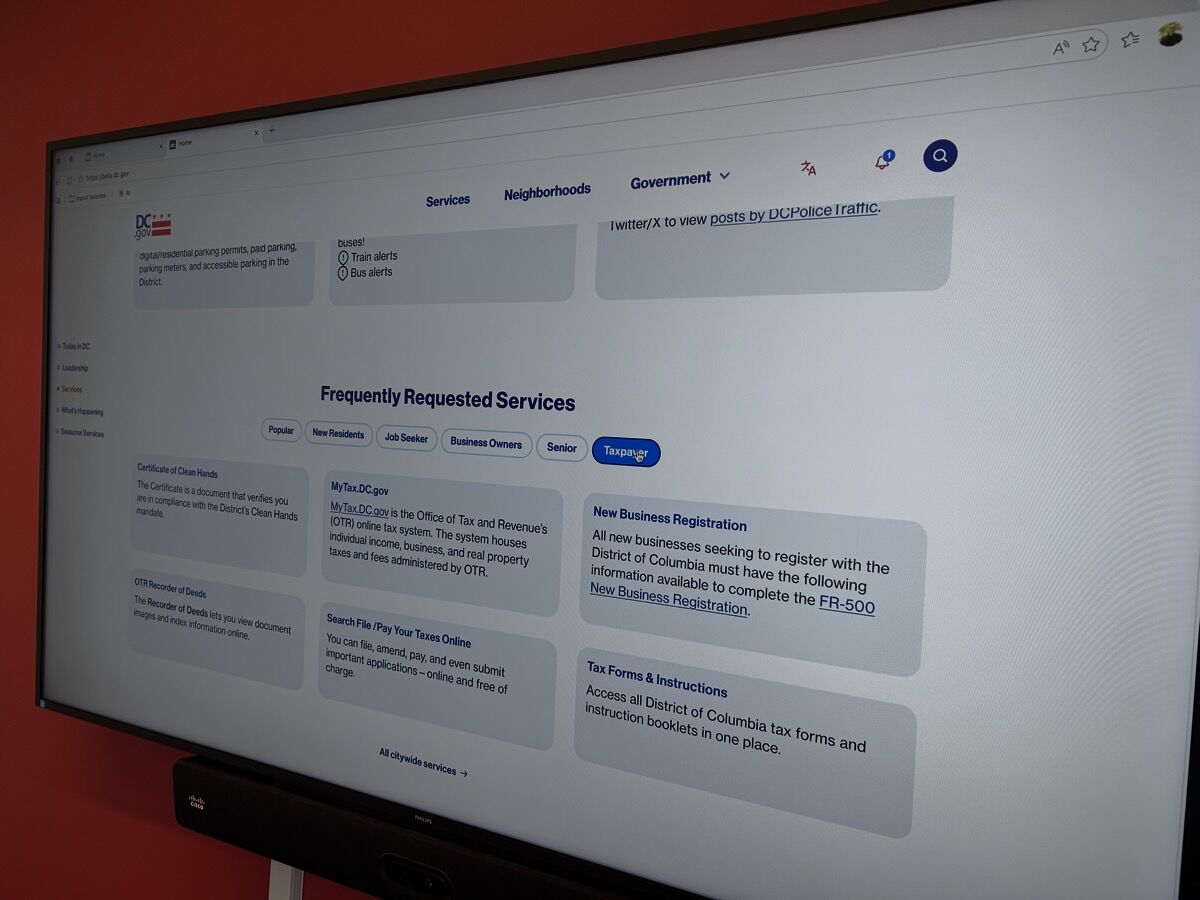
The overhaul is the first in more than a decade and comes in response to feedback that it’s hard to find information on the current site without being efficient at using Google or other search tools.

The D.C. government’s website is getting a complete revamp, a step city leaders hope will make it easier for residents, visitors and business owners to access the help they need.
The District unveiled a beta version of the new DC.gov — beta.dc.gov — and plans to have the redesigned site ready to launch before the end of the year.
The website’s overhaul is the first in more than a decade. It comes in response to feedback that it’s hard to find information on the current site without being efficient at using Google or other search tools.
“This website, it’s really going to eliminate the alphabet soup that you have to remember every day,” said Stephen Miller, the District’s chief technology officer. “So, do you need to know that it’s DPW that’s picking up your trash, or you just need to know that it’s dc.gov?”
The site is built on Drupal 11, which the city said has stronger built-in security features. It includes an integrated calendar and sections for seasonal government services.
Popular searches, based on site traffic data, will also be featured prominently on the main page.
“It’s going to show you, here’s popular services today, based on being a resident, based on being a new resident, based on being a job seeker, based on being a business owner, or based on just being a general resident of the city,” Miller said.
The project cost about $500,000 in dedicated funds.
“We’re setting this up so that you can just go in, say, ‘My trash was missed,’ and it’s going to tell you exactly how to fix that problem,” Miller said.
D.C.’s Office of the Chief Technology Officer is collecting feedback. Residents can leave comments on the beta site and at events at Haynes Senior Wellness Center and Eastern Market, among others, in the coming weeks.
An artificial intelligence-powered search tool, built using Google’s AI technology, will be included on the new DC.gov site after its official launch.
The District, Miller said, is “trying to clean up our content, because what we want to make sure is when we put AI into this site, it’s giving you the right information.”
“We see a lot of future use with AI,” Miller said. “I’d love to get to a point where it’s, ‘Hey Siri, renew my driver’s license,’ and we’ve laid out the foundation for something like that to happen in the future.”
Get breaking news and daily headlines delivered to your email inbox by signing up here.
© 2026 WTOP. All Rights Reserved. This website is not intended for users located within the European Economic Area.
-

 Texas6 minutes ago
A truck crash released 20 million bees. Local beekeepers rushed to save them.
-

 Utah9 minutes ago
‘2.5 minutes of terror’: Passengers sue Delta, alleging crew flew into dangerous weather despite warnings, injuring dozens
-

 Vermont21 minutes ago
Four Vermont beaches named among New England’s best. How to go
-

 Virginia24 minutes ago
Virginia Thomas – Scranton Times-Tribune
-

 Washington29 minutes ago
Where to watch Washington Nationals vs Baltimore Orioles: TV channel, start time, streaming for June 27
-

 Wisconsin36 minutes ago
Baboucarr Ann’s commitment pushes Wisconsin into nation’s top three
-

 West Virginia38 minutes ago
Justice firm’s delinquent DEP fines rise past $1.6M amid DOJ criminal liability relief
-

 Wyoming44 minutes ago
Wyoming, women, and winning the right to vote: Historian presents suffragette research

