Virginia
ACTA Senior Program Officer Nick Down Testifies On Virginia Senate Bill 506


Thank you, Chairwoman Sewell, and distinguished members of the Subcommittee. My name is Nick Down, and I am a senior program officer with the American Council of Trustees and Alumni, or ACTA for short. I am here before you today to urge you to vote against moving Senate Bill 506 forward to the full committee.
By way of background, ACTA is a nonpartisan nonprofit organization committed to preserving academic freedom, academic excellence, and accountability at four-year public and private colleges and universities across the U.S. Since 1995, ACTA has worked with over 23,000 higher education trustees across the country to ensure that students receive an intellectually rich, high- quality college education at an affordable price. We believe that governing boards are key to maintaining these core values, and thus we work with trustees to help them fulfill their fiduciary duties.
Senate Bill 506 seeks to alter fundamentally the nature of Virginia’s boards of visitors by calling on their members to “act at all times in accordance with the duty of loyalty owed primarily to such institution,” while removing existing references to board members’ “primary duty to the citizens of the Commonwealth.” For those on the boards of public institutions this includes a responsibility to serve the citizens of their state. Passage of SB 506 in its current form would significantly erode the capacity of Virginia’s boards of visitors to fulfill this primary duty.
ACTA understands the desire to protect Virginia’s boards of visitors from undue political interference, and we agree that for trustees to fulfill their fiduciary duties they MUST be independent actors. However, I urge you to consider an alternative way to secure trustees’ independence, as their duty to serve the Commonwealth should not be misconstrued as a duty to obey any political actor.
Visitors serve the public by looking to the common good rather than merely the immediate interests of their institutions. For example, when a college administration proposes a tuition increase, it is the responsibility of visitors to determine whether it’s appropriate for the citizens of Virginia. By removing the duty of visitors to serve the citizens of the Commonwealth first, you are removing the only internal check against the narrow interest of each college or university, which weakens the ability of these institutions to self-regulate. Given that our surveys of public higher education show that Virginia’s institutions rate in the bottom third of the nation on several measures of access and cost, this legislation is something that the people of Virginia can ill afford.
Again, I urge the Subcommittee to vote against SB 506 and I thank you for your time and the opportunity to appear before you today. I am happy to answer any questions.


RICHMOND, Va. — Jerrod Buford first picked up a paintbrush as a kid, never imagining that same creative outlet would carry him through his darkest days in prison.
Buford, who grew up in Williamsburg, was convicted and arrested as a young man and spent almost a decade behind bars. During that time, he struggled deeply.
“Turning to drugs and alcohol to kind of shadow over emotions,” Buford said. “Looking for acceptance, approval. Not just from my parents, but from friends, from, you name it. I mean, I tried to commit suicide, I don’t even know how many times,” Buford said.
WTVR
It was inside prison walls that art became more than a hobby.
“Throughout my prison time, I learned, the freedom that I desired, I’ve always had it. I got, I found it, in a box,” Buford said.
More than three years after his release, Buford continues to advocate for art as a tool for healing. He describes his work as a gift he feels called to share.
“I received a blessing from God that just allowed me to display what he’s given me,” Buford said.
For Buford, creating art is also a way of processing his past.
“That’s what art has done for me. It’s given me the ability to look at parts of my life, all parts of my life, and find the good and the negative, learn from the negative,” Buford said.
He shares his story and artwork with a wide audience through social media, including live sessions on TikTok, and holds art classes with new communities.
The Story Cafe
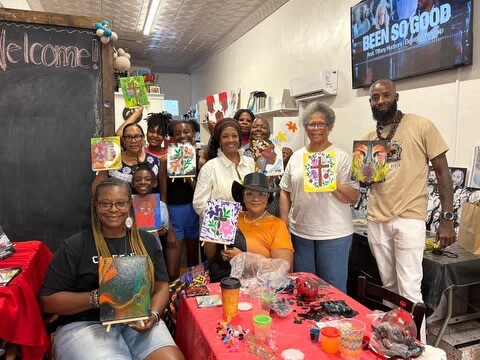
Buford said his mission is to help others find their own path toward healing — whatever form that takes.
“What I strive to do is guide this person to just create, man. Don’t care what people think about your creation, you just need to get it out,” Buford said. “Whether it’s with art, addressing your mental health, getting your life right — just do it.”
CBS 6 is committed to sharing community voices on this important topic. Email your thoughts to the CBS 6 Newsroom.
📲: CONNECT WITH US
Blue Sky | Facebook | Instagram | X | Threads | TikTok | YouTube

This story was initially reported by a journalist and has been converted to this platform with the assistance of AI. Our editorial team verifies all reporting on all platforms for fairness and accuracy. To learn more about how we use AI in our newsroom, click here.

Lovingston, VA (7News) — Good Morning Washington interviews Amanda Beckwith of Virginia Distillery Company- one of the contributing distilleries to the Virginia Spirits Board’s 250th Celebration Trio Pack, a special, exclusive release created to commemorate America’s upcoming 250th anniversary. This limited-edition package features a curated collection of a rum, a gin, and a whiskey, all crafted from scratch by distillers in Virginia to celebrate the rich history and current state of distilling within the Commonwealth.
Beckwith elaborates on VA Distillery Company’s role in the project, noting her focus on Virginia-grown grain to make the bottle of unique whiskey that is included in the Trio Pack. It is also worth noting that the Trio Packs themselves were bottled and produced right here at Virginia Distilling Company!
American single malts are the newest official category of American whiskey, distilled from one grain and from a single distillery. Virginia Distillery Co specializes in this new category of whiskey and crafted their contribution to the Trio Pack with this very specialty. Given the limited remaining availability of the Trio Pack, its historical value and collectible nature, the message it loud and clear encouraging viewers to grab a pack before they are all gone!
BE THE FIRST TO COMMENT
21+ Please drink responsibly, this content is sponsored by Virginia Distillery Company.


Powerball, Mega Millions jackpots: What to know in case you win
Here’s what to know in case you win the Powerball or Mega Millions jackpot.
Just the FAQs, USA TODAY
The Virginia Lottery offers multiple draw games for those aiming to win big.
Here’s a look at June 24, 2026, results for each game:
Powerball
Powerball drawings are held Monday, Wednesday and Saturday at 11 p.m.
13-14-16-21-38, Powerball: 14, Power Play: 2
Check Powerball payouts and previous drawings here.
Saturday, June 27, 2026
Pick 3
DAY drawing at 1:59 p.m. NIGHT drawing at 11 p.m. each day.
Night: 3-1-5, FB: 8
Day: 7-8-8, FB: 4
Check Pick 3 payouts and previous drawings here.
Pick 4
DAY drawing at 1:59 p.m. NIGHT drawing at 11 p.m. each day.
Night: 4-7-2-1, FB: 7
Day: 7-3-4-6, FB: 3
Check Pick 4 payouts and previous drawings here.
Pick 5
DAY drawing at 1:59 p.m. NIGHT drawing at 11 p.m. each day.
Night: 7-5-2-6-9, FB: 0
Day: 6-9-4-0-7, FB: 0
Check Pick 5 payouts and previous drawings here.
Cash Pop
Drawing times: Coffee Break 9 a.m.; Lunch Break 12 p.m.; Rush Hour 5 p.m.; Prime Time 9 p.m.; After Hours 11:59 p.m.
Coffee Break: 12
After Hours: 08
Prime Time: 13
Rush Hour: 01
Lunch Break: 14
Check Cash Pop payouts and previous drawings here.
Cash 5
Drawing every day at 11 p.m.
09-12-15-24-43
Check Cash 5 payouts and previous drawings here.
Bank a Million
Bank a Million draws are held every Wednesday and Saturday at 11 p.m.
18-21-25-33-36-39, Bonus: 13
Check Bank a Million payouts and previous drawings here.
Millionaire for Life
Drawing everyday at 11:15 p.m.
03-04-10-36-37, Bonus: 05
Check Millionaire for Life payouts and previous drawings here.
Feeling lucky? Explore the latest lottery news & results
This results page was generated automatically using information from TinBu and a template written and reviewed by a Center for Community Journalism (CCJ) editor. You can send feedback using this form.
-

 Alaska2 minutes ago
Alaska, Hawaiian Airlines expand free Wi-Fi on flights
-

 Arizona9 minutes ago
Arizona Lottery Pick 3 Evening, Fantasy 5 results for June 25, 2026
-

 Arkansas11 minutes ago
DeGray Lake Resort State Park offers a week’s worth of summer fun in Arkansas
-

 California17 minutes ago
This 1947 adobe home has found a new life as a ‘modern California hacienda’
-

 Colorado24 minutes ago
Colorado Springs police searching for missing 11-year-old
-

 Connecticut27 minutes ago
Opinion: More to do on gun violence prevention in CT
-

 Delaware32 minutes ago
After changing Delaware’s library system forever, she’s stepping away
-

 Florida39 minutes ago
Florida tattoo shop refuses service to military and veterans for being ‘war criminals’

