Virginia
3 GOP candidates for West Virginia governor try to outdo each other on anti-LGBTQ issues


Leading up to Tuesday’s West Virginia primary, three of the Republican candidates for governor have been trying to outdo each other in proving their opposition to transgender rights.
In TV ads running in West Virginia, state Attorney General Patrick Morrisey, Chris Miller and Moore Capito have been accusing each other of harboring transgender sympathies while touting their own efforts to restrict LGBTQ rights.
“Unfortunately, these are not solutions-based campaigns,” the ACLU of West Virginia told CBS News in a statement. “They’re built instead on demonizing already vulnerable people to score cheap political points.”
Morrisey’s campaign website describes him as “one of the nation’s most outspoken advocates against biological males playing sports with women” and says he’s a staunch supporter of the West Virginia Save Women’s Sports Act of 2021, which required that each athlete’s participation in official or unofficial school-sanctioned sporting and athletic events be “based on the athlete’s biological sex as indicated on the athlete’s original birth certificate issued at the time of birth.” Morrisey recently announced that he plans to ask the U.S. Supreme Court to consider the legislation’s constitutionality after the 4th U.S. Circuit Court of Appeals overturned the law in mid-April.

In response to these efforts, the ACLU of West Virginia told CBS News, “The state has sunk untold resources into keeping one girl from being on her middle school’s track team, including asking the U.S. Supreme Court to treat the matter as an emergency on par with national security”
A super PAC supporting Morrisey, Black Bear, released an ad targeting GOP candidate Chris Miller, claiming Miller “looked the other way as pro-transgender events happened on his watch” while he was a board member at Marshall UniveCrsity in West Virginia.
Miller, the owner of an auto dealership group in the state, has vowed to “protect our kids from the radical transgender agenda” if elected governor. He hit back with an ad accusing Morrisey of previously lobbying for a transgender clinic dispensing gender transition medication to children in New York before he was elected state attorney general.
Capito, who previously served in West Virginia’s House of Delegates, touts his fight to ban transgender surgeries from being performed on minors and to outlaw puberty blockers. He released an ad called “Girl Dad” that portrays a fictional race. In it, a runner who appears to be a less athletic male “mid-pack finisher” easily outpaces harder-working female runners as the ad narration accuses “woke leftists” of destroying women’s sports. Capito’s campaign website says he’ll “make sure biological men are NEVER allowed to be in the locker rooms with our daughters.”
So far, more than a dozen Republican-led states have filed lawsuits to block the Biden administration’s new Title IX regulations, which would protect transgender students from discrimination in schools receiving government funding. Education Secretary Miguel Cardona announced last month the 1972 law protecting sex-based discrimination extends to “discrimination based on sex stereotypes, sexual orientation, gender identity, and sex characteristics.” The new regulations are slated to take effect Aug. 1.
The GOP attorneys general who are suing the administration, including Morrisey, allege the administration’s changes extend the coverage of Title IX further than allowed, calling them “sweeping and unlawful.”
The uptick in anti-LGBTQ rhetoric among Republican gubernatorial candidates and state legislators in West Virginia has attracted the notice of the ACLU, which tracked 29 anti-LGBTQ bills there. The organization notes that while not all of the bills would become law, “they all cause harm for LGBTQ people.”
The West Virginia legislature adjourned in March after passing just one of those bills, which was signed into law by Republican Gov. Jim Justice, who is now running for the U.S. Senate seat left open by Democratic Sen. Joe Manchin’s retirement. The new law bans transgender and non-binary West Virginians from changing their sex on their driver’s license.


Gov. Abigail Spanberger speaks at a press conference announcing there is a deal to authorize cannabis sales and put the legislation in the upcoming budget, Tuesday, June 16, 2026, in Richmond, Va. (Mike Kropf/Richmond Times-Dispatch via Getty Images)
Richmond Times-Dispatch via Getty Images
For the last five years, Virginia cannabis has existed in a strange policy gap.
Adults could legally possess it. They could grow it at home. They could gift it. They could consume it. But if they wanted to walk into a licensed adult-use dispensary and buy a tested, labeled product from a regulated business, Virginia still had no legal retail market.
That contradiction has defined the Commonwealth’s cannabis story since 2021, when Virginia became the first state in the South to legalize adult-use possession. The original promise was bigger than decriminalization. It was supposed to be the beginning of a regulated commercial market—one that would move consumers away from the illicit market, create room for small businesses and farmers, and finally give the state an enforceable framework for products already being sold and consumed.
Instead, Virginia legalized the front end of adult use without opening the front door of the industry.
Since then, the state has been caught in political limbo. Retail implementation stalled after the 2021 elections. Republican control of the House slowed the process. Former Gov. Glenn Youngkin later vetoed adult-use retail bills. Operators, investors and would-be applicants watched session after session with the same question: when would Virginia finally stop treating cannabis like something adults could legally have, but not legally buy?
The answer appeared close in 2026. With Gov. Abigail Spanberger in office and Democrats controlling the General Assembly, cannabis advocates expected the retail framework to finally move. Lawmakers sent the governor a bill that would have launched adult-use sales in 2027. Spanberger returned it with amendments, including a later sales date, a lower possession limit than lawmakers proposed, a higher future tax rate and tougher enforcement provisions. The legislature rejected those changes.
Then came the veto.
For many in the industry, Spanberger’s May veto landed as political whiplash. After years of delay, the state had once again stopped short of launching a legal adult-use marketplace. Worse, the veto came from a governor many advocates and operators expected to be more receptive than her predecessor.
For Brett Puffenbarger, CEO of Old Dominion Cannabis, the moment carried personal weight. Puffenbarger has spent nearly a decade in the cannabis industry and saw Virginia’s 2021 legalization as a chance to bring that experience back home.
“I have been in cannabis for almost a decade, and when Virginia first legalized adult use, it looked like an opportunity to build on that career in my home state,” Puffenbarger said via email. “I had been in Florida for years, but I was born and raised in Virginia. We moved back five years ago because we believed the Commonwealth would eventually open a regulated market. Now Old Dominion Cannabis is preparing to compete for cultivation and manufacturing licenses.”
That kind of long-range planning is common in cannabis. It is also risky. Markets can take years to open. Rules can change overnight. A state can legalize possession and still leave businesses waiting for a real path to licensure.
Virginia became a case study in that uncertainty.
The veto seemed to push the market another year down the road. But within weeks, the same framework came back in a different vehicle: the state budget. Spanberger, Sen. Lashrecse Aird and Del. Paul Krizek announced a compromise that would create a regulated adult-use retail market through budget language, with sales beginning July 1, 2027.
That turnabout changed the mood almost immediately.
“When the veto came down, we thought, ‘Here we go again—another year gone,’” said Jody Roun, COO of Old Dominion Cannabis, via email. “To see the conversation turn around this quickly through the budget process was surprising and exciting. For operators who have been planning around a moving target, it finally feels like there is a path.”
The compromise is not the same bill lawmakers originally passed. It reflects concessions to the governor, especially on timing, taxes, possession limits and enforcement. But it also preserves several priorities from legislators and advocates, including a larger retail cap, statewide access and a framework designed to give small businesses, farmers and microbusinesses a chance to participate.
Here are 10 key pieces of the framework Virginia is now poised to put into law:
1. Adult-use retail sales would begin July 1, 2027. The Virginia Cannabis Control Authority would begin accepting license applications on February 1, 2027, giving regulators time to write rules, establish testing standards and build the oversight structure before stores open.
2. Adults 21 and older would have a legal retail channel. Virginia already legalized adult possession and limited home cultivation, but this framework would finally allow consumers to purchase regulated cannabis from licensed retailers.
3. The adult possession limit would increase from one ounce to two ounces. That is less than the 2.5-ounce limit lawmakers originally sought, but higher than the current possession limit.
4. The state would allow up to 350 retail cannabis establishment licenses. Regulators would not be required to issue them all at once, but the cap is designed to create enough access to compete with the illicit market.
5. Localities would not be able to opt out of the market. That matters because local bans in other states have often left consumers with limited legal access and preserved demand for unregulated sellers.
6. Delivery services are expected to be allowed as part of the regulated market. Combined with the retail cap and no local opt-outs, delivery could become an important tool for statewide access, especially in rural areas.
7. The tax structure would start relatively low. Adult-use cannabis would carry a 6% state excise tax at launch, increasing to 8% beginning July 1, 2029. Local governments could add another 1% to 3.5%, in addition to existing retail sales taxes.
8. The Cannabis Control Authority would gain expanded oversight over intoxicating hemp products. The compromise is designed to close Virginia’s 25:1 hemp loophole and move intoxicating hemp regulation away from the Department of Agriculture and Consumer Services and under the cannabis regulator.
9. The framework includes stronger child-safety and advertising rules. It would require child-resistant packaging, ban cartoon advertising and prohibit products shaped like animals, fruits, vehicles or humans.
10. The state would add stronger compliance and enforcement tools. Retailers could face escalating penalties for failing to check IDs, including possible license revocation for repeated underage sales. Stores would also have to be at least 1,000 feet from schools, hospitals, playgrounds and drug treatment facilities, while the CCA could maintain a public licensee registry, create a tip line and audit ownership and financial relationships.
“The cannabis license application cycle goes through peaks and valleys,” said Justin Singer, a partner at Feuerstein Kulick LLP and chair of the firm’s Regulatory Compliance and Licensing practice via phone interview. “We have been in an extended valley for sought-after licenses for some time, and as a result we have seen a tremendous amount of interest in this upcoming application process.”
Put together, the framework signals that Virginia is trying to do more than open stores. It is trying to correct the imbalance created in 2021: legal adults, legal possession, legal home cultivation—but no legal commercial channel for most consumers.
The challenge now is execution.
Cannabis regulators across the country have learned that legal markets do not automatically beat illicit ones. Taxes that are too high, licensing that is too slow, limited access, lack of capital and burdensome rules can all keep consumers in the unregulated market. Virginia’s relatively modest starting excise tax may help. So could the 350-store cap, if the state issues licenses in a way that creates real geographic coverage.
But questions remain. How quickly will cultivation and manufacturing licenses be processed? How much room will there be for independent operators? Will microbusinesses and impact applicants have meaningful access to banking and capital? Will existing medical operators have a first-mover advantage? And can the state build a market that is regulated enough to protect consumers without being so expensive and slow that it recreates the same illicit-market incentives legalization was supposed to solve?
For companies like Old Dominion Cannabis, the answer will determine whether Virginia becomes a real opportunity or simply another tightly controlled market dominated by the best-capitalized players.
Still, after five years of waiting, the significance of this moment is hard to ignore. Virginia is no longer debating whether adults should be allowed to possess cannabis. That question was answered in 2021. The question now is whether the Commonwealth can build a functioning legal industry around that decision.
The budget compromise does not end the work. It starts it.
For operators, the next several months will be about applications, compliance, capital and partnerships. For regulators, it will be about writing rules that can survive contact with the market. For consumers, it could mean finally having a legal way to purchase tested cannabis products in the first Southern state to legalize adult use.
Virginia took the symbolic step five years ago. Now it may finally be taking the commercial one.

RICHMOND, Va. — Jerrod Buford first picked up a paintbrush as a kid, never imagining that same creative outlet would carry him through his darkest days in prison.
Buford, who grew up in Williamsburg, was convicted and arrested as a young man and spent almost a decade behind bars. During that time, he struggled deeply.
“Turning to drugs and alcohol to kind of shadow over emotions,” Buford said. “Looking for acceptance, approval. Not just from my parents, but from friends, from, you name it. I mean, I tried to commit suicide, I don’t even know how many times,” Buford said.
WTVR
It was inside prison walls that art became more than a hobby.
“Throughout my prison time, I learned, the freedom that I desired, I’ve always had it. I got, I found it, in a box,” Buford said.
More than three years after his release, Buford continues to advocate for art as a tool for healing. He describes his work as a gift he feels called to share.
“I received a blessing from God that just allowed me to display what he’s given me,” Buford said.
For Buford, creating art is also a way of processing his past.
“That’s what art has done for me. It’s given me the ability to look at parts of my life, all parts of my life, and find the good and the negative, learn from the negative,” Buford said.
He shares his story and artwork with a wide audience through social media, including live sessions on TikTok, and holds art classes with new communities.
The Story Cafe
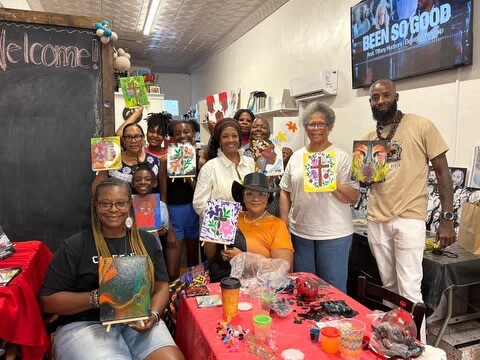
Buford said his mission is to help others find their own path toward healing — whatever form that takes.
“What I strive to do is guide this person to just create, man. Don’t care what people think about your creation, you just need to get it out,” Buford said. “Whether it’s with art, addressing your mental health, getting your life right — just do it.”
CBS 6 is committed to sharing community voices on this important topic. Email your thoughts to the CBS 6 Newsroom.
📲: CONNECT WITH US
Blue Sky | Facebook | Instagram | X | Threads | TikTok | YouTube

This story was initially reported by a journalist and has been converted to this platform with the assistance of AI. Our editorial team verifies all reporting on all platforms for fairness and accuracy. To learn more about how we use AI in our newsroom, click here.

Lovingston, VA (7News) — Good Morning Washington interviews Amanda Beckwith of Virginia Distillery Company- one of the contributing distilleries to the Virginia Spirits Board’s 250th Celebration Trio Pack, a special, exclusive release created to commemorate America’s upcoming 250th anniversary. This limited-edition package features a curated collection of a rum, a gin, and a whiskey, all crafted from scratch by distillers in Virginia to celebrate the rich history and current state of distilling within the Commonwealth.
Beckwith elaborates on VA Distillery Company’s role in the project, noting her focus on Virginia-grown grain to make the bottle of unique whiskey that is included in the Trio Pack. It is also worth noting that the Trio Packs themselves were bottled and produced right here at Virginia Distilling Company!
American single malts are the newest official category of American whiskey, distilled from one grain and from a single distillery. Virginia Distillery Co specializes in this new category of whiskey and crafted their contribution to the Trio Pack with this very specialty. Given the limited remaining availability of the Trio Pack, its historical value and collectible nature, the message it loud and clear encouraging viewers to grab a pack before they are all gone!
BE THE FIRST TO COMMENT
21+ Please drink responsibly, this content is sponsored by Virginia Distillery Company.
-

 Tennessee3 minutes ago
‘Oppressive’ heat is on the way. How long will heat dome last in Tennessee
-

 Texas6 minutes ago
Giraffe that escaped Texas ranch spotted by helicopter, manager says
-

 Utah11 minutes ago
Utah weather conditions trigger historic red flag warning as wildfires rage in state
-

 Vermont18 minutes ago
Arlington Common, Albert Construction recognized by Preservation Trust of Vermont
-

 Virginia20 minutes ago
Virginia Cannabis: Will Retail Finally Start In 2027?
-

 Washington26 minutes ago
Touring Trump’s Washington: How the president is putting his imprint on the nation’s capital
-

 Wisconsin33 minutes ago
Northwest Wisconsin Highway Construction Update – Jun. 26, 2026
-

 West Virginia36 minutes ago
West Virginia AD: McAfee’s Value to School ‘Maybe Eight Figures’

