Texas
Texas Ethics Commission will require influencers to disclose when they’re paid for political advertisement


The action comes after The Texas Tribune reported that influencers were being paid to defend impeached Attorney General Ken Paxton.
AUSTIN (Texas Tribune) — Texas’ top campaign finance watchdog voted Tuesday to require social media figures to disclose when they are paid for political advertisement, nearly a year after The Texas Tribune reported that influencers were being quietly paid to defend impeached Attorney General Ken Paxton.
In a 7-0 vote, the Texas Ethics Commission gave final approval to the changes, which were first proposed in March.
Last summer, the Tribune reported on a new company, Influenceable, that was paying Gen Z influencers to create or share social media posts that attacked the impeachment process and the Texas Republicans leading it, including House Speaker Dade Phelan. Commissioners did not mention the company directly on Tuesday but said at their previous meeting that the changes were in response to “at least one business” that was paying social media figures for undisclosed political messaging.
Influenceable has a partnership with Campaign Nucleus, a digital campaign service that was founded by Brad Parscale, a top official on former President Donald Trump’s last two campaigns. It also received $18,000 from Defend Texas Liberty in May 2023, after which influencers began to parrot claims that Paxton was the victim of a political witch hunt, accuse Phelan of being a drunk or urge their millions of collective followers to come to Paxton’s aid.
Defend Texas Liberty is a political action committee that two West Texas oil billionaires, Tim Dunn and Farris Wilks, used to give more than $15 million to far-right campaigns and candidates in the state since 2021. The two are by far Paxton’s biggest donors.
The new change amends the commission’s rules to clarify that disclosures are required for those who are paid more than $100 to post or repost political advertisements.
“This is not the case of the TEC inventing a substantive requirement to rulemaking,” the commission’s general counsel, James Tinsley, said before the vote. “It’s quite the opposite. It’s pairing back an exception.”
The rule change was strongly opposed by groups and figures funded by Dunn and Wilks, who decried it when it was first proposed earlier this year and claimed that the commission was creating a “secret speech police” that could target citizens for routine social media posts. Some of the loudest critics of the proposal, including the right-wing website Texas Scorecard, have for years been involved in lawsuits that challenged the constitutionality of the commission and sought to strip it of most of its regulatory powers.
Others argued that it did not go far enough because it held social media users accountable, but not those who pay them and fail to disclose as much.
“I just don’t want to pass the buck onto people that are literally only posting these because they’ll get $75, $80 or $90 out of it,” Andrew Cates, an Austin-based attorney focused on political campaigns, testified Tuesday.
The commission’s executive director, J.R. Johnson, agreed with Cates that the change is narrowly tailored, but added that it does prevent the commission from pursuing new rules in the future that deal with those who are paying social media users to post their political advertisements.
Campaign law experts have previously said that company’s like Influenceable reflect a decadeslong failure to modernize disclosure rules, many of which have not been updated since the widespread proliferation of social media or the internet.
“The [federal] laws around disclosure of campaign spending assumed a traditional model, like paying somebody to print your ad in the newspaper or paying a TV station to play your ad on the air,” Ian Vandewalker, an expert on the influence of money in politics and elections at the Brennan Center, told the Tribune last year. “Paying an influencer to talk about a candidate doesn’t fit into those traditional definitions, and so it’s slipping through the cracks.”
Texas has some restrictions on out-of-state donations, limits donations during the biennial legislative session and requires disclosures of political advertising that contain “express advocacy.” But otherwise, one longtime campaign finance lawyer said, the state’s rules allow “dark money to run amok.”
“If you’re not actually advocating for or against the election of someone or a proposition, then you pretty much fall outside” most regulations, Austin lawyer Roger Borgelt said last year.
This year, some Republican state lawmakers have called for ethics reform during the 2025 legislative session, citing what they said was a flood of misinformation and deceptive advertising during this year’s GOP primaries. Others directly cited Influenceable, and called for legislation to curb companies like it when lawmakers meet next year.
“I’m somebody who cares about truth and motivation,” State Rep. Tom Oliverson, a Cypress Republican who is currently running for Texas House Speaker, told the Tribune last summer. “I really dislike manufactured outrage and manufactured narratives. I prefer people to be honest, straightforward and truthful. And so I do think that, at a bare minimum, these things should have to be disclosed.”
This article originally appeared in The Texas Tribune at www.texastribune.org. The Texas Tribune is a nonprofit, nonpartisan media organization that informs Texans – and engages with them – about public policy, politics, government and statewide issues.


Man, identified as Lorenzo Salgado Araujo, is latest to be killed by ICE officers since President Trump took power.
Published On 8 Jul 2026
A United States immigration agent fatally shot a man in Houston, Texas, while officers were attempting to stop his vehicle, US Immigration and Customs Enforcement (ICE) said.
The man killed on Tuesday was identified as Lorenzo Salgado Araujo, described by ICE as a Mexican national and “illegal alien” who attempted to evade arrest during a “targeted enforcement operation” by federal immigration officers.
Recommended Stories
list of 3 itemsend of list
Ronaldo Salgado, who identified himself as Salgado Araujo’s son, told the Spanish-language television station Telemundo Houston that his father was shot while he was looking for workers to hire in the area.
The Department of Homeland Security (DHS), which oversees ICE, said Salgado Araujo ignored commands to stop his vehicle, saying he “rammed an ICE law enforcement vehicle, refused to follow multiple verbal commands, and weaponized his vehicle in an attempt to run over an ICE law enforcement officer”.
In past shooting incidents, including the January killings of Renee Good and Alex Pretti, immigration officials had said that their officers were being attacked when the two were shot, claims vigorously disputed in both incidents.
Video footage captured on Tuesday by a surveillance camera from a nearby business and reviewed by the Reuters news agency showed a person lying on the ground beside a white van and surrounded by officers, in what appeared to be the aftermath of the shooting.
Salgado Araujo was targeted in an operation because he was living in the country without legal permission, according to DHS.
Democratic US Representative Sylvia Garcia called for an independent and thorough investigation of ICE’s claims about the fatal shooting.
“All available footage, communications, and other evidence should be preserved and reviewed as part of a full and impartial investigation,” Garcia posted on social media.
Juan Proano, CEO of the League of United Latin American Citizens, echoed Garcia’s calls for a transparent investigation into ICE’s actions.
“We don’t take DHS at their word at all,” Proano told The Associated Press news agency. “There should be an independent investigation, and they should release all the videos.”
There have been at least six fatal shootings by federal immigration officers since the start of President Donald Trump’s intensified immigration enforcement crackdown.
Good, a 37-year-old US citizen, was shot in the head by a federal immigration agent during a crackdown in Minneapolis. DHS also said Good was trying to hit the agent with her vehicle, which local officials and witnesses disputed, saying she was only trying to drive away.
The backlash from Good’s killing and other similar incidents led ICE to step back from some of its more controversial operations.
However, Tuesday’s deadly confrontation in Houston came amid a recent increase in the number of ICE arrests nationwide, with immigration officers picking up about 2,000 migrants a day last week, Reuters reported.
Texas
Trump takes credit for Toyota moving some truck production from Mexico to Texas: ‘That’s what tariffs do’
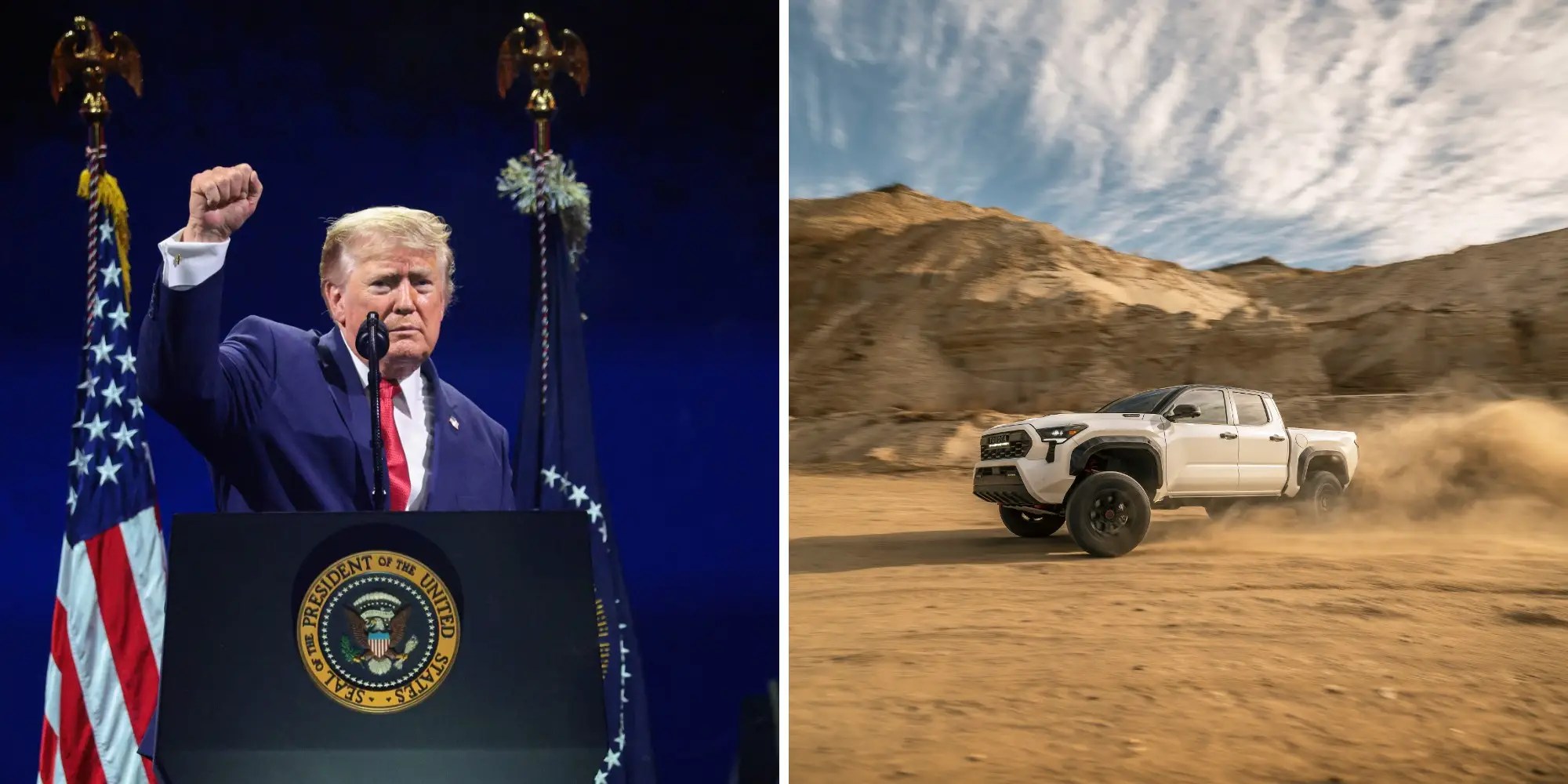
Toyota is planning a $3.6 billion expansion of its Texas truck assembly plant. President Donald Trump took credit for the investment.
On Monday, the automaker announced the multibillion-dollar investment to add a second vehicle assembly line at its San Antonio manufacturing campus to support production of the Tacoma pickup. Toyota said the expansion project would shift some of the midsize truck’s production from its Mexico plants to San Antonio over roughly 4 years. Toyota will still build some Tacoma models and the Corolla in Mexico.
While Toyota did not attribute the expansion to tariffs in its announcement and the company is not fully exiting production in Mexico, Trump said the fresh investment was a sign that his tariffs were working.
“It came over the wires that Toyota is moving out of Mexico into the United States, and building one of the biggest truck and car plants ever built,” Trump said on Tuesday during a visit to Ankara, Turkey. “It’s amazing. That’s what tariffs do, properly used.”
Toyota said the investment will create 2,000 jobs and add 2.5 million square feet to the site, doubling the company’s Texas footprint by 2030.
Toyota

On Monday, Ted Ogawa, president and CEO of Toyota Motor North America, said the investment reflected the company’s “confidence in the region’s workforce, innovation, and long-term growth potential.”
The move gives Trump a high-profile example of a well-recognized company creating manufacturing jobs. His administration has argued that tariffs incentivize companies — particularly automakers — to reshore manufacturing in America and reduce reliance on foreign production.
Toyota’s announcement also comes amid major uncertainty for automakers with plants in North America. The USMCA — the trilateral free trade pact between the US, Canada, and Mexico struck during Trump’s first term — is under review after the US declined to renew the treaty in its current form on July 1. The Trump administration is reportedly pushing to change the agreement so 50% of all automotive parts and manufacturing would happen in the US.
Toyota also nodded to that trade uncertainty in its release, saying it remained committed to operations in all three countries while encouraging “a quick resolution to USMCA” to keep North America globally competitive.
Texas
Supreme Court won’t block Texas from enforcing a law requiring age verification for app downloads

WASHINGTON – The U.S. Supreme Court on Monday declined to block Texas from enforcing a state law that requires apps stores to verify users’ ages and obtain parental consent for minors seeking to download apps or make in-app purchases on mobile phones.
Justice Samuel Alito, in a pair of one-sentence orders, denied petitions by plaintiffs who claim that the Texas App Store Accountability Act violates users’ constitutional rights to free speech.
Last month, a three-judge panel from the 5th U.S. Circuit Court of Appeals ruled that the law can take effect. The panel suspended a district court’s ruling last December that the law is unconstitutional.
The plaintiffs suing to block the law include the Computer & Communications Industry Association and Students Engaged in Advancing Texas. Texas Attorney General Ken Paxton is a defendant in both cases.
Plaintiffs’ lawyers argued that the law impermissibly seeks to limit access to content protected by the First Amendment, including news and educational material.
“Equity and the public interest support relief because protecting First Amendment rights — and parents’ rights to supervise their children as they see fit, not as the government tells them they should — is always in the public interest,” wrote attorneys for Students Engaged in Advancing Texas.
Attorneys from Paxton’s office argued that the law protects children from “dangerous modern products.”
“A child with access to an app store and a mobile device (such as a tablet or smartphone) can potentially download any number of software applications, potentially agreeing to invasions of the child’s privacy and sale of the child’s data and be exposed to any conceivable content without parental consent or even parental knowledge,” they wrote.
Copyright 2026 The Associated Press. All rights reserved. This material may not be published, broadcast, rewritten or redistributed without permission.
-

 World1 minute ago
US urges donors to abandon UNRWA funding as UN defends agency’s mission
-

 Politics4 minutes ago
EXCLUSIVE: FBI adds alleged COVID fraudster accused of taking $5M from kids’ meal program to Most Wanted list
-

 Health9 minutes ago
One walking habit could signal a healthier brain after 80, scientists say
-

 Sports16 minutes ago
New Jersey pro wrestling promotion bringing the fight to the beach
-

 Technology19 minutes ago
Are airline miles still worth it?
-
 Business24 minutes ago
Walmart’s EV chargers are coming to California with discounts for members
-
 Entertainment31 minutes ago
Still a Nico and Devo fan, Wes Anderson looks back on 30 years of musical moments
-
 Lifestyle34 minutes ago
Is it safe to eat from your garden after the Boyle Heights warehouse fire?

