Texas
Reunion Tower lights up Dallas for FIFA World Cup


If you want to get into the FIFA spirit, all you have to do is look up.
Dallas’ Reunion Tower unveiled a new series of FIFA‑themed light shows Thursday night, kicking off a monthlong celebration as North Texas prepares to host nine FIFA World Cup matches at AT&T Stadium.
The displays are the work of Scott Ingham, who has spent the last four months designing graphics that will transform one of Dallas’ most recognizable landmarks into a tribute to the world’s biggest sporting event.
“That’s where the magic happens,” Ingham said from the control room where he programs the tower’s displays.
While most people see Reunion Tower as part of the Dallas skyline, Ingham sees hundreds of lights and millions of possibilities.
Bringing soccer energy to Dallas
Throughout the tournament, the tower will display FIFA graphics, soccer‑inspired animations, and, on match days at AT&T Stadium, the flags of the competing nations. Special displays are also planned whenever Team USA takes the pitch.
“The idea is that we can put Japan and Argentina and put their flag up and show it up,” Ingham said. “And so we can kind of maybe generate a little bit of excitement that way for the match.”
The displays are powered by a lighting system installed last year, representing one of the most advanced upgrades in Reunion Tower’s history.
“It is fun because we can do more,” Ingham said.
Years of planning behind upgrades
The project took years of planning and included about 13 prototypes before the final system was selected.
“We designed them, built them … and then we shipped the lights here, installed them,” he said.
The upgraded system features nearly nine miles of wiring. The fixtures themselves are also significantly lighter than their predecessors.
“The new one is half the weight and twice the size,” Ingham said.
The last major lighting upgrade at Reunion Tower came in 2012. The new technology allows for smoother animations, expanded color capabilities, and more detailed displays.
FIFA accelerates the transformation
Reunion Tower Vice President of Operations Shawn Miller said FIFA helped accelerate the project.
“We see guests from all corners of the earth every day, every month,” Miller said. “So with FIFA on the books, nine matches, we really, really wanted to show what Dallas is all about.”
Miller said visitors can expect to see nearly two dozen FIFA‑themed shows throughout the tournament.
“You’ll know when the tournament’s kicking off. You’ll know when there’s a match,” Miller said. “When the U.S. team’s playing, I would imagine you’ll see upwards to a dozen and a half, two dozen shows throughout the tournament.”
For Dallas, the displays represent more than entertainment. As the city prepares to welcome visitors from around the globe, Reunion Tower’s lights have become another way to say: Welcome to North Texas.
June schedule of light shows
Reunion Tower FIFA Light Show Schedule
- June 11: World Cup Kickoff
- June 12: USA World Cup Game
- June 14: Flag Day / Dallas World Cup Game: Netherlands vs. Japan
- June 17: Dallas World Cup Game: England vs. Croatia
- June 18: Red for the RedBall Project in partnership with the Dallas Arts District
- June 19: USA World Cup Game
- June 21: Father’s Day
- June 22: Dallas World Cup Game: Argentina vs. Austria
- June 25: Dallas World Cup Game: Japan vs. Sweden and USA World Cup Game
- June 27: Dallas World Cup Game: Jordan vs. Argentina June 30: Dallas World Cup Game
Additional June light shows include Pride‑themed displays on June 5, June 6 and June 7.
Events planned on the Geo‑Deck
Reunion Tower is also hosting a series of events throughout June, many of which are included with general admission to the Geo‑Deck.
Upcoming activities include Lotería nights, silent discos, family programming, music bingo, painting classes, fitness events and special appearances from local guests.
A full list of events, ticket information, and the latest schedule updates can be found on Reunion Tower’s website.



Texas
Trump takes credit for Toyota moving some truck production from Mexico to Texas: ‘That’s what tariffs do’
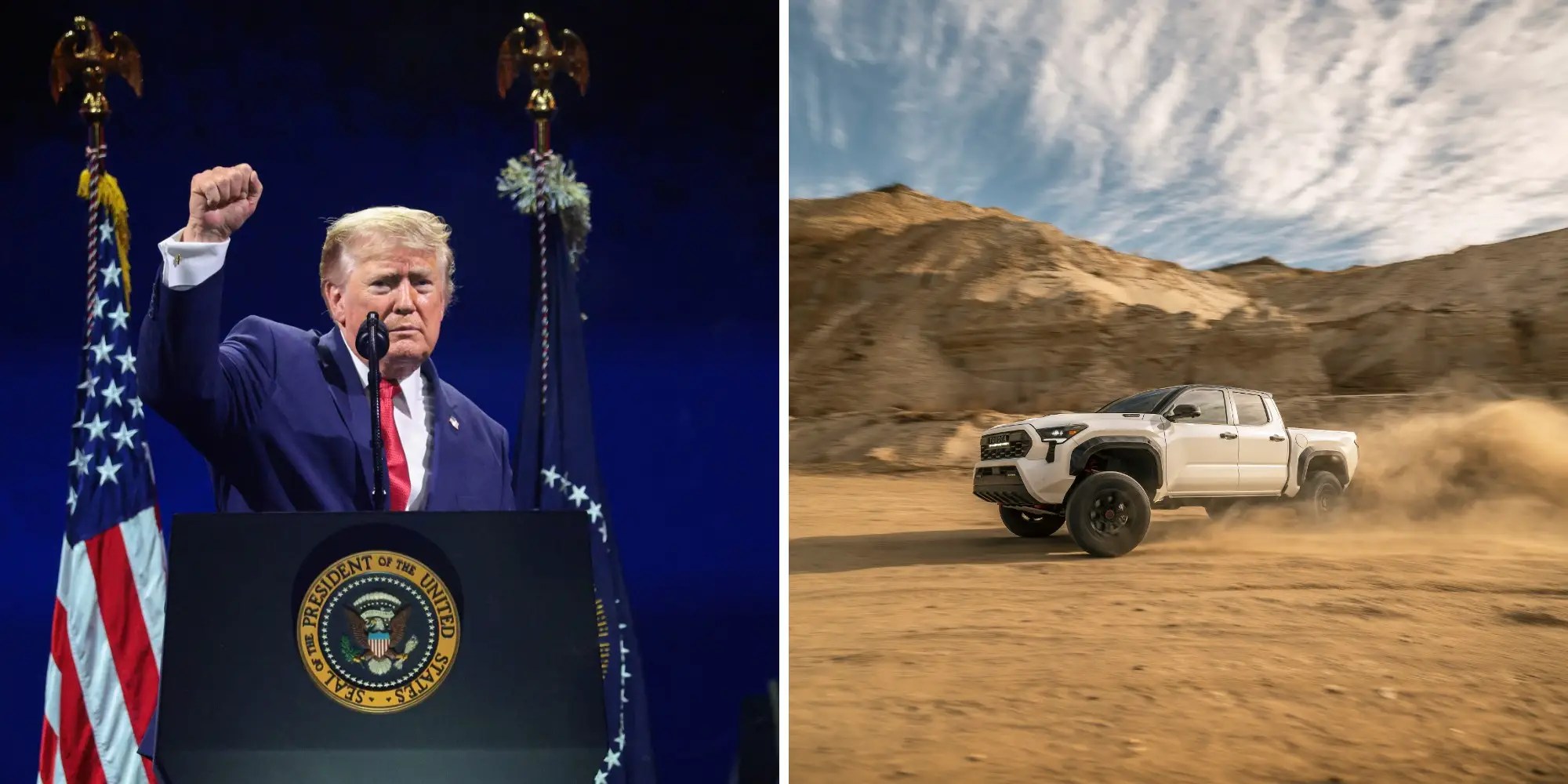
Toyota is planning a $3.6 billion expansion of its Texas truck assembly plant. President Donald Trump took credit for the investment.
On Monday, the automaker announced the multibillion-dollar investment to add a second vehicle assembly line at its San Antonio manufacturing campus to support production of the Tacoma pickup. Toyota said the expansion project would shift some of the midsize truck’s production from its Mexico plants to San Antonio over roughly 4 years. Toyota will still build some Tacoma models and the Corolla in Mexico.
While Toyota did not attribute the expansion to tariffs in its announcement and the company is not fully exiting production in Mexico, Trump said the fresh investment was a sign that his tariffs were working.
“It came over the wires that Toyota is moving out of Mexico into the United States, and building one of the biggest truck and car plants ever built,” Trump said on Tuesday during a visit to Ankara, Turkey. “It’s amazing. That’s what tariffs do, properly used.”
Toyota said the investment will create 2,000 jobs and add 2.5 million square feet to the site, doubling the company’s Texas footprint by 2030.
Toyota

On Monday, Ted Ogawa, president and CEO of Toyota Motor North America, said the investment reflected the company’s “confidence in the region’s workforce, innovation, and long-term growth potential.”
The move gives Trump a high-profile example of a well-recognized company creating manufacturing jobs. His administration has argued that tariffs incentivize companies — particularly automakers — to reshore manufacturing in America and reduce reliance on foreign production.
Toyota’s announcement also comes amid major uncertainty for automakers with plants in North America. The USMCA — the trilateral free trade pact between the US, Canada, and Mexico struck during Trump’s first term — is under review after the US declined to renew the treaty in its current form on July 1. The Trump administration is reportedly pushing to change the agreement so 50% of all automotive parts and manufacturing would happen in the US.
Toyota also nodded to that trade uncertainty in its release, saying it remained committed to operations in all three countries while encouraging “a quick resolution to USMCA” to keep North America globally competitive.
Texas
Supreme Court won’t block Texas from enforcing a law requiring age verification for app downloads

WASHINGTON – The U.S. Supreme Court on Monday declined to block Texas from enforcing a state law that requires apps stores to verify users’ ages and obtain parental consent for minors seeking to download apps or make in-app purchases on mobile phones.
Justice Samuel Alito, in a pair of one-sentence orders, denied petitions by plaintiffs who claim that the Texas App Store Accountability Act violates users’ constitutional rights to free speech.
Last month, a three-judge panel from the 5th U.S. Circuit Court of Appeals ruled that the law can take effect. The panel suspended a district court’s ruling last December that the law is unconstitutional.
The plaintiffs suing to block the law include the Computer & Communications Industry Association and Students Engaged in Advancing Texas. Texas Attorney General Ken Paxton is a defendant in both cases.
Plaintiffs’ lawyers argued that the law impermissibly seeks to limit access to content protected by the First Amendment, including news and educational material.
“Equity and the public interest support relief because protecting First Amendment rights — and parents’ rights to supervise their children as they see fit, not as the government tells them they should — is always in the public interest,” wrote attorneys for Students Engaged in Advancing Texas.
Attorneys from Paxton’s office argued that the law protects children from “dangerous modern products.”
“A child with access to an app store and a mobile device (such as a tablet or smartphone) can potentially download any number of software applications, potentially agreeing to invasions of the child’s privacy and sale of the child’s data and be exposed to any conceivable content without parental consent or even parental knowledge,” they wrote.
Copyright 2026 The Associated Press. All rights reserved. This material may not be published, broadcast, rewritten or redistributed without permission.

A passerby’s curiosity may have saved a life behind a Dallas high school. Police say that around 5:25pm on June 28, a young man followed faint cries coming from a wooded area and discovered a young woman stuck in a steep ravine, mired in mud and sewage after being trapped for days, Fox News reports. Dallas police and fire crews mounted a joint rescue in 104-degree heat, trekking about a quarter-mile over rough ground to reach her. They hauled her out and rushed her to a hospital, where she was treated for severe dehydration, extended sun exposure, and other injuries.
Police did not release the woman’s identity or say how she ended up in the ravine, WFAA reports. In a Facebook post Monday, the Dallas Police Department credited the “collaborative effort” of officers, firefighters, and paramedics whose quick work “saved a young woman who was in desperate need of help.” “The well-being of the Dallas community is not something that’s handled by a single agency,” the department said.”It takes a collaborative effort from multiple teams and organizations working side-by-side to ensure every person’s safety.”
-

 Pennsylvania51 seconds ago
The 11 Most Picturesque Small Towns in Pennsylvania
-

 Rhode Island4 minutes ago
The Must C’s of Rhode Island
-

 South-Carolina9 minutes ago
When is South Carolina’s tax free weekend? Here’s what to know
-

 South Dakota16 minutes ago
150-mile power line to connect substation near Fargo to northeast South Dakota
-

 Tennessee19 minutes ago
When is Tennessee’s tax-free weekend in 2026? Here’s what you need to know
-
Texas24 minutes ago
Trump takes credit for Toyota moving some truck production from Mexico to Texas: ‘That’s what tariffs do’
-

 Utah31 minutes ago
Utah Shutters Boarding School Paris Hilton Says Abused Her
-

 Vermont34 minutes ago
Letter to the Editor | Judy Murphy: In support of Molly Gray


