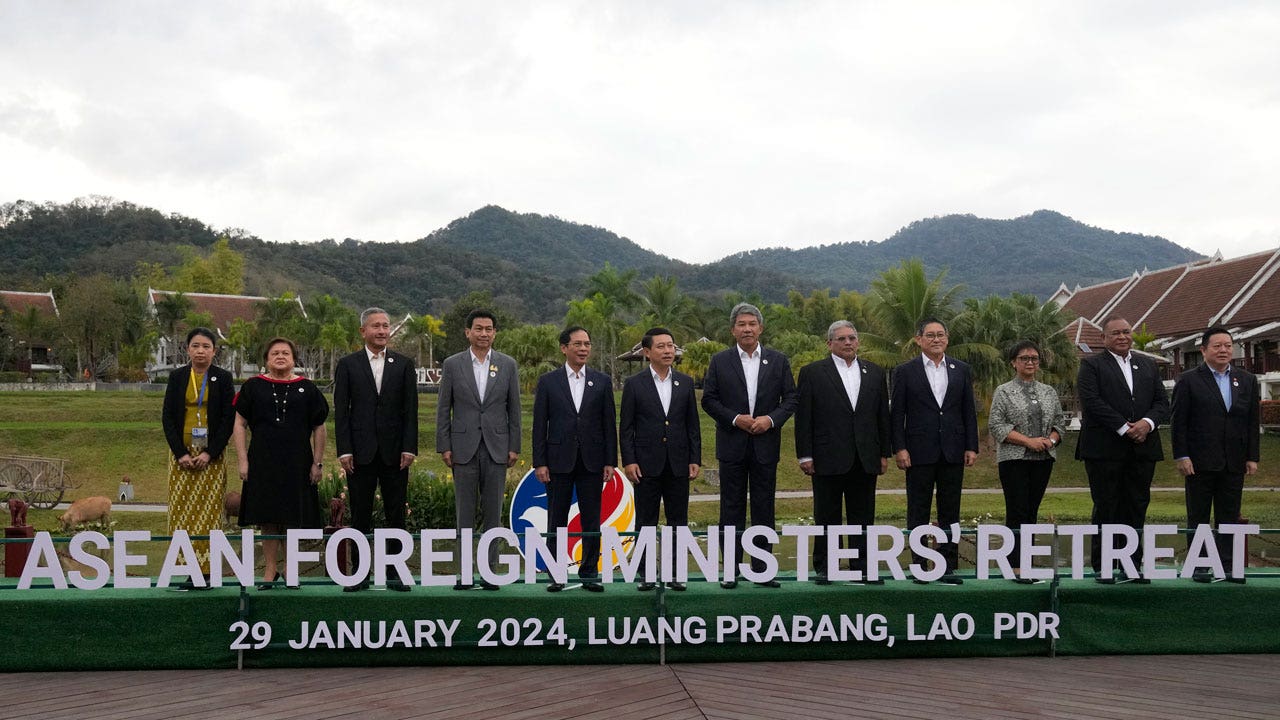
China’s increasingly assertive posture in the South China Sea and escalating violence in Burma topped the agenda for Southeast Asian diplomats at their meeting in Laos on Monday, with the Laotian foreign minister expressing guarded optimism that progress could be made this year on both acrimonious issues.
Lao Foreign Minister Saleumxay Kommasith told reporters that Thailand was moving ahead with plans to provide more humanitarian assistance to Burma, where more than 2.6 million people have been displaced by civil war.
He said it was a good sign that the military leaders who seized control of Burma in February 2021 from the democratically elected government of Aung San Suu Kyi had for the first time sent a high-level representative to attend the meeting of ASEAN foreign ministers in the historic city of Luang Prabang in Laos.
US NAVY RESPONDS AFTER CHINA CLAIMS AMERICAN WARSHIP ‘ILLEGALLY INTRUDED’ INTO THE SOUTH CHINA SEA
“We feel a little bit optimistic that the engagement may work, although we have to admit that the issues that are happening in Burma will not resolve overnight,” Saleumxay said. “I think there is probably a small light at the end of the tunnel.”
Burma has been prohibited from sending its foreign minister or any political representative to high-level ASEAN meetings since the end of 2021, when it blocked the group’s envoy from meeting with Suu Kyi. Instead, it has sent non-political representatives to lower-level working meetings but has refused to send anyone to high-level meetings.
In Laos, however, it sent a Foreign Ministry civil servant, ASEAN Permanent Secretary Marlar Than Htike, which Saleumxay called “a positive sign.”
Representatives of participating countries in the Association of Southeast Asian Nations (ASEAN) are seen here posing for a photograph at a retreat meeting in Luang Prabang, Laos, on Jan. 29, 2024. (AP Photo/Sakchai Lalit)
ASEAN member nations Indonesia, Thailand, Singapore, Philippines, Vietnam, Malaysia, Burma, Cambodia, Brunei and Laos have a combined population of nearly 650 million and GDP of more than $3 trillion.
Landlocked Laos, which has taken over this year’s rotating ASEAN leadership, is the bloc’s poorest nation and one of its smallest, and many have expressed skepticism about how much it can accomplish while the crises mount.
Still, it is the first ASEAN country that shares a border with Burma to serve as chair since the military took control of the country, giving it a perspective different from that of previous chairs.
Laos has already sent a special envoy to Burma for meetings with the head of the ruling military council and other top officials in an attempt to make progress on ASEAN’s “five-point consensus” plan for peace.
The plan calls for the immediate cessation of violence in Burma, a dialogue among all concerned parties, mediation by an ASEAN special envoy, provision of humanitarian aid through ASEAN channels, and a visit to Burma by the special envoy to meet all concerned parties.
The military leadership in Burma has so far ignored the plan, and the violence and humanitarian crisis has been growing at a rapid pace.
Singaporean Foreign Minister Vivian Balakrishnan told reporters after the meeting that it was “helpful” to have a representative from Burma attend again, but that he would not say he was optimistic Burma would take concrete steps to implement the plan.
“If you take reference from the past, it can sometimes take a very long time for positive change to occur,” he said. “I do not want to raise hopes or expectations unrealistically.”
Saleumxay said ASEAN would continue to push for full implementation of the consensus while also increasing humanitarian support.
“We think humanitarian assistance is the priority for the immediate period of time when implementing the five-point consensus,” he said. “We welcome in this regard the efforts by the Thai government to … try to create a humanitarian corridor where support and assistance can be provided to all Burmese people.”
Communist Laos is one of the ASEAN countries with the closest ties to China, and some have speculated it may look to its giant neighbor for help in dealing with the crisis in Burma, where Beijing also wields considerable influence.
PHILIPPINE COAST GUARD CONSTRUCTS NEW SURVEILLANCE BASE IN THE SOUTH CHINA SEA TO MONITOR CHINESE VESSELS
China has said it will not interfere in the internal affairs of other states, however, and it is also unknown whether it taking on such a role would be acceptable to other ASEAN members.
ASEAN members Vietnam, the Philippines, Malaysia and Brunei are locked in maritime disputes with China over its claims of sovereignty over virtually all of the South China Sea, one of the world’s most crucial waterways for shipping. Indonesia has also expressed concern about what it sees as Beijing’s encroachment on its exclusive economic zone.
An estimated $5 trillion in international trade passes through the South China Sea each year, which has led China into direct confrontations, most notably with the Philippines and Vietnam.
The ASEAN meeting in Laos came on the same day that Philippine President Ferdinand Marcos Jr, was meeting with officials in Vietnam, among other things to discuss the ongoing tensions in the South China Sea.
The Philippines has been looking for more support from its ASEAN neighbors amid increasingly tense hostilities with China, which many worry could escalate into a broader conflict that could involve Washington, Manila’s longtime treaty ally.
The Philippine government protested the Chinese coast guard’s use of water cannons, a military-grade laser and dangerous blocking maneuvers that caused minor collisions off Philippine-occupied Second Thomas Shoal.
China and ASEAN agreed in 2002 and 2012 to a declaration on conduct in the South China Sea, seeking to “enhance favorable conditions for a peaceful and durable solution of differences and disputes,” but there has been little sign of adherence to that in recent years.
In Luang Prabang, the group “underscored the importance of the full and effective” implementation of the declaration, according to a statement issued by Laos after the talks.
“We reaffirmed the importance of maintaining and promoting peace, security, stability, safety and freedom of navigation in, and overflight above, the South China Sea,” it said.
Under last year’s chair, Indonesia, ASEAN agreed with China on guidelines to accelerate negotiations for a South China Sea code of conduct, but that has yet to produce results.
In the talks Monday, Saleumxay said several ASEAN nations brought up the tensions in the South China Sea and that Laos hoped to have a third reading of the code of conduct with China “as soon as possible.”
CLICK HERE TO GET THE FOX NEWS APP
“That would create an environment where both ASEAN member states, especially the claimant states, and China can build more trust and confidence,” he said. “Whatever happens in the South China Sea should be resolved in a peaceful manner through dialogue and consultations.”
Saleumxay said all sides with claims in the South China Sea need to respect the United Nations convention on the law of the sea.
Under that convention, a U.N.-backed tribunal ruled in 2016 that China’s expansive claims in the South China Sea on historical grounds were invalid and that Beijing had violated the right of Filipinos to fish in the shoal.
China has refused to participate in the arbitration, rejected its outcome and continues to defy it.