South-Carolina
Warde Manuel compares resumes for Clemson, South Carolina with rivalry showdown looming


In the latest rankings from the College Football Playoff selection committee, No. 17 Clemson clocked in two spots ahead of in-state rival and No. 19 South Carolina. And the two arrived in the teens of the rankings with much different resumes.
While Clemson has mostly dominated a weaker ACC since getting throttled by Georgia in the opener, South Carolina has been a bit more volatile. Either way, not much separates the teams save for one win or loss either way — Clemson is 8-2 and South Carolina is 7-3.
“Well, both are coming off wins,” Manuel said. “The win by Clemson and South Carolina’s win versus Missouri. The difference, as you can see, Clemson has lost two games. They bounced back from that Louisville loss and had back-to-back road wins against Virginia Tech and Pitt. Significant loss to Georgia at the beginning of the season, but they’ve come back. Cade Klubnik has really controlled the offense and done very well. That run to end the game against Pitt was phenomenal. I just think they are playing good football as well as South Carolina.”
The question in ranking the two might come down to valuing mindlessly winning like Clemson had until stumbling against Louisville or the flashes of upside that South Carolina has shown.
The Gamecocks hold the best win of the two teams, pulverizing Texas A&M at home. But Clemson’s road wins clearly hold some weight with the committee. And given the two teams are mere spots apart in the rankings, there’s not much to separate them in the eyes of the committee.
Which should make it all the more exciting when the two teams face off to end the season, as the Tigers will also potentially be monitoring results around the ACC with a path to the title game still open.
“So it’ll be interesting to see — as you can see they’re very close,” Manuel said. “The committee feels that Clemson and South Carolina are very close to each other as it relates to how we see those two teams.”


In Laurens County, a dual-sided historic marker stands next to a mailbox off the side of the road. The name Jonathan Downs was commemorated on one side, while the other side was signed with the story of Lindley’s Fort in the American Revolution.
The Battle of Fort Lindley took place July 15, 1776, some 1,800 feet away from the modern-day historic marker. Private farmland now sits where the battle ensued, but physical pieces of history and oral retellings of the battle have continued to propel the story in Laurens County lore.
Loyalists to the British crown and Cherokee citizens planned an attack on a group stationed at the fort. The Little River Regiment used the fort as their base. Loyalist Capt. David Fanning described the scene as a “fort built with logs” in his autobiographical retelling of the Revolutionary War.
Cherokee land had continually been encroached on, which pushed members of the tribe to retaliate.
The loyalists who joined in the attack were dressed as Native Americans. They – along with other South Carolina backcountry loyalists – were referred to as Scopholites. The group took action at midnight for what became a two-hour fight in one of the first conflicts of the Cherokee War of 1776.
Historian Durant Ashmore said the crux of the battle was a clash of culture and a fundamental lack of understanding among the groups.
“One thing that has been very important to understand is the conflicts between cultures – the misunderstandings between cultures – and the deadly consequences that can result from that,” he said.
Luis-Alfredo Garcia
/
South Carolina Public Radio
Troops at the fort had at first not believed word of the upcoming attack when informed by a group of soldiers, according to a pension application of Matthew Brown, who was a 16-year-old boy stationed at a fort about 20 miles away from Fort Lindley. The men were drunk from a night of indulging in rum, which Ashmore said was a common occurrence during the war.
“The Little River Regiment did not believe them. They actually even leveled their guns at them, saying, ‘Who’s telling you such lies as this?’” he said.
Maj. Downs, however, prepped the troops for defense. Downs was a previous member of the First Provincial Congress, Second Provincial Congress, and South Carolina General Assembly.
A sizable chunk of the Patriot troops had already experienced fighting Cherokee citizens during the Anglo-Cherokee War that lasted from about 1758-1761. Soldiers at Fort Lindley responded to the attack by sending out troops in lines of 10. Eventually, the loyalists and Cherokee citizens retreated.
The patriot victory boosted local morale and belief in their cause, but for some unscathed loyalists and Cherokee citizens, the aftermath’s impact trumped the actual battle loss in consequences.
The morning after the battle, troops from the fort found about 30 horses at a campsite. One saddlebag contained the commission papers of Capt. James Lindley. Lindley was a staunch loyalist and the eponymous owner of Fort Lindley.
Six months prior to the battle, he had been captured at the Battle of Great Cane Break. Lindley had promised to not take up arms against patriot forces again, or he would face death. Although he was not captured in the midnight battle, he did succumb to patriot troops at the Battle of Kettle Creek and was hanged for breaking his parole.
As for the Cherokee citizens, their land was further encroached upon and people killed; about 2,000 were killed during the Cherokee War of 1776.
Ashmore said the consequences from escalating conflict were terrible.
“Patriots gathered together with the idea of a plan, the goal of eliminating the Cherokees. Genocide,” he said. “That’s what was preached to the backcountry settlers along with the ability to make their own decisions. A primary motivating factor in the American Revolution is the right of self-determination.”
Luis-Alfredo Garcia
/
South Carolina Public Radio
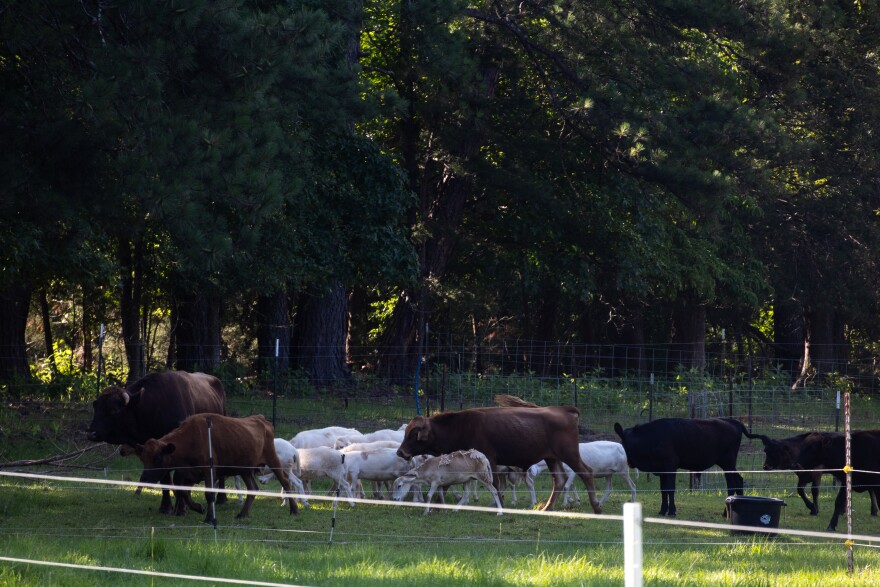
Now, private land with cows and sheep sits on the area where the fort once stood. Ashmore said he gives tours just during the winter to avoid the risk of ticks. The area where trenches once helped shield soldiers are still visible.
Some remnants from the fort now reside at the Laurens County Museum in the city of Laurens’ downtown area. The objects, although not individually labeled, will be part of an upcoming opening collection.

Luis-Alfredo Garcia
/
South Carolina Public Radio
Museum docent Julia Sermons said being informed of local history helps shape modern decisions.
“You have to know where you’re coming from to know where you’re going,” she said.
Ashmore, too, saw the same value.
“We are all in the middle of this,” he said. “This history – the important role that South Carolina played in the Revolution.”
An estimated 14 battles took place in Laurens County, according to Ashmore. He has been keeping track of local history for about 6 years. He said the county has set a 50-year plan to help with future record keeping.

Luis-Alfredo Garcia
/
South Carolina Public Radio


Video of SCHSL 5A Division 1 Upper State track and field championships
Here’s video of some of the action from the SCHSL Class 5A Division 1 Upper State boys and girls track and field championships held May 8 at Dorman.
Riley Vaughn of Spartanburg girls Track and Field was named the 2025-26 South Carolina girls Gatorade Player of the Year.
Vaughn won the shot put and discus events at the Class 5A-D1 state championships. She nailed a 13.1 meters on the shot and 41.77 meters on the discus. Her 14.41 in the shot at the region meet was the state’s best for 2026.
The 5-foot-10 junior helped lead Spartaburg to a fifth-place team finish. Vaughn had also competed on the national stage after taking third place in the shot put event at the Under Armour Nationals.
“Unbeaten in the discus throw on home state soil this year, Vaughn achieved success in both throws, but really sparkled in the shot put circle,” PrepCalTrack editor, Rich Gonzalez, said. “Her season-best there was the state’s top mark in the event in seven years and moved her to No. 4 on South Carolina’s all-time list.”
Vaughn is now part of an elite group of athletes who have won the prestigious award, including four-time Olympic gold medalist Sydney McLaughlin, five-time Olympic medalist Sanya Richards, and 11-time Olympic medalist Allyson Felix.
Vaughn was also named to the Greenville News’ All-Upstate First Team in girls’ Track and Field for the second consecutive season.
Kamryn Jackson covers high school and college sports for the Spartanburg Herald-Journal, Greenville News, Anderson Independent Mail, and the USA TODAY Network. Please email her at KEJackson@gannett.com and follow her on X @KamxJack (formerly Twitter).

-

 Denver, CO3 minutes ago
Pat Surtain II Gets More Bad News Amid Broncos’ Uncertainty
-

 Seattle, WA8 minutes ago
The World Cup 2026 Pride Match between Egypt and Iran that Seattle hopes can ‘unite football community’
-

 San Diego, CA15 minutes ago
County Leaders Still Eyeing County-Backed Tax Hike
-

 Milwaukee, WI18 minutes ago
We must have answers before awarding new wastewater contract | Opinion
-

 Atlanta, GA23 minutes ago
Semi-truck, train collide in fiery crash in SW Atlanta
-

 Minneapolis, MN29 minutes ago
Reform, money and trust: Council members’ key criteria for Minneapolis’ next police chief
-

 Indianapolis, IN33 minutes ago
Ciara Myst is Indianapolis’ shapeshifting superstar on social media, too
-

 Pittsburg, PA38 minutes ago
Woman accused of stealing nearly $300,000 from Penn Hills refrigeration company

