South-Carolina
South Carolina looking to limit production of Missouri's star wide receivers


South Carolina, like it has in past weeks, will prepare its defense for the possibility of two different quarterbacks taking the field when it faces Missouri on Saturday.
Brady Cook, who has been the Tigers’ starter for much of the 2024 campaign, is listed as doubtful for this weekend’s game, per the team’s latest injury report. Drew Pyne will play in Cook’s stead should he be unable to suit up.
[GamecockCentral: $1 for 7 days and 50% off first year]
But head coach Shane Beamer said the Gamecocks must also be prepared for Missouri’s wide receivers, regardless of who is under center.
“They have arguably the best receiving corps in this conference when you talk about Luther Burden, who will be a top-10 pick in the NFL Draft, and Theo Wease, who took over that game last week against Oklahoma in the fourth quarter,” Beamer said.
Burden has been a dangerous threat to opposing defenses long before this season began. He was among the SEC’s top wideouts in 2023, finishing third in receiving yards behind only Malik Nabers and Xavier Legette. Over the course of 13 games, Burden caught a team-high 86 passes for 1,212 yards and nine touchdowns. That strong play led to him earning All-SEC First Team honors, in addition to being named a Second Team All-American by the Associated Press and CBS Sports.
The start of the 2024 campaign has been less productive for Burden, though. He has been limited to just 505 receiving yards and four touchdowns on 45 receptions in his first nine contests. Burden has yet to record 100-plus yards in a game this season, something he did six times last year.
Despite Burden’s downtick in yardage, he remains a key part of Missouri’s offense. And Beamer said the Tigers have found creative ways to keep him involved on that side of the football.
“They get the ball to Burden in a lot of different ways, whether it be handing the ball off to him on a fourth-and-one the other night against Oklahoma on a jet sweep. Or, they get in an unbalanced formation, and he’s off the ball to the field, and they motion him in, motion him out, and he runs an out-and-up for a 50-yard touchdown,” Beamer said. “They just find different ways to get the ball in his hands.”
[On3 App: Get South Carolina push notifications from GamecockCentral]
While Burden is a familiar face for Beamer, Wease was on the same sideline as Beamer at one point. Wease spent the first four years of his college football career at Oklahoma. For two of those seasons, Beamer served as the Sooners’ assistant head coach and tight ends coach.
Wease caught 49 passes for 682 yards and six scores during his first season with the Tigers in 2023. And he is well on his way to surpassing those totals this year. He has recorded 552 yards and three touchdowns across 41 total catches.
Wease’s physical attributes make him a difficult player to defend, Beamer said.
“Wease is a really big receiver, also. He’ll catch a ball, and then he does a really good job of getting vertical,” Beamer said. “He’s a hard guy to bring down. He’s a twitchy, shifty, tall, big, athletic guy.”
Beamer understands that holding either Burden or Wease to zero catches will be a tall task. But keeping them from turning routine plays into big gains will be a key to success for South Carolina’s defense.
“They’re going to get their catches. It’d be great if I looked at the stat sheet after the game Saturday night, and they didn’t have any catches. Is that realistic? Probably not. What we’ve got to do is do a really good job tackling. “It’s really impressive watching those two guys, what they do once they catch the ball,” Beamer said.
“Let’s limit their catches. But when they do catch the ball, make sure we’re limiting what they do (with) yards after the catch and after contact.”



USA TODAY 250th anniversary travel guides and American stories
USA TODAY marks America’s 250th with travel guides, culture, history, and local stories.
As the nation prepares for its 250th anniversary, one of the efforts underway is America’s Time Capsule.
The time capsule project is led by America250 and meant to bring together carefully selected artifacts and documents from all 50 states, five U.S. territories, the District of Columbia, and each branch of the federal government.
This national project is designed to capture the story of the United States at this historic 250th birthday, according to America250.
Here’s what South Carolina contributed to the national project.
What did South Carolina put in the America250 time capsule?
South Carolina is marking the nation’s 250th anniversary by contributing two historic items to the national America’s Time Capsule project, according to America250.
As part of the SouthCarolina250, which is the state’s initiative for the U.S.’s 250th celebration, commemoration effort, the state has provided a commemorative challenge coin and an official SC250 lapel pin.
Both will be buried inside the capsule on July 4, along with items from other states. And it is set to be reopened 250 years later in 2276.
Where will the Americ250 time capsule be buried?
The ceremonial burial of America’s Time Capsule is set to take place at Independence National Historical Park, located at 599 Market Street in Philadelphia, Pennsylvania, on July 4, according to america250.org.
What else is in America’s 250th anniversary time capsule
As America’s 250th anniversary approaches, the national time capsule has been filled with items meant to capture the character and diversity of the country in this moment.
The collection spans a range of items, from archival letters and state proclamations to student work from the America’s Field Trip contest, uncirculated currency, and even pieces of national sports memorabilia.
Time capsule engineered to last centuries
As planners work to ensure America’s Time Capsule endures for the next two and a half centuries, engineers and archivists have focused heavily on long‑term preservation.
The capsule itself is a cylinder‑shaped stainless‑steel vessel, precision‑designed by the National Institute of Standards and Technology in partnership with archival scientists at the Library of Congress, according to the Institute.
Travis Jacque Rose is the trending news reporter for the Greenville News, part of the USA TODAY Network. Reach him at trose@gannett.com.

In Laurens County, a dual-sided historic marker stands next to a mailbox off the side of the road. The name Jonathan Downs was commemorated on one side, while the other side was signed with the story of Lindley’s Fort in the American Revolution.
The Battle of Fort Lindley took place July 15, 1776, some 1,800 feet away from the modern-day historic marker. Private farmland now sits where the battle ensued, but physical pieces of history and oral retellings of the battle have continued to propel the story in Laurens County lore.
Loyalists to the British crown and Cherokee citizens planned an attack on a group stationed at the fort. The Little River Regiment used the fort as their base. Loyalist Capt. David Fanning described the scene as a “fort built with logs” in his autobiographical retelling of the Revolutionary War.
Cherokee land had continually been encroached on, which pushed members of the tribe to retaliate.
The loyalists who joined in the attack were dressed as Native Americans. They – along with other South Carolina backcountry loyalists – were referred to as Scopholites. The group took action at midnight for what became a two-hour fight in one of the first conflicts of the Cherokee War of 1776.
Historian Durant Ashmore said the crux of the battle was a clash of culture and a fundamental lack of understanding among the groups.
“One thing that has been very important to understand is the conflicts between cultures – the misunderstandings between cultures – and the deadly consequences that can result from that,” he said.
Luis-Alfredo Garcia
/
South Carolina Public Radio
Troops at the fort had at first not believed word of the upcoming attack when informed by a group of soldiers, according to a pension application of Matthew Brown, who was a 16-year-old boy stationed at a fort about 20 miles away from Fort Lindley. The men were drunk from a night of indulging in rum, which Ashmore said was a common occurrence during the war.
“The Little River Regiment did not believe them. They actually even leveled their guns at them, saying, ‘Who’s telling you such lies as this?’” he said.
Maj. Downs, however, prepped the troops for defense. Downs was a previous member of the First Provincial Congress, Second Provincial Congress, and South Carolina General Assembly.
A sizable chunk of the Patriot troops had already experienced fighting Cherokee citizens during the Anglo-Cherokee War that lasted from about 1758-1761. Soldiers at Fort Lindley responded to the attack by sending out troops in lines of 10. Eventually, the loyalists and Cherokee citizens retreated.
The patriot victory boosted local morale and belief in their cause, but for some unscathed loyalists and Cherokee citizens, the aftermath’s impact trumped the actual battle loss in consequences.
The morning after the battle, troops from the fort found about 30 horses at a campsite. One saddlebag contained the commission papers of Capt. James Lindley. Lindley was a staunch loyalist and the eponymous owner of Fort Lindley.
Six months prior to the battle, he had been captured at the Battle of Great Cane Break. Lindley had promised to not take up arms against patriot forces again, or he would face death. Although he was not captured in the midnight battle, he did succumb to patriot troops at the Battle of Kettle Creek and was hanged for breaking his parole.
As for the Cherokee citizens, their land was further encroached upon and people killed; about 2,000 were killed during the Cherokee War of 1776.
Ashmore said the consequences from escalating conflict were terrible.
“Patriots gathered together with the idea of a plan, the goal of eliminating the Cherokees. Genocide,” he said. “That’s what was preached to the backcountry settlers along with the ability to make their own decisions. A primary motivating factor in the American Revolution is the right of self-determination.”
Luis-Alfredo Garcia
/
South Carolina Public Radio
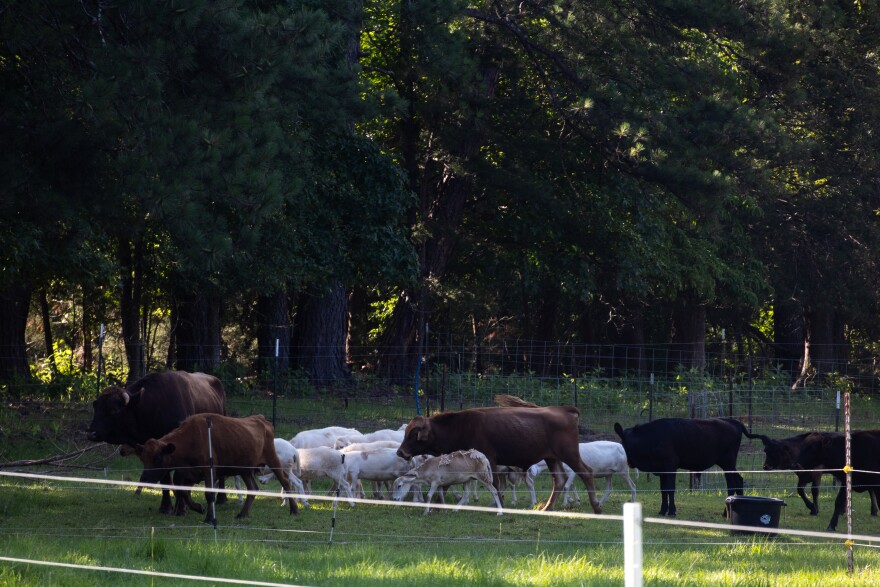
Now, private land with cows and sheep sits on the area where the fort once stood. Ashmore said he gives tours just during the winter to avoid the risk of ticks. The area where trenches once helped shield soldiers are still visible.
Some remnants from the fort now reside at the Laurens County Museum in the city of Laurens’ downtown area. The objects, although not individually labeled, will be part of an upcoming opening collection.

Luis-Alfredo Garcia
/
South Carolina Public Radio
Museum docent Julia Sermons said being informed of local history helps shape modern decisions.
“You have to know where you’re coming from to know where you’re going,” she said.
Ashmore, too, saw the same value.
“We are all in the middle of this,” he said. “This history – the important role that South Carolina played in the Revolution.”
An estimated 14 battles took place in Laurens County, according to Ashmore. He has been keeping track of local history for about 6 years. He said the county has set a 50-year plan to help with future record keeping.

Luis-Alfredo Garcia
/
South Carolina Public Radio

Video of SCHSL 5A Division 1 Upper State track and field championships
Here’s video of some of the action from the SCHSL Class 5A Division 1 Upper State boys and girls track and field championships held May 8 at Dorman.
Riley Vaughn of Spartanburg girls Track and Field was named the 2025-26 South Carolina girls Gatorade Player of the Year.
Vaughn won the shot put and discus events at the Class 5A-D1 state championships. She nailed a 13.1 meters on the shot and 41.77 meters on the discus. Her 14.41 in the shot at the region meet was the state’s best for 2026.
The 5-foot-10 junior helped lead Spartaburg to a fifth-place team finish. Vaughn had also competed on the national stage after taking third place in the shot put event at the Under Armour Nationals.
“Unbeaten in the discus throw on home state soil this year, Vaughn achieved success in both throws, but really sparkled in the shot put circle,” PrepCalTrack editor, Rich Gonzalez, said. “Her season-best there was the state’s top mark in the event in seven years and moved her to No. 4 on South Carolina’s all-time list.”
Vaughn is now part of an elite group of athletes who have won the prestigious award, including four-time Olympic gold medalist Sydney McLaughlin, five-time Olympic medalist Sanya Richards, and 11-time Olympic medalist Allyson Felix.
Vaughn was also named to the Greenville News’ All-Upstate First Team in girls’ Track and Field for the second consecutive season.
Kamryn Jackson covers high school and college sports for the Spartanburg Herald-Journal, Greenville News, Anderson Independent Mail, and the USA TODAY Network. Please email her at KEJackson@gannett.com and follow her on X @KamxJack (formerly Twitter).
-

 Washington, D.C4 minutes ago
DC reaches settlement with man detained while protesting troops with Darth Vader song
-

 Cleveland, OH6 minutes ago
Heinen’s closing downtown Cleveland location
-

 Austin, TX11 minutes ago
Texas board approves Bible stories as required reading in public schools
-

 Alabama14 minutes ago
Best downtowns in Alabama? These 10 towns made the list
-

 Alaska19 minutes ago
Lavrov Challenges Rubio: Kremlin Says Trump-Putin Reached Deal as Moscow Questions Washington’s Neutrality
-

 Arizona26 minutes ago
Central Arizona is home to the ‘World’s Oldest Rodeo.’ Here’s what to see and do there
-

 Arkansas29 minutes ago
Sanders announces Medicaid work requirement soft launch for Arkansas ARHOME recipients
-

 California34 minutes ago
Newsom urges a national ‘billionaires’ tax’ while fighting one in California

